White Noise for Baby: Placement, Volume, and Safety
White noise baby: the quick answer
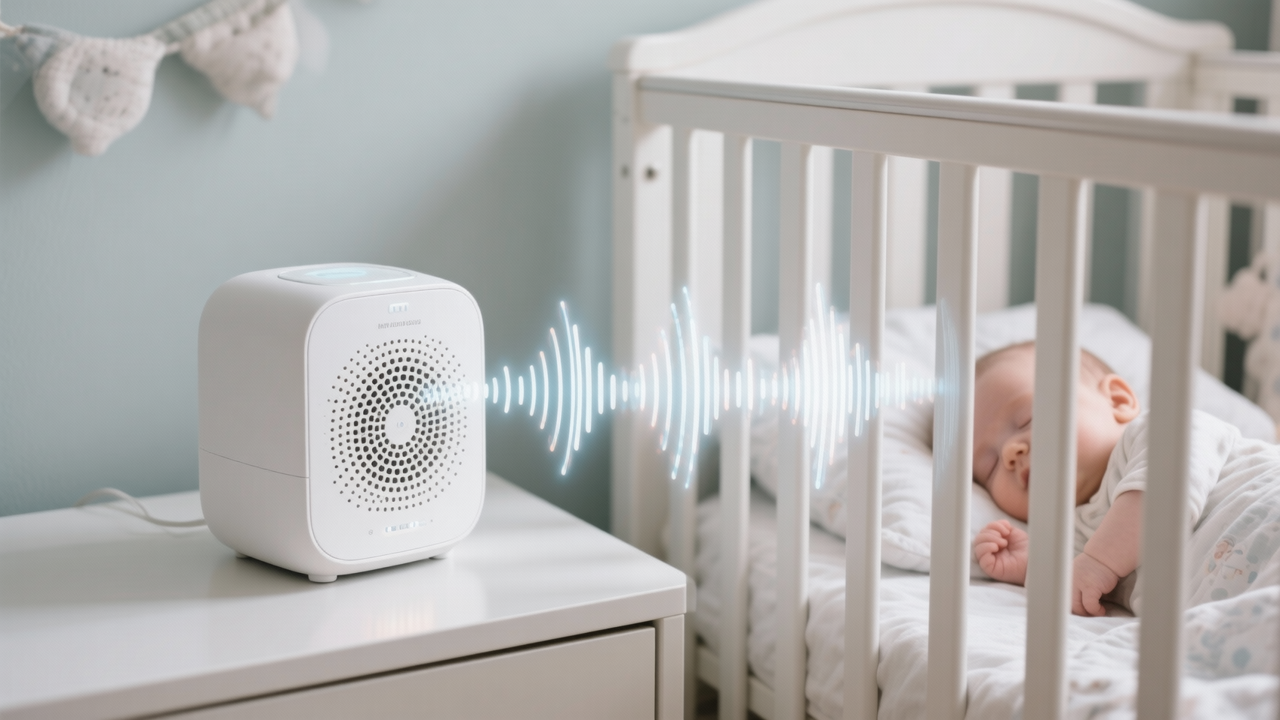
White noise can help babies sleep by masking household sounds, but it must be used safely. For white noise baby safe use, keep the volume at or below 50 decibels (about a soft shower), place the machine at least 7 feet (2 meters) from the crib, and never put a speaker inside the crib or clipped to the rail. Used this way, it is a helpful sleep cue, not a hazard.
For the full picture, read our pillar guide on Nursery setup: The Pediatrician’s Complete Nursery Setup Guide: Safe S.
Why white noise baby happens — the sleep science
Understanding the biology makes the plan easier to follow. Baby sleep runs on two systems. The first is sleep pressure — the natural build-up of a chemical called adenosine during waking hours that makes sleep feel urgent. The second is the circadian rhythm, the internal 24-hour clock that uses light and darkness to decide when the body expects sleep and when it expects wakefulness. Melatonin, the hormone that helps initiate sleep, rises in the evening and fades before dawn.
When these two systems are misaligned — for example, when daytime sleep is too long, bedtime is too early, or light enters the room before the desired wake time — the baby hits their total sleep need too soon and wakes. A baby who falls asleep independently can usually link sleep cycles and return to sleep; a baby who needs feeding, rocking, or holding to fall asleep often cannot recreate that condition at 5 a.m. and calls out. This is why most early waking, short napping, and night fragmentation is a signal about schedule, environment, or sleep associations rather than a fixed trait.
Safe-sleep biology matters too. The risk factors for sleep-related infant death — prone or side sleeping, soft surfaces, loose bedding, overheating, and bed-sharing on a soft surface — are well described by the AAP and CDC. Keeping the baby on the back, on a firm flat surface, in a crib or bassinet free of bumpers, pillows, and positioners directly reduces those risks.
Why parents reach for white noise
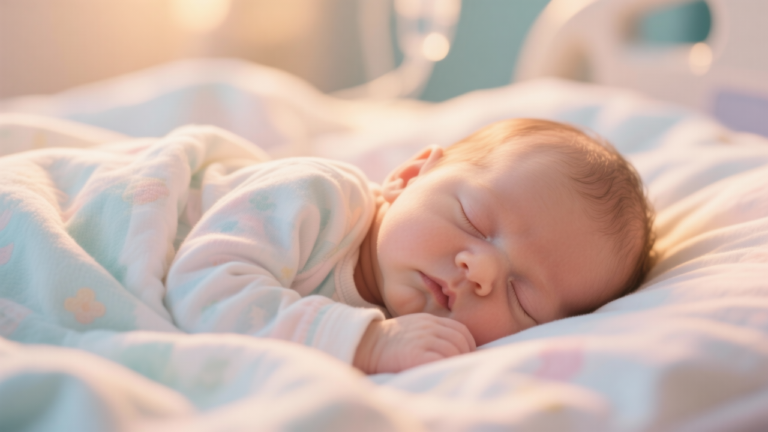
Newborns spend months in the womb surrounded by a constant, rhythmic rush of sound — blood flow, the mother’s heartbeat, digestive noises. That is not silence. After birth, the world can feel too quiet and too startling.
White noise mimics that steady background hum. Many parents find it shortens the time to fall asleep and softens night waking from normal household sounds like a dishwasher, a sibling, or traffic.
White noise baby is also a strong sleep cue. When the sound turns on, the baby’s brain learns “sleep is coming.” That association can make naps and bedtime smoother, especially in a busy home.
Volume safety — the 50 dB rule
The single most important safety point is volume. A baby’s ears are delicate and still developing. Loud, close, all-night sound can affect hearing over time.
Aim for 50 decibels or less at the baby’s ear. That is roughly the level of a soft rainfall or a quiet shower. Many commercial machines exceed safe levels at their maximum setting, so the lowest effective volume is best. You do not need it loud for it to work.
A rough check: use a free decibel-meter app on your phone, place the phone at crib height about where the baby’s head rests, and measure while the machine runs. If it reads above 50 dB, turn the machine down or move it farther away.
Remember that decibels work on a curve, and small increases in volume mean much more sound energy. When in doubt, go quieter.
Placement matters as much as volume
Even at a safe volume, a speaker right next to the baby’s head is too close. Sound intensity drops quickly with distance, so placement is a simple, powerful safety lever.
Follow these placement rules:
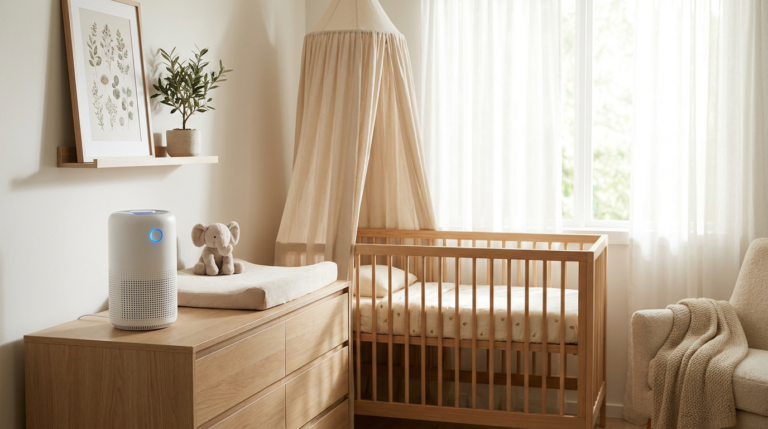
- Keep the machine at least 2 meters (about 7 feet) from the crib.
- Place it on a dresser or shelf across the room, never inside the sleep space.
- Never clip a speaker or phone to the crib rail.
- Keep cords well out of reach to avoid any strangulation risk.
- Point the speaker away from the baby, toward a wall if possible.
The farther the source, the lower the sound at the ear — so distance does the protective work for you.
Risks if white noise is misused
Used incorrectly, white noise has real downsides:
- Hearing risk: loud, close, all-night noise may affect hearing development over time.
- Sleep association: a baby may learn to need the sound to fall asleep. This is minor next to safety, and it fades easily when you choose to wean it.
- Distorted sound: cheap machines can buzz or distort, which is less soothing and potentially harsher on the ear.
- False security: white noise is not a safe sleep device. It does not replace back-to-sleep, firm flat surfaces, or a bare crib.
None of these mean white noise is unsafe. They mean it should be used the right way.
How long to use it
There is no medical rule that says you must stop at a certain age. Many families fade white noise out around the first birthday, simply because the baby sleeps through more and the household is quieter. Others keep it longer with no harm.
To wean, lower the volume gradually over a week or two, then turn it off for naps first and nights last. If your baby sleeps fine without it, great; if not, keep using it. The goal is a rested baby and a rested parent.
When traveling, a phone app at a safe volume works well. Just mind placement in a hotel room where the crib may be close to a bedside table.
White noise in the safe-sleep picture
White noise is a tool, not a substitute for safe sleep. The non-negotiables stay the same:
- Back to sleep for every nap and night.
- Firm, flat, level sleep surface meeting safety standards.
- Bare crib: no bumpers, loose blankets, pillows, or positioners.
- Room share, not bed share, for at least six months.
- No overheating; dress for the room and use a sleep sack.
Think of white noise as the “ambience” layer on top of a safe foundation, never the foundation itself.
Age-specific notes
Newborn (0–3 months)
White noise can be especially helpful in the fourth trimester, when babies expect womb-like sound. Keep volume low and distance generous. The newborn’s startle reflex responds well to steady sound.
3–6 months
As sleep matures, white noise helps protect naps from household noise. This is a good time to decide whether you want it as a long-term cue.
6–12 months
Older babies often sleep through more. If you plan to wean, do it gradually. A toddler who still loves it can keep using it safely under the same rules.
Sample nighttime setup
| Step | Action |
|---|---|
| — | — |
| 1 | Dim the room 20–30 minutes before sleep |
| 2 | Diaper, feed, sleep sack |
| 3 | Place baby on back in bare crib |
| 4 | Turn on white noise at ≤50 dB |
| 5 | Machine on dresser ≥7 ft from crib |
| 6 | Leave the room calm and dark |
This small routine pairs white noise with the safe sleep basics so the baby learns a consistent sleep signal.
Safety checklist
- [ ] Volume at or below 50 dB at the baby’s ear
- [ ] Machine at least 7 feet (2 meters) from the crib
- [ ] Speaker on a shelf or dresser, not in the crib
- [ ] Cords out of reach
- [ ] Lowest effective setting used
- [ ] Steady, non-distorted sound
- [ ] Safe sleep rules still followed exactly
Safety reminders
White noise is a comfort tool, not a safety device. The core safe sleep rules always come first:
- Always place your baby on the back for every nap and night.
- Use a firm, flat, level sleep surface that meets safety standards.
- Keep the crib bare: no bumpers, loose bedding, pillows, or positioners.
- Do not bed share, especially on a couch, soft armchair, or other soft surface, where risk is dramatically higher.
- Avoid overheating; keep the room 68–72°F and dress the baby in about one extra layer.
- Place the white-noise machine at least 7 feet from the crib and keep volume at or below 50 dB.
- Keep cords out of reach to avoid strangulation.
White noise and the bigger safe-sleep picture
Think of white noise as one layer of a healthy sleep routine, sitting on top of the non-negotiable safe sleep foundation. It cannot make an unsafe surface safe, and it should never delay moving a baby from a swing or couch to a crib. Used within the rules above—low, far, and steady—it is a helpful cue that many families keep for months or years without problem. If you ever feel you “can’t sleep without it,” that is a sign to plan a gentle wean, not a sign of danger.
When to Call Your Pediatrician
Contact your pediatrician if:
Related reading: Baby Room Temperature & Sleep Clothing.
- Your baby seems startled or distressed by the noise, or you suspect a hearing concern.
- There is a fever, especially under 3 months.
- You notice poor weight gain or feeding trouble.
- There are breathing changes: fast breathing, grunting, pauses, or color change.
- The baby has a high-pitched or weak cry that is new.
- You see signs of dehydration: fewer wet diapers, no tears, dry mouth.
If you are ever unsure about volume, turn it down. Safer is always the right call.
FAQ
Is white noise baby safe to use every night?
Yes, when used correctly. Keep volume at or below 50 dB, place the machine at least 7 feet from the crib, and never put a speaker in the sleep space. Under those rules, white noise baby safe use is well established as a helpful sleep aid.
Can white noise damage my baby’s hearing?
It can if it is too loud or too close for long periods. Staying at 50 dB or less at the ear and keeping the source far away protects hearing.
Do I need a special machine?
No. A simple sound machine or a phone app at a safe volume works. Avoid cheap units that distort, and always manage placement and volume.
When should I stop using white noise?
Whenever you like. Many families wean around the first birthday by lowering volume gradually. There is no harm in continuing if it helps.
Does white noise replace safe sleep rules?
No. It is an add-on comfort, not a safety device. Back-to-sleep, a firm flat surface, and a bare crib always come first.
Common white-noise myths
Myth: “Louder works better.” Fact: louder does not help a baby sleep and can harm hearing. Stay at or below 50 dB at the ear.
Myth: “The speaker should be next to the baby’s head.” Fact: close sound is the main hearing risk. Keep the machine at least 7 feet away on a shelf or dresser.
Myth: “White noise replaces safe sleep.” Fact: it is a comfort add-on only. Back-to-sleep, a firm flat surface, and a bare crib always come first.
Myth: “Babies become dependent forever.” Fact: if you choose to wean, lowering volume gradually over a week or two usually works, and there is no harm in continuing.
What the evidence says about hearing
A baby’s ear canal is small and the hearing system is still developing. Studies on infant sound exposure focus on keeping long-term noise low and distant. The 50 dB, 7-foot guideline is a practical way to gain the sleep benefit while protecting delicate ears. If a machine has no volume number, use a phone decibel app at crib height and adjust. When in doubt, quieter is safer.
Using white noise with twins or multiples
With more than one baby, household noise is higher and the need for masking sound is real. Give each sleep space its own low, distant source rather than one loud machine turned up. Place machines across the room from each crib, never inside. Keep cords secured high and out of reach. The same 50 dB and 7-foot rules apply per baby.
Troubleshooting when the baby still wakes
If white noise is on but your baby still wakes, check the basics first: is the room 68–72°F, is the baby on the back in a bare crib, and is the sleep sack right for the temperature? Hunger, illness, or a dirty diaper wake babies regardless of sound. White noise masks environmental noise; it does not fix a feed or a fever. If waking is sudden, intense, or paired with other symptoms, call your pediatrician.
See also: How to Dress Baby for Sleep by Room Temperature.
A simple nightly white-noise routine
Make white noise part of a consistent wind-down. About 20 to 30 minutes before sleep, dim the lights, change the diaper, feed, and put on the sleep sack. Place the baby on the back in the bare crib, then switch on the machine at a safe volume from across the room. The sound becomes a reliable “sleep is coming” signal. Keep the same order each night so the baby learns the pattern. Over time, the routine itself does as much work as the noise.
White noise versus other sleep aids
White noise is one tool among many. A pacifier, for example, is associated with reduced SIDS risk when offered at sleep time for young infants, typically once breastfeeding is well established. Rocking, feeding to sleep, and a dark room are common aids too. None of these replace the safe sleep surface, and white noise works best as part of a simple routine rather than a standalone fix.
Unlike a pacifier, white noise does not need to be in the baby’s mouth, which some parents prefer. Unlike rocking, it does not require you to be holding the baby. The trade-off is that some babies come to expect it; that is usually easy to fade later and is a small concern next to safety.
Setting up more than one safe sleep space
Many families use a crib in the nursery and a bassinet in the parents’ room. Both should meet safety standards and stay bare. A portable play yard is handy for the living room or a grandparent’s house. Wherever the baby sleeps, the same rules apply: back, bare, firm, flat. If you use white noise in more than one room, give each space its own machine placed far from the crib.
For childcare, share your routine, including white noise volume and placement, so providers keep the same safe setup. Written instructions avoid confusion during a busy hand-off and protect your baby when you are not there.
When to lower the volume or stop entirely
You can lower the volume gradually as your baby grows and the household gets quieter. Drop it a notch every few nights; most babies barely notice. To stop, turn it off for naps first, then nights, over a week or two. If sleep falls apart, simply keep using it—there is no deadline.
Turn it down immediately if you ever suspect it is too loud, if the machine sounds distorted, or if a decibel check at crib height reads above 50 dB. Safer is always the right call, and a slightly quieter room still lets white noise do its job.
A note on phone apps and speakers
Many parents use a phone as a white-noise source. If you do, keep the phone plugged in across the room, not in the crib, and set a playlist that loops without ads or sudden volume changes. A cheap phone speaker can distort at high volume, so keep it low and far. A dedicated machine is simpler, but a phone works if you respect the same distance and volume rules. Check the app’s maximum output and never rest the phone on the crib rail.
Building healthy sleep associations
White noise is a “sleep cue”—something the baby learns means sleep is near. Other cues, like a dark room and a consistent order of events, work together. The healthiest associations are ones you can keep up easily and that do not require you to be physically holding the baby all night. White noise fits that goal. If you later wean it, the other cues remain, so sleep stays stable.
Common Myths vs Facts
- Myth: “A tired baby will fall asleep anywhere.” Fact: Overtired babies make more cortisol, which fragments sleep.
- Myth: “A later bedtime always means a longer night.” Fact: Only if anchored to the baby’s true sleep need; too late backfires.
- Myth: “One rough night means failure.” Fact: Judge progress across 1–2 weeks, not a single night.
- Myth: “You must sleep-train.” Fact: Consistency, a dark room, and gentle boundaries resolve many issues without formal training.
If Nothing Works After Two Weeks
- Re-check total daytime sleep (too much or too little both fragment nights).
- Confirm the room is genuinely dark and quiet until your chosen wake time.
- Review the last nap’s timing so it does not steal the night.
- Rule out discomfort: illness, teething, reflux, ear pain, growth spurt.
- Call your pediatrician for a brief check to exclude underlying issues.
- Best Baby Room Temperature for Sleep
- How to Dress Baby for Sleep
- Baby Sleep in a Hot Room
- American Academy of Pediatrics — A Parent’s Guide to Safe Sleep
- NICHD Safe to Sleep — Safe Sleep Environment
- CDC — About Sudden Unexpected Infant Death
- World Health Organization — Newborn Care
About the author
Dr. Michael Anderson, MD (Pediatrics) is a board-certified pediatrician on the ChildBloom medical panel, focusing on infant sleep, safe sleep environments, and responsive routines. This article was medically reviewed and approved by Dr. Ahmad Raza, MD (Pediatrics) against current AAP safe-sleep guidance. Read our editorial and review standards.
This guide is general education, not a diagnosis. If you are worried about your baby’s breathing, feeding, growth, or sleep, contact your pediatrician. For any breathing emergency, call emergency services immediately.
Related ChildBloom Guides
- Start here: Nursery setup: The Pediatrician’s Complete Nursery Setup Guide: Safe S
- Nursery Air Quality: VOCs, Formaldehyde & What an Air Purifier Actuall
- Baby Room Temperature: What’s Safe and What’s Dangerous (By Age)
- Nursery glider: Do You Need a Nursery Glider? Ergonomics for Feeding &
- Best air purifier for baby nursery
- Nursery Temperature: The Ideal Range for Safe Sleep & Comfort
- Browse all Sleep & Nursery guides
References & Medical Sources
- NICHD Safe to Sleep: safe sleep environment
- CPSC safe sleep and crib product rules
- EPA on VOCs and indoor air quality
- NIDCD on noise-induced hearing loss
Reviewed by the ChildBloom pediatric panel. Learn about our physicians on the About page. This article is educational and does not replace your child’s clinician.