Introducing New Foods to Toddlers: A Pediatrician’s Practical Guide
Introducing new foods to toddlers takes patience: 10–15 exposures, no pressure, safe prep. Get a calm approach, choking tips, and when to call your pediatrician.

Introducing new foods to toddlers takes patience: 10–15 exposures, no pressure, safe prep. Get a calm approach, choking tips, and when to call your pediatrician.
# Antibiotic Side Effects in Babies: What to Expect Quick Answer Antibiotics save babies’ lives by fighting bacterial infections, but they can cause side effects. The most common ones include diarrhea, diaper rash, mild skin rash, vomiting, and fussiness. These are usually mild and go away once the course is finished. Severe allergic reactions, persistent…
Medically reviewed by Dr. Ahmad Raza, MD (Pediatrics) — ChildBloom Medical Review Panel. Last updated: September 27, 2026. Written by Dr. Sophia Martinez, MD (Pediatrics) and the ChildBloom Pediatric Panel. Most babies are born with 4–6 months of iron. Here is when a supplement is actually needed (breastfed: from 4 months; formula-fed: almost never), the…
# Baby Teething Gels: Benzocaine Safety Warning — What Every Parent Must Know Quick Answer **Do not use benzocaine teething gels on babies or children under 2 years old.** The U.S. Food and Drug Administration (FDA) issued a black-box warning in 2018 against all over-the-counter benzocaine oral products for infants and young children because they…
# Baby Allergy Medicine: Antihistamine Safety **Quick answer:** Most babies with mild allergies don’t need medication — trigger avoidance and supportive care are usually enough. When medicine is necessary, antihistamines like diphenhydramine (Benadryl) may be used under pediatrician direction for babies over 6 months, dosed strictly by weight (1.25 mg/kg every 6 hours). Newer antihistamines…
# Saline Drops for Babies: Safe Nasal Congestion Relief **Quick answer:** Saline drops for babies are a gentle, medication-free way to relieve nasal congestion. They work by loosening thick mucus and moisturizing dry nasal passages, making it easier for your baby to breathe, feed, and sleep. Safe for newborns and infants of all ages, saline…

When Do Babies Start Cruising Along Furniture? Cruising usually appears after a baby can pull to stand and shift weight while holding a stable surface. Many babies cruise during the second half of the first year or around the first birthday, but the age range is broad. Some cruise before they walk, while others take…

Tummy Time for Babies With Reflux: Comfortable Positions Babies with reflux may tolerate tummy time better when it is gentle, brief, and timed away from a full feed. Upright cuddling after feeds, chest-to-chest play, side-lying play, and a supported prone position across an alert caregiver’s lap can offer alternatives. Never place a baby prone or…
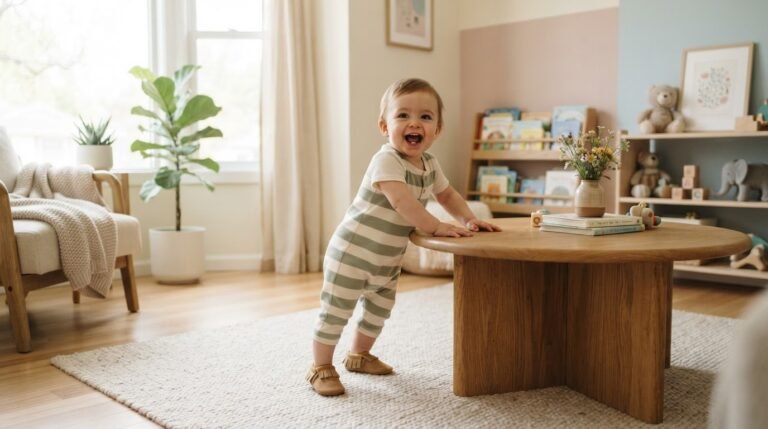
Signs a Baby May Be Ready to Pull to Stand Pulling to stand is an exciting transition: a baby uses the arms, trunk, hips, and legs together to move from the floor into an upright position. It often appears after a period of sitting, reaching, crawling, scooting, or cruising, but babies do not all follow…

Sensory Play Without Food for 6–12 Months Sensory play for babies can be simple, clean, and food-free. Safe textures, water in a shallow container with an adult present, fabric squares, household sounds, mirrors, and temperature-neutral objects give babies ways to see, hear, touch, and explore without edible materials that create choking or allergy concerns. For…

Screen-Free Indoor Play for Toddlers in Small Spaces Toddlers can get rich screen-free play in a small home when activities use the floor, a few household objects, movement, imitation, and pretend play. A small space does not need a large toy collection. Rotating a few safe choices often creates more engagement than leaving everything out….
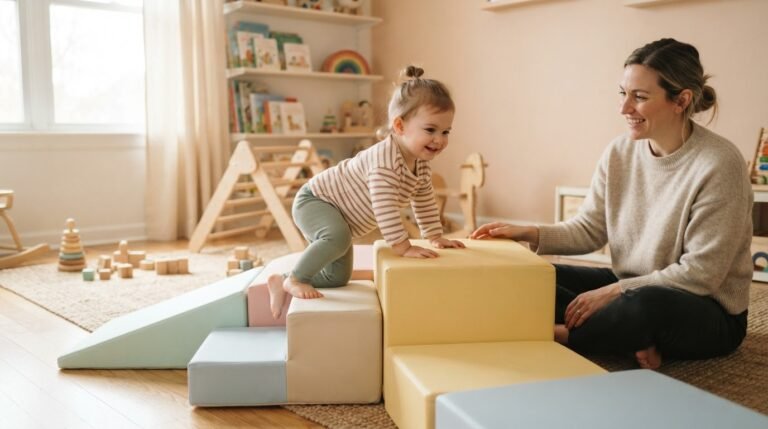
Safe Climbing Play for a 15-Month-Old Climbing is a normal way for a 15-month-old to practice strength, balance, planning, and confidence, but toddlers do not understand height or danger reliably. Safe climbing means creating low, stable challenges on the floor while blocking unsafe heights, stairs, windows, furniture, and playground hazards. Stay within arm’s reach, use…
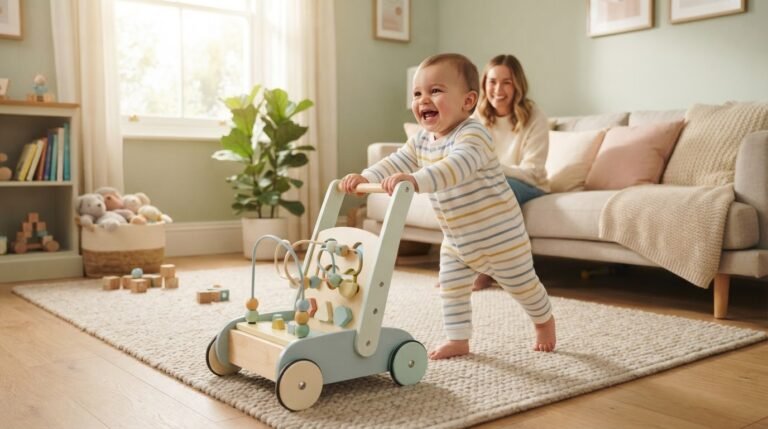
Push Toys Before Walking: When They Help and When They Do Not Push toys may be useful after a child can stand and cruise with control, but they are not required to teach walking and can be unsafe when they roll too quickly. Choose a heavy, stable toy with a controllable handle, use it only…

Premature Baby Milestones: Corrected Age for Movement Corrected age helps clinicians interpret developmental milestones for babies born prematurely. It adjusts chronological age by the number of weeks early, usually during the first two years. Corrected age is a tool for fair comparison, not a reason to ignore concerns or delay care when a parent sees…
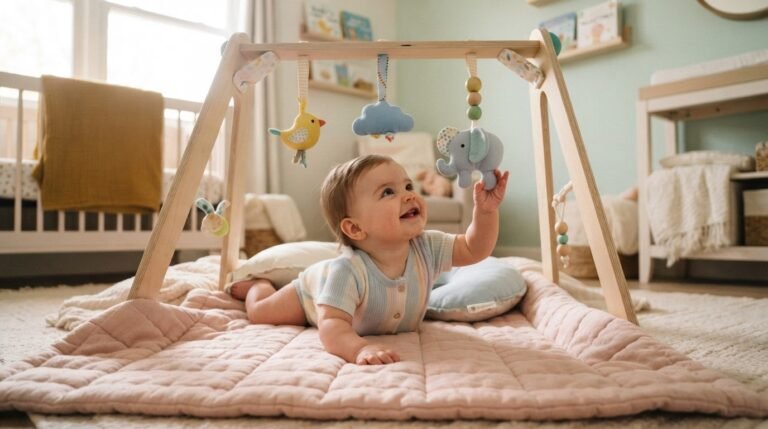
Play Ideas for Babies With Limited Mobility A baby with limited mobility can still enjoy rich play through looking, listening, reaching, grasping, vocal turn-taking, supported position changes, mirrors, books, and sensory exploration. The goal is not to make the baby perform a movement but to create accessible ways to participate and communicate. Place toys within…

Outdoor Play for a Baby Who Is Not Walking A baby does not have to walk to benefit from outdoor play. Supervised time on a clean blanket, looking at leaves, reaching for safe objects, rolling, crawling, sitting, supported standing, and listening to outdoor sounds can support exploration before independent walking. Choose a safe surface and…
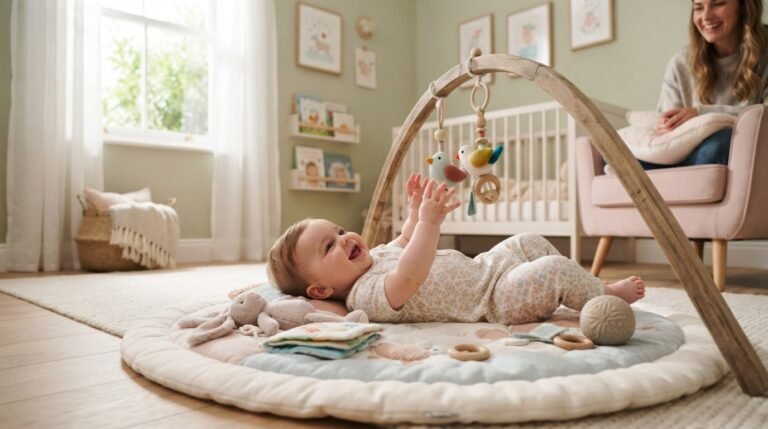
How Much Floor Time Does a 6-Month-Old Need? There is no universally required number of minutes of floor time for every 6-month-old. Offer several short, supervised periods across the day, adjusted for sleep, feeding, temperament, and tolerance. Floor time should complement—not replace—sleep, feeding, cuddling, and responsive interaction. At 6 months, floor play can include back…

Fine-Motor Play for Babies Who Cannot Crawl Yet A baby does not need to crawl before practicing fine-motor skills. Reaching, grasping, transferring objects, banging safe toys together, looking toward a sound, and bringing hands to the middle all build useful coordination before or alongside crawling. Offer short, supervised floor-play games that encourage reaching, grasping, releasing,…

Best Open-Ended Toys by Developmental Stage The best open-ended toys are simple objects that can be used in more than one way: stacking cups, large blocks, soft balls, scarves, containers, chunky puzzles, pretend-play props, and books. Choose toys by the child’s current abilities and safety needs, then allow the child to decide how to use…
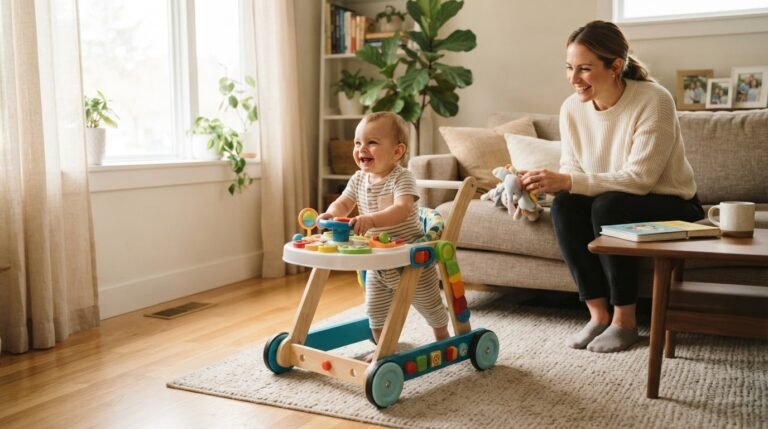
Baby Uses a Walker: Safety, Alternatives, and Development Wheeled baby walkers are not recommended as a developmental necessity and can increase injury risk. They can give a child rapid access to stairs, hot surfaces, cords, and objects that would otherwise be out of reach. Safer alternatives include supervised floor play, stable furniture, stationary activity centers…
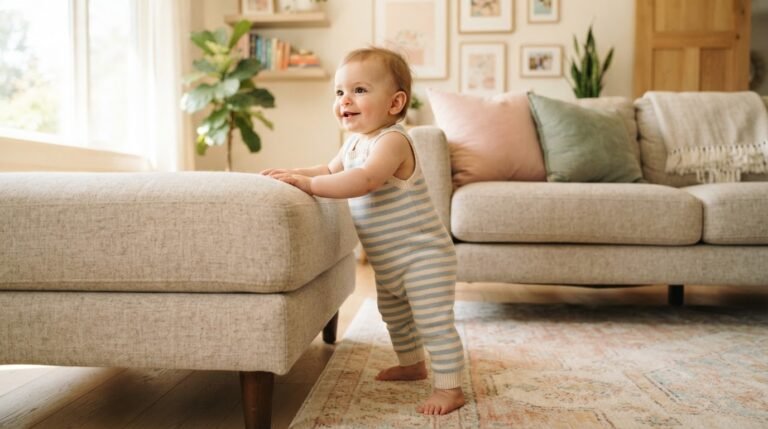
Baby Stands but Does Not Walk: Normal Range and Red Flags A baby who stands but does not walk is often practicing an important part of the process, not failing to reach a deadline. Standing, lowering, shifting weight, cruising, and taking independent steps require different combinations of balance, strength, confidence, coordination, and motor planning. A…
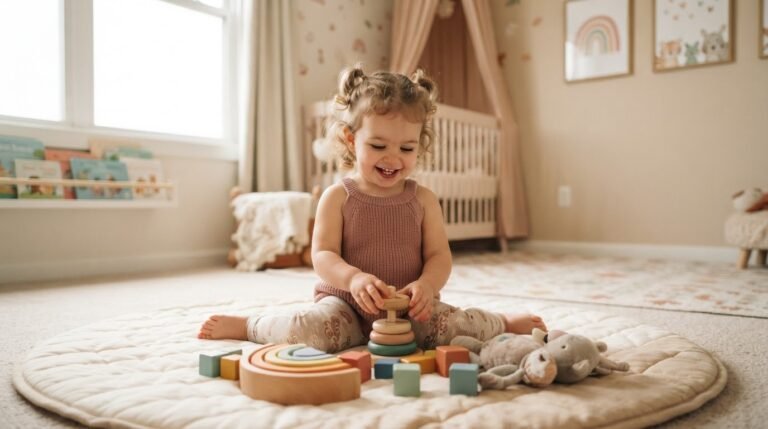
Baby Sits in a W Position: What Parents Should Know W-sitting is a posture in which a child sits between the heels with the knees bent and feet turned outward. Brief W-sitting is common and does not automatically damage the hips or cause a developmental problem. It is worth discussing if the child sits almost…
Baby Reaches With One Hand: Normal Preference or Concern? A baby may temporarily reach with one hand because of toy position, posture, fatigue, or a learned preference. Consistently using one hand much more than the other between 6 and 18 months, especially with a fisted or inactive opposite hand, is worth discussing with the pediatrician….
Baby Not Crawling at 9 Months: What Is Normal? A baby not crawling at 9 months is often still within the broad range of typical development. Crawling is a familiar milestone, but it is not a required step for every healthy child, and the exact age at which babies begin moving varies widely. Some babies…

Baby Not Crawling at 10 Months: When to Ask the Pediatrician If your baby is not crawling at 10 months, it is reasonable to mention it to the pediatrician, but the absence of a classic crawl does not automatically mean something is wrong. Babies reach mobility skills through different routes. One child may crawl on…
We use cookies to improve your experience on our site. By using our site, you consent to cookies.
Manage your cookie preferences below:
Essential cookies enable basic functions and are necessary for the proper function of the website.
These cookies are needed for adding comments on this website.
Statistics cookies collect information anonymously. This information helps us understand how visitors use our website.
Google Analytics is a powerful tool that tracks and analyzes website traffic for informed marketing decisions.
Service URL: policies.google.com (opens in a new window)