Baby Sleeps Only in a Swing or Car Seat: Safe Transition
Baby sleeps in swing: the quick answer
A swing or car seat is fine for supervised soothing or short travel naps, but it is not a safe regular sleep surface. If your baby sleeps in swing for naps, move them to a flat, firm crib or bassinet on their back. Keep the swing for awake soothing, then transfer once drowsy. This protects the airway and follows safe sleep standards.
For the full picture, read our pillar guide on Safe Sleep Checklist: Room Sharing, Firm Mattresses & SIDS Preventi.
Why a swing or car seat is not safe for routine sleep
Many babies fall asleep happily in a swing or car seat because the motion and snug fit feel comforting. Parents understandably want to protect that sleep. But these products were designed for soothing or transport, not for unsupervised or prolonged sleep.
The main problem is position. A swing or car seat holds a baby semi-upright in a padded, curved shell. An infant’s head is heavy and the neck muscles are weak. The head can drop forward onto the chest, which narrows the airway and makes breathing harder. This is called positional asphyxia.
The surface is also soft and contoured rather than firm and flat. Soft, inclined surfaces let a baby sink into a position that is not safe for sleep. Straps that are safe for travel can become a hazard if a baby shifts and a blanket or clothing catches.
Finally, swings and car seats are often used in the living room or in front of a caregiver who is also busy. Sleep that starts as “just a minute” can become an hour or more of unsupervised, unsafe rest.
The incline is the core danger
The American Academy of Pediatrics is clear: any sleep surface that inclines more than about 10 degrees is not safe for infant sleep. Many swings and “bouncers” recline well past that angle.
Inclined sleep products have been linked to infant deaths because a baby’s head can fall forward onto the chest. Even when a baby is “supervised,” a caregiver may be nearby but not watching every second, and a baby can get into trouble fast.
Flat and firm is the standard. The crib, bassinet, or portable play yard is built so the baby lies level, the airway stays open, and nothing blocks breathing. That is why the transition matters.
The safe transition plan
Moving a swing-loving baby to a crib takes patience. Use a gentle, consistent plan:
- Use the swing only while you are in the room and the baby is awake or drowsy. Treat it as a soothing tool, not a bed.
- When the baby drifts off, move them to the crib or bassinet promptly — flat and on the back.
- Build a short pre-nap routine: dim the room, soft sound, sleep sack, then place in the crib awake but calm.
- Bridge with contact or stroller naps if the baby protests the crib, then return to the crib for the next nap.
- Practice one nap a day in the crib first. Once that works, add more.
- Watch wake windows. An overtired baby fights sleep harder, so catch sleep cues early.
- Stay consistent for two weeks. New habits take time; avoid flipping back and forth.
- Keep the car seat for travel only. Once home, transfer to a flat surface.
Car-seat naps on the go
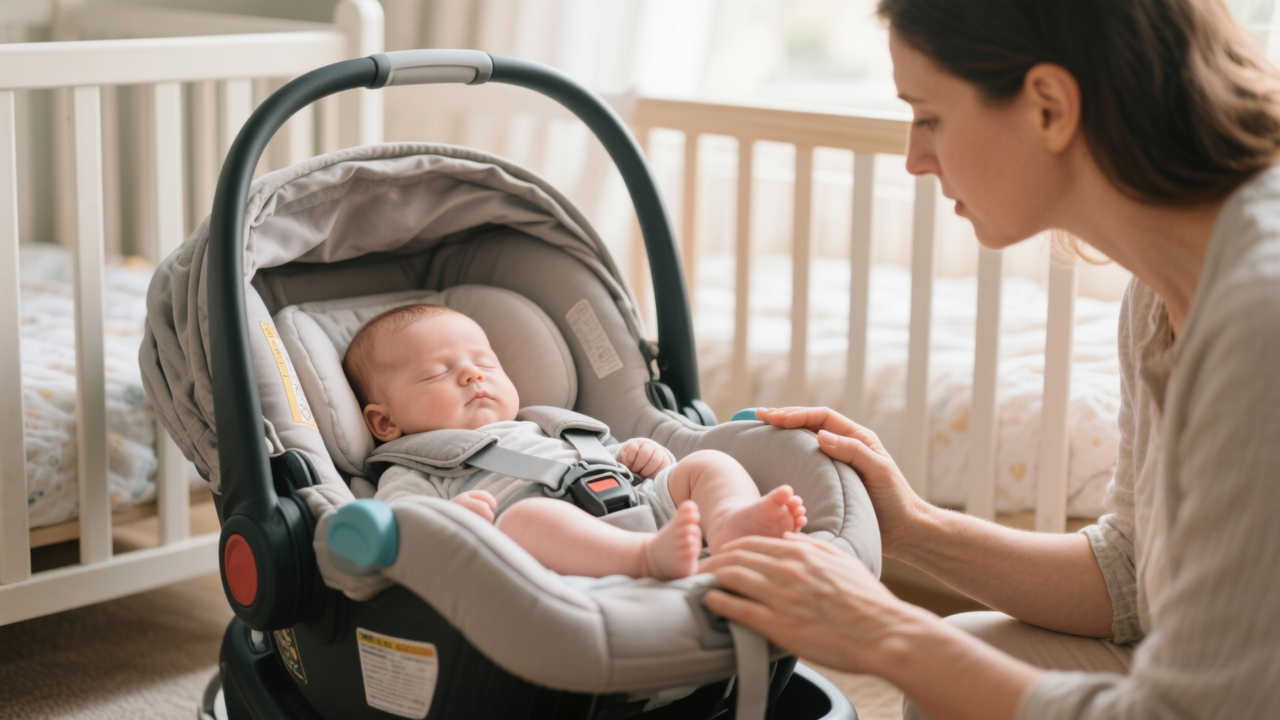
A car seat is safe while driving and supervised. The harness is designed to protect a baby in a moving vehicle. The problem is what happens after the drive.
Once you reach your destination, transfer the baby to a flat surface. Do not leave them buckled and reclined for a long nap or overnight. The very incline that is fine for travel becomes a risk for stationary sleep, because there is no one actively watching and the head can drop forward.
If you are on a long road trip, plan stops. A quick stretch and a flat surface at a rest area is safer than a long, parked, reclined sleep.
Why babies love the swing (and what to offer instead)
Babies are drawn to swings for good reasons: gentle motion mimics the womb, the snug fit feels secure, and white noise or music adds comfort. You do not have to throw those tools away. You just move them out of the sleep space.
Offer the same comforts in a safe way:
- Motion: a stroller walk or a gentle rock before placing in the crib.
- Snug feel: a correctly sized sleep sack.
- Sound: soft white noise from a machine placed well away from the crib.
- Dark, calm room: blackout curtains and a quiet wind-down.
The goal is to teach the baby that the crib is where sleep happens, while keeping the soothing feeling they love.
Age-specific guidance
Newborn (0–3 months)
Newborns often doze in the swing after feeds. Keep these sessions short and supervised. Start one crib nap a day early so the habit builds before the baby gets attached to the swing.
3–6 months
Baby sleeps in swing is a common age for “only sleeps in the swing” habits to form. Use the full transition plan. Most babies adjust within one to two weeks of consistency.
6–12 months
Older babies are more mobile and may climb or slump in a swing, raising injury risk. Move fully to the crib now. A predictable routine helps more than motion at this age.
Sample daily schedule (example for ~5 months)
| Time | Activity |
|---|---|
| — | — |
| 7:00 AM | Wake, feed, diaper, calm play |
| 8:30 AM | Crib nap (back, flat, sleep sack) |
| 10:00 AM | Feed, short swing for soothing only |
| 11:30 AM | Crib nap |
| 1:00 PM | Feed, tummy time |
| 2:30 PM | Crib nap |
| 4:00 PM | Feed, stroller walk if needed |
| 5:30 PM | Short catnap in crib if required |
| 6:30 PM | Bath, feed, dim room, sleep sack |
| 7:00 PM | Night sleep in crib |
Adjust to your baby’s cues. The swing appears only as a daytime soothing tool, never as a sleep location.
Safety reminders
- Always place your baby on the back for sleep.
- Use a firm, flat, level surface that meets safety standards.
- Keep the crib bare: no bumpers, loose bedding, positioners, or pillows.
- Do not use a swing, lounger, or car seat for overnight sleep.
- Never bed share, especially on a couch or soft surface.
- Avoid overheating; dress for the room and use a sleep sack.
- Transfer a sleeping baby from car seat or swing to a flat surface promptly.
Baby sleeps in swing: when to call your pediatrician
Call your pediatrician if:
- Your baby seems able to sleep only upright and also has reflux, choking, or breathing noises during feeds or sleep. Reflux is managed medically, not by an inclined sleep surface.
- You notice poor weight gain or feeding difficulty.
- There is a fever at any age, especially under 3 months.
- You see breathing changes: fast breathing, grunting, pauses, or color change.
- The baby has a high-pitched or weak cry that is new.
- There are signs of dehydration: fewer wet diapers, no tears, dry mouth.
Baby sleeps in swing FAQ
My baby only sleeps in swing — will the crib feel too plain?
At first, yes. Add the comforts that are safe: a sleep sack, dark room, and soft sound. Within one to two weeks most babies accept the crib, especially with a consistent routine.
Is a car seat safe for naps during travel?
Yes while driving and supervised. Once you arrive, move the baby to a flat surface. Do not leave them reclined and buckled for a long stationary nap.
Can I incline the crib mattress for reflux?
No. Inclining the sleep surface is not safe and does not treat reflux. Babies with reflux should sleep flat on the back. Talk with your pediatrician about daytime management.
Will using the swing for soothing hurt my baby?
No, used correctly. The swing is a fine soothing tool while you are present and the baby is awake or drowsy. The risk is only when it becomes the regular sleep surface.
What if my baby cries every time I put them in the crib?
Start with one crib nap a day and use contact or stroller naps to bridge. Consistency over two weeks usually wins. If crying is intense or paired with other symptoms, call your pediatrician.
Related reading: Newborn Won’t Sleep in Bassinet? 7 Fixes That Actually Work.
Common myths about swing and car-seat sleep
Myth: “The swing is safe because it has a harness.” Fact: a travel harness keeps a baby secure in a moving car, but it does not make an inclined, padded surface safe for prolonged sleep. The head can still drop forward.
Myth: “Supervision makes a swing safe for naps.” Fact: supervision reduces but does not remove the risk. A caregiver can look away for seconds while a baby’s airway narrows. Flat and firm is the only safe standard.
Myth: “My baby only sleeps in the swing, so it must be fine.” Fact: many habits form around unsafe surfaces. The transition plan moves sleep to the crib while keeping the comforting feel your baby loves.
Myth: “An inclined sleeper treats reflux.” Fact: inclined sleep surfaces do not treat reflux and are not safe for sleep. Babies with reflux sleep flat on the back; talk with your pediatrician about daytime management.
Special situations: travel, grandparents, and childcare
The rules travel with your baby. At a grandparent’s house, bring a portable crib that meets safety standards and a sleep sack; do not rely on an old crib or a couch. In childcare, give written instructions: back to sleep, bare crib, no swing or car-seat naps. When visiting, ask where the baby will sleep before you arrive so you are not deciding at midnight.
On planes and long drives, the car seat is safe while moving and supervised. Once you stop, transfer the baby to a flat surface. A travel stroller that lies fully flat can serve for a contact nap, but overnight sleep belongs in a proper crib or bassinet.
Helping an overtired baby settle in the crib
An overtired baby fights sleep harder, which makes the swing tempting. Catch early tired signs: eye rubbing, looking away, fussing, pulling ears. Start the nap routine as soon as you see them. Keep the routine short and the same every time: dim room, sleep sack, soft sound, then crib.
If your baby cries in the crib, give a few minutes of calm presence without picking up immediately, then offer a hand on the chest and a shush. Consistency over one to two weeks usually wins. If crying is intense or paired with other symptoms, call your pediatrician rather than returning to the swing.
Signs the transition is working
You are succeeding when at least one nap a day happens in the crib on the back; the swing is used only for awake soothing; the baby falls asleep in the crib more often than in the swing; and overnight sleep happens on a flat surface. Progress is rarely instant. Small steps add up, and every crib nap is a win for safety.
Why the “flat and firm” standard exists
The advice to use a flat, firm surface is not arbitrary. A baby’s airway is narrow and their control over head position is still developing. On a flat, firm mattress, the head rests in a neutral position and the mouth and nose stay clear. On a soft or inclined surface, the face can press into padding or the chin can drop toward the chest, both of which narrow the airway and make breathing harder.
Firm means the surface does not indent when the baby lies on it. A memory-foam topper, a soft couch cushion, or a pillow-like infant lounger all fail this test. The crib mattress made for that specific crib, with only a fitted sheet, is the safe choice. This is exactly why a swing or car seat, which are padded and curved, are wonderful for soothing but not for sleep.
The “flat” part matters too. The American Academy of Pediatrics advises that any sleep surface inclining more than about 10 degrees is unsafe. A swing often reclines well past that angle. When a baby’s body is tilted, gravity pulls the heavy head forward, and a sleepy infant lacks the muscle tone to lift it back. Flat removes that risk entirely, which is the whole point of moving naps to the crib.
See also: Baby Rolls in Sleep and Gets Stuck.
Soft surfaces also raise the risk of rebreathing—a baby breathing in their own exhaled air trapped in bedding. A firm, flat, bare mattress lets air move freely around the face. None of this means a baby is fragile; it means their sleep space should be built for their anatomy, not for convenience.
Contact naps, babywearing, and safe holding
Contact naps—sleeping on a caregiver’s chest—are fine while you are awake and alert. Many newborns love them, and they support bonding and feeding. The key word is awake. Falling asleep with a baby on a couch, armchair, or your chest while you also doze is dangerous, because the baby can slip into a position that blocks breathing or become trapped against soft cushions. The risk is highest on a couch or soft armchair, where sleep-related death risk is dramatically higher than in a crib.
Babywearing in a properly fitted carrier is safe for awake comfort and can help a fussy baby settle. It is not a sleep substitute. Once the baby is deeply asleep in the carrier, move them to the crib on the back. Never leave a sleeping baby in a reclined or tilted carrier for a long stretch, since the same incline problem that makes swings unsafe applies here as well.
If you are exhausted, it is safest to place the baby in the crib and rest yourself in another way. Protecting your own alertness protects the baby more than any contact nap does. Trade off with a partner or ask for help so that no one falls asleep with the baby in an unsafe spot.
Reading sleep cues and preventing overtiredness
Learning your baby’s early tired signs makes the crib transition far smoother. Watch for looking away from faces or toys, rubbing eyes, pulling at ears, yawning, and fussing that builds quickly. Catch these early and start the routine before the baby becomes overtired and fights sleep.
An overtired baby often looks “wired”—wide-eyed, arching, hard to settle, and resistant to the crib. That is the exact moment a swing seems like the only answer. Preventing overtiredness with well-timed naps is the quiet secret to moving away from the swing. Keep wake windows appropriate for the baby’s age, keep the environment calm, and start the wind-down as soon as you see the first cue.
A short, predictable routine teaches the baby what to expect. Dim the lights, change the diaper, offer a feed if due, put on the sleep sack, and place the baby in the crib on the back. Repeat it the same way each time. Over one to two weeks, the crib becomes the expected sleep place, and the swing steps back to a daytime soothing tool only. Consistency, not force, is what changes the habit.
- Baby Lounger Sleep Safety
- Unsafe Baby Sleep Products
- Contact Naps: Are They Safe?
- American Academy of Pediatrics — A Parent’s Guide to Safe Sleep
- NICHD Safe to Sleep — Safe Sleep Environment
- CDC — About Sudden Unexpected Infant Death
- World Health Organization — Newborn Care
About the author
Dr. Michael Anderson, MD (Pediatrics) is a board-certified pediatrician on the ChildBloom medical panel, focusing on infant sleep, safe sleep environments, and responsive routines. This article was medically reviewed and approved by Dr. Ahmad Raza, MD (Pediatrics) against current AAP safe-sleep guidance. Read our editorial and review standards.
This guide is general education, not a diagnosis. If you are worried about your baby’s breathing, feeding, growth, or sleep, contact your pediatrician. For any breathing emergency, call emergency services immediately.
Related ChildBloom Guides
- Start here: Safe Sleep Checklist: Room Sharing, Firm Mattresses & SIDS Preventi
- Is a Baby Lounger Safe for Sleep
- Room Sharing vs Separate Nursery
- Crib Bumpers & Weighted Sacks
- Safe Sleep for Preterm Babies
- Baby Choking Hazards: Prevention and Safer Mealtimes
- Browse all Sleep & Nursery guides
References & Medical Sources
- NICHD Safe to Sleep: safe sleep environment
- AAP parent guide to safe sleep
- CPSC safe sleep and crib product rules
- CDC data on SUID and SIDS
Reviewed by the ChildBloom pediatric panel. Learn about our physicians on the About page. This article is educational and does not replace your child’s clinician.