When Do Babies Start Teething? Age, Symptoms & Order (2026)
Medically reviewed by Dr. Ahmad Raza, MD (Pediatrics) — ChildBloom Medical Review Panel. Last updated: August 03, 2026.
Editorial & affiliate disclosure: our guidance is written and reviewed by clinicians. ChildBloom may earn a commission from qualifying purchases made through links on this page, which never changes what our pediatric reviewers recommend.
If you are searching for answers about when do babies start teething, you are in the right place. This pediatrician-reviewed guide explains what is normal, what the likely causes are, the red flags that mean you should call your doctor, and what you can safely do at home — all based on current AAP, CDC and NIH guidance on when do babies start teething.
When Do Babies Start Teething? Age, Symptoms & Baby Tooth Order Chart (2026 Pediatrician Guide)
Short answer: Most babies get their first tooth between 6 and 10 months of age, though the medically normal range spans 3 to 14 months. The two lower central incisors erupt first, followed by the upper centrals around 8–12 months. A complete set of 20 primary (baby) teeth is usually in place by age 2½ to 3. Teething before 3 months, or no teeth by 15 months, is worth a pediatric visit — but the vast majority of variations inside that window are entirely normal.
If you are here because your baby is drooling, chewing everything in sight, or sleeping worse this week, take a breath. This guide is designed to answer the question comprehensively — timeline, symptoms, myths, safe relief, warning signs, and what to expect at each stage — in the same order a pediatrician would walk you through it in clinic.
Baby Teething Timeline: When Each Tooth Comes In (Chart)
| Age | Teeth erupting | What you’ll typically notice |
|---|---|---|
| 4–7 months | Lower central incisors (bottom front 2) | Drooling ramps up, chewing on hands, mild gum swelling, one or two rough nights |
| 8–12 months | Upper central incisors (top front 2) | Visible white bud through gum, biting on cold objects, drool rash on chin |
| 9–13 months | Upper lateral incisors | Sleep disruption around each eruption, gum rubbing |
| 10–16 months | Lower lateral incisors | 3–5 days of increased irritability per tooth, decreased appetite for solids |
| 13–19 months | First molars (top and bottom) | Cheek rubbing, ear pulling on the affected side, more discomfort |
| 16–22 months | Canines (cuspids) | Longer eruption window; sharper points cause more soreness |
| 23–33 months | Second molars | The last set, often the most uncomfortable — expect 5–7 rough days |
| By age 3 | All 20 primary teeth erupted | Baseline dental visit already established |
How Teething Works: What Happens Inside the Gum
Primary teeth begin forming in utero — as early as 6 weeks of gestation, tooth buds appear in the developing jaw, and by the second trimester the enamel and dentin of all 20 primary teeth have started to mineralize. Your baby is born with a full set of unerupted teeth already hidden inside the jaw.
Teething is the process of those teeth migrating through the bone and gum tissue to the surface. Two things drive discomfort:
- Mechanical pressure as the tooth pushes through periosteum and gum.
- Local inflammation — the gum tissue releases cytokines and prostaglandins that produce swelling, warmth, and mild pain around the eruption site only.
This inflammation is strictly local. It does not produce whole-body fevers, systemic diarrhea, rashes on the trunk, or vomiting. That distinction matters more than any other point in this article, and I will return to it.
Baby Teething Age Range: What Is Normal?
Parents often ask, “My friend’s baby got a tooth at 4 months, mine is 9 months with nothing — is something wrong?” Almost always, no.
- 3–4 months: Early but within normal range. Genetically strong predictor — if either parent teethed early, so will many of their children.
- 5–7 months: The most common window for the first tooth.
- 8–12 months: Still fully normal. About 15% of babies fall here.
- 12–15 months: Late but usually normal, especially in babies who were born preterm (adjust for gestational age).
- After 15 months: Time to evaluate. Rule out hypodontia (congenitally missing teeth), nutritional causes (rare in developed countries), or endocrine causes such as hypothyroidism.
Preterm babies teethe based on corrected age, not birth age. A baby born at 32 weeks may get their first tooth at 9–11 months chronological — that is on-time.
Signs of Teething in Babies (Evidence-Based Symptom List)
A landmark prospective cohort study published in Pediatrics (2000) and replicated in a systematic review (PMC, 2016) tracked infants daily around tooth eruption events. The symptoms consistently associated with teething — meaning they occurred more often on eruption days than non-eruption days — are:
- Drooling — begins as early as 3 months, peaks around active eruption
- Gum rubbing and biting — on fingers, toys, teethers, your shoulder
- Chewing on objects
- Mild irritability — usually 3–5 days before a tooth breaks through, resolving within 1–2 days after
- Decreased appetite for solids (breast and bottle feeds are typically unaffected — if they are affected, look for another cause)
- Mild sleep disruption — 1–2 rougher nights around eruption
- A very mild temperature elevation — up to about 99.5°F (37.5°C). This is not a true fever.
- Drool rash on the chin, cheeks, and neck folds — irritant contact dermatitis from saliva pooling
That is the complete evidence-based list. Anything beyond this belongs in the next section.
Teething Myths: Does Teething Cause Fever or Diarrhea?
This is the single most important section of the article. Attributing systemic symptoms to teething is one of the most common reasons true infections are missed in infants under 2. Teething does not cause:
- Fever ≥100.4°F (38°C). True fever in a teething baby is an infection until proven otherwise — most commonly a viral upper respiratory infection or otitis media. In babies under 3 months, any rectal temperature ≥100.4°F is a medical emergency regardless of teething.
- Diarrhea. There is no biologically plausible mechanism for teething to cause loose stools. If your baby has diarrhea, it is a GI illness that happens to coincide with a tooth coming in. Watch hydration.
- Rash anywhere except the drool zone. Chin, cheek, and neck rashes from saliva are fine. Rashes on the trunk, limbs, or diaper area are not teething.
- Vomiting. A single spit-up during a fussy period is not teething-related — it is normal reflux. Repeated vomiting needs evaluation.
- Lethargy or refusing all liquids. These are red flags at any age. Teething babies remain alert and continue to nurse or drink.
- Cough, runny nose, or congestion. These are viral symptoms. The overlap with teething age (6–24 months, when infants first encounter many pathogens) is coincidence, not causation.
- Ear infections. Ear pulling can occur in teething because the mandibular nerve refers pain to the ear. But if a baby has fever + ear pulling + fussiness, assume otitis until an exam proves otherwise.
Rule of thumb: Local symptoms belong to teething. Systemic symptoms belong to something else.
Baby Tooth Order: Month-by-Month Eruption Guide
4–7 months: The lower central incisors
The bottom two front teeth are almost always first. You will typically see a hard white bump under the gum a week or two before it breaks through. Drooling can be dramatic — go through 4–6 bibs a day. Introduce a cold silicone teether from 4 months.
8–12 months: The upper central incisors
Once the top two front teeth come in, most babies briefly look “goofy” — bottom teeth first, top teeth second, with a gap between them. This is normal and self-corrects. Expect one or two harder nights.
9–16 months: The lateral incisors
The four teeth immediately beside the centrals fill in over several months. By the first birthday most babies have 6–8 teeth. This is the ideal time to schedule the first dental visit (AAP and AAPD both recommend by age 1).
13–19 months: The first molars
Molars are the first big pain point. Larger surface area, more gum to break through, and multiple cusps erupting at once. Expect 3–7 uncomfortable days per molar. Cheek rubbing and ear pulling are classic — but always rule out otitis if there is fever.
16–23 months: The canines (cuspids)
Pointed teeth with a longer eruption window. Because they are between the incisors and molars, the gum has to stretch more. Some parents notice a bluish blister (“eruption cyst”) over the gum — this is benign fluid accumulation and resolves on its own without treatment.
23–33 months: The second molars
The last and often the most uncomfortable set. Toddlers can now tell you it hurts, which paradoxically makes it easier. Ibuprofen, cold food (frozen banana slices, chilled cucumber sticks in a mesh feeder), and extra cuddles.
By age 3: The full primary set
All 20 baby teeth are in. Cavity risk begins the moment the first tooth erupts — brush twice daily with a rice-grain-sized smear of fluoride toothpaste from tooth #1, escalating to a pea-sized amount at age 3.
How to Soothe a Teething Baby: Safe Relief That Works
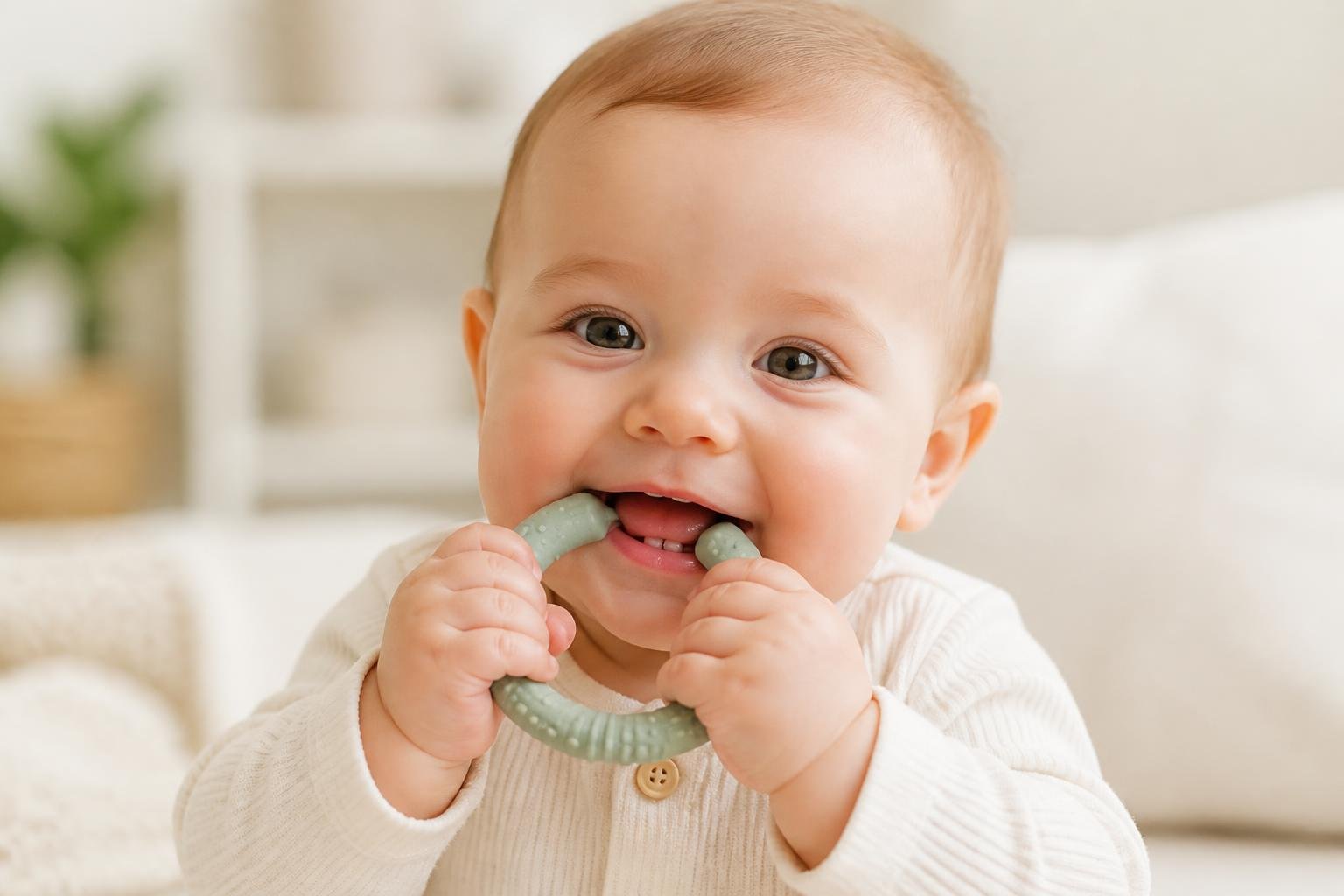
- Chilled (not frozen) silicone teether. Fifteen minutes in the fridge. Cold numbs the gum without ice-burn risk. Solid silicone is safer than liquid-filled teethers, which can leak or rupture.
- Clean adult finger with gentle counter-pressure on the erupting gum for 30–60 seconds. This is genuinely the most effective at-home intervention and costs nothing.
- Cold, damp washcloth to chew on. The texture plus temperature is remarkably effective and easy for babies to grip.
- Chilled food in a silicone mesh feeder for babies eating solids — cold banana, chilled cucumber, frozen breastmilk cubes.
- Weight-appropriate acetaminophen — for genuine pain that disrupts sleep or feeding. Never scheduled preemptively; use only per your pediatrician’s dosing.
- Ibuprofen — acceptable after 6 months for more significant discomfort (molars). Longer-acting than acetaminophen. Never combine unless directed.
- Extra breast or bottle feeds. Comfort suckling stimulates the vagus nerve, releases endogenous opioids, and reliably reduces perceived pain.
- Distraction. Novel toys, a bath, going outside. Do not underestimate this — teething discomfort is worst when a baby has nothing else to focus on.
Unsafe Teething Remedies: FDA and AAP Warnings
- Benzocaine teething gels (Orajel, Baby Orajel, Anbesol, Hurricaine). The FDA has issued repeated Drug Safety Communications warning against use in children under 2, citing methemoglobinemia — a life-threatening blood disorder that can occur even at recommended doses.
- Homeopathic teething tablets and gels. Multiple recalls (2010, 2016, 2017) for inconsistent belladonna content, which caused seizures and deaths in some infants. FDA advises against use.
- Amber (Baltic) teething necklaces. No proven mechanism, and documented strangulation and choking deaths. The AAP explicitly warns against them.
- Silicone or wooden teething necklaces worn by the baby. Same strangulation risk. If you want a “chew necklace,” it goes on the parent, not the baby.
- Frozen teethers or actual ice cubes. Can cause frostbite of the gum tissue. Chilled, not frozen.
- Liquid-filled teethers left in the freezer. Can rupture and leak.
- Rubbing alcohol, whiskey, or brandy on the gums. Never safe at any dose. This is folk practice, not medicine.
- Teething biscuits or crackers. Choking hazard for babies who cannot yet manage solids, and they cake sugar onto emerging teeth — the worst combination for early cavity formation.
Teething and Sleep: How Long Does Teething Really Disrupt Sleep?
Parents often blame every sleep regression on teething. Some are; most are not.
- Real teething-related sleep disruption lasts 1–2 nights around eruption.
- If sleep has been rough for more than a week, the cause is almost certainly something else: developmental leap, illness, wake window mismatch, or a schedule that has outgrown itself. See our wake windows chart and overtired vs. undertired guide.
- Do not abandon sleep foundations for teething. Continue your normal bedtime routine, safe-sleep setup, and consistent responses. A rough teething night handled with your usual approach is easier than a rough teething night that also breaks the routine.
Baby Oral Hygiene: Brushing From the First Tooth
Start brushing the moment tooth #1 appears:
- Under 3 years: rice-grain-sized smear of fluoride toothpaste, twice daily
- Age 3+: pea-sized amount, twice daily, spit but do not rinse aggressively
- First dental visit by age 1 (AAP + AAPD joint recommendation)
- No bottles in bed with anything other than water after tooth eruption — the leading cause of early childhood caries
- Wipe gums with a clean damp cloth before the first tooth if you like, but this is optional; the true intervention starts with the first tooth
Teething Red Flags: When to Call Your Pediatrician
ER now (call 911 or go to an emergency department) for:
- Any rectal temperature ≥100.4°F (38°C) in a baby under 3 months — regardless of teething
- Lethargy, extreme fussiness that cannot be consoled, or a baby that does not respond normally
- Refusing all liquids for more than 8 hours, or signs of dehydration (no wet diapers for 8+ hours, sunken fontanelle, no tears when crying)
- Seizure, blue color around the lips, or difficulty breathing
Call the same day for:
- Fever ≥102°F (38.9°C) at any age attributed to “teething” — teething does not cause true fever
- Diarrhea lasting more than 24 hours, or with blood or mucus
- Persistent ear pulling with fever (rule out otitis media)
- A gum abscess (yellow-white pus around a tooth) or a bluish-purple gum bump that is enlarging quickly
- A tooth that erupts loose (rare “natal” tooth may need extraction if it can dislodge and be aspirated)
Schedule a routine visit for:
- No teeth by 15 months (evaluate hypodontia, nutritional, endocrine causes)
- First tooth before 3 months — usually benign but needs a look
- A tooth that erupts discolored (gray, brown, yellow) — possible enamel defect or trauma
- Persistent asymmetric eruption over 3+ months
- A baby who has never had a pediatric dental visit and is approaching age 1
For a complete decision framework on fevers by age, see our when-to-worry baby fever chart.
Baby Teething FAQ
Each answer opens with a direct 1–2 sentence response (optimized for Google featured snippets and People Also Ask), then adds a brief clinical explanation.
At what age do babies start teething?
Most babies start teething between 4 and 7 months of age, with the first tooth typically visible between 6 and 10 months. The full medically normal range spans 3 to 14 months. Early teethers often have a parent who also teethed early — it is strongly genetic. No teeth by 15 months warrants a pediatric evaluation.
What are the first signs of teething in a baby?
The earliest signs of teething are increased drooling, chewing on hands and objects, mild gum swelling, and 3–5 days of extra fussiness before a tooth breaks through. Sleep may be briefly disrupted and appetite for solids may dip. Breast and bottle feeds usually continue normally. A hard white bump under the gum often appears 1–2 weeks before eruption.
Can teething cause a fever?
No — teething does not cause a true fever (≥100.4°F / 38°C). A mild temperature rise up to 99.5°F (37.5°C) can occur, but anything higher is caused by an infection, not the tooth. In babies under 3 months, any rectal temperature of 100.4°F or higher is a medical emergency regardless of whether they are teething.
How long does teething pain last per tooth?
Teething discomfort for a single tooth typically lasts 3 to 5 days — starting a few days before the tooth breaks through and easing within 1–2 days after eruption. Molars can cause 5–7 days of discomfort because they are larger and have multiple cusps erupting at once. If fussiness lasts longer than a week, the cause is usually not teething.
In what order do baby teeth come in?
Baby teeth erupt in a predictable order: lower central incisors first (6–10 months), then upper central incisors (8–12 months), lateral incisors (9–16 months), first molars (13–19 months), canines (16–22 months), and second molars last (23–33 months). All 20 primary teeth are usually in by age 2½ to 3.
Does teething cause diarrhea or a runny nose?
No — teething does not cause diarrhea, vomiting, cough, or a runny nose. These are viral or bacterial illness symptoms that happen to coincide with teething age (6–24 months), when infants first encounter many common pathogens. Treating them as “just teething” is one of the most common reasons real infections get missed.
What is the safest way to soothe a teething baby?
The safest teething relief is a chilled (not frozen) silicone teether, gentle counter-pressure with a clean adult finger for 30–60 seconds, and a cold damp washcloth to chew on. For genuine pain that disrupts feeding or sleep, use weight-appropriate acetaminophen (any age) or ibuprofen (6+ months) per your pediatrician’s dosing. Avoid benzocaine gels, homeopathic tablets, and amber necklaces.
When should a baby have their first dental visit?
A baby should have their first dental visit by age 1, per the joint recommendation of the AAP and the American Academy of Pediatric Dentistry (AAPD). The visit establishes a dental home, catches early enamel or bite issues, and teaches parents brushing technique — do not wait until a “mouth full of teeth” or until age 3.
Bottom Line: When Do Babies Start Teething?
Teething is a normal, predictable developmental process — not an illness. Real symptoms are mild and local: drool, gum rubbing, brief fussiness, one or two rough nights per tooth. Anything systemic — true fever, diarrhea, lethargy, rash on the body, refusing all liquids — is not teething, and treating it as such is how real infections get missed. Manage discomfort with cold, counter-pressure, and appropriate dosing of acetaminophen or ibuprofen. Skip benzocaine, homeopathic tablets, and amber necklaces entirely. Start brushing from the first tooth, and book your child’s first dental visit by their first birthday.
Medically reviewed by Dr. Zeeshan Salam, MD — Pediatrician & Neonatologist. Reviewed July 2026. About the author.
Internal links: Development & Milestones pillar · When to Worry About Baby Fever · Baby Wake Windows Chart · Overtired vs. Undertired · Newborn Grunting & Straining While Sleeping · Baby Poop Color Chart
Citations:
– AAP HealthyChildren – Teething: 4 to 7 Months
– American Academy of Pediatric Dentistry – Eruption Charts and FAQs
– FDA Drug Safety Communication – Benzocaine and Infants Under 2
– PMC – Symptoms Associated with Infant Teething: A Prospective Study (Macknin et al.)
– Cleveland Clinic – Teething Symptoms & Relief
– AAP + AAPD – Age One Dental Visit Recommendation
Related Pediatrician-Authored Guides
Teething often brings drool rashes and skin changes that parents confuse with more concerning conditions. If your baby has developed spots or blotches, these clinical guides help you tell benign from urgent:
- baby rash types with pictures
- red blotches on your infant’s face: 10 causes
- when to worry about a rash on your child
📖 More from the Pediatrician’s Corner Hub: your complete pediatrician-reviewed guide to your baby’s first year — milestones, feeding, sleep, vaccines, common illnesses, and more
When Do Babies Start Teething: quick pediatrician summary
Development runs on ranges, not deadlines, and the direction of travel matters more than any single date on a chart. Track what your child does across several weeks rather than any one day, and remember that skills should be added over time and not lost. Bring it up with your pediatrician if a skill disappears, if there is no response to sound or faces, if muscle tone seems very stiff or very floppy, or if your gut says something has changed — early evaluation is low-risk and high-value.
Common mistakes parents make
- Treating a single measurement or one bad day as a trend instead of watching the pattern over several days.
- Trying several remedies at once, so it becomes impossible to tell what helped.
- Waiting for a convenient time to call when a red flag is already present — feeding, breathing and alertness changes are always worth a same-day call.
- Following advice from an unsourced social post rather than your own pediatrician, who knows your child’s history and growth curve.
Related guides from our pediatric team
- When Do Babies Start Walking? Timeline and Readiness Signs
- When Do Babies Start Crawling? The Complete Guide
- Baby Teething Symptoms and Relief: What Works
- Teething Timeline: Symptoms and What Actually Helps
- More expert answers in Pediatrician’s Corner
References and further reading
- CDC Learn the Signs. Act Early. milestones
- AAP developmental surveillance guidance
- WHO early child development
Medical disclaimer
This article is for general education and is not a substitute for individual medical advice, diagnosis or treatment. Every child is different — talk to your own pediatrician about your baby, and seek urgent care for breathing difficulty, poor feeding, dehydration, unusual sleepiness, fever in an infant under 3 months, or any sudden change in your child’s condition.