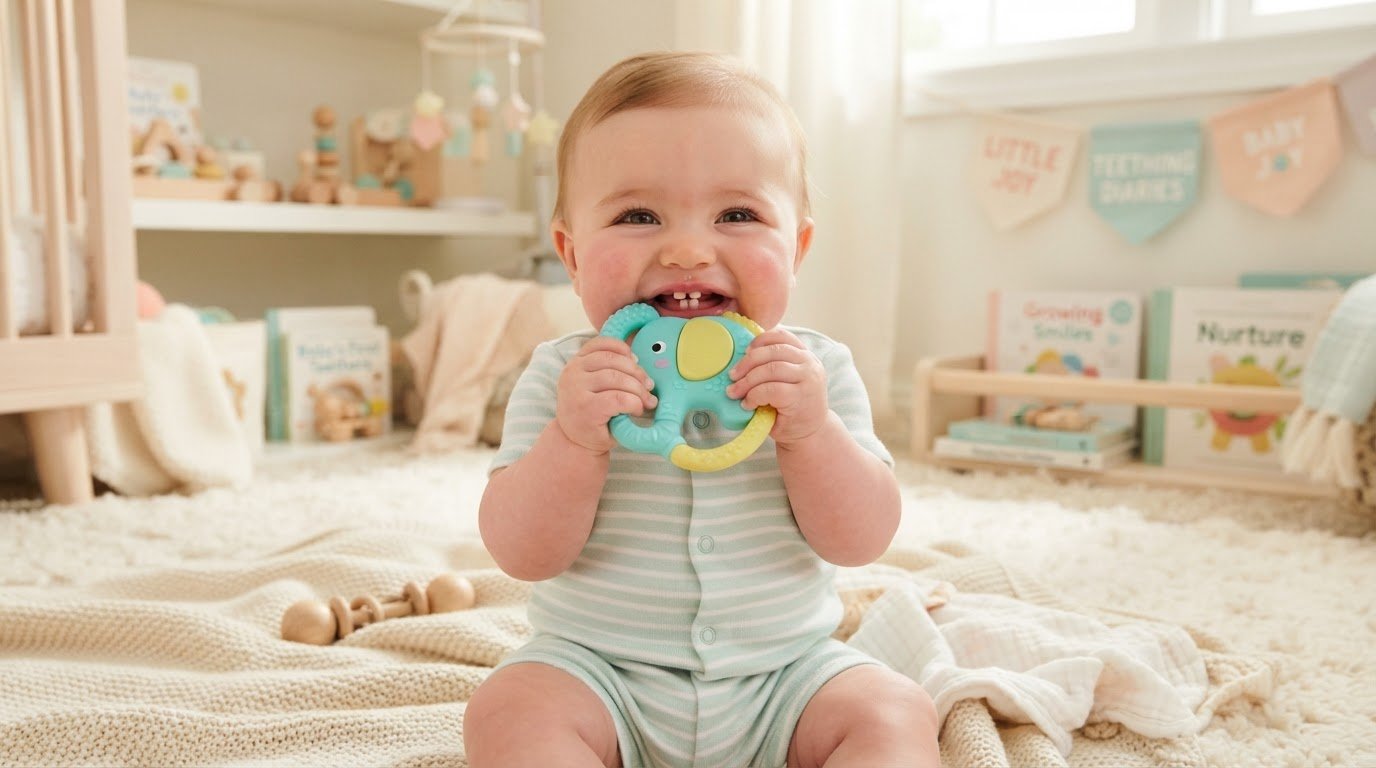
Baby Teething Timeline: First Teeth, Symptoms, and Safety
Medically reviewed by Dr. Ahmad Raza, MD (Pediatrics) — ChildBloom Medical Review Panel. Last updated: August 4, 2026.
Editorial & affiliate disclosure: our guidance is written and reviewed by clinicians. ChildBloom may earn a commission from qualifying purchases made through links on this page, which never changes what our pediatric reviewers recommend.
Looking for clear answers about baby teething timeline? This pediatrician-reviewed guide covers what matters, what to skip, the safety checks that count, and exactly when to involve your doctor — based on current AAP, CDC and CPSC guidance on baby teething timeline.
Quick pediatrician summary: baby teething timeline
Short answer: A pediatrician explains baby teething timeline: what is normal, the real risks, red flags to watch for and exactly when to call your doctor.
Watching your baby’s first teeth appear is an exciting milestone. Along with teething, proper baby grooming is another key care area. But it can also bring sleepless nights, drool-soaked bibs, and a fussy baby. Knowing the baby teething timeline helps you prepare for what is coming and respond to your baby’s discomfort with confidence. Teething can also affect baby feeding and mealtime comfort.
Most babies get their first tooth between 4 and 7 months of age. By age 3, most children have a full set of 20 primary teeth. Each tooth follows a predictable pattern of eruption, though every baby is different. The AAP provides helpful guidance on teething comfort.
This complete guide includes a detailed baby teething timeline chart, signs and symptoms to watch for, safe relief methods, and tips for each stage. You will know exactly what to expect and when.
Table of Contents
- When Do Babies Start Teething?
- Complete Baby Teething Timeline Chart
- Signs and Symptoms of Teething
- Teething by Age: What to Expect at Each Stage
- Safe Teething Relief Methods
- What NOT to Do for Teething Pain
- Teething and Sleep: How to Help Your Baby Rest
- Teething and Feeding: Tips for Comfortable Meals
- When to See a Pediatric Dentist
- Key Takeaways
- Frequently Asked Questions
- Bottom Line
- References
When Do Babies Start Teething?
Most babies start teething between 4 and 7 months of age. However, the timeline varies widely. Some babies get their first tooth as early as 3 months, while others do not see a tooth until after their first birthday.
Factors that can affect teething timing:
- Genetics — If you or your partner got teeth early or late, your baby may follow the same pattern.
- Premature birth — Babies born early may teethe later, based on their adjusted age.
- Birth weight — Lower birth weight babies sometimes teethe later.
- Nutrition — Adequate vitamin D and calcium support healthy tooth development.
Featured Snippet Answer: Most babies start teething between 4 and 7 months of age. The first teeth to appear are usually the two bottom front teeth (lower central incisors). However, some babies may start teething as early as 3 months or as late as 12 months. Every baby is different.
Complete Baby Teething Timeline Chart
This chart shows the typical order and timing for all 20 primary (baby) teeth.
Baby Teething Timeline by Age
| Age Range | Teeth | Number | Total Teeth |
|---|---|---|---|
| 6–10 months | Lower central incisors | 2 | 2 |
| 8–12 months | Upper central incisors | 2 | 4 |
| 9–13 months | Upper lateral incisors | 2 | 6 |
| 10–16 months | Lower lateral incisors | 2 | 8 |
| 13–19 months | Upper first molars | 2 | 10 |
| 14–18 months | Lower first molars | 2 | 12 |
| 16–23 months | Upper canines (cuspids) | 2 | 14 |
| 17–23 months | Lower canines (cuspids) | 2 | 16 |
| 23–33 months | Lower second molars | 2 | 18 |
| 25–33 months | Upper second molars | 2 | 20 |
Visual Teething Order
Stage 1 (6-10 months):  ── Lower front 2 teeth
Stage 2 (8-12 months):  ── Upper front 2 teeth
Stage 3 (9-13 months):  ── Upper side teeth next to front
Stage 4 (10-16 months): ── Lower side teeth next to front
Stage 5 (13-19 months): ── Upper back teeth (first molars)
Stage 6 (14-18 months): ── Lower back teeth (first molars)
Stage 7 (16-23 months): ── Upper pointed teeth (canines)
Stage 8 (17-23 months): ── Lower pointed teeth (canines)
Stage 9 (23-33 months): ── Lower back teeth (second molars)
Stage 10 (25-33 months): ── Upper back teeth (second molars)
Important: These ages are averages. Your baby’s teeth may arrive earlier or later and still be completely normal. The American Academy of Pediatrics (AAP) and the American Dental Association (ADA) both emphasize that wide variation in teething timing is expected.
Signs and Symptoms of Teething
Teething can cause a range of symptoms in babies. Not every baby shows the same signs, and some babies seem to breeze through teething with minimal fuss.
Common teething symptoms:
- Excessive drooling — Teething stimulates saliva production. You may notice drool soaking through bibs constantly.
- Chewing on everything — Babies gnaw on fingers, toys, and anything they can reach. The pressure feels good on sore gums.
- Swollen, tender gums — You may see redness or a small bump where the tooth is about to break through.
- Irritability or fussiness — Discomfort from teething can make babies cranky, especially at night.
- Disrupted sleep — Teething pain often worsens at night when there are fewer distractions.
- Ear pulling — Babies may tug at their ears because the pain from the gums radiates to the ears.
- Cheek redness — A flushed cheek on the side where the tooth is emerging.
- Mild temperature increase — Teething may cause a very slight rise in body temperature, but NOT a true fever (100.4°F / 38°C or higher).
- Changes in eating — Some babies eat less because sucking or chewing hurts. Others want to nurse or bottle-feed more for comfort.
Featured Snippet Answer: Common teething symptoms include excessive drooling, chewing on objects, swollen gums, irritability, disrupted sleep, ear pulling, and mild temperature increase. Teething does NOT cause high fever, diarrhea, or rashes beyond the drool area. If your baby has these symptoms, see your pediatrician.
Teething Myths: What Teething Does NOT Cause
Research shows that teething does not cause:
– High fever (above 100.4°F / 38°C)
– Diarrhea
– Body rashes
– Vomiting
– Cold or flu symptoms
If your baby has these symptoms, they are likely caused by an illness, not teething. Always consult your pediatrician.
Teething by Age: What to Expect at Each Stage
3–6 Months: Pre-Teething Stage
Even before teeth appear, your baby may show early signs. Gums may feel firm or bumpy. You might notice increased drooling and chewing. This is the preparation phase.
What to do: Offer a clean, damp washcloth chilled in the refrigerator. Let your baby chew on it gently. The cool temperature soothes the gums.
6–10 Months: First Teeth (Lower Central Incisors)
The two bottom front teeth are usually the first to appear. These teeth are relatively small and sharp. You may see a white bump on the lower gum line before the tooth breaks through.
What to expect: Increased drooling, fussiness, and a desire to chew. Some babies sleep poorly during this stage.
8–12 Months: Upper Front Teeth (Upper Central Incisors)
The two top front teeth usually follow shortly after the bottom ones. These teeth are more visible and may cause more noticeable discomfort.
What to expect: Your baby may start showing their first “toothy smile.” Chewing may intensify. Some babies develop a drool rash around the mouth.
9–16 Months: Side Teeth (Lateral Incisors)
The teeth next to the front teeth (upper and lower lateral incisors) come in next. These fill out the front of the mouth.
What to expect: Your baby now has 4 to 8 teeth. Chewing ability improves. Teething discomfort may be less intense than with the first teeth.
13–19 Months: First Molars
The first back teeth (molars) are larger and flatter. They can cause more significant discomfort because of their size.
What to expect: Your baby may be more fussy than usual. Chewing may help. Offer teething toys designed for back teeth.
16–23 Months: Canine Teeth (Cuspids)
The pointed canine teeth fill the gap between the incisors and molars. These teeth have sharp points and can cause noticeable gum discomfort.
What to expect: Your baby is approaching a full set of primary teeth. Teething symptoms may come and go.
25–33 Months: Second Molars
The last primary teeth to arrive are the second molars, located at the very back of the mouth. These are the largest baby teeth and may cause the most discomfort.
What to expect: By age 3, most children have all 20 primary teeth. Teething is nearly complete.
Safe Teething Relief Methods
These pediatrician-approved methods can help ease your baby’s teething discomfort.
1. Chilled Teething Toys
Solid rubber teething toys chilled in the refrigerator (not the freezer) provide soothing pressure and coolness. Look for BPA-free, one-piece designs without small parts.
2. Cold Washcloth
Wet a clean washcloth, wring it out, and chill it in the refrigerator for 30 minutes. Let your baby chew on it. The texture and coolness provide relief.
3. Gum Massage
Wash your hands thoroughly. Then use your finger to gently rub your baby’s gums in circular motions. The pressure can relieve soreness.
4. Chilled Foods (For Babies on Solids)
If your baby has started solid foods, offer cold options like:
– Chilled applesauce
– Cold yogurt
– Chilled cucumber slices (supervised, in a mesh feeder)
– Cold banana pieces
5. Over-the-Counter Pain Relief
If your baby is very uncomfortable, your pediatrician may recommend:
– Acetaminophen (Tylenol) — Safe for babies 2 months and older. Dose based on weight.
– Ibuprofen (Motrin/Advil) — Safe for babies 6 months and older. Dose based on weight.
Always check with your pediatrician before giving any medication. Follow dosing instructions carefully.
6. Wipe Away Drool
Excess drool can cause a rash around the mouth, chin, and neck. Gently pat the area dry with a soft cloth. Apply a thin layer of petroleum jelly or Aquaphor to protect the skin.
What NOT to Do for Teething Pain
Some teething remedies are unsafe for babies. Avoid these common mistakes.
Do NOT Use Benzocaine Teething Gels
The FDA warns against using benzocaine-containing products (such as Orajel, Anbesol) in children under 2 years old. Benzocaine can cause a rare but serious condition called methemoglobinemia, which reduces the blood’s ability to carry oxygen.
Do NOT Use Amber Teething Necklaces
The AAP warns that amber teething necklaces pose choking and strangulation hazards. There is no scientific evidence that amber releases any pain-relieving substance. Many hospitals and daycares ban them.
Do NOT Freeze Teething Toys Solid
Frozen-hard toys can damage delicate gum tissue. Chill teething toys in the refrigerator, not the freezer. If a toy is frozen, let it thaw slightly before giving it to your baby.
Do NOT Use Homeopathic Teething Tablets
The FDA has issued warnings about homeopathic teething tablets containing belladonna. Inconsistent amounts of this toxic ingredient have been found in some products, posing a risk to infants.
Do NOT Give Aspirin
Never give aspirin to children or teenagers. It is linked to Reye’s syndrome, a rare but life-threatening condition.
Do NOT Place Alcohol on the Gums
This old folk remedy is dangerous. Alcohol is toxic to babies and should never be applied to the gums or given in any form.
Teething and Sleep: How to Help Your Baby Rest
Teething pain often worsens at night. With fewer distractions, babies become more aware of gum discomfort. Here is how to help your baby sleep better during teething.
Bedtime Teething Tips
- Give a gum massage before bed. Spend 2–3 minutes gently rubbing your baby’s gums. This can reduce pain at bedtime.
- Offer a chilled teething toy before sleep. Let your baby chew for a few minutes before lying down.
- Use pain relief if needed. If your pediatrician approves, give acetaminophen or ibuprofen 30 minutes before bedtime on particularly difficult nights.
- Keep a consistent bedtime routine. Predictable routines help babies feel secure even when uncomfortable.
- Comfort without creating new habits. It is okay to offer extra cuddles. But try not to introduce new sleep associations (like rocking to sleep) that will be hard to break later.
What to Expect
Teething-related sleep disruption usually lasts 2–5 days per tooth. If your baby’s sleep problems last longer than a week, the cause may be something other than teething. Consider a sleep regression, illness, or other discomfort.
Teething and Feeding: Tips for Comfortable Meals
Teething can affect how your baby eats. Some babies nurse or bottle-feed more for comfort. Others refuse food because sucking hurts. Here is how to handle feeding during teething.
For Breastfed Babies
- If nursing is uncomfortable for your baby, try shorter, more frequent feeds.
- If biting becomes an issue (usually when teeth are fully in), gently break the latch with your finger and say “no biting” in a calm voice. Babies learn quickly.
- Offer a cold teething toy before nursing to numb the gums slightly.
For Bottle-Fed Babies
- Try a different nipple flow speed. A faster flow may reduce the sucking effort needed.
- Offer slightly cooler milk or formula. The coolness may soothe sore gums.
For Babies on Solid Foods
- Offer soft, cool foods like yogurt, applesauce, or mashed banana.
- Avoid acidic or salty foods that can irritate sore gums (tomatoes, citrus, salty crackers).
- Use a mesh feeder for cold fruits or vegetables.
- Serve foods at room temperature if your baby seems sensitive to cold.
Hydration Matters
Teething babies sometimes drink less, which can lead to mild dehydration. Offer water (for babies over 6 months) or extra breast milk or formula to keep your baby hydrated.
When to See a Pediatric Dentist
The American Academy of Pediatric Dentistry (AAPD) recommends that babies see a dentist within 6 months of the first tooth appearing, or by their first birthday — whichever comes first.
Schedule an earlier visit if:
- Your baby has no teeth by 18 months
- Teeth appear discolored (brown, gray, or white spots)
- A tooth seems to be coming in crooked or in the wrong position
- Your baby has a tooth that appears damaged or chipped
- You notice swelling, bleeding, or pus around a tooth
- Your baby complains of tooth pain (for older babies who can communicate)
First Dental Visit: What to Expect
- The dentist will examine your baby’s teeth, gums, and jaw.
- They will check for early signs of decay.
- They will discuss fluoride, diet, and oral hygiene.
- The visit is usually short (15–30 minutes) and designed to be gentle.
Caring for Baby Teeth Before They Are Fully In
- Wipe your baby’s gums with a soft, damp cloth twice a day.
- Once the first tooth appears, brush it twice a day with a soft baby toothbrush and a smear of fluoride toothpaste (the size of a grain of rice).
- Avoid putting your baby to bed with a bottle. This can cause “baby bottle tooth decay.”
- Limit sugary drinks and foods.
Key Takeaways
- Most babies start teething between 4 and 7 months of age.
- The first teeth to appear are usually the lower central incisors (bottom front teeth).
- By age 3, most children have all 20 primary teeth.
- Common teething symptoms include drooling, chewing on objects, swollen gums, irritability, and disrupted sleep.
- Teething does NOT cause high fever, diarrhea, or body rashes.
- Safe relief methods include chilled teething toys, cold washcloths, gum massage, and (with doctor approval) acetaminophen or ibuprofen.
- Avoid benzocaine gels, amber necklaces, frozen teething toys, and homeopathic tablets.
- See a pediatric dentist by age 1 or within 6 months of the first tooth.
Frequently Asked Questions
1. When do babies start teething?
Most babies start teething between 4 and 7 months of age. The first teeth to appear are usually the two bottom front teeth. However, some babies may start as early as 3 months, while others may not see a tooth until after 12 months.
2. What is the order of baby teeth eruption?
The typical order is: lower central incisors (6–10 months), upper central incisors (8–12 months), upper lateral incisors (9–13 months), lower lateral incisors (10–16 months), upper first molars (13–19 months), lower first molars (14–18 months), upper canines (16–23 months), lower canines (17–23 months), lower second molars (23–33 months), and upper second molars (25–33 months).
3. Does teething cause fever?
Teething may cause a very slight increase in body temperature, but it does NOT cause a true fever (100.4°F / 38°C or higher). If your baby has a fever during teething, they likely have an infection or illness. Consult your pediatrician.
4. How long does teething pain last?
Teething pain typically lasts about 2–5 days before a tooth breaks through the gum and a few days after. The entire teething process, from first tooth to last, spans from about 6 months to 33 months.
5. Is it normal for a 3-month-old to teethe?
Yes. While the average teething age is 4–7 months, some babies start teething as early as 3 months. This is normal and not a cause for concern. Early teething is often genetic.
6. What helps a teething baby sleep?
Try a gum massage before bed, a chilled teething toy, or (with your pediatrician’s approval) a dose of acetaminophen or ibuprofen. Keep your bedtime routine consistent. Teething-related sleep disruption usually lasts only a few days per tooth.
7. Can teething cause diarrhea?
No. Research has not found a direct link between teething and diarrhea. If your baby has diarrhea during teething, they may have picked up a virus (babies also put everything in their mouths during this stage). Consult your pediatrician if diarrhea persists.
8. When should I take my baby to the dentist for the first time?
The American Academy of Pediatric Dentistry recommends the first dental visit within 6 months of the first tooth appearing, or by the baby’s first birthday — whichever comes first.
9. How do I clean my baby’s first teeth?
Once the first tooth appears, brush it twice a day with a soft baby toothbrush and a smear of fluoride toothpaste (the size of a grain of rice). Before teeth appear, wipe the gums with a soft, damp cloth.
10. Is it normal for my baby to bite while breastfeeding?
Biting can happen when teeth come in, usually around 6–8 months. Gently break the latch with your finger and say “no biting” calmly. Most babies learn not to bite after a few consistent responses. Biting is more common toward the end of a feed when the baby is no longer actively sucking.
Bottom Line
The baby teething timeline follows a predictable pattern, but every baby is unique. Most babies get their first tooth between 4 and 7 months and have a full set of 20 primary teeth by age 3. Knowing what to expect at each stage helps you respond to your baby’s needs with confidence.
Teething can be uncomfortable, but safe relief methods — chilled teething toys, gum massage, cold washcloths, and doctor-approved pain relief — can make a big difference. Avoid unsafe remedies like benzocaine gels, amber necklaces, and homeopathic tablets.
Remember that teething does not cause high fever or diarrhea. If your baby seems seriously unwell, always consult your pediatrician. And do not forget the first dental visit — schedule it by your baby’s first birthday or within 6 months of the first tooth.
References
- American Academy of Pediatrics (AAP). “Teething.” HealthyChildren.org. https://www.healthychildren.org/English/ages-stages/baby/teething-tooth-care/Pages/Teething-Discomfort.aspx
- American Dental Association (ADA). “Teething.” https://www.mouthhealthy.org/all-topics/teething/
- American Academy of Pediatric Dentistry (AAPD). “Policy on the Dental Home.” https://www.aapd.org
- National Health Service (NHS). “Teething.” https://www.nhs.uk/conditions/baby/teething-and-tooth-care/teething/
- National Institutes of Health (NIH) / MedlinePlus. “Teething.” https://medlineplus.gov/ency/article/002047.htm
- U.S. Food and Drug Administration (FDA). “Teething Products: Questions and Answers.” https://www.fda.gov/consumers/consumer-updates/fda-warns-about-teething-tablets-containing-belladonna
- Cleveland Clinic. “Teething.” https://my.clevelandclinic.org/health/diseases/15185-teething
Related pediatrician-reviewed reading
- Baby Teeth Eruption Chart
- The Pediatrician’s Guide to Baby Teething
- Best Baby First Aid Kits
- Start brushing
- baby health & safety hub
References & further reading
Medical disclaimer: this article is for general education and does not replace individual medical advice. Always follow your own pediatrician’s guidance for your child.
Quick answer: timing varies
Baby teeth commonly emerge during the first two years, but the sequence and timing vary. Drooling, chewing, a drool-related facial rash, and mild gum discomfort can occur; fever, diarrhea, diaper rash, and runny nose should not automatically be attributed to teething.
Safer soothing
Avoid teething necklaces, frozen items, choking-risk foods, and benzocaine gels for infants without appropriate medical advice. Seek care for fever, significant crying, worsening illness, or a child who looks very sick.
Medical review
Reviewed by Dr. Ahmad Raza, MD, Pediatrics. This page was reviewed for pediatric accuracy and safety. It is educational information and does not replace individualized advice from a qualified clinician.





One Comment