When Do Babies Start Walking? Timeline and Readiness Signs
Medically reviewed by Dr. Ahmad Raza, MD (Pediatrics) — ChildBloom Medical Review Panel. Last updated: August 03, 2026.
Editorial & affiliate disclosure: our guidance is written and reviewed by clinicians. ChildBloom may earn a commission from qualifying purchases made through links on this page, which never changes what our pediatric reviewers recommend.
If you are searching for answers about when do babies start walking, you are in the right place. This pediatrician-reviewed guide explains what is normal, what the likely causes are, the red flags that mean you should call your doctor, and what you can safely do at home — all based on current AAP, CDC and NIH guidance on when do babies start walking.
Watching your baby take their first steps is one of the most unforgettable moments of parenthood. As a pediatrician, I know how much anticipation — and anxiety — surrounds this milestone. Let me walk you through the timeline, what’s normal, and how to support your baby’s journey to walking. This guide covers normal age range for baby to take first independent steps to help parents make informed decisions.
The Walking Timeline: What’s Normal

Furthermore, the range of normal for independent walking is 9 to 18 months. About 50-60% of babies walk by 12 months, and 90-95% walk by 15 months. If your baby isn’t walking by 18 months, it’s worth checking in with your pediatrician, but even then, many perfectly healthy children walk closer to 20 months.
| Age | Milestone |
|---|---|
| 6–9 months | Sits independently, begins crawling or scooting |
| 8–10 months | Pulls to stand, cruises along furniture |
| 9–12 months | Stands alone briefly, may take first steps |
| 10–14 months | Walks independently (most babies) |
| 12–18 months | Walks confidently, begins running |
| 15–18 months | Walks backward, climbs stairs with help |
| 18–24 months | Runs, kicks a ball, climbs onto furniture |
Prerequisites for Walking
Before your baby can walk independently, they need to master these precursor skills:
- Sitting independently — core strength to stay upright
- Crawling or scooting — builds arm, leg, and core strength
- Pulling to stand — leg strength and balance to lift their own weight
- Cruising — walking while holding furniture, which develops balance and coordination
- Standing alone — balance without support, usually achieved 2-4 weeks before first steps
If your baby is working through these skills in order, they’re on track — even if they haven’t walked yet. For expert-reviewed guidance, the American Academy of Pediatrics offers reliable information on this topic.
Different Walking Styles
For example, just like crawling, walking styles vary. Some babies take their first steps and never look back — walking confidently within days. Others take one or two steps, then return to crawling for weeks before trying again. Some walk with their feet wide apart and arms raised (the “Frankenstein walk”) for balance. Others walk on their tiptoes initially. All of these variations are normal. The key is forward progress — even slow progress is still progress.
How to Encourage Walking
- Create a safe environment: Clear floor space, remove sharp-edged furniture, and let your baby explore freely. Bare feet are best for developing balance — shoes are for outdoor protection only.
- Encourage cruising: Place furniture slightly apart so your baby has to take a step between pieces. Low tables, sofas, and sturdy ottomans work well.
- Use push toys carefully: Stable push toys (wagons, activity walkers that your baby pushes in front of them) can help. Avoid seated baby walkers with wheels — they are dangerous and banned in Canada. Stationary activity centers are fine.
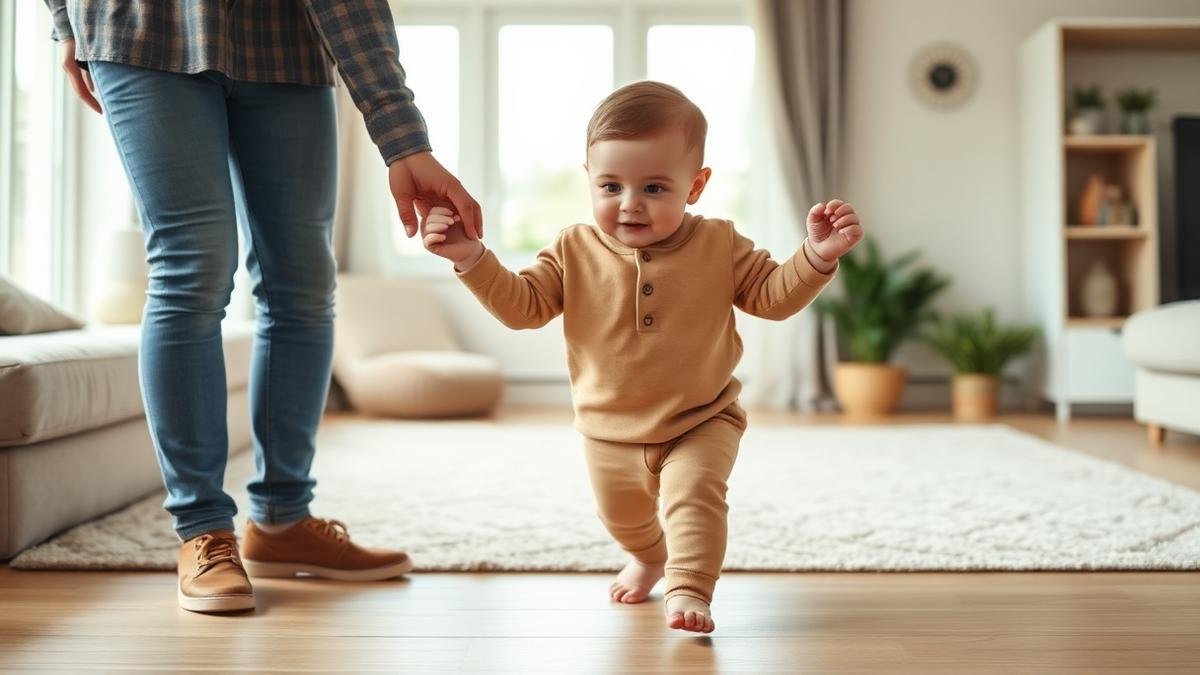
- Offer your hands: Let your baby hold your fingers while walking. Don’t hold their hands above their head — this puts pressure on their shoulders. Hold at their natural hand height.
- Kneel a few feet away: Sit on the floor and encourage your baby to walk toward you. Celebrate every step, even if it’s just one.
- Be patient: Never force walking. Your baby will walk when they’re ready. Pressure can create anxiety and slow progress.
Footwear: When and What
Barefoot is best for walking development. Being barefoot allows the foot muscles to develop naturally, helps with balance and proprioception (knowing where your body is in space), and lets the toes grip the floor. When you need shoes (outdoors, daycare), choose soft, flexible, wide-toe-box shoes. Avoid stiff-soled shoes, hard high-tops, and shoes that restrict foot movement. The best first walking shoe is essentially a soft slipper with a flexible rubber sole for grip.
What About Walking on Tiptoes?
Many toddlers walk on their toes when they first start walking. This is usually a normal phase that resolves within 2-3 months of walking independently. If toe-walking persists beyond 6 months of walking, or if it’s the only way your child walks (never putting heels down), mention it to your pediatrician. Persistent toe-walking can be caused by short Achilles tendons, sensory processing differences, or — rarely — neurological conditions. Most toe-walking resolves on its own or with simple stretching exercises.
Walking and Fall Prevention
As a result, falls are inevitable when learning to walk. Most are harmless — babies are short and flexible. However, prevent serious falls by: installing baby gates at the top and bottom of stairs, anchoring furniture to walls, using window guards on upper floors, removing area rugs (tripping hazard), padding sharp furniture corners, and never leaving your baby unattended on elevated surfaces. A baby who falls from standing height onto a carpeted floor is almost always fine — a little cuddle and they’re back at it.
When to Call Your Pediatrician
- Your baby is not pulling to stand by 12 months
- Your baby is not standing alone by 15 months
- Your baby is not walking by 18 months
- Your baby walks only on their toes after 3+ months of walking
- Your baby seems to drag one leg or foot when walking
- Your baby has very stiff or very floppy legs
- Your baby loses walking skills (regression)
- You notice a significant limp
Frequently Asked Questions
Are shoes necessary for early walkers?
Not indoors — bare feet are best for balance and foot development. Outdoors, choose soft, flexible shoes with wide toe boxes. Avoid hard-soled shoes until your child is walking confidently.
My baby was walking but stopped — should I worry?
Temporary regression is common during illness, teething, or developmental leaps. If the regression lasts more than a week or two, or if they lose other skills too, mention it to your pediatrician.
Do walkers help babies walk earlier?
In addition, no. Traditional seated baby walkers with wheels are dangerous and do not help babies learn to walk. They can actually delay walking by strengthening the wrong muscles. Stationary activity centers or push-walkers your baby stands behind are safer alternatives.
Is it bad if my baby’s feet turn in or out?
Most toddler intoeing (pigeon-toed) and out-toeing resolve on their own. Intoeting is very common and rarely needs treatment. Out-toeing is also usually normal. Mention it at your well-child visit for confirmation.
Balance and Coordination Development
Walking requires more than leg strength — it requires balance, coordination, and the integration of multiple sensory systems. The vestibular system (inner ear, responsible for balance), proprioception (awareness of body position), and vision all work together to keep your baby upright. This is why many babies look unsteady at first — their systems are still learning to work together.
Specifically, time on the floor, crawling, cruising, and practicing standing all help develop these systems. Activities like gentle rocking, swinging, and spinning (supervised) also support vestibular development. Good balance isn’t just about walking — it’s the foundation for running, jumping, climbing, and all future physical activity.
Shoes for Walking: A Detailed Guide
When your baby starts walking outdoors, choose shoes that are: lightweight and flexible (you should be able to bend the shoe easily in your hand), wide toebox (toes should be able to spread), breathable material (leather, mesh, or canvas), non-slip sole (thin rubber or suede for grip), secure closure (Velcro is best — keeps shoes on and allows for adjustable fit), and flat (no heel, arch support, or cushioning — babies need to feel the ground). Check fit every 2-3 months — baby feet grow fast. A properly fitted shoe should have about a thumb’s width of space at the toe.
The Bottom Line
Walking is a major milestone that babies achieve on their own timeline. Trust the process, celebrate the small steps, and don’t compare your baby’s progress to others. Before you know it, they’ll be running, and you’ll wonder how they ever stayed still.
What If My Baby Is Bow-Legged or Pigeon-Toed?
Additionally, many babies and toddlers are bow-legged (genu varum) when they start walking. This is normal — the slight bowing typically resolves by 18-24 months. Similarly, intoeing (pigeon-toed gait) is very common and usually resolves on its own by age 8 without treatment. Out-toeing (duck feet) is less common and also typically resolves. If you’re concerned about your child’s leg alignment or gait pattern, mention it at your well-child visit. Your pediatrician can distinguish between normal developmental variation and conditions that need referral to a pediatric orthopedist.
Celebrating the Walking Milestone
Take videos of those first wobbly steps — they’re magical and fleeting. Share the milestone with your pediatrician at your next checkup so they can document it in your baby’s chart. And then get ready: once walking is established, running, climbing, and jumping follow quickly. Your life is about to get much more active. Congratulations — your baby is officially a toddler on the move.
Your baby’s first steps are a moment to treasure. Whether they happen at 9 months or 18 months — whether they’re confident or tentative — each baby finds their own path to walking. Trust the process, celebrate every small step, and don’t compare your baby to others. Before you know it, they’ll be running, and you’ll be chasing after them. Enjoy every wobbly step along the way.
Physical Therapy for Walking Delays
However, if your baby is delayed in walking, your pediatrician may recommend physical therapy. Pediatric physical therapy is play-based — your baby won’t be doing “exercises” in the traditional sense. Instead, a PT will engage your baby in activities that build strength, balance, and coordination through play.
They might use toys to encourage standing, create obstacle courses for cruising, or use gentle hands-on guidance to help your baby feel the motion of walking. Parent coaching is a big part of PT — you’ll learn strategies to use at home during daily play. Most babies respond well and make rapid progress with consistent PT.
Celebrating Your Baby’s Unique Timeline
Every baby develops on their own timeline. Some walk at 9 months, others at 18 months. Both can be perfectly healthy. Your baby is not in a race, and there’s no award for walking early. Focus on creating a safe, encouraging environment and celebrating every small step forward — literally. The first steps are just the beginning of a lifetime of movement, exploration, and adventure. Enjoy the journey.
Walkers, Push Toys, and Other Mobility Aids
Moreover, not all baby mobility products are created equal. Stationary activity centers (where baby stands and plays without moving) are safe and fine for short periods. Push-walkers (wagons or activity walkers that baby pushes in front) can help with balance and confidence — choose a sturdy one with a wide base.
Avoid seated baby walkers with wheels — they are banned in Canada due to serious fall and injury risk, and the AAP strongly advises against them. Baby swings, jumpers, and bouncers don’t help with walking development and should be used in moderation. The best “walking aid” is a safe, open floor space, sturdy furniture for cruising, and your encouraging hands.
Walking is a journey, not a race. Trust your baby, trust the process, and celebrate every wobbly step. Before you know it, you’ll be chasing a toddler around the house, marveling at how fast they’ve grown.
Furthermore, whether your baby takes their first steps at 10 months or 18 months, the moment is magical. Don’t rush it, don’t force it, and don’t compare. Your baby will walk when they’re ready — and when they do, the world opens up in a whole new way. Enjoy every wobbly, wonderful step of the journey.
Trust the process, celebrate the small victories, and know that your baby is developing exactly as they should — in their own time, in their own way. The first steps are just the beginning of a lifetime of movement and exploration. Enjoy watching your little one discover the joy of walking.
The Joy of First Steps
Few moments in parenthood compare to watching your baby take their first independent steps. The look of concentration on their face, the wobble, the triumphant grin when they reach you — it is pure magic. Whether it happens at 9 months or 18 months, the moment is unforgettable. Take a video, call the grandparents, celebrate this milestone. And then get ready — because once they start walking, there is no stopping them.
For example, Read more: when do babies start crawling milestone
This content is for informational purposes only and does not substitute professional medical advice. Always consult your pediatrician with concerns about your baby’s development.
Clinical Pearl: What the Research Actually Says
One of the most valuable skills a parent can develop is the ability to evaluate health information critically. In the age of social media and parenting influencers, misinformation about child health spreads faster than evidence-based guidance. When you encounter a new parenting recommendation — whether about sleep, feeding, development, or safety — ask yourself three questions: Who is making this recommendation and what are their credentials? Is the recommendation supported by peer-reviewed research or is it based on anecdote and tradition?
As a result, does the recommendation align with guidance from major medical organizations like the American Academy of Pediatrics, the Centers for Disease Control and Prevention, or the World Health Organization? If a recommendation contradicts established medical guidance, it should be viewed with skepticism, regardless of how compelling the testimonial may be. When in doubt, bring what you have read or heard to your pediatrician. We are trained to help you separate evidence from anecdote and to make decisions that are right for your individual child.
Related: normal postpartum bleeding vs hemorrhage warning signs
When Do Babies Start Walking: quick pediatrician summary
Development runs on ranges, not deadlines, and the direction of travel matters more than any single date on a chart. Track what your child does across several weeks rather than any one day, and remember that skills should be added over time and not lost. Bring it up with your pediatrician if a skill disappears, if there is no response to sound or faces, if muscle tone seems very stiff or very floppy, or if your gut says something has changed — early evaluation is low-risk and high-value.
Common mistakes parents make
- Treating a single measurement or one bad day as a trend instead of watching the pattern over several days.
- Trying several remedies at once, so it becomes impossible to tell what helped.
- Waiting for a convenient time to call when a red flag is already present — feeding, breathing and alertness changes are always worth a same-day call.
- Following advice from an unsourced social post rather than your own pediatrician, who knows your child’s history and growth curve.
Related guides from our pediatric team
- When Do Babies Start Teething? Age, Symptoms & Order
- When Do Babies Start Crawling? The Complete Guide
- Babies sit: When Do Babies Sit Up? Ages, Stages, and How to Help
- Signs of Dehydration in Babies: Red-Flag Checklist for Parents
- More expert answers in Pediatrician’s Corner
References and further reading
- CDC Learn the Signs. Act Early. milestones
- AAP developmental surveillance guidance
- WHO early child development
Medical disclaimer
This article is for general education and is not a substitute for individual medical advice, diagnosis or treatment. Every child is different — talk to your own pediatrician about your baby, and seek urgent care for breathing difficulty, poor feeding, dehydration, unusual sleepiness, fever in an infant under 3 months, or any sudden change in your child’s condition.