International Travel With a Baby: Passport and Consent-Document Checklist
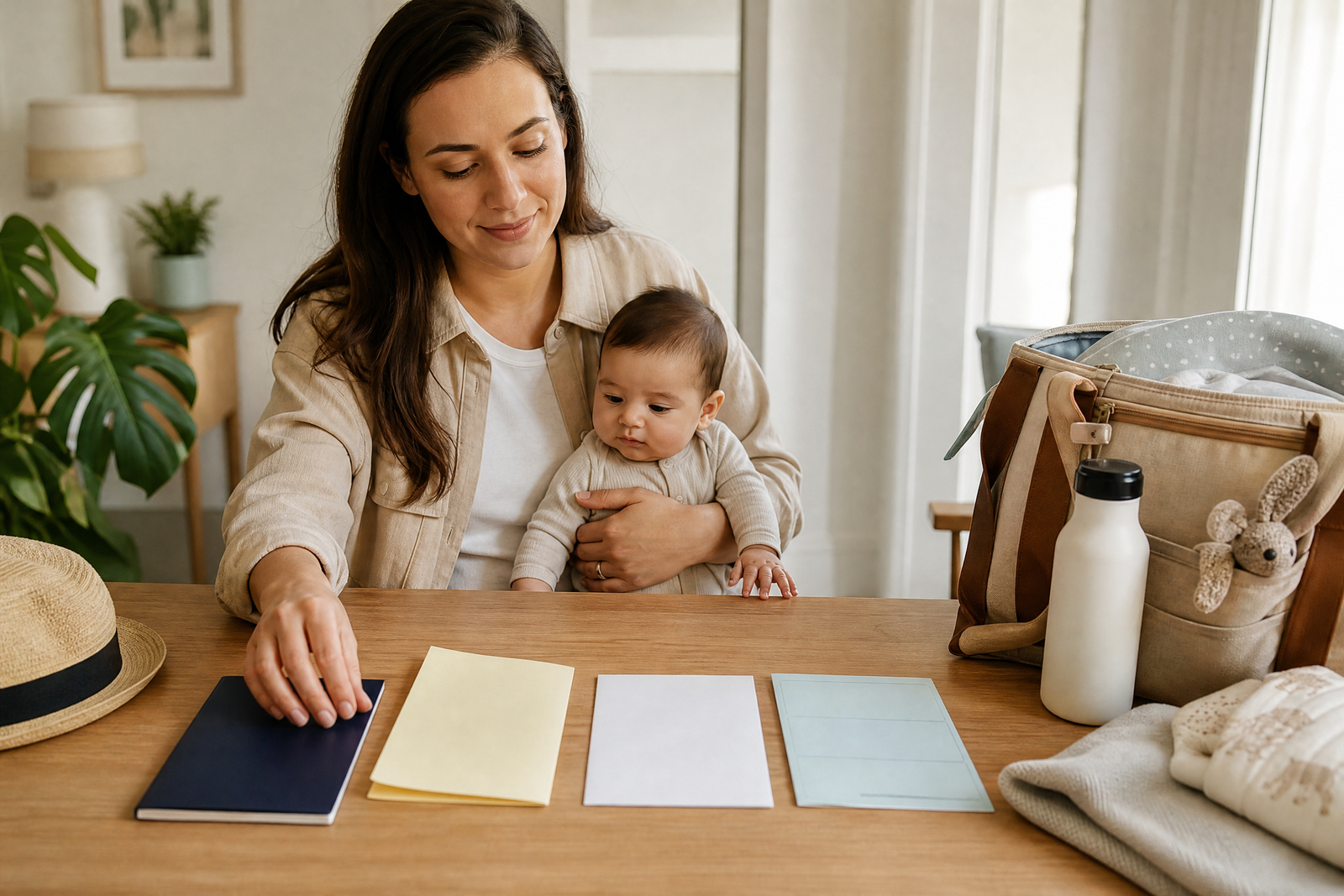
For international travel with a baby, start with the child’s passport, proof of the parent-child relationship, destination entry requirements, and any consent or custody documents that may apply. A baby does not become exempt from travel-document rules because of age. Requirements vary by citizenship, destination, transit country, airline, custody situation, and whether the child travels with one parent or another adult.[1] [2] [3]
For the full picture, read our pillar guide on Baby’s First Flight: A Pediatrician-Reviewed Checklist.
Short answer: Most U.S. citizen babies traveling internationally by air need their own passport book. Bring the baby’s original or certified relationship document, copies of key records, and a signed consent letter when the child travels with only one parent, a guardian, or another adult if the destination may require it. Check the destination country’s embassy, the U.S. State Department, the transit countries, and your airline before departure.[1] [2] [3]
This guide is designed for U.S.-based families planning international travel with a baby or young child. It explains the paperwork to investigate and organize. It is not legal advice, and it cannot determine which documents your family must carry for a specific destination or custody arrangement.
International baby travel documents checklist
Use this table as a planning starting point. The exact requirements are determined by the child’s citizenship, destination, route, and circumstances.
| Document or check | Why it may matter | What to do |
|---|---|---|
| Baby’s passport book | Identifies the child for most international air travel involving a U.S. citizen | Apply early and check that the name and date of birth are correct. |
| Birth certificate or relationship evidence | Helps show the legal relationship between the child and accompanying adult | Carry the original or a certified copy when appropriate, plus a protected copy. |
| Consent letter | Some destinations may request permission from a non-traveling parent or guardian | Check destination rules; consider a signed and notarized letter when applicable. |
| Custody, guardianship, adoption, or court order | Explains special family circumstances or authority to travel | Carry certified copies when relevant and seek destination-specific advice. |
| Visa, electronic authorization, or entry form | Some destinations require additional permission before arrival | Check the destination’s official immigration or embassy website. |
| Transit-country requirements | A connection can create another border or document issue | Review every country on the itinerary, not only the final destination. |
| Airline document rules | Airlines may check documents before boarding | Ask the operating carrier what it requires for infants and minors. |
| Copies and secure backups | Helpful if an original is lost or damaged | Keep copies separate from originals and use secure digital backups. |
The table is not a substitute for an official document check. Requirements can change, and a document that is accepted by one authority may not satisfy another.
Does a baby need a passport to travel internationally?
A baby needs travel identification just as an older child does. For a U.S. citizen traveling internationally by air, families should generally plan on obtaining a passport book for the child. The State Department explains that children under 16 have their own passport application process and that a child’s passport is valid for five years.[2]
Do not assume that a baby can be added to a parent’s passport or travel under a parent’s document. Do not assume that a birth certificate alone is enough for an international flight. Land and sea travel can have different rules, and non-U.S. citizens or dual nationals may have additional requirements.
Check the destination’s official entry rules before booking. Confirm whether the country requires a passport with remaining validity, a visa, an electronic travel authorization, proof of onward travel, vaccination documentation, or a specific form for minors. Avoid relying on a travel blog, an old social-media post, or a booking website’s summary when the government’s current instructions are available.
How to apply for a U.S. passport for a baby
A child under 16 must apply in person. The State Department says both parents or guardians generally appear with the child, or additional consent and supporting documents are needed when one or both cannot appear.[2]
Gather citizenship evidence
The State Department lists documents such as a U.S. birth certificate, a Consular Report of Birth Abroad, a Certificate of Citizenship, or a qualifying previous U.S. passport as evidence of citizenship.[2]
The document must be acceptable under the current application instructions. A phone photo or digital copy is not a replacement for the required physical evidence when the application requires the original or a certified document.
Gather relationship evidence
The passport agency must be able to verify the legal relationship between the child and the parent or guardian. A birth certificate may serve both as citizenship evidence and relationship evidence when it contains the required information. Other families may need an adoption decree, custody decree, court order, or another accepted document.[2]
If a parent’s current name differs from the name on the relationship document, bring the required name-change evidence. Resolve discrepancies before the appointment when possible.
Prepare parent or guardian identification
Parents or guardians applying for the child’s passport must provide physical photo identification and photocopies according to the current State Department instructions.[2]
Check the official application page for current form requirements, photo rules, fees, appointment procedures, and processing information. These details can change. Do not copy outdated forms or old fee figures from another website.
Plan for an in-person appointment
The child must attend the appointment. The acceptance facility may administer an oath and will tell the applying adult when to sign the application.[2]
Bring documents in an organized folder rather than a loose stack. Keep the child’s original records protected from spills, food, and damage. Ask the acceptance facility whether an appointment is required and what payment methods it accepts.
What if one parent cannot attend the passport appointment?
If one parent or guardian cannot appear with the child, the State Department may require additional documentation. In many situations, the non-applying parent completes a Statement of Consent, Form DS-3053, and provides a photocopy of the identification presented to the notary.[2]
The exact documents depend on the family’s circumstances. A sole-custody order, death certificate, adoption record, guardianship document, or other evidence may be required in different situations. If a parent cannot be located, special-family-circumstance documentation may be relevant.[2]
Do not treat a consent letter for travel as a substitute for the passport-application consent process. These are separate questions:
- Can the child receive a passport? The State Department decides the application requirements.
- Can the child cross a particular border? The destination or transit country may impose its own requirements.
- Can the child board the flight? The airline may apply its document-checking procedures.
If the family has a custody dispute, adoption or guardianship arrangement, a restraining order, or an international child-abduction concern, consult the appropriate government authority and a qualified attorney. Do not rely on a generic online form.
Does a baby need a travel consent letter?
There is no single worldwide rule that makes a consent letter mandatory for every child. The U.S. State Department says the United States does not require evidence of both parents’ permission for a minor to travel internationally, but some countries do.[1]
A destination may ask for a signed and notarized letter when a child travels with only one parent. Some countries may request written permission when a child travels with a guardian or another adult who is not a parent or legal guardian.[1] USAGov also recommends contacting the destination country’s embassy or consulate about consent letters and entry or exit requirements.[3]
A consent letter can help clarify the adults’ understanding even when a border official does not specifically require it. It is not a guarantee of entry and does not override a custody order or local law.
What should a consent letter include?
The destination’s requirements come first. As a practical starting point, a letter may identify:
- The child’s full legal name and date of birth.
- The traveling adult’s full legal name, relationship to the child, and passport details when requested.
- The non-traveling parent’s or guardian’s full legal name and contact information.
- The destination, travel dates, and whether the trip includes transit through another country.
- A clear statement that the child has permission to travel internationally with the named adult.
- Emergency contact information.
- The signature and notarization requested by the destination or transit authority.
USAGov gives sample wording that begins, “I acknowledge that my child is traveling outside the country with [the name of the adult] with my permission.”[3] Do not copy a sample blindly. Confirm the required language, language of the document, translation, notarization, and validity period with the destination’s embassy or consulate.
Carry the original letter if the destination requests it. Keep a copy separate from the original.
What documents should a parent traveling alone with a baby carry?
A parent traveling alone should prepare more than a passport. The State Department recommends bringing evidence of the legal relationship to each child.[1] A practical folder may include:
- The baby’s passport book.
- A birth certificate or other relationship evidence.
- A consent letter from the non-traveling parent when the destination or circumstances make it appropriate.
- A certified custody, guardianship, adoption, or court document when relevant.
- A copy of the traveling parent’s identification and the other parent’s identification when requested.
- Visa, electronic authorization, and destination entry documents.
- Contact details for the destination’s embassy or consulate.
- A copy of the itinerary and accommodation details.
Do not carry custody documents in an unprotected diaper bag pocket. Place originals in a waterproof document holder inside the adult’s personal carry-on. Keep a second paper copy in another adult’s bag when possible.
What if the baby has dual nationality?
A baby may have dual nationality if one parent is a citizen of another country or if the child qualifies for another nationality through birth or family connection. The State Department advises families to contact the other country’s embassy or consulate about passport requirements and entry and exit laws for dual nationals.[1]
Do not assume that holding a U.S. passport eliminates the other country’s rules. Some countries may expect their citizens to enter or leave using that country’s passport. The State Department states that U.S. citizens must enter the United States using a U.S. passport.[1]
Related reading: Can You Bring Car Seat on Airplane Without Extra Seat (FAA).
Ask the relevant embassies which document to present at departure, arrival, transit, and return. Keep the answer in writing when possible, because airport staff may need to interpret multiple documents.
How to check destination and transit requirements
Start with the destination country’s official embassy, consulate, immigration, or foreign-affairs website. The State Department’s travel-with-minors page specifically advises families to research destination-specific entry and exit requirements because laws vary.[1]
Then check the following questions:
| Check | Example question |
|---|---|
| Child’s citizenship | Does the baby need a visa, electronic authorization, or special registration? |
| Passport validity | How much remaining validity does the destination require? |
| Blank pages or passport type | Does the destination require a passport book rather than a card? |
| Transit route | Will the family pass through immigration in a connection country? |
| Consent documentation | Is a notarized letter, translation, or custody proof requested? |
| Airline rules | Does the operating airline require an infant document check before boarding? |
| Entry and exit | Are there special rules for minors leaving the destination? |
| Health documents | Does the destination require vaccination or health documentation? |
The travel route is more than the first flight and final arrival. A transit country can have its own rules, even when the family does not plan to leave the airport. Ask the airline or official authorities if the connection is unclear.
How to protect baby travel documents
Passports and birth certificates are difficult to replace during a trip. Use a document system that protects the originals and allows you to access backup information without exposing it publicly.
Keep originals in a waterproof, zippered document holder inside the adult’s carry-on. Do not place them in checked luggage. Carry paper copies separately from the originals. Use secure, encrypted digital storage for scans, and avoid sending sensitive documents through unsecured public messaging or email.
Before departure, confirm that the name, date of birth, passport number, and document expiration details match across the itinerary and applications. A small spelling difference can create a delay. Do not laminate documents unless the issuing authority permits it.
If a passport is lost or stolen abroad, contact the nearest U.S. embassy or consulate for instructions. Keep an emergency contact list that includes the embassy or consulate, airline, travel insurer, pediatrician, and a trusted person at home.
Common international baby-document mistakes
Waiting until the trip is booked to apply
Passport applications, corrections, renewals, and supporting documents take time. Current processing periods can change, and mailing time may be additional. Check the State Department’s live passport page before booking nonrefundable travel.[2]
Assuming a baby travels on a parent’s passport
Plan on a separate document for the child unless the official destination and carrier rules clearly state otherwise. For most international air travel involving a U.S. citizen baby, a passport book is the practical starting point.
Treating a consent letter as universal
A consent letter may be requested by some countries and not others. It should reflect the destination, route, adults, and custody facts. It does not replace a passport or override a court order.[1] [3]
Checking only the destination country
Review every transit country and the airline’s document process. A connection can introduce another border or document requirement.
Using outdated forms or fees
Passport forms, fees, appointment processes, and processing times can change. Use the current State Department page rather than a saved form from a previous trip.[2]
Carrying only digital copies
A phone image can help with reference, but it may not replace an original or certified document. Carry the physical documents required by the issuing and border authorities.
When to get professional help
Seek destination-specific assistance if your situation involves sole custody, shared custody, guardianship, adoption, a name mismatch, dual nationality, a missing parent, a court order, or a previous international travel dispute. The State Department and destination embassy can explain official processes. A qualified attorney can advise on legal rights and custody documents.
See also: Can You Bring Breast Milk Through TSA? A Practical Packing Guide.
This article cannot decide whether your consent letter is valid, whether your custody order permits international travel, or whether a destination will admit your child. Ask the relevant official authority before the trip, and keep written confirmation when possible.
Frequently asked questions
Does a newborn need a passport to fly internationally?
A newborn or baby needs the travel documents required for the child’s citizenship, destination, route, and airline. For most international air travel involving a U.S. citizen child, plan on a separate passport book and confirm the destination’s rules before departure.[1] [2]
Can I travel internationally with my baby without the other parent?
You may be able to travel, but the requirements vary. The United States does not require evidence of both parents’ permission for every minor traveling internationally, while some countries may require a signed and notarized letter or proof of sole custody.[1]
Does a child travel consent letter need to be notarized?
Some countries may require notarization, and USAGov says a consent letter is preferably in English and notarized. Confirm the exact format with the destination’s embassy or consulate.[3]
Is a birth certificate enough for a baby to travel internationally?
Do not assume it is. A birth certificate may help prove the relationship between the child and parent, but passport, visa, entry, exit, transit, and airline requirements are separate questions. Check the official rules for the itinerary.[1] [2]
How long is a child’s U.S. passport valid?
The State Department says passports for children under age 16 are valid for five years.[2] The destination may still require additional remaining validity, so verify the entry rules before travel.
What if my baby has a different last name from me?
Carry the baby’s passport and relationship evidence, such as a birth certificate, plus any name-change, custody, adoption, or guardianship documents that explain the difference. Check with the destination and airline if you are unsure.
What if my baby has dual nationality?
Contact the other country’s embassy or consulate about passport, entry, and exit rules. The State Department says U.S. citizens must enter the United States using a U.S. passport.[1]
Should I carry original documents or copies?
Carry the originals or certified documents required by the authority, protected in your carry-on. Also bring paper copies and secure digital backups. Copies do not automatically replace originals.
The bottom line
Start international baby travel planning with the child’s own passport, relationship evidence, destination and transit checks, and any consent or custody documents that may apply. Requirements vary, so verify them with official government sources and the operating airline before departure. Organize originals, copies, and secure backups well before travel day.
For broader flight preparation, see ChildBloom’s first-flight checklist. You can also browse the ChildBloom Travel category for related pediatric travel guides.
Author and medical review
Written by: ChildBloom Editorial Team
Medically reviewed by: Dr. Ahmad Raza, MD (Pediatrics)
Medical review date: August 26, 2026
This article provides general travel-document education and is not legal advice. It does not replace instructions from the U.S. Department of State, the destination country’s embassy or consulate, an airline, or a qualified attorney.
- U.S. Department of State: Travel with Minors
- U.S. Department of State: Apply for a Child’s Passport Under 16
- USA.gov: International Travel Documents for Children
Related ChildBloom Guides
- Baby Ear Pressure on a Plane
- How Soon Can a Newborn Fly After Birth (Pediatrician)
- How Often to Stop on a Road Trip With a Baby
- Minimal Baby Travel Gear Checklist for Flying
- Baby Sleep in a Hotel Room
- Browse all Travel guides
References & Medical Sources
- AAP / HealthyChildren: flying with baby
- FAA child air travel / car seats
- TSA traveling with children
- CDC travelers’ health
Reviewed by the ChildBloom pediatric panel. Meet our physicians on the About page. This article is educational and does not replace your child’s clinician.