Baby Ear Pressure on a Plane: Feeding, Pacifiers, and When to Ask a Doctor
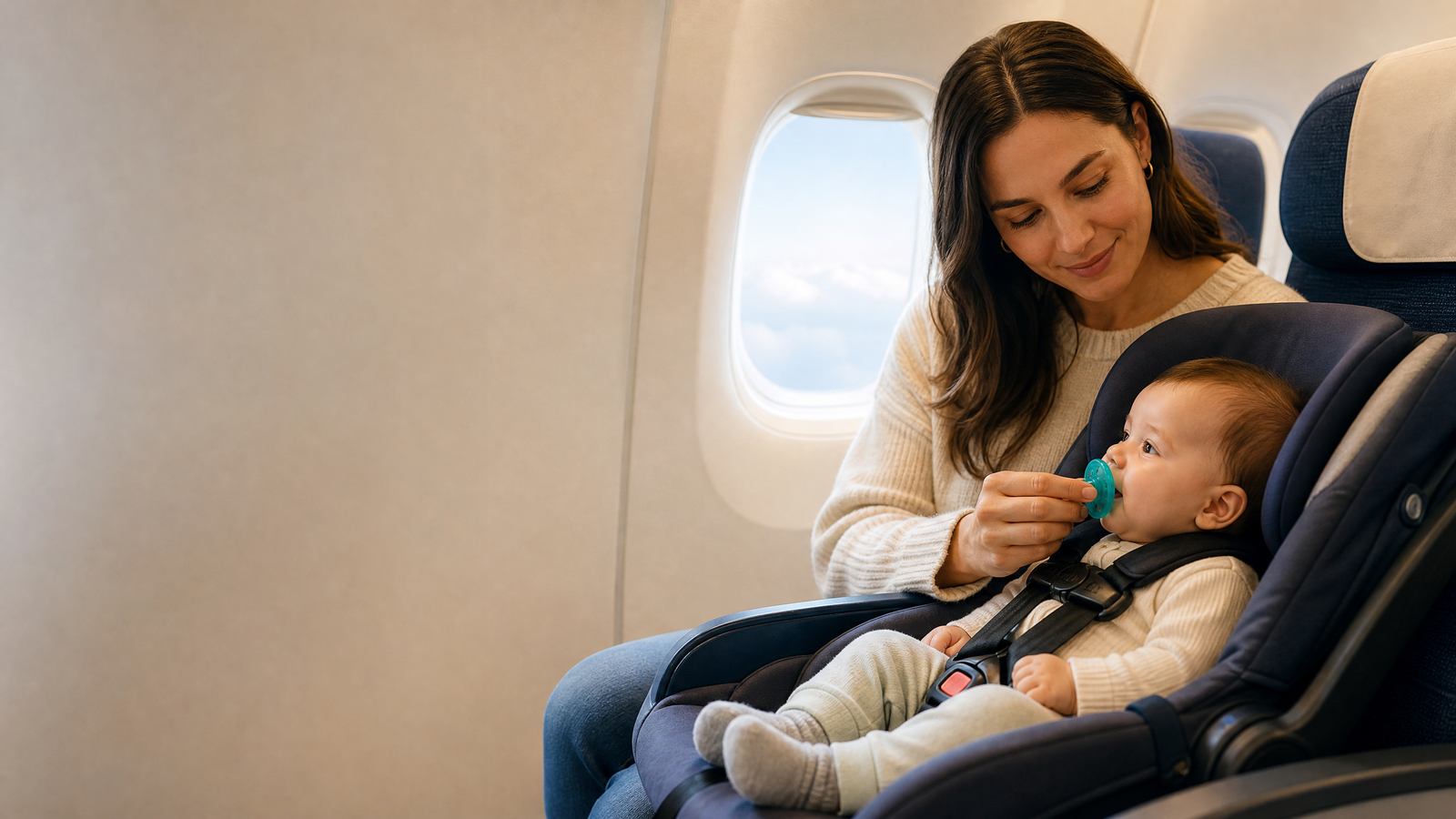
Baby ear pressure on a plane is most common during descent and landing. The safest first steps are simple: offer breastfeeding, a bottle, or a pacifier when your baby is awake and willing. Swallowing can help the middle ear adjust to changing cabin pressure. Do not force a feed, and do not give a decongestant or sedating medicine just to prevent airplane ear. If your baby recently had an ear infection, ear surgery, or has significant congestion, ask the clinician before the trip. [1] [2]
For the full picture, read our pillar guide on Baby’s First Flight: A Pediatrician-Reviewed Checklist.
Reviewed by Dr. Ahmad Raza, MD, Pediatrics
Medical review completed August 2026. This article is educational and does not replace advice from your child’s own pediatrician.
A baby may cry during the last part of a flight for many reasons. Pressure discomfort is one possibility, but hunger, a wet diaper, tiredness, temperature, and overstimulation can look similar. Therefore, use a calm checklist instead of assuming that every cry means an ear problem.
This guide is for families traveling from the United States with infants and young children. It explains common pressure discomfort and practical comfort measures. It does not diagnose an ear infection or decide whether a specific child is fit to fly.
Quick answer: what helps baby ear pressure on a plane?
| Situation | What parents can try | Important boundary |
|---|---|---|
| Takeoff or descent | Offer nursing, a bottle, or a pacifier if your baby is awake and willing | Never force a feed or put a distressed baby in an unsafe position |
| Bottle-feeding | Keep your baby upright and use the normal feeding method | Do not dilute formula or create a new feeding plan for the flight |
| Baby refuses to suck | Comfort, hold, check the diaper, and try again later if appropriate | A baby does not have to use a pacifier for the flight to be safe |
| Cold or congestion | Ask the clinician whether travel timing should change | Do not start a decongestant solely for airplane ear prevention |
| Recent ear infection or ear surgery | Contact the child’s clinician before flying | The answer depends on the child’s symptoms and procedure |
| Pain after landing | Observe and comfort if symptoms are mild and improving | Severe or persistent pain needs medical advice |
Why do babies feel pressure in their ears during a flight?
Behind the eardrum is a small air-filled space called the middle ear. A passage called the Eustachian tube connects that space to the back of the nose and throat. When the tube opens, air can move and pressure can equalize on both sides of the eardrum. [2] [3]
Cabin pressure changes as the airplane climbs and descends. During descent, cabin pressure rises. If the middle-ear pressure does not adjust quickly, the eardrum can stretch and feel full or painful. This is commonly called airplane ear or ear barotrauma. [2] [4]
Babies and young children may have more trouble with this process because their Eustachian tubes are narrower. They also cannot intentionally yawn, swallow on command, or perform pressure exercises. As a result, a baby may show discomfort through crying, pulling away from the breast or bottle, or becoming difficult to settle.
Usually, the discomfort is temporary. As the tube opens and the pressure balances, the feeling should ease. Still, a cold, a stuffy nose, or an ear infection can make pressure equalization harder. [2] [3]
When is airplane ear most likely?
Pressure discomfort can occur during both ascent and descent. However, parents often notice it during descent and the final part of landing. That is when cabin pressure rises quickly and the baby may need to swallow more often.
The timing of the flight can help you plan, but it cannot guarantee a quiet landing. Delays can change feeding times. A baby who usually takes a bottle at a certain hour may be hungry earlier or later after airport screening. Therefore, pack enough supplies for the whole travel period and a reasonable delay.
You do not need to keep a baby awake for the entire flight. However, if your baby sleeps through descent, they may swallow less often. If the child wakes and seems uncomfortable, offer normal comfort measures. Never wake a baby or force a feed solely because a flight is descending unless your pediatrician has given specific instructions.
Can breastfeeding help a baby’s ears on a plane?
Yes. Breastfeeding encourages sucking and swallowing. Those actions may help open the Eustachian tubes and ease pressure discomfort. The American Academy of Pediatrics specifically lists nursing as one option during takeoff and landing. [1]
Offer the breast when your baby is awake and showing interest. You do not need to make the baby nurse for a fixed amount of time. Follow your normal responsive-feeding pattern. If the baby turns away, pauses, or becomes upset, stop and try another comfort measure.
A nursing parent may prefer to feed before boarding, during descent, or at another time that fits the baby’s routine. There is no single perfect minute. The practical goal is to have feeding available when pressure changes occur, not to force a schedule.
During turbulence, follow the crew’s safety instructions. Keep yourself and the baby secured as required. If you need help, ask a flight attendant before the aircraft begins a safety-critical phase.
Can a bottle help with baby ear pressure?
A bottle can also encourage swallowing. Offer breast milk or formula in the way your baby normally takes it. If you bottle-feed, keep the baby upright or well supported rather than feeding flat. This position is also more practical for watching the baby’s breathing and cues. [1] [3]
Bring the supplies you already use. Depending on your routine, that may include prepared formula, ready-to-feed formula, breast milk, bottles, nipples, and a burp cloth. Follow the product’s preparation and storage instructions. Do not dilute formula to make it last longer, and do not introduce a new bottle or nipple on the flight if you can avoid it.
TSA allows breast milk, formula, baby food, and cooling packs in reasonable quantities above the usual 3.4-ounce liquid limit. Tell the officer about these items at the beginning of screening. Keep them together in an easy-to-open pouch so the process is less disruptive. [5]
If your baby refuses the bottle during descent, do not push it into the mouth. A forced feed can increase distress and may create a choking risk. Pause, hold the baby safely, check for other needs, and try again only if the baby wants to feed.
Does a pacifier help a baby’s ears on a plane?
A pacifier may help because sucking can encourage swallowing. The AAP includes pacifier use among the comfort options for takeoff and landing. [1] However, a pacifier is not required, and it does not guarantee that a baby will avoid discomfort.
Offer the pacifier if your baby already uses one. Bring a clean backup if possible. If your baby refuses it, do not force it into the mouth or keep replacing it during a crying spell. Instead, try holding, nursing, a bottle, skin-to-skin comfort when practical, or a quiet break from stimulation.
A pacifier should not be attached with a long cord, ribbon, or strap that could create a safety hazard. Also, do not add loose items to an airplane bassinet or other sleep space. Follow the airline’s instructions for bassinets, restraints, and turbulence.
Should a baby be awake for takeoff and landing?
There is no universal rule that every baby must be awake. Some parent-facing guidance notes that sleeping children swallow less often, which may make pressure equalization less frequent. [3] At the same time, waking a sleeping baby can create a tired, upset child without guaranteeing that pressure discomfort will be prevented.
Use a flexible plan. If your baby is awake, offer a breast, bottle, or pacifier during descent. If your baby is asleep and breathing comfortably, follow the airline’s safety instructions and monitor the child. If the baby wakes and cries, check the usual needs first. Then offer feeding or sucking if the child is willing.
Safety comes before pressure comfort. A baby must be secured or held as required during taxi, takeoff, landing, and turbulence. Do not keep a baby loose in your arms when the crew instructs passengers to secure themselves. For restraint planning, see ChildBloom’s guide to using a car seat on an airplane.
What if my baby cries during descent?
Crying during descent can be frightening, but it does not automatically mean that the baby has an ear infection or a serious injury. Start with a short, repeatable check:
- Check the feeding cue. Offer nursing, a bottle, or a pacifier if the baby is awake and willing.
- Check the position. Keep the baby supported and comfortable. For bottle-feeding, keep the baby upright.
- Check the diaper and temperature. A wet diaper or overheating can intensify crying.
- Reduce stimulation. Lower your voice, dim a screen, and hold the baby safely.
- Watch the pattern. Note whether the distress eases after landing or continues for hours.
Do not shake, bounce forcefully, or use medicine to make a baby sleep. Do not put an unapproved object in the baby’s mouth. Also, do not assume that another passenger’s suggestion is medically appropriate for your child.
Related reading: International Travel With a Baby.
Your baby may still cry even when you do everything correctly. That is not a parenting failure. Comfort the child, ask the crew for practical help, and focus on safe care rather than on keeping every passenger happy.
Does a cold make airplane ear worse?
A cold can cause nasal congestion and mucus. Swollen tissues can make it harder for the Eustachian tube to open. For that reason, a congested baby may experience more pressure discomfort during a flight. [2] [3]
A mild runny nose does not automatically mean that a baby cannot fly. The right choice depends on age, symptoms, medical history, destination, and the clinician’s advice. Ask before travel if the baby has significant congestion, breathing symptoms, fever, poor feeding, repeated vomiting, or a change in usual wet diapers.
Do not use an over-the-counter decongestant as a routine airplane-ear prevention strategy for an infant. The CDC Yellow Book states that antihistamines and decongestants have not been shown to help routine airplane ear. It also notes that the AAP recommends against decongestants for any reason in children younger than 4 years. [2]
Do not give diphenhydramine, such as Benadryl, to sedate a baby for a flight unless the child’s clinician has specifically advised it. Sedation can cause serious side effects, and some children become more alert instead of sleepy. [1]
What if my baby recently had an ear infection?
Ask the clinician before flying if your baby recently had an ear infection. An infection can cause inflammation or fluid behind the eardrum. Pressure changes may then be more uncomfortable. The clinician can consider the child’s age, symptoms, examination findings, treatment, and timing.
Do not use the flight as a way to test whether an ear infection has resolved. If the baby still has fever, significant pain, drainage, poor feeding, unusual sleepiness, or other concerning symptoms, arrange medical advice before departure.
Recent ear surgery also requires a clinician’s plan. HealthyChildren.org advises asking the doctor about flying after ear surgery or an ear infection. [1] Families should follow the advice of the clinician who knows the child’s procedure and recovery.
Children with chronic heart or lung conditions or sickle cell disease may need additional pre-travel planning. The CDC recommends professional guidance for these conditions. [2]
What should parents do after landing?
Most mild pressure discomfort improves as the ears equalize. Offer normal comfort. Continue the baby’s usual feeding routine. Avoid repeated attempts to make the ears “pop.” Infants cannot perform the same deliberate pressure maneuvers as older children and adults.
Observe the baby over the next several hours. Note whether the child returns to normal feeding, sleep, interaction, and wet-diaper patterns. A brief cry during landing that resolves is different from severe pain that continues after the flight.
If symptoms are severe or do not improve with simple care, contact a healthcare professional. Mayo Clinic advises medical evaluation for severe pain or airplane-ear symptoms that do not improve with self-care. [4] For an infant, call sooner if you are worried or cannot tell whether the child is in pain.
When to ask your pediatrician before flying
Contact your child’s clinician before the flight if any of the following apply:
See also: Can You Bring Car Seat on Airplane Without Extra Seat (FAA).
- The baby recently had an ear infection, ear surgery, or ear-tube procedure.
- The baby has significant congestion, breathing symptoms, or a fever.
- The baby has a chronic heart or lung condition, sickle cell disease, or another complex medical condition.
- The baby is feeding poorly, vomiting repeatedly, or making fewer wet diapers.
- You are unsure whether the baby’s current medicine is safe during travel.
- You want advice about an upcoming flight after a recent illness.
A pre-travel question can be simple: “My baby recently had these symptoms. Is there anything we should change before flying, and what signs should make us seek care?” Bring the medicine list and the date of the planned flight.
When to seek urgent care
Seek urgent medical help for trouble breathing, blue or gray color, unresponsiveness, a seizure, severe dehydration, uncontrolled bleeding, or another emergency symptom. These signs require urgent attention whether or not a flight is involved.
For ear-related symptoms, seek prompt medical advice for severe or worsening pain, blood or fluid from the ear, new hearing concerns, marked dizziness, or symptoms that do not improve. Do not wait for another flight to see whether a serious symptom disappears.
Baby ear-pressure flight checklist
Before leaving home
- Check whether the baby has a current illness, significant congestion, recent ear infection, or recent ear surgery.
- Ask the clinician about any condition or medicine that could affect the trip.
- Pack the feeding supplies the baby already uses.
- Bring a clean pacifier and a backup if the baby uses one.
- Save the airline’s current rules for infant seating, bassinets, and car seats.
- Keep milk, formula, medicine, diapers, and a change of clothes in the carry-on.
During takeoff and descent
- Keep the baby safely supported or secured as required.
- Offer nursing, a bottle, or a pacifier if the baby is awake and willing.
- Keep bottle-feeding upright.
- Pause if the baby refuses or becomes more upset.
- Check other needs, including hunger, diapering, temperature, and overstimulation.
- Ask the crew for help if you need a bag, water, or assistance.
After landing
- Return to the normal feeding and comfort routine.
- Observe whether pressure discomfort improves.
- Call the clinician for severe or persistent symptoms.
- Seek urgent care for emergency signs.
FAQ
Is baby ear pressure on a plane dangerous?
Usually, pressure discomfort is temporary. However, severe or persistent pain, ear drainage, bleeding, hearing concerns, or marked dizziness needs medical advice. A clinician should assess a baby who recently had an ear infection or ear surgery before flying.
Should I feed my baby during takeoff or landing?
You may offer nursing, a bottle, or a pacifier when your baby is awake and willing. Swallowing may help the middle-ear pressure adjust. Do not force a feed or delay normal feeding only to match the flight schedule. [1] [2]
Can a pacifier stop airplane ear?
A pacifier may encourage sucking and swallowing, so it may ease discomfort for some babies. It cannot guarantee that a baby will have no pain. Offer it if the baby already uses one, but do not force it.
Should I give my baby Benadryl or a decongestant before flying?
Do not use medicine to sedate a baby for a flight without specific clinician advice. Routine antihistamines and decongestants have not been shown to help airplane ear, and decongestants are not recommended for young children as a routine measure. [1] [2]
Can a baby fly with a cold?
A mild cold does not automatically answer the question. Congestion can make pressure equalization harder. Ask the clinician before travel if the baby has significant congestion, fever, breathing trouble, poor feeding, or a recent ear infection.
How long should baby ear pain last after a flight?
Mild discomfort often improves as pressure equalizes. If pain is severe, continues for hours, worsens, or comes with drainage, bleeding, dizziness, hearing changes, or other concerning symptoms, contact a healthcare professional. [4]
The bottom line
Baby ear pressure on a plane is most likely to bother a child during descent and landing. Offer breastfeeding, a bottle, or a pacifier when the baby is awake and willing. Keep bottle-feeding upright, follow normal feeding practices, and never force a feed. Avoid routine decongestants and sedating medicines. Ask the pediatrician before flying after an ear infection, ear surgery, significant congestion, or a serious medical condition. If pain is severe or persistent, seek medical advice.
A calm plan helps, but it cannot prevent every cry. Safe positioning, responsive care, and knowing when to ask for help matter more than achieving a perfect flight.
Author and medical-review note
Editorial status: Prepared for publication on ChildBloom. Medical reviewer: Dr. Ahmad Raza, MD, Pediatrics. Medical review status: Reviewed and approved by Dr. Ahmad Raza. Review date: August 2026. This article is educational and does not replace advice from your child’s own pediatrician.
- American Academy of Pediatrics / HealthyChildren.org: Flying With Baby
- CDC Yellow Book: Traveling Safely with Infants and Children
- Nemours KidsHealth: Flying and Your Child’s Ears
- Mayo Clinic: Airplane Ear — Diagnosis and Treatment
- Transportation Security Administration: Traveling with Children
Related ChildBloom Guides
- Can You Bring Breast Milk Through TSA? A Practical Packing Guide
- How Soon Can a Newborn Fly After Birth (Pediatrician)
- How Often to Stop on a Road Trip With a Baby
- Minimal Baby Travel Gear Checklist for Flying
- Baby Sleep in a Hotel Room
- Browse all Travel guides
References & Medical Sources
- AAP / HealthyChildren: flying with baby
- FAA child air travel / car seats
- TSA traveling with children
- CDC travelers’ health
Reviewed by the ChildBloom pediatric panel. Meet our physicians on the About page. This article is educational and does not replace your child’s clinician.





One Comment