Baby Wakes After One Sleep Cycle: Why and What to Try
Baby wakes after 45 minutes: the quick answer
When a baby wakes after 45 minutes, it usually means they finished one sleep cycle and could not link to the next. The baby wakes after 45 minutes because a sleep association—like being fed or rocked fully to sleep—is missing at the cycle break. Put them down drowsy but awake, fix wake windows, and wait a few minutes before going in.
For the full picture, read our pillar guide on Evidence-Based Baby Sleep Solutions.
Why baby wakes after 45 minutes happens — the sleep science
Baby sleep is built from cycles that are much shorter than adult sleep. In the first months of life, a single cycle lasts about 30 to 45 minutes. At the end of each cycle, the brain briefly surfaces toward light sleep. Adults move through this shift without waking. Babies often do not, especially if they learned that falling asleep requires a specific outside help.
This outside help is called a sleep association. Common ones include feeding until asleep, rocking, bouncing, patting, or holding. None of these are wrong—they are loving and normal. The problem appears only at the cycle break. If your baby fell asleep at the breast or bottle, then at 45 minutes, when the cycle ends, they open their eyes and look for the same help to go back down. When it is not there, they cry and the nap ends.
The same mechanism explains the classic 30-minute nap. A younger baby may surface at 30 minutes; an older baby may stretch to 45. Either way, the root cause is the same: the baby has not yet learned to connect cycles on their own.
It helps to know that this is not a sign of a medical problem. It is a skill-building stage. Just as a baby learns to roll, sit, and crawl, they also learn to link sleep cycles. Your job is to give them calm, repeated chances to practice.
How baby sleep cycles work
A sleep cycle has two main parts: light sleep and deep sleep, plus a brief REM (dreaming) stage. In babies, light sleep makes up a bigger share of the cycle than it does in adults. That means babies spend more time near the surface, where waking is easy.
At the end of a cycle, there is a natural “arousal.” The baby’s body may twitch, their eyes may flutter, and they may make small sounds. If everything around them feels the same as when they fell asleep, they usually roll right into the next cycle. If the setting has changed—for example, they were in your arms and now they are in a crib—the change can fully wake them.
Baby wakes after 45 minutes is why the single most useful habit is putting your baby down in the same place and same state they will be in at the cycle break. If they fall asleep in your arms every night, the crib at 2 a.m. feels wrong. If they fall asleep in the crib, the crib at the 45-minute mark feels normal.
A step-by-step plan to extend naps
Use this plan one step at a time, and give each change about five to seven days before judging it.
- Watch the wake window. A wake window is the time your baby is awake between sleep periods. Too short and they are not tired enough; too long and they are overtired. Both lead to short naps. For most babies 3 to 5 months, aim for 1.5 to 2.5 hours. For 6 to 12 months, aim for 2.5 to 3.5 hours before naps.
- Put down drowsy but awake. This is the hardest and most important step. Lay your baby in the crib when they are sleepy but still awake. They then practice the exact skill they need at the 45-minute mark: falling asleep in the crib, on their own.
- Build a short, identical pre-nap routine. Same order every time: dim the lights, close the curtains, a quick song or book, then into the sleep sack and crib. The routine is a signal that sleep is coming.
- Wait before going in. When you hear stirring at the 40-to-50-minute point, pause. Give your baby five to ten minutes. Many babies resettle on their own once they learn the skill. Rushing in can interrupt the very practice they need.
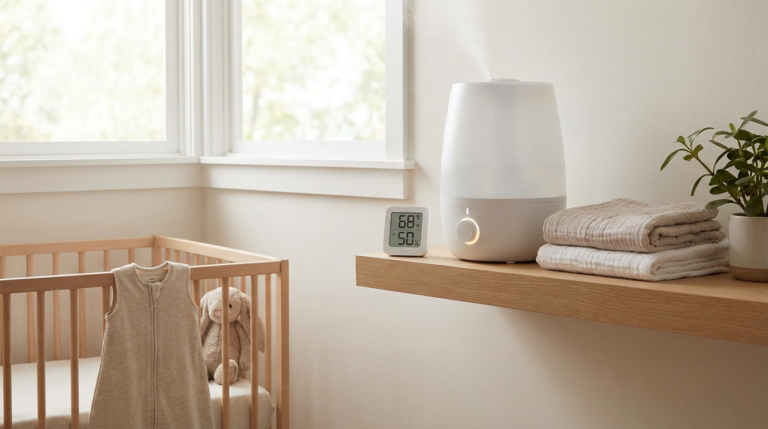
- Keep the room sleep-friendly. Darkness, a cool temperature, and steady white noise reduce the chance that small noises or light wakes them fully.
- Offer one contact nap if needed. If night sleep or mood suffers while you build the skill, do one contact or stroller nap a day to protect total sleep. This is a bridge, not a failure.
- Stay consistent. The babies who learn fastest are the ones whose parents repeat the same approach night after night. Mixed messages slow the process.
Age-specific guidance
Babies 3 to 5 months
At this age, cycles are short and the brain is still maturing. Do not expect long independent naps yet. Your main goals are protecting total sleep and introducing the drowsy-but-awake habit gently. A contact nap, stroller nap, or car nap is fine to fill the gap. Many babies this age take three or four short naps.
Babies 6 to 8 months
Baby wakes after 45 minutes is the prime window for teaching cycle-linking. Wake windows are longer, and most babies are developmentally ready. Push the drowsy-but-awake habit, keep a tight routine, and try the “wait five to ten minutes” rule. Many babies start stretching naps to 60 to 90 minutes during this stage.
Babies 9 to 12 months
By now, most babies are on two naps and can link cycles well. If your baby still wakes at 45 minutes, look at timing first: is the wake window too short? Is the room bright? Is a new skill like pulling to stand disrupting sleep? Stay consistent and the naps usually consolidate.
Sample schedules
The table below shows common, flexible schedules. Every baby is different; use these as a starting map, not a rule.
| Age | Wake time | Nap 1 | Nap 2 | Nap 3 | Bedtime | Total day sleep |
|---|---|---|---|---|---|---|
| —– | ———– | ——- | ——- | ——- | ——— | —————– |
| 4 months | 7:00 a.m. | 9:00–10:30 | 12:30–2:00 | 4:00–4:45 | 7:30 p.m. | 3.5–4 hrs |
| 6 months | 6:30 a.m. | 9:00–10:30 | 1:00–2:30 | 4:30–5:00 (short) | 7:30 p.m. | 3–3.5 hrs |
| 9 months | 7:00 a.m. | 10:00–11:15 | 2:30–3:45 | dropped | 8:00 p.m. | 2.5–3 hrs |
| 12 months | 7:00 a.m. | 12:00–2:00 (one nap) | — | — | 7:30 p.m. | 2–2.5 hrs |
A nap troubleshooting checklist
Use this checklist when naps keep ending at 45 minutes:
- [ ] Is the room dark enough? Try blackout curtains.
- [ ] Is white noise steady and not too loud?
- [ ] Was the baby put down drowsy but awake, not fully asleep?
- [ ] Is the wake window in the right range for the age?
- [ ] Is the last nap of the day too late, causing a late bedtime?
- [ ] Are feeds and growth on track (no signs of poor weight gain)?
- [ ] Has the same approach been tried for at least five to seven days?
Safety reminders
Safe sleep rules do not change while you work on naps. The American Academy of Pediatrics recommends:
- Always place your baby on their back to sleep, for every sleep, nap and night.
- Use a firm, flat sleep surface with a fitted sheet only.
- Keep the crib free of bumpers, loose blankets, pillows, stuffed toys, and positioners.
- Do not use sleep positioners or inclined products for sleep.
- Avoid bed-sharing, especially on soft surfaces like couches or adult mattresses with soft bedding.
- Room-sharing without bed-sharing is recommended for at least the first six months.
A lounger, swing, or car seat is not a substitute for a crib or bassinet for routine sleep. If your baby falls asleep in a carrier or car seat, move them to a flat firm surface once you can.
When to Call Your Pediatrician
Most 45-minute waking is a normal skill stage and not a health problem. Contact your pediatrician if you notice:
- Poor weight gain or a drop in the number of wet diapers.
- A fever, especially in a baby under three months.
- Breathing changes such as fast, noisy, or labored breathing, or pauses in breathing.
- A high-pitched or weak cry that is unusual for your baby.
- Signs of dehydration, such as a dry mouth, no tears, or far fewer wet diapers.
- Naps that never lengthen by 6 to 7 months despite a consistent, safe approach.
These signs can point to issues beyond sleep habits, and your doctor can help sort them out.
FAQ
Why does my baby wakes after 45 minutes only at naps but sleep longer at night?
Night sleep often comes easier because sleep pressure (the build-up of the need for sleep) is higher after a long awake stretch, and the room is usually darker and quieter. Naps happen after shorter awake periods, so the drive to sleep is weaker and the cycle break is easier to wake from.
Related reading: Baby Wakes Every Hour: Is It Hunger, Habit, or Discomfort.
Will letting my baby cry teach them to link cycles?
You do not need to use a strict cry-it-out method. The “wait five to ten minutes” step is about giving your baby space to practice, not about ignoring distress. If crying builds, respond with comfort. Many families succeed with gentle, gradual approaches.
Is a 45-minute nap enough for my baby?
One short nap is not a problem. Total sleep across the day and night matters most. If your baby is happy, feeding well, and growing, short naps alone are usually fine while the skill develops.
Should I wake my baby from a long nap to protect bedtime?
If a late nap runs long and pushes bedtime too late, a gentle wake can help protect the schedule. For the first two naps of the day, letting them sleep is usually best. Use the checklist above to decide.
Does teething or a developmental leap cause 45-minute waking?
Teething and new skills (like rolling or sitting) can briefly disrupt sleep. But the pattern of waking at the exact cycle break usually points to a sleep association. Treat the temporary cause, but keep the same gentle routine.
Common myths about the 45-minute wake
Parents hear a lot of advice about short naps, and much of it does not match how baby sleep works. One common myth is that a baby who wakes at 45 minutes is hungry. In most cases, a baby who fed well before the nap is not waking from hunger at the end of a single sleep cycle. Offering a feed every time the baby stirs teaches a new sleep association and can lock in the pattern instead of breaking it.
Another myth is that the baby needs to be “worn out” with extra play or activity. The opposite is usually true. An overtired baby makes more of the stress hormone that keeps the body alert, which makes falling asleep and staying asleep harder. More awake time is not the answer; the right-sized wake window is.
A third myth is that you must always rescue the nap by holding or rocking the baby back to sleep. Contact naps are a fine short-term bridge, but if you do them for every sleep, the baby never gets to practice linking cycles alone. The aim is balance: protect total sleep while steadily building the independent skill.
Reading your baby’s sleepy cues
Babies send signals before they become overtired. Early cues include slowing down, rubbing eyes, pulling at ears, staring into space, or losing interest in play. Catch these and you can offer sleep at the right moment, when sleep pressure is high but the baby is not yet overtired. Late cues—arching, crying, or seeming wired and silly—mean the window has closed, and you may need an earlier bedtime to reset.
How much total sleep does your baby need?
A single short nap matters less than the full day’s sleep. Use this guide as a rough map, not a strict rule:
See also: Baby Crying in Sleep But Not Awake at Night.
| Age | Night sleep | Day sleep | Total |
|---|---|---|---|
| —– | ————- | ———– | ——- |
| 3–4 months | 9–10 hrs | 4–5 hrs (3–4 naps) | 14–15 hrs |
| 5–6 months | 10–11 hrs | 3–4 hrs (2–3 naps) | 14–15 hrs |
| 7–9 months | 10–12 hrs | 2.5–3.5 hrs (2 naps) | 13–15 hrs |
| 10–12 months | 11–12 hrs | 2–3 hrs (1–2 naps) | 13–14 hrs |
If your baby reaches these totals and is happy, feeding well, and growing, the occasional 45-minute nap is not a problem. The skill often consolidates with maturity and consistency, even without a perfect method.
The sleep environment, in more detail
Three things shape whether a baby bridges a cycle: darkness, sound, and temperature. Darkness tells the brain to make melatonin, the sleep hormone. Even a small amount of light at the cycle break can fully wake a baby. White noise masks the household sounds that tend to happen right at the 45-minute mark. A room that is too warm or too cool can also cause stirring. Aim for a comfortable, slightly cool room.
Together these are “sleep hygiene” for babies. They do not replace the drowsy-but-awake habit, but they make that habit easier to succeed.
A week-at-a-glance plan
| Day | Focus | What to try |
|---|---|---|
| —– | ——- | ————- |
| 1–2 | Watch windows | Track wake times; adjust to the age range |
| 3–4 | Drowsy-but-awake | Put down awake at one nap per day |
| 5–6 | Wait rule | Pause 5–10 min at the 45-minute stir |
| 7 | Review | Count total sleep; keep what worked |
When to relax about short naps
If your baby is meeting total sleep, gaining weight, and generally cheerful, you can relax. Not every nap must be long. Some babies are naturally short nappers their whole first year and do perfectly well. The pressure to “fix” a normal pattern can create stress that makes sleep worse. Keep a steady routine, protect the first one or two naps, and let the rest fall where they may.
Quick-reference summary
If you remember nothing else, remember this: a baby who wakes after 45 minutes is at a normal stage of learning to link sleep cycles. Put them down drowsy but awake, protect the wake windows, wait a few minutes at the stir, and keep the room dark and calm. Most babies consolidate naps by 5 to 6 months with a steady approach. You are not doing anything wrong.
Common Myths vs Facts
- Myth: “A tired baby will fall asleep anywhere.” Fact: Overtired babies make more cortisol, which fragments sleep.
- Myth: “A later bedtime always means a longer night.” Fact: Only if anchored to the baby’s true sleep need; too late backfires.
- Myth: “One rough night means failure.” Fact: Judge progress across 1–2 weeks, not a single night.
- Myth: “You must sleep-train.” Fact: Consistency, a dark room, and gentle boundaries resolve many issues without formal training.
If Nothing Works After Two Weeks
- Re-check total daytime sleep (too much or too little both fragment nights).
- Confirm the room is genuinely dark and quiet until your chosen wake time.
- Review the last nap’s timing so it does not steal the night.
- Rule out discomfort: illness, teething, reflux, ear pain, growth spurt.
- Call your pediatrician for a brief check to exclude underlying issues.
- Why Your Baby Takes Short Naps
- Baby Wakes Hourly at Night
- Dropping the Morning Nap
- American Academy of Pediatrics — A Parent’s Guide to Safe Sleep
- NICHD Safe to Sleep — Safe Sleep Environment
- CDC — About Sudden Unexpected Infant Death
- World Health Organization — Newborn Care
About the author
Dr. Michael Anderson, MD (Pediatrics) is a board-certified pediatrician on the ChildBloom medical panel, focusing on infant sleep, safe sleep environments, and responsive routines. This article was medically reviewed and approved by Dr. Ahmad Raza, MD (Pediatrics) against current AAP safe-sleep guidance. Read our editorial and review standards.
This guide is general education, not a diagnosis. If you are worried about your baby’s breathing, feeding, growth, or sleep, contact your pediatrician. For any breathing emergency, call emergency services immediately.
Related ChildBloom Guides
- Start here: Evidence-Based Baby Sleep Solutions
- Safe Sleep During a Power Outage or Heat Wave
- Baby Cries in Sleep but Is Calm When Awake
- 8-Month Split Nights: What Causes Them and What Helps
- Night Feeding and Sleep
- Baby Wakes Every Hour but Is Not Hungry
- Browse all Sleep & Nursery guides
References & Medical Sources
- AAP guidance on getting your baby to sleep
- AAP healthy sleep hours by age
- NICHD Safe to Sleep: safe sleep environment
- NICHD infant sleep research overview
Reviewed by the ChildBloom pediatric panel. Learn about our physicians on the About page. This article is educational and does not replace your child’s clinician.