
Baby-Led Weaning Safety: Rules Every Parent Should Know
Medically reviewed by Dr. Ahmad Raza, MD (Pediatrics) — ChildBloom Medical Review Panel. Last updated: September 27, 2026.
Written by Dr. Sophia Martinez, MD (Pediatrics).
Baby-led weaning safety starts with the right rules. Learn how to introduce finger foods, avoid choking hazards, and spot warning signs — pediatrician-approved.
📋 TL;DR — if you read nothing else
- Start only when your baby is ready: sits with minimal support, good head control, real interest in food — usually around 6 months.
- Shape matters more than type: soft spear-shaped strips about the size of your finger (2-3 inches / 5-7 cm), squishable between your fingers.
- Gagging is normal and protective; choking is silent and an emergency. Knowing the difference is the single most important BLW skill.
- Avoid the big hazards: whole grapes, cherry tomatoes, hot dogs, nuts, popcorn, hard candy, raw hard vegetables, and sticky blobs of nut butter.
- No honey before age 1, skip added salt and sugar, and always seat baby upright with feet supported — within arm’s reach, every single meal.
Baby-led weaning (BLW) is safe when your baby shows the readiness signs, food is served in the right shape and size, and a grown-up stays within arm’s reach the whole time. The research is reassuring: when babies start around 6 months, sit upright, and are offered soft, spear-shaped foods, BLW does not increase choking risk compared with traditional spoon-feeding. The rules below are the practical, pediatrician-reviewed checklist that turns “is this safe?” into “I’ve got this.”
What Is Baby-Led Weaning?
Baby-led weaning is an approach to starting solids where your baby feeds themselves whole (but safely prepared) finger foods from the start, rather than being spoon-fed smooth purees. The baby joins family meals at the table, picks up food with their hands, and sets the pace. Milk (breast milk or formula) remains the main source of nutrition until about 12 months; solids are for learning, practice, and gradually adding nutrients like iron and zinc.
BLW is not “let the baby eat whatever the family eats.” It is a structured method with its own safety rules — and those rules are exactly what this guide covers.
Is Baby-Led Weaning Safe?
The short answer: yes, when the readiness, shape, and supervision rules are followed. A widely cited study (Brown & Lee, 2011) and later reviews found that infants doing BLW did not experience more choking than spoon-fed infants, and many actually gagged less as they got older because they learned to handle textures early. The American Academy of Pediatrics notes that both purees and finger foods are reasonable ways to start solids, and that the most important safety factors are when you start and how food is prepared (HealthyChildren.org, AAP).
The catches are real, though. BLW is not safe if you start before your baby is ready, offer round or hard foods, or leave the baby unsupervised. The rest of this guide removes the guesswork.
Readiness Signs Checklist
Do not start BLW based on age alone — wait until you can check all of these, which usually happens around 6 months (CDC):
- ☐ Sits with minimal support — can stay upright in a high chair without slumping or being propped.
- ☐ Good head control — holds head steady, especially when upright.
- ☐ Brings objects to mouth — the pincer/grasp reflex is developing.
- ☐ Shows interest in food — reaches for what you’re eating, watches meals intently.
- ☐ Tongue-thrust reflex has faded — no longer automatically pushing everything out with the tongue.
- ☐ Doubled birth weight and can hold head/neck steady (general developmental cue).
If you can’t check every box yet, wait a week or two and try again. Starting early is the single biggest modifiable choking risk.
The Golden Rule: Food Shape & Size
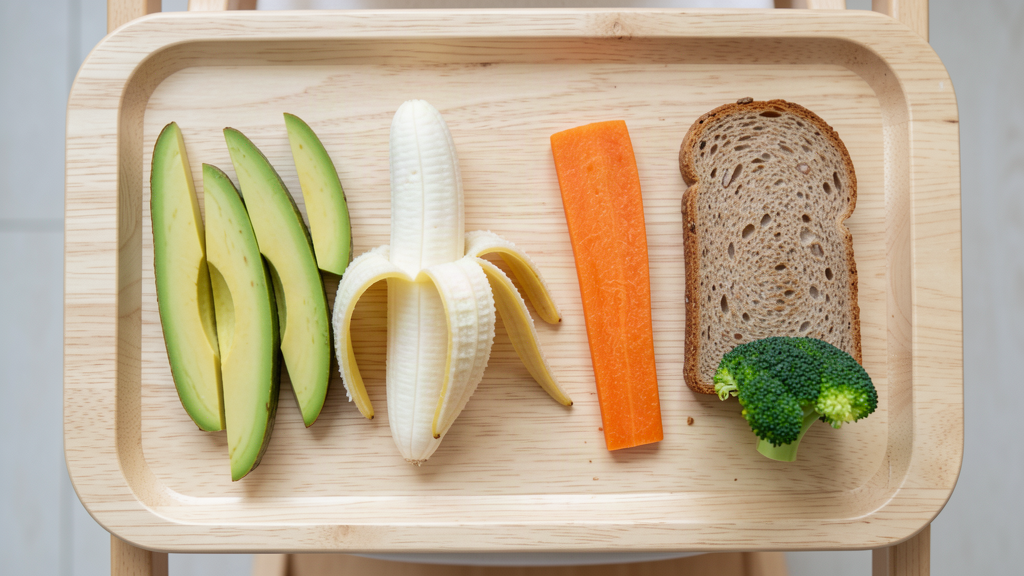
If you remember one thing, remember this: shape matters more than type. The safest shape for a beginner (roughly 6-9 months) is a spear — a strip about the length and width of an adult finger (roughly 2-3 inches / 5-7 cm long, half an inch / 1-2 cm wide). Reasons:
- A spear sticks out past the baby’s fist, so they can grip it and the top reaches the back of the mouth for gnawing — without the whole thing disappearing inside.
- It is long enough to hold, short enough not to be a mouthful.
- It must be soft enough to squish between your fingers (the AAP/HealthyChildren “squish test”). If you can’t mash it with gentle pressure, it’s too hard for a baby with no molars.
Avoid coin shapes, rounds, and golf-ball-sized blobs entirely. A coin-shaped slice of carrot or sausage is the classic choking shape; a long spear of the same food is safe.
Food Cutting Guide by Age
How you cut food changes as your baby’s skills develop. Use this table as your quick reference:
| Age | How to cut | Why | Examples |
|---|---|---|---|
| 6-9 months (palmar grasp) | Long spears, 2-3 in / 5-7 cm, half an inch wide; soft enough to squish. | Baby rakes with the whole hand; a spear sticks out past the fist so they can gnaw safely. | Avocado spear, banana spear, steamed carrot/broccoli spear, toast strip, ripe pear slice. |
| 9-12 months (pincer grasp emerges) | Small pea-sized / chickpea-sized soft pieces; keep some spears too. | They can now pick up tiny bits between thumb and forefinger; pieces stay small and mashable. | Soft cooked pea, small well-cooked pasta, flaked salmon, small banana chunks. |
| 12+ months (more teeth, chewing) | Bite-sized pieces; most foods can be fork-mashed rather than spear-cut. | Chewing skills are developing; whole foods can be offered in manageable bites. | Bite-sized soft fruit, small sandwich squares, finely shredded meat. |
Always skip the skin on round fruits (peel grapes, cherries, tomatoes, and cut into quarters), and cook hard vegetables until soft.
Choking Hazards to Avoid
These foods are the highest-risk choking items for babies under 1 (and many under 4). Keep them off the menu or modify them until your child is older and a confident chewer (Cleveland Clinic, NHS):
- Whole grapes, cherry tomatoes, blueberries — round and slick. Always cut lengthwise into quarters.
- Hot dogs / sausages — classic choking shape. Avoid, or cut into thin long strips, then quartered.
- Nuts and seeds — never whole; avoid entirely under age 4-5.
- Popcorn and pretzels — avoid under age 4.
- Hard candy and gum — never.
- Raw hard vegetables (carrot, apple, celery) — cook until soft; don’t offer raw rounds.
- Chunks of meat or cheese — shred finely or offer soft, moist pieces.
- Sticky foods — marshmallows, gummy candy, and blobs of nut butter (a spoonful of peanut butter can glue the airway shut). Spread thinly on bread instead.
- Large spoonfuls of anything smooth and sticky (e.g., a thick dollop of yogurt) — offer in small amounts.
Gagging vs. Choking — Know the Difference
This is the single most important safety concept in BLW. New parents often panic at gagging, which is normal and protective. Confusing the two can make you do the wrong thing.
Gagging (Normal — Do NOT Intervene)
- 😣 Makes noise — coughing, gagging, spluttering
- 😣 Face may be red
- 😣 Baby is breathing and pushing the food forward
- 😣 Usually resolves in seconds on its own
What to do: Stay calm, let baby work it out. Do not reach in or pat their back — that can push food further down. Gagging is the body’s safety reflex and decreases with practice.
Choking (Emergency — Intervene Now)
- 🤐 Silent — no sound, no crying, no coughing
- 🤐 Face may turn blue/grey, lips dusky
- 🤐 Cannot breathe, speak, or make noise
- 🤐 May clutch the throat, eyes wide with panic
What to do: Call emergency services immediately and begin infant choking/CPR back-blows and chest thrusts (see CPR & Choking Rescue below). Every second counts.
Rule of thumb: if there’s noise, there’s air — it’s gagging, stay calm. If it’s silent and the lips are blue, it’s choking — act now.
Seated Position & Supervision
- Upright, always. Baby must sit as upright as an adult, never reclined or in a bouncy seat, stroller, or car seat while eating.
- Feet supported. In the high chair, feet should rest on a footrest (or a rolled towel) so the core is stable — a dangling baby hunches and can’t swallow well.
- Within arm’s reach. A supervising adult stays close enough to intervene in seconds, the entire meal.
- No distractions. No walking around with food, no propping a bottle, no eating in the car. Meals happen at the table, seated, with a grown-up present.
- Buckle up. Use the high-chair harness so baby can’t slip down or stand.
Allergen Introduction
Current guidance (AAP, CDC, and major allergy organizations) is to introduce common allergens early and often, starting around 6 months alongside other solids — early and repeated introduction of peanut, egg, and fish actually reduces the risk of developing an allergy. Offer a small amount of the allergen (e.g., thin peanut-butter-on-toast, well-cooked egg) and repeat regularly.
- Introduce one new allergen at a time when you can watch for a reaction.
- For babies with severe eczema or an existing food allergy, talk to your pediatrician first — they may recommend supervised introduction.
- Know the signs of a reaction (hives, swelling of lips/face, vomiting, wheezing) and when to call for help (see the callout below).
Related reading: Iron-Rich First Foods for Babies.
Foods to Avoid: Honey, Salt & Sugar
Beyond choking shapes, a few foods are unsafe or unnecessary for babies:
- Honey — never before age 1. Honey (even baked into goods) can contain Clostridium botulinum spores that cause infant botulism, a serious illness. After the first birthday the gut is mature enough to handle it.
- Added salt — avoid. Babies’ kidneys can’t process much sodium. Skip salting their food; most natural foods have enough.
- Added sugar — avoid under age 2. It adds empty calories and trains a sweet tooth. Offer the food’s natural taste instead.
- Unpasteurized / high-mercury foods — avoid raw milk, undercooked egg/meat, and high-mercury fish (shark, swordfish, king mackerel).
When to Call Your Pediatrician
Contact your pediatrician or seek care if: your baby chokes and you are unsure they fully cleared the airway; you notice signs of an allergic reaction after a new food (hives, lip/tongue swelling, repeated vomiting, wheezing, or any breathing difficulty — call emergency services for those); your baby refuses solids for several days or isn’t gaining weight; or you have any doubt about whether your baby is ready to start. When in doubt, a quick call to your pediatrician is always the right move.
CPR & Choking Rescue
Every caregiver who feeds a baby should learn infant CPR and choking rescue before the first meal. Take a hands-on class (Red Cross, AAP, or local hospital) and keep the steps fresh. The technique for an infant is different from an adult — it uses back blows while the baby is face-down on your forearm, then chest thrusts with two fingers. Free, authoritative guides:
- AAP HealthyChildren — choking prevention and rescue guidance (healthychildren.org)
- American Red Cross — Infant CPR & Choking
- American Heart Association — CPR training courses (cpr.heart.org)
Frequently Asked Questions
Is baby-led weaning actually safe?
Yes, when started around 6 months with the readiness signs, soft spear-shaped foods, and constant supervision. Studies show BLW does not raise choking risk versus spoon-feeding when these rules are followed.
What’s the difference between gagging and choking?
Gagging is loud, the baby is red and breathing, and it passes on its own — don’t intervene. Choking is silent, the face may turn blue, and the baby can’t breathe — call for help and start rescue back-blows/chest thrusts immediately.
What foods should I avoid with baby-led weaning?
Avoid round/hard choking hazards (whole grapes, hot dogs, nuts, popcorn, hard candy, raw hard veg), sticky blobs of nut butter, honey before age 1, and added salt and sugar. Cut round foods into quarters and cook hard veg until soft.
When can my baby eat grapes, popcorn, or nuts?
Whole grapes and cherry tomatoes should be quartered until at least age 4; popcorn, nuts, and hard candy are best avoided until age 4-5, when chewing and airway protection are more mature.
How do I cut food for baby-led weaning?
For 6-9 months, cut food into soft, spear-shaped strips about the size of your finger and do the squish test. From 9-12 months, move to pea-sized soft pieces as the pincer grasp develops, then bite-sized pieces after 12 months.
Can baby-led weaning cause choking more than purees?
No — research does not show higher choking rates with BLW when safety rules are followed. The bigger risk factor is starting too early or offering unsafe shapes, regardless of purees vs. finger foods.
The Bottom Line
Baby-led weaning is safe and rewarding when you follow the rules: wait for the readiness signs, serve food as soft spears you can squish, keep the highest-risk choking foods off the menu, know gagging from choking, and stay within arm’s reach every single meal. Start with our guide on when to start solids, see how BLW compares in Baby-Led Weaning vs. Purees, and follow a step-by-step plan in Introducing Solid Foods: A Step-by-Step Guide.
🩺 Doctor’s Take
The three things I check with every family starting BLW: readiness (sitting truly upright, around 6 months), shape (soft spears you can squish — never rounds), and supervision (arm’s reach, every meal). Gagging is loud and messy and it means the reflex is working; stay back and let it happen. Choking is silent — that is the one scenario you act on instantly, and every caregiver should take an infant CPR class before the first solid meal. Skip honey until 1, cut grapes lengthwise, and when a new food worries you, a quick call to your pediatrician beats an hour of searching.
This article is for parents and caregivers of babies roughly 5-12 months who are starting or considering solid foods. ChildBloom articles are written and reviewed by board-certified pediatricians for educational purposes only. They are not a substitute for diagnosis, treatment, or personalized medical advice from your own pediatrician. Always consult your child’s doctor with specific concerns.
Medical review
Reviewed by Dr. Ahmad Raza, MD, Pediatrics. Last reviewed September 27, 2026. Written by Dr. Sophia Martinez, MD (Pediatrics). Reviewed against AAP HealthyChildren guidance, CDC infant- and toddler-nutrition guidance, and NHS weaning guidance — all verified this date; the CDC link was repointed to the current URL after the original page 404’d, and the Cleveland Clinic, AAP Choking-Prevention, and American Heart Association CPR pages are cited by name (dead or blocked at time of review).
Learn about our physicians on the About page.




15 Comments