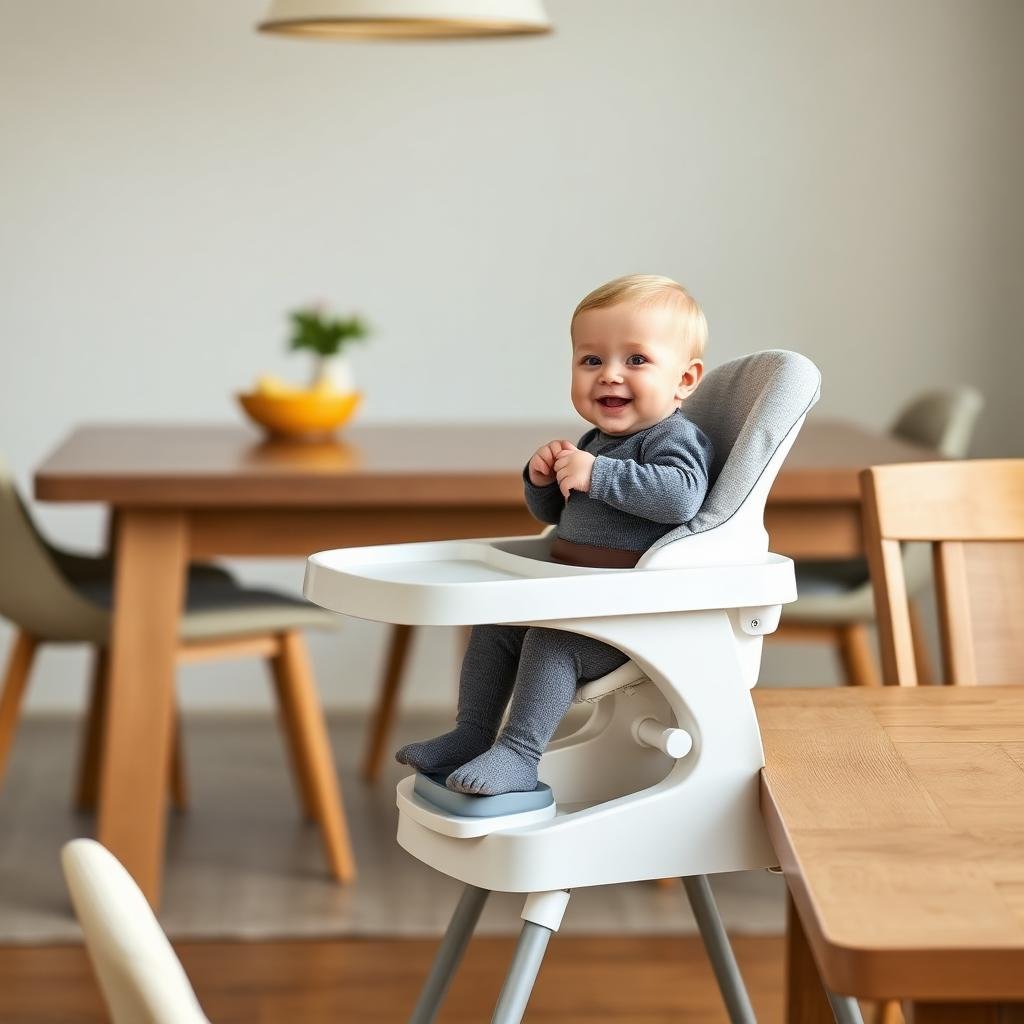
Top 5 High Chairs for Easy Cleanup & Posture Support
Medically reviewed by Dr. Ahmad Raza, MD (Pediatrics) — ChildBloom Medical Review Panel. Last updated: September 27, 2026.
Editorial & affiliate disclosure: our guidance is written and reviewed by clinicians. ChildBloom may earn a commission from qualifying purchases made through links on this page, which never changes what our pediatric reviewers recommend. As an Amazon Associate, we earn from qualifying purchases.
Proper posture is critical for safe swallowing and comfortable feeding. A pediatrician reviews the top 5 high chairs based on posture support, stability, ease of cleaning, and longevity.
📋 TL;DR — if you read nothing else
Short answer: A baby-led-weaning high chair needs four things: a footrest, a harness that holds your baby upright, a wide stable base, and surfaces you can wipe clean in under a minute.
- Footrest first. When babies cannot plant their feet, they slide and slump — the position that raises choking risk. AAP guidance calls footrests important for exactly this reason.
- Harness every time. Five-point is ideal; a lap belt alone does not stop a determined baby from sliding down.
- Cleanability decides usage. A dishwasher-safe tray and a wipe-clean seat mean the chair actually gets used every day.
- Budget is fine. A roughly $30 IKEA Antilop with a separately sold footrest outperforms a $300 chair that skips one.
- Fit problems are fixable. If your baby slumps or slides during meals, adjust the chair before the next feed — and bring persistent feeding worries to your pediatrician.
This pediatrician-reviewed guide keeps things practical: what genuinely affects your baby’s safety and comfort at the table, what marketing you can ignore, and how to decide quickly — with seven full-size picks, five budget options, and the setup rules that matter.
Baby-led weaning (BLW) is a popular approach where babies feed themselves soft finger foods from the start of solid food introduction (around 6 months), instead of being spoon-fed purées. The right high chair is essential for safety — here’s what pediatricians look for in a BLW-ready chair.
What Makes a High Chair Safe for Baby-Led Weaning
BLW puts more demands on high chairs than traditional spoon-feeding. Baby is reaching, grabbing, and potentially throwing food while sitting upright. Safety requirements:
- Footrest: A footrest allows baby to push up with their feet for stability — prevents the “sliding down” position that increases choking risk.
- Three-point or five-point harness: A three-point harness (waist belt only) is minimum; five-point is ideal and strongly recommended by AAP.
- Stable base: Wide footprint, heavy base — baby cannot tip it over even when leaning or pushing with feet.
- Adjustable height: Allows the chair to grow with your baby and function at different table heights.
- Ease of cleaning: Removable, dishwasher-safe tray and seat cushion — BLW is messy.
Top 7 High Chairs for Baby-Led Weaning (2026 Picks)
Seven full-size chairs cover every budget and space — from a $30 classic to a wooden chair built to last through the toddler years. Prices are approximate as published.
- 1. Abiie Beyond Wooden High Chair — Grows from infant to toddler, five-point harness, easy-clean tray, attractive wooden design ($300).
- 2. Stokke Tripp Trapp — Classic Scandinavian design, adjustable height, footrest, durable wood, lifetime warranty ($229).
- 3. Keekaro Healthy Glow High Chair — Affordable wooden option, three-point harness, footrest, dishwasher-safe tray ($140).
- 4. IKEA Antilop — Budget winner (~$30), lightweight aluminum legs, footrest available separately, wipe-clean seat ($30-55).
- 5. Nuna Mixx — Compact fold, four recline positions, five-point harness, pairs with Nuna bassinet ($380).
- 6. Joovy FooRoo — Ultralight (12 lbs), four-point harness, deep seat for reclining infants, easy cleanup ($200).
- 7. BabyBjorn High Chair — Swedish design, three-point harness, adjustable height, no footrest (design controversy — AAP disagrees with omission) ($370).
Budget and Convertible Picks
Five budget and convertible alternatives — booster and 4-in-1 designs that cost less than the full-size picks above. Prices are shown as tiers (budget = under about $50, mid = about $50–150); tap any pick for current pricing and availability on Amazon. One caveat first: booster-style seats strap to your own dining chair, so they work once baby sits steadily — but a floor-standing chair with a footrest is the safer BLW default.
Graco Made2Grow 5-in-1 Convertible Highchair
- Price: $$ (mid tier).
- 5-in-1 design: infant recline, baby highchair, toddler booster, youth stool, and big-kid chair.
- Eco fabric: made with Graco One Planet highchair fabrics from 100% recycled materials; three-position recline.
Ingenuity Baby Base 2-in-1 Booster
- Price: $ (budget tier).
- Two-in-one: booster straps to most dining chairs; remove the foam insert to convert it into a toddler seat.
- Tray: self-storing tray; safe infant seat with harness for babies sitting up.
Bright Starts Pop ‘N Sit Portable Booster
- Price: $ (budget tier).
- Three modes: floor seat, feeding seat with removable tray, and travel high chair.
- Folds flat: compact fold (about 5 × 15 inches), dishwasher-safe tray, machine-washable seat pad; indoor and outdoor use.
Evenflo Eat and Grow 4-in-1 Convertible High Chair
- Price: $$ (mid tier).
- Four stages: infant high chair to toddler dining chair and tray, up to 50 lb (22.6 kg).
- Harness: includes a five-point harness to keep wiggly babies in place.
Cosco Kids Simple Fold Highchair
- Price: $$ (mid tier).
- Portability: folds flat and stands on its own; sets up in seconds.
- Simple cleanup: easy-wipe seat for quick cleaning between meals.
The Footrest Question
AAP specifically calls out the importance of footrests for high chairs, and research supports this. When babies can’t plant their feet, they have less trunk stability and more head-and-neck movement — increasing the risk of choking if they tip forward. The BabyBjorn chair, despite its attractive design, lacks a footrest — this is a meaningful safety gap for BLW.
Beyond the High Chair: BLW Setup
- Introduce solids at 6 months, when baby can sit upright with minimal support and shows interest in food.
- Start with soft foods baby can palm — avocado strips, steamed carrot sticks, banana fingers.
- Never leave baby unattended in the high chair.
- Avoid hard, round foods that are choking hazards: whole grapes, cherry tomatoes, hot dogs (cut lengthwise if served).
- Take an infant CPR/choking rescue class before starting BLW.
Common Mistakes Parents Make
At mealtime
- Starting before baby can sit independently (usually 6+ months).
- Not paying attention to food shape — round foods are the #1 choking risk.
- Leaving the room while baby is eating.
- Not buckling the high chair harness correctly every time.
- Introducing allergenic foods without proper introduction protocols (recent AAP guidelines support early allergen introduction).
When buying a chair
- Buying for the baby your child will be in six months rather than the baby in front of you today.
- Adding extra padding, inserts or accessories the manufacturer did not test.
- Skipping the manual — most safety failures we see are correct products used incorrectly.
- Reusing older hand-me-downs that predate current safety standards or have been recalled.
Frequently Asked Questions
Feeding questions parents ask at almost every visit — the answers matter for how and where your baby eats:
How do I know if my baby is getting enough? This is the most common question parents ask about feeding. The most reliable indicators are weight gain (your baby should follow their growth curve), diaper output (at least 6-8 wet diapers per day after the first week), and your baby’s behavior after feeds (content and relaxed, not crying or rooting). If you are concerned, your pediatrician can perform a weighted feed to measure exactly how much milk your baby transfers during breastfeeding.
Can I switch between breast and bottle? Yes, many babies successfully alternate between breast and bottle (combination feeding). The key is establishing breastfeeding first (usually 3-4 weeks) before introducing a bottle. Use a slow-flow nipple to maintain a feeding pace similar to breastfeeding. Have someone other than the breastfeeding parent offer the first few bottles, as babies can smell their mother’s milk and may refuse the bottle from her. If your baby resists the bottle, try different nipple shapes, temperatures, and timing.
Choosing Baby Products: An Evidence-Based Approach
The baby product market is a multi-billion dollar industry that markets directly to exhausted, anxious new parents with the promise that the right product will solve their baby’s sleep problems, feeding challenges, or developmental concerns. The reality is that most baby products are unnecessary, and the ones that matter most are those that address genuine safety or health needs. Understanding how to evaluate baby products through an evidence-based lens can save you money and reduce decision fatigue. Most importantly, it keeps your baby safe.
The safety of baby products is regulated by the Consumer Product Safety Commission (CPSC), but the level of regulation varies dramatically by product category. Car seats, cribs, and pacifiers are subject to mandatory federal safety standards with rigorous testing requirements. Other products — including baby carriers, nursing pillows, diaper bags, and many toys — are subject only to voluntary standards, meaning that manufacturers choose whether to test their products. When evaluating any baby product, look for certification from the Juvenile Products Manufacturers Association (JPMA). It indicates that the manufacturer has voluntarily submitted the product for independent safety testing. Also check the CPSC website for recall information before purchasing any product, especially if you are buying secondhand.
The car seat is the single most important safety purchase you will make for your baby, and the evidence supports a clear hierarchy of priorities. The safest car seat is the one that fits your vehicle, fits your child, and will be installed and used correctly on every single ride. All car seats sold in the United States meet federal safety standards, which means that the most expensive car seat is not necessarily safer than a mid-range model. The critical features to look for are ease of installation, the presence of a five-point harness, and a high rear-facing weight and height limit. A seat that is difficult to install correctly is less likely to be installed correctly. The AAP recommends rear-facing until at least age 2, and ideally until the child reaches the maximum height or weight allowed by the seat. The extended rear-facing position is five times safer than forward-facing. The evidence does not support the common concern that rear-facing causes leg injuries — leg injuries in forward-facing crashes are actually more common.
Baby monitors are a category where the evidence and the marketing are particularly divergent. For families who room-share — which the AAP recommends for at least the first 6 months — a monitor is largely redundant. For families where the baby sleeps in a separate room, a simple audio monitor is sufficient for safety. Video monitors can be helpful for checking on a sleeping baby without entering the room, but they can also become a source of parental hypervigilance and anxiety. Wearable monitors, pulse oximeters, and “smart” sleep trackers have not been shown to prevent SIDS and are not recommended by the FDA or the AAP for healthy infants. These devices can produce false alarms that cause unnecessary emergency department visits. They can also create a false sense of security that leads to unsafe sleep practices. The safest monitor is a nearby parent, not a technological device.
Feeding products — bottles, breast pumps, high chairs — are necessary but do not require the premium-priced options to be effective. The best bottle is the one your baby will accept, and it is common to need to try two or three different brands before finding one that works. The best breast pump is the one that fits your nipples correctly, is comfortable to use, and effectively removes milk — and the evidence suggests that manual pumps can be as effective as electric pumps for occasional use. The best high chair is one that is stable, easy to clean, and has a five-point harness (not just a lap belt, which does not prevent a child from sliding down and strangling). The features that add cost — fancy designs, multiple recline positions, built-in Bluetooth speakers — do not add safety or nutritional value.
Clinical Pearl: Navigating the World of Baby Toys
The baby toy market is saturated with products that claim to boost development, but the evidence tells a different story. The best toys for babies are simple, open-ended, and encourage exploration and creativity. A cardboard box, a set of wooden blocks, and a collection of household objects (clean, safe, and age-appropriate) are more developmentally valuable than most electronic toys that light up, sing songs, and claim to teach letters and numbers. Research on toy-based learning shows that the most important factor is not the toy itself. It is the interaction the toy facilitates between the child and a caregiver. A simple toy that a parent and child explore together — talking about the colors, describing the textures, taking turns stacking and knocking down — is far more beneficial than a fancy electronic toy that the child interacts with alone. When choosing toys, prioritize those that encourage creativity, problem-solving, and social interaction over those that provide passive entertainment.
If you have specific concerns about your child’s health, development, or behavior that are not addressed in this article, please bring them to your next pediatrician visit. Every child is unique, and personalized medical advice — based on your child’s individual history, examination findings, and family context — is always more valuable than generalized guidance. Your pediatrician is your partner in navigating the complex and rewarding journey of raising a healthy, happy child.
Baby Products: What Research Says About Safety and Value
The baby product industry is a $12 billion market that thrives on parental anxiety. The promise that the right product will make your baby smarter, sleep better, be safer, or develop faster is a powerful marketing message, but it is rarely supported by evidence. In my clinical practice, I have developed a framework for evaluating baby products that I share with every new parent, and it has saved countless families from unnecessary purchases and, in some cases, from products that are actually harmful.
The first principle is that the most important factor in your baby’s health and development is not a product — it is you. The thousands of dollars spent on educational toys, development-tracking monitors, and specialized sleep products would be better spent on parental leave, childcare, and mental health support. The evidence for this is overwhelming: the quality of the parent-child relationship is a stronger predictor of child outcomes than any product or intervention. This does not mean that products are irrelevant — it means that they should be evaluated in the context of whether they genuinely support the parent-child relationship, not whether they promise to replace it.
The second principle is that the most expensive product is not necessarily the safest or most effective. In the car seat market, for example, all seats sold in the United States must meet federal safety standards, and a $150 seat and a $500 seat provide equivalent crash protection if both are used correctly. The extra cost buys convenience features — easier installation, easier harness tightening, more padding — that can make correct use more likely, but they do not add safety beyond what the federal standard requires. The safest car seat is the one that will be installed correctly on every ride, and the features that make correct installation easier are worth paying for. The features that add style, comfort, or entertainment value are not.
The Bottom Line
BLW has good evidence supporting its role in developing fine motor skills and preventing food refusals later — but only when done safely. The high chair is foundational. Invest in one with a footrest and five-point harness.
References & further reading
- CDC — Infant and Toddler Nutrition
- American Academy of Pediatrics policy statement on breastfeeding and the use of human milk (cited by name; link not accessible)
- FDA — Questions and Answers for Consumers Concerning Infant Formula
🩺 Doctor’s Take
If you remember one thing: the chair’s whole job is to hold your baby still, upright, and feet-first against a footrest so both hands stay free for food. Check the footrest and the harness before any other feature, test the buckle with one hand while your baby leans, and wipe the seat before every meal. A $30 chair with a footrest beats a $300 chair without one. And if your baby slumps, slides, or fights every meal in the chair you already own, fix the fit first — then call your pediatrician if feeding still looks hard.
This article is for general education and is not a substitute for individual medical advice, diagnosis or treatment. Every baby is different — talk to your own pediatrician about your child’s feeding, sleep, growth or development, and seek urgent care for breathing difficulty, poor feeding, dehydration, fever in an infant under 3 months, or any sudden change in your baby’s condition.
Medical review
Reviewed by Dr. Ahmad Raza, MD, Pediatrics. Last reviewed September 27, 2026. This article provides general education and does not replace individualized advice from your child’s pediatrician. Learn about our physicians on the About page.





53 Comments