Smart Baby Monitors: Do Oxygen & Heart Rate Alerts
Medically reviewed by Dr. Ahmad Raza, MD (Pediatrics) — ChildBloom Medical Review Panel. Last updated: August 4, 2026.
Editorial & affiliate disclosure: our guidance is written and reviewed by clinicians. ChildBloom may earn a commission from qualifying purchases made through links on this page, which never changes what our pediatric reviewers recommend.
Looking for clear answers about smart baby monitors? This pediatrician-reviewed guide covers what matters, what to skip, the safety checks that count, and exactly when to involve your doctor — based on current AAP, CDC and CPSC guidance on smart baby monitors.
Quick pediatrician summary: smart baby monitors
Short answer: A pediatrician explains smart baby monitors: what is normal, the real risks, red flags to watch for and exactly when to call your doctor.
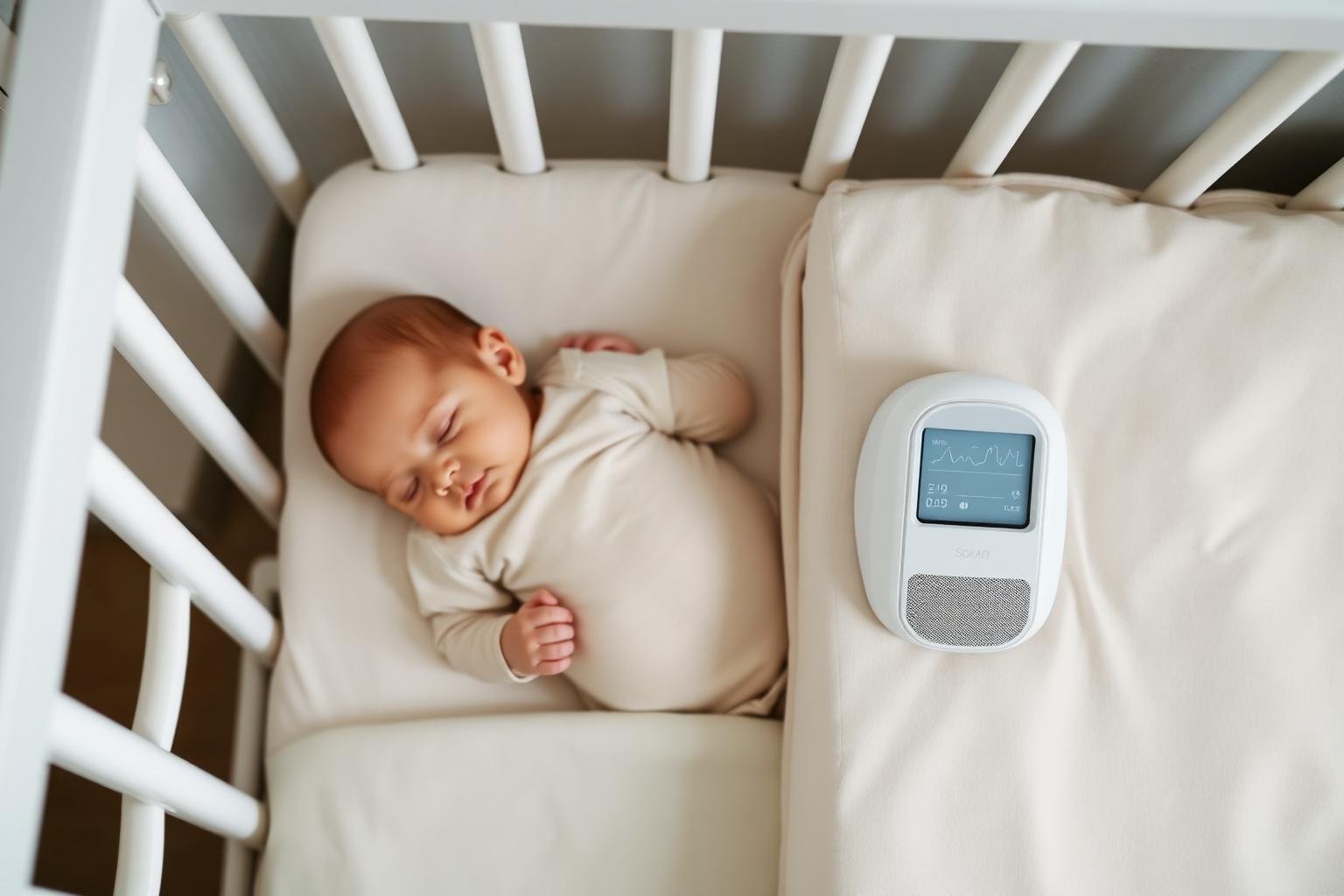
The marketing is compelling. A small sock on your baby’s foot monitors their heart rate and oxygen levels 24/7. If something goes wrong — if their oxygen drops, if their heart rate is abnormal — your phone buzzes with an alert. You rush in. You save your baby.
It is a powerful narrative. And it has driven hundreds of thousands of parents to spend $200-$400 on smart monitoring devices. But here is the question that the marketing does not answer: do these devices actually prevent SIDS?
The answer, based on the available evidence and the position of the FDA and the AAP, is no. And understanding why requires a closer look at the technology, the science, and the difference between detecting a problem and preventing a death.
PART 1: HOW THESE MONITORS WORK
Looking for the best options? Check out Best Baby Monitors 2026: Pediatrician-Reviewed Safety Guide.
1.1 Pulse Oximetry
Most smart baby monitors that track oxygen use pulse oximetry — the same technology used in hospitals. A light sensor (usually on the foot or wrist) measures the color of the blood to estimate oxygen saturation (SpO2). Heart rate is measured using the same sensor.
In hospitals, pulse oximetry is a critical monitoring tool. But hospital-grade pulse oximeters are:
- Applied by trained clinicians who ensure proper sensor placement
- Connected to alarm systems with clinically validated thresholds
- Interpreted by medical professionals who understand the context
- Used on patients who are already under medical care
Consumer versions use the same basic technology but with less precise sensors, less rigorous validation, and no clinical oversight.
1.2 The Alert System
When the device detects a reading outside its “normal” range, it sends an alert to the parent’s phone. The thresholds are set by the manufacturer — not by a pediatrician or by clinical guidelines.
The problem: babies’ heart rates and oxygen levels fluctuate normally during sleep. A baby who moves, who has a foot that is cold (reducing sensor accuracy), or who is simply in a different sleep position may trigger an alert without any actual danger.
PART 2: WHAT THE EVIDENCE SHOWS
2.1 No Study Has Proven SIDS Prevention
There is no peer-reviewed, randomized controlled trial demonstrating that consumer vital-signs monitors reduce SIDS incidence. This is a critical point. These products are marketed with the implication that they prevent SIDS, but the evidence for this claim does not exist.
2.2 False Alarm Rates Are Significant
A study published in JAMA Pediatrics evaluated consumer pulse oximetry monitors and found:
- False alarm rates of up to 10% of monitoring time
- Many alerts were triggered by normal movement, poor sensor contact, or temporary positional changes
- Parents reported significant sleep disruption from false alarms
2.3 The FDA’s Position
The FDA has issued a safety communication specifically addressing consumer pulse oximeters marketed for SIDS prevention:
- These devices are NOT FDA-cleared for SIDS prevention
- The FDA is not aware of any cleared or approved consumer pulse oximeter for this use
- The FDA warns that reliance on these devices may give parents a false sense of security, potentially leading them to skip evidence-based safe sleep practices
2.4 The AAP’s Position
The AAP’s safe sleep guidelines (most recently updated in 2022) state:
- “There is no evidence that cardiorespiratory monitoring devices reduce the risk of SIDS.”
- “Commercial devices that measure heart rate, oxygen saturation, or movement are not recommended as a strategy to reduce SIDS risk.”
PART 3: THE REAL RISKS OF THESE DEVICES
3.1 False Sense of Security
The most concerning risk is that parents may believe the monitor is protecting their baby and may therefore be less vigilant about evidence-based safe sleep practices. A baby sleeping on their stomach on a soft mattress with blankets is at high SIDS risk — regardless of whether a monitor is tracking their heart rate.
3.2 Alert Fatigue and Anxiety
Frequent false alarms train parents to ignore alerts — including the rare true alarm. This “alert fatigue” is a well-documented phenomenon in clinical medicine. Additionally, the constant stream of data (heart rate, oxygen, sleep stages) can increase parental anxiety rather than reduce it.
3.3 Sleep Disruption
Parents who receive alerts throughout the night — most of which are false — experience chronic sleep disruption. Sleep-deprived parents are less attentive, less responsive, and more prone to accidents. The monitor designed to improve safety may inadvertently create a different safety risk.
3.4 Cost
These devices cost $200-$400, and some require monthly subscriptions ($10-$15/month) for full functionality. For families on a budget, this money could be more effectively spent on a firm crib mattress, a well-fitting sleep sack, or a quality video monitor.
PART 4: WHO MIGHT BENEFIT FROM A SMART MONITOR
There are specific situations where vital-signs monitoring may be appropriate:
- Parents of premature infants (especially those discharged with apnea monitors prescribed by their pediatrician)
- Parents of babies with known cardiac or respiratory conditions
- Parents with extreme anxiety about SIDS who find that the monitor provides genuine reassurance (not increased anxiety)
For these families, a smart monitor may be a reasonable choice — with the understanding that it does NOT replace safe sleep practices and does NOT prevent SIDS.
PART 5: WHAT ACTUALLY PREVENTS SIDS
The evidence-based SIDS prevention strategies are well-established:
- Back sleeping for every sleep
- Firm, flat sleep surface with fitted sheet only
- Room sharing (not bed sharing) for at least 6 months
- Avoiding overheating
- Breastfeeding
- Pacifier use at sleep time
- Smoke-free environment (prenatal and postnatal)
- Vaccination
- Avoiding alcohol and drug use during pregnancy
These are the interventions that have been proven to reduce SIDS risk. No consumer monitor has achieved this.
Pediatrician’s Take
“I understand the appeal of smart monitors. The idea that a device can watch over your baby while you sleep is deeply reassuring. But I want parents to understand: these devices have NOT been proven to prevent SIDS. The FDA has warned about this. The AAP does not recommend them for SIDS prevention. The most effective things you can do for your baby’s safety are behavioral — back sleeping, firm mattress, no loose bedding, room sharing. If you choose to use a smart monitor, do so with realistic expectations. It may provide reassurance. It will generate false alarms. And it does not replace the safe sleep practices that actually save lives.”
When to Call the Doctor
- If your baby has episodes of apparent life-threatening events (ALTE) — color change, limpness, stopped breathing — seek emergency care immediately. Do not rely on a consumer monitor.
- If you are considering a smart monitor because your baby was premature or has a medical condition, discuss the appropriate monitoring strategy with your pediatrician.
Related Articles
- Baby Wearable Trackers: Are They Worth the Anxiety?
- Smart Socks & Sleep Trackers: What the Data Tells You
- Baby Tech That Actually Helps: A Pediatrician’s Honest Review
Recommended Products
Best Smart Baby Monitors with Health Tracking (FDA status, accuracy, and value compared) → See our top picks
Pediatrician’s Take: I want to be direct about this. The FDA has not cleared any consumer monitor — not one — for SIDS prevention. The Owlet, the Snuza, the Miku, the Nanit Breathing Band, the Babysense — none of them are medical devices, and none of them have been shown to prevent SIDS in any peer-reviewed study. They are consumer electronics that can give you a reading. Whether that reading is reassuring or anxiety-producing depends mostly on you. If you choose to use one, use it as a curiosity, not as a guardian.
What Parents Need to Know
A practical, evidence-based checklist for thinking clearly about smart baby monitors:
- What these monitors CAN do: give you a rough, real-time estimate of your baby’s heart rate and oxygen levels, alert you to gross changes from baseline, and provide a sense of reassurance for some families. They are useful for the parent who sleeps better with a green light on the dresser.
- What these monitors CANNOT do: prevent SIDS, replace safe sleep practices, diagnose apnea or cardiac conditions, or substitute for a medical-grade monitor prescribed by your pediatrician. Marketing often blurs this line. The science does not.
- False alarms are common. A 2019 study in JAMA Pediatrics found false alarm rates as high as 10% of total monitoring time. The sensor can lose contact when the baby kicks, when a sock slips, or when the foot is cold. Plan for it.
- What to do when the alarm goes off: stay calm. Look at the baby with your own eyes, not the phone. If the baby is pink, breathing comfortably, and responsive, the alarm is almost certainly false. If the baby is blue, limp, or not breathing, call 911 and start infant CPR — do not rely on the device to tell you what to do next.
- The AAP does not recommend these monitors for SIDS prevention. The FDA has issued a safety communication warning against using consumer pulse oximeters for this purpose. Both positions are evidence-based and current.
- Follow the AAP safe sleep guidelines regardless of what monitor you choose. Back to sleep, firm flat mattress with a fitted sheet, no loose bedding, room share for at least six months, avoid overheating. These are what actually reduce SIDS risk.
- If your baby was premature, has a known cardiac or respiratory condition, or was sent home on an apnea monitor, talk to your pediatrician before adding a consumer device. A prescribed medical monitor is a different product, with FDA clearance, validated accuracy, and clinical oversight.
- If you notice the monitor is making you more anxious, not less, it is the wrong tool for your family. Return it, gift it, or put it in a drawer. The data has no value if it harms your sleep and your peace of mind.
Common Questions (FAQ)
Is the Owlet FDA-approved?
As of mid-2026, the Owlet Smart Sock is not FDA-cleared or approved for SIDS prevention or for medical monitoring. It is marketed as a consumer wellness device. Owlet’s own documentation, packaging, and app reflect this. The FDA has explicitly stated that it is not aware of any consumer pulse oximeter cleared or approved for SIDS prevention. If you see marketing to the contrary, treat it as a red flag, not a feature. For a deep dive on the Owlet specifically, read my Owlet pediatrician review.
Will a smart monitor prevent SIDS?
No. There is no peer-reviewed, randomized controlled trial, and no observational study of sufficient quality, demonstrating that any consumer smart monitor reduces SIDS incidence. The AAP is explicit on this. SIDS is not thought to be a continuously monitorable event in the way that, say, sustained low oxygen is — and even the oxygen-based monitors have not been shown to prevent the rare catastrophic events they purport to catch. The baby tech pillar guide covers the full landscape.
What do I do if the alarm goes off at 3 AM?
Step one is always the same: look at your baby. If the baby is pink, breathing comfortably, has good muscle tone, and is responsive to your touch or voice, the alarm is almost certainly a sensor error. Gently readjust the sock or sensor, check that the battery is charged, and go back to bed. If the baby is pale, blue, limp, not breathing, or unresponsive, call 911 immediately and begin infant CPR if you have been trained. Do not waste time troubleshooting the device. The device is a tool, not a triage nurse.
Is pulse oximetry safe for my baby?
The technology itself is safe. Pulse oximetry has been used in hospitals for decades and does not emit ionizing radiation or harm the skin. The risk is not in the measurement but in the interpretation. Consumer devices can give readings that are inaccurate due to motion, poor fit, cold extremities, or low perfusion, and a parent without clinical training may not be able to tell a real desaturation from a sensor artifact. The result is often unnecessary panic, unnecessary ER visits, and disrupted sleep for the entire family. For more on what pulse oximetry can and cannot do, see the Owlet review and the SIDS prevention article.
Should I use a smart monitor if my baby was premature?
Possibly — but only the right kind of monitor, and only on your pediatrician’s recommendation. Babies discharged from the NICU on an apnea monitor are typically sent home with a medical-grade device that has FDA clearance and is monitored by a clinical team. Adding a consumer smart monitor on top of that is usually not necessary and can create a confusing double-feed of overlapping data. If your baby was premature and is not on a prescribed monitor, ask your pediatrician at the next visit whether any monitoring is indicated, and if so, what kind. The smart monitor comparison guide explains which devices are and are not appropriate for higher-risk infants, and your neonatology team remains the final authority on what your specific baby needs.
When to Call Your Pediatrician
Smart monitors do not replace clinical judgment. Call your pediatrician — or seek emergency care — for any of the following, regardless of what the app or the base station is telling you:
- Your baby has an apparent life-threatening event (ALTE) or brief resolved unexplained event (BRUE): color change to blue or pale, loss of tone, stopped breathing, choking, or needing stimulation to rouse. Call 911 or go to the emergency room. Do not wait to see what the monitor does next.
- Your baby is breathing fast (over 60 breaths per minute when calm), retracting, flaring the nostrils, grunting, or has a persistent cough or wheeze. These are signs of respiratory distress that warrant a clinician’s eyes and ears, not a phone app.
- Your baby has a fever of 100.4°F (38°C) or higher rectally in the first three months, or any fever with rash, lethargy, or poor feeding. Newborn fever is always an emergency.
- Your monitor alarm is going off repeatedly, and you are losing sleep or finding yourself unable to settle without checking the app. We can talk through whether the device is helping or quietly harming your family.
- You have anxiety about SIDS that is interfering with your daily life, sleep, or relationships. Perinatal anxiety and OCD are common, treatable, and nothing to be ashamed of. Please reach out.
Use the monitor to gather information. Use your pediatrician to interpret it. If you are weighing which device to buy, or whether to buy one at all, the Owlet-specific review, the sleep tracker accuracy guide, and the full smart monitor comparison walk through the realistic pros and cons of each option. None of them replace a back-to-sleep, firm-mattress, room-sharing routine — and none of them replace a calm, well-rested, well-informed parent. That is still the single most important variable in your baby’s safety, and it is the part you have the most control over.
Medical Disclaimer: This article is for informational purposes only and does not constitute medical advice. Always consult your pediatrician for guidance on your baby’s health and safety.
================================================================================
================================================================================
Related Articles in This Cluster
This article is part of ChildBloom’s pediatrician-reviewed Baby Tech & Gear cluster. Read the complete series:
- Baby Tech That Actually Helps: A Pediatrician’s Honest Review of Smart Monitors, Socks & Apps
- Baby Wearable Trackers (Owlet, etc.): Are They Worth the Anxiety?
- Smart Socks & Sleep Trackers: What the Data Actually Tells You
- White Noise Apps vs. Dedicated Machines: Which Is Better for Baby Sleep?
- Baby Camera vs. Full Monitor System: What Do You Actually Need?
- Best Smart Baby Monitors with Health Tracking: Pediatrician-Reviewed Comparison
- Top 5 Baby Sleep Trackers & Wearables: Pediatrician-Reviewed Accuracy Guide
- Best Wi-Fi Baby Cameras for Remote Monitoring: Security & Quality Reviewed
Related Pediatrician-Reviewed Resources
This article is part of the pediatrician-reviewed Baby Tech & Gear series. Continue reading:
- Baby Camera vs. Full Monitor System: What Do You Actually Need?
- White Noise Apps vs. Dedicated Machines: Which Is Better for Baby Sleep?
- Smart Socks & Sleep Trackers: What the Data Actually Tells You
- Baby Wearable Trackers (Owlet, etc.): Are They Worth the Anxiety?
Trusted Authority Sources
Frequently Asked Questions
Q: How much sleep does my baby need?
A: Newborns (0-3 months) need 14-17 hours per day. Infants (4-11 months) need 12-15 hours. Toddlers (1-2 years) need 11-14 hours. These are totals including naps. Every baby is different, but consistency in schedule and sleep environment matters more than hitting exact numbers.
Q: When will my baby sleep through the night?
A: Most babies start sleeping longer stretches (5-6 hours) around 3-4 months, but “sleeping through the night” (10-12 hours) typically doesn’t happen consistently until 6-9 months or later. Night wakings are normal and developmentally appropriate even after your baby can sleep longer stretches.
Q: What is the safest sleep position for my baby?
A: Always place your baby on their back for every sleep (naps and nighttime). This is the single most important step to reduce SIDS risk. Once your baby can roll independently (usually 4-6 months), they may roll to their stomach during sleep—this is okay if they got there on their own, but always start them on their back.
Related: Smart Baby Monitor Buying Guide
📖 More from the Health & Safety Hub: your A-Z pediatrician guide to baby health, common illnesses, fevers, rashes, allergies, safety
Common mistakes parents make with smart baby monitors
- Assuming a higher price means a safer or better-performing option — certification and correct fit matter far more.
- Skipping the instruction manual, weight limits and product registration, which is how recall notices reach you.
- Changing several things at once, so you cannot tell what actually helped your baby.
- Relying on advice from social media instead of your pediatrician when something feels off.
Related pediatrician-reviewed reading
- Best Baby Monitor 2026
- Smart Baby Monitor Buying Guide
- Safe Sleep SIDS Prevention
- Best Non-WiFi Baby Monitors 2026
- baby health & safety hub
References & further reading
Medical disclaimer: this article is for general education and does not replace individual medical advice. Always follow your own pediatrician’s guidance for your child.



2 Comments