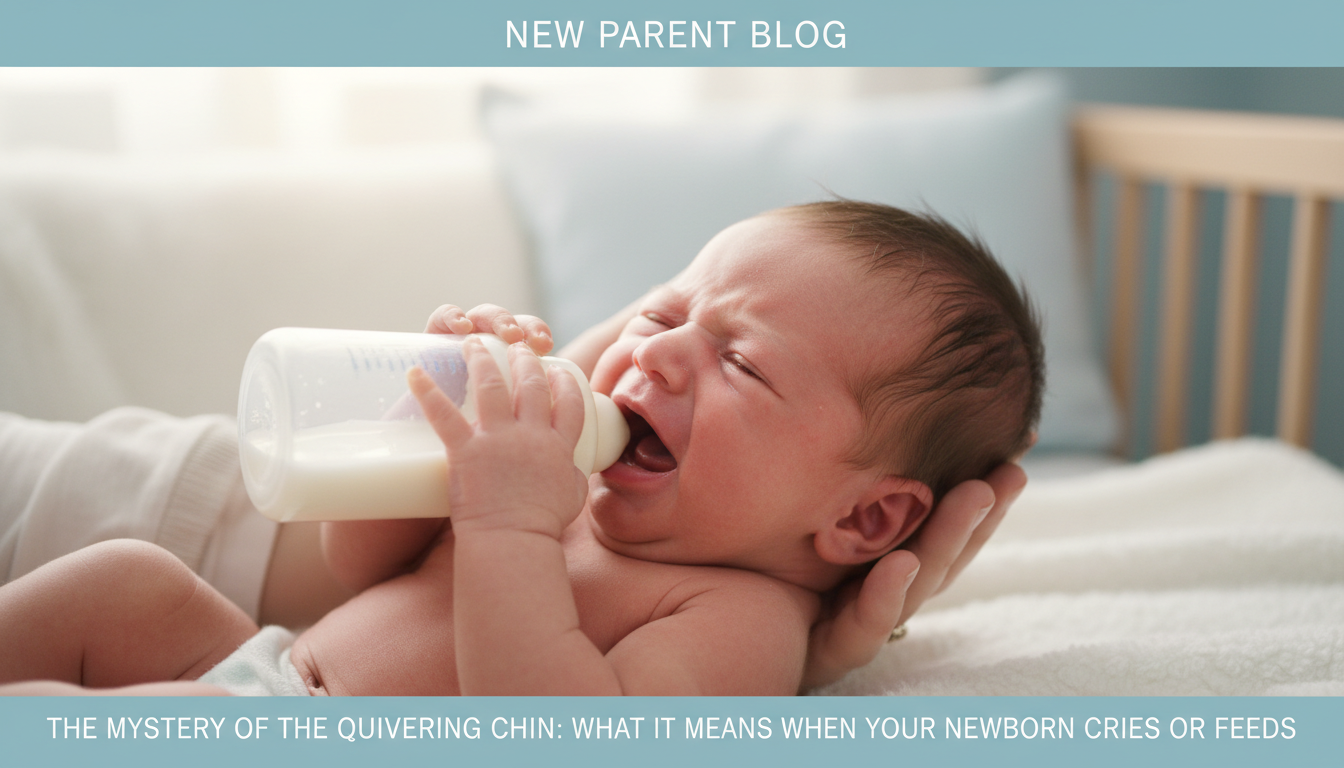
Newborn Chin Quiver When Crying or Feeding: Is It Normal?
Medically reviewed by Dr. Ahmad Raza, MD (Pediatrics) — ChildBloom Medical Review Panel. Last updated: August 03, 2026.
Editorial & affiliate disclosure: our guidance is written and reviewed by clinicians. ChildBloom may earn a commission from qualifying purchases made through links on this page, which never changes what our pediatric reviewers recommend.
If you are searching for answers about newborn chin quiver when crying, you are in the right place. This pediatrician-reviewed guide explains what is normal, what the likely causes are, the red flags that mean you should call your doctor, and what you can safely do at home — all based on current AAP, CDC and NIH guidance on newborn chin quiver when crying.
Newborn Chin Quiver When Crying or Feeding: Is It Normal or a Seizure? (2026 Pediatrician’s Guide)
Your newborn’s chin is trembling — a rapid, rhythmic quivering that appears when they cry, when they feed, or sometimes for no obvious reason. You watch it and think: is this normal? Is it a seizure? Is something wrong with their brain? You are not overreacting — the combination of an involuntary movement and the word “seizure” is one of the most anxiety-provoking questions in newborn parenting. This pediatrician-written guide explains exactly what chin quiver means, why it is almost always normal, the specific features that distinguish it from a seizure, and the rare red flags that warrant investigation.
Medically reviewed: Dr. Sophia Martinez, MD (Pediatrics) · Reviewed by Dr. Ahmed Raza, MD (Pediatrics) · Updated July 2026.
Quick Answer: Yes — a Chin Quiver Is Almost Always Normal
In the vast majority of newborns, a quivering or trembling chin is a normal manifestation of an immature nervous system. The medical term is benign neonatal jitteriness or benign neonatal tremulousness. It is caused by the immaturity of the neurological pathways that control fine motor movements — specifically, the underdeveloped connections between the brain and the muscles of the lower face. The chin quiver is a normal finding that resolves on its own as the nervous system matures, typically by 3-4 months of age. It is not a seizure, not a sign of brain damage, and not a predictor of any neurological problem. However, there are specific features that distinguish a normal chin quiver from a seizure, and every parent should know them.
Normal Chin Quiver vs. Seizure: The At-a-Glance Comparison
| Feature | Normal Chin Quiver (Benign Jitteriness) | Seizure (Warrants Evaluation) |
|---|---|---|
| What it looks like | Fine, rapid trembling of the chin only | Rhythmic jerking that may involve face, arms, legs, or whole body |
| Stops when you hold the chin | ✅ Yes — gentle pressure stops the quiver | ❌ No — continues despite gentle restraint |
| Stops when you reposition | ✅ Often stops when you change the baby’s position | ❌ Continues regardless of position |
| Stops when the baby stops crying | ✅ Almost always — the quiver is triggered by the effort of crying | ❌ May continue or start when baby is calm |
| Eye involvement | ❌ None — eyes are normal | ✅ Possible eye deviation, rolling, or fixed gaze |
| Color change | ❌ None — baby remains pink | ✅ Possible blue or pale color |
| Consciousness | ✅ Baby is fully alert and responsive between episodes | ❌ Baby may be unresponsive or lethargic after episode |
| Age peak | Birth to 4 months (resolves by 3-4 months) | Any age — no typical resolution |
| Asymmetry | ❌ Never — both sides of chin quiver equally | ✅ May be asymmetric (one side of face, one arm, one leg) |
Why Newborns Have Chin Quivers: The Neurological Explanation
To understand why chin quivers are normal, it helps to understand how the newborn nervous system is wired. At birth, the brain’s motor cortex — the part that controls voluntary movement — is underdeveloped. The pathways that send signals from the brain to the muscles are not fully myelinated (myelin is the insulating sheath that allows nerve signals to travel quickly and smoothly). Without full myelination, signals can “leak” or fire irregularly, causing small, involuntary muscle contractions. The chin — specifically the mentalis muscle, which controls the lower lip and chin area — is particularly prone to this because it has a high density of nerve endings and is activated during crying (which involves coordinated contraction of multiple facial muscles). The quiver is essentially the nervous system’s version of a static signal — the brain is sending a “cry” command, but the signal is not perfectly smooth, so the chin trembles. As myelination progresses — which happens rapidly in the first 3-4 months — the signals become smoother and the quiver disappears. This is the same reason some newborns have trembling hands or feet during the first few weeks of life.
When Chin Quivers Are Most Noticeable (Triggering States)
Normal chin quivers are typically triggered by specific states. The most common triggers are: crying (the quiver appears as the baby works up to a full cry and resolves as the cry subsides), feeding (the effort of sucking — especially vigorous feeding — can trigger a chin tremor), excitement or startle (a sudden noise, a new face, or a tickle can trigger a brief quiver), cold (shivering from cold can look like a chin quiver; warming the baby resolves it), hunger (the frustration of hunger can trigger jitteriness that resolves when feeding begins), and fatigue (overtired babies may have more noticeable jitteriness because their nervous system is already depleted). If the quiver occurs only during these states and resolves when the state changes, it is almost certainly normal benign neonatal jitteriness.
The “Hold the Chin” Test: A 10-Second Home Assessment
The single most useful home test for distinguishing benign chin quiver from a seizure is what pediatricians call the “hold and observe” test. When you see the chin quivering, gently place your finger on the baby’s chin — not holding it still, just touching it with light pressure. If the quiver stops with gentle touch, this is a normal finding. Seizure activity will not stop with gentle touch or repositioning. Then, if the quiver stops, observe the rest of the body. Is the baby’s body relaxed? Are the arms and legs still? Is the baby making eye contact and breathing normally? If the answer is yes to all three, the quiver is almost certainly benign. If the quiver is accompanied by stiffening of the arms or legs, rhythmic jerking of any other body part, eye deviation, or a change in skin color, this is not a simple chin quiver and warrants immediate medical evaluation.
The Five Red Flags That Require Medical Evaluation
While chin quivers are almost always normal, there are five specific situations where a pediatrician should evaluate the baby. First, if the chin quiver persists beyond 4 months of age — benign neonatal jitteriness should resolve as the nervous system matures. If it is still present at 5 or 6 months, a neurological evaluation is warranted. Second, if the quiver does not stop when the baby stops crying or feeding — normal jitteriness is triggered by effort and resolves when the effort stops. Third, if the quiver is accompanied by rhythmic jerking of the arms, legs, or eyes — this suggests the movement is not isolated to the chin and may be a seizure. Fourth, if the chin quiver is present when the baby is completely calm and relaxed — normal jitteriness occurs only during active states. Fifth, if the baby has any other neurological concerns — poor feeding, lethargy, poor muscle tone, poor eye contact, absence of social smile by 8 weeks, or failure to meet other developmental milestones.
The Single Most Important Thing: Video It
If you are worried about your baby’s chin quiver, the single most helpful thing you can do is record a video. A 30-60 second video of the quiver — showing the baby’s full body, not just the chin — is infinitely more useful to a pediatrician than a verbal description. Film in good light, show the baby’s face and body, record through a full cry cycle (start to finish), and if possible, show the quiver stopping when the cry stops. If you end up calling your pediatrician or visiting the ER, this video can save hours of observation and uncertainty. Many pediatricians now accept video uploads through patient portals for this exact purpose.
The Conditions That Can Look Like a Chin Quiver
Benign neonatal jitteriness (chin quiver) is the most common explanation, but there are three other conditions that can look similar. Neonatal hypoglycemia (low blood sugar) can cause jitteriness, tremors, and irritability. This is more common in babies of diabetic mothers, large-for-gestational-age babies, preterm babies, and babies who had a difficult delivery. The jitteriness from hypoglycemia affects the whole body — hands, feet, chin — and is accompanied by lethargy, poor feeding, and sometimes a bluish color. Neonatal hypocalcemia (low calcium) can also cause jitteriness and tremors, though this is rare in full-term healthy newborns. Neonatal abstinence syndrome (NAS) — withdrawal from opioids or other substances the baby was exposed to in utero — causes tremors, jitteriness, high-pitched crying, poor feeding, and irritability. If there was any substance use during pregnancy, this needs to be disclosed to the pediatrician for appropriate evaluation and treatment. If your baby has a chin quiver and any of these risk factors are present — maternal diabetes, prematurity, difficult delivery, or in-utero substance exposure — mention them to your pediatrician.
Age Timeline: When the Chin Quiver Should Resolve
Benign neonatal jitteriness follows a predictable timeline. At birth to 2 weeks, the quiver is most noticeable — the newborn nervous system is at its most immature, and the chin may tremble with every cry or vigorous feed. At 2 weeks to 2 months, the quiver begins to decrease in frequency and intensity — the nervous system is myelinating rapidly and the movements become smoother. At 2-4 months, the quiver is intermittent — it may appear only during very vigorous crying or when the baby is overtired. Beyond 4 months, the quiver should be gone or extremely rare. If the quiver is still present and easily triggered at 5 months, mention it at your next well-child visit. The vast majority of babies outgrow chin quivers completely without any intervention or treatment.
What NOT to Do When You See a Chin Quiver
When you see your baby’s chin trembling, your instinct may be to rush to the ER or call 911. Here is what not to do: do not assume it is a seizure (the comparison table above will help you distinguish them — the vast majority of chin quivers are not seizures); do not shake or jostle the baby to try to stop the quiver (this does not help and can be dangerous — shaking a baby can cause shaken baby syndrome, which is life-threatening); do not withhold feeds because you think the quiver means something is wrong (the quiver is not a sign of illness and feeding does not need to be interrupted); do not spend the night searching the internet for answers (you are reading a pediatrician-reviewed guide right now — close the other tabs and trust what you have learned here); and do not let the anxiety keep you from sleeping (if the quiver meets all the criteria for normal benign jitteriness — only during crying/feeding, stops when the state changes, no other symptoms — you can safely wait until your next well-child visit to mention it).
When Other Family Members Notice the Chin Quiver
A common scenario pediatricians hear: “My mother-in-law saw the baby’s chin quivering and said it looked like a seizure.” Family members who have not seen many newborns may interpret the quiver as something more serious than it is. The truth is that benign neonatal jitteriness is so common that most pediatricians see it multiple times per week. If a family member expresses concern, show them this guide, demonstrate the “hold the chin” test (the quiver stops with gentle touch), and explain that the baby’s pediatrician has reviewed the current medical guidance on this topic. The reassurance of a pediatrician-reviewed resource often calms worried grandparents more effectively than anything else.
The Connection Between Chin Quiver and Breastfeeding Success
Some lactation consultants and breastfeeding mothers notice that a chin quiver seems more pronounced during breastfeeding than bottle feeding. This is normal — breastfeeding requires more coordinated facial muscle activity (the baby must create a vacuum, rhythmically compress the areola, and coordinate suck-swallow-breathe), and the increased neurological demand can trigger more noticeable jitteriness. If the chin quiver is affecting breastfeeding confidence, know that the quiver itself does not interfere with the baby’s ability to transfer milk effectively. The baby’s sucking mechanism is driven by a different set of muscles and nerves than the chin tremor. If the baby is gaining weight appropriately, producing adequate wet diapers, and the quiver resolves when the feed ends, breastfeeding is proceeding normally. Some mothers find that switching to a side-lying or laid-back breastfeeding position reduces the quiver by decreasing the effort required to maintain the latch.
Frequently Asked Questions
Can a chin quiver be a sign of cerebral palsy?
Extremely unlikely as an isolated finding. Cerebral palsy typically presents with other signs — persistent low muscle tone, delayed milestones, asymmetric movements, difficulty feeding from birth — not an isolated chin quiver that resolves by 4 months.
Does a chin quiver mean my baby has low calcium?
In a full-term, healthy newborn with no risk factors, an isolated chin quiver is almost never a sign of hypocalcemia. Low calcium would cause whole-body tremors, not just chin quivering.
My baby’s chin quivers when they are not crying — should I worry?
A chin quiver that appears when the baby is completely calm and relaxed is more concerning than one that appears only during crying or feeding. If the quiver occurs at rest, mention it to your pediatrician within the next 24 hours.
Is a chin quiver more common in premature babies?
Yes. Preterm babies have even less mature nervous systems than full-term babies, so jitteriness — including chin quivers — is more common and may persist longer (up to 4-6 months corrected age instead of 3-4 months).
Should I wake my baby up if I see a chin quiver during sleep?
No. Chin quivers during sleep can occur during active (REM) sleep and are normal. If the quiver is not accompanied by rhythmic jerking of the limbs or eye deviation, do not wake the baby.
My 2-month-old has a chin quiver that seems to be getting worse — is that normal?
A chin quiver that worsens over time rather than improving is a yellow flag. While benign jitteriness typically peaks in the first 2 weeks and gradually fades, some babies have a slightly different timeline. If you are sure it is getting more frequent or more intense at 2 months, mention it to your pediatrician.
Related Reading on ChildBloom
- Baby Rolling Eyes Back When Sleeping: Normal or Seizure?
- Newborn Sounds: What They Mean
- Baby Crying in Sleep But Not Awake
- Newborn Sleep Schedule: First 12 Weeks
Written by Dr. Sophia Martinez, MD (Pediatrics) · Medically reviewed by Dr. Ahmed Raza, MD (Pediatrics) · Updated July 2026.
Disclaimer: This article is for informational purposes only and does not replace individualized medical advice from your child’s pediatrician.
📖 More from the Pediatrician’s Corner Hub: your complete pediatrician-reviewed guide to your baby’s first year — milestones, feeding, sleep, vaccines, common illnesses, and more
📖 More from the Health & Safety Hub: your A-Z pediatrician guide to baby health, common illnesses, fevers, rashes, allergies, safety
Newborn Chin Quiver When Crying or Feeding: quick pediatrician summary
Feeding problems are usually about position, pace and volume before they are about the milk itself. Check the latch or nipple flow first, feed on early hunger cues instead of crying, keep your baby upright and calm for a few minutes afterwards, and count wet diapers and weight gain as the real scoreboard. Escalate to your pediatrician or an IBCLC if intake drops, weight gain stalls, feeds are consistently painful, or your baby seems distressed at every feed.
Common mistakes parents make
- Treating a single measurement or one bad day as a trend instead of watching the pattern over several days.
- Trying several remedies at once, so it becomes impossible to tell what helped.
- Waiting for a convenient time to call when a red flag is already present — feeding, breathing and alertness changes are always worth a same-day call.
- Following advice from an unsourced social post rather than your own pediatrician, who knows your child’s history and growth curve.
Related guides from our pediatric team
- The Pediatrician’s Guide to Baby Feeding: From First Bottle to F
- Breastfeeding Latch and Positions: A Newborn Starter Guide
- Baby Arching Back When Feeding and Screaming: What Is Wrong?
- Baby Hiccups After Feeding: Normal or Something to Worry About?
- More expert answers in Pediatrician’s Corner
References and further reading
Medical disclaimer
This article is for general education and is not a substitute for individual medical advice, diagnosis or treatment. Every child is different — talk to your own pediatrician about your baby, and seek urgent care for breathing difficulty, poor feeding, dehydration, unusual sleepiness, fever in an infant under 3 months, or any sudden change in your child’s condition.




4 Comments