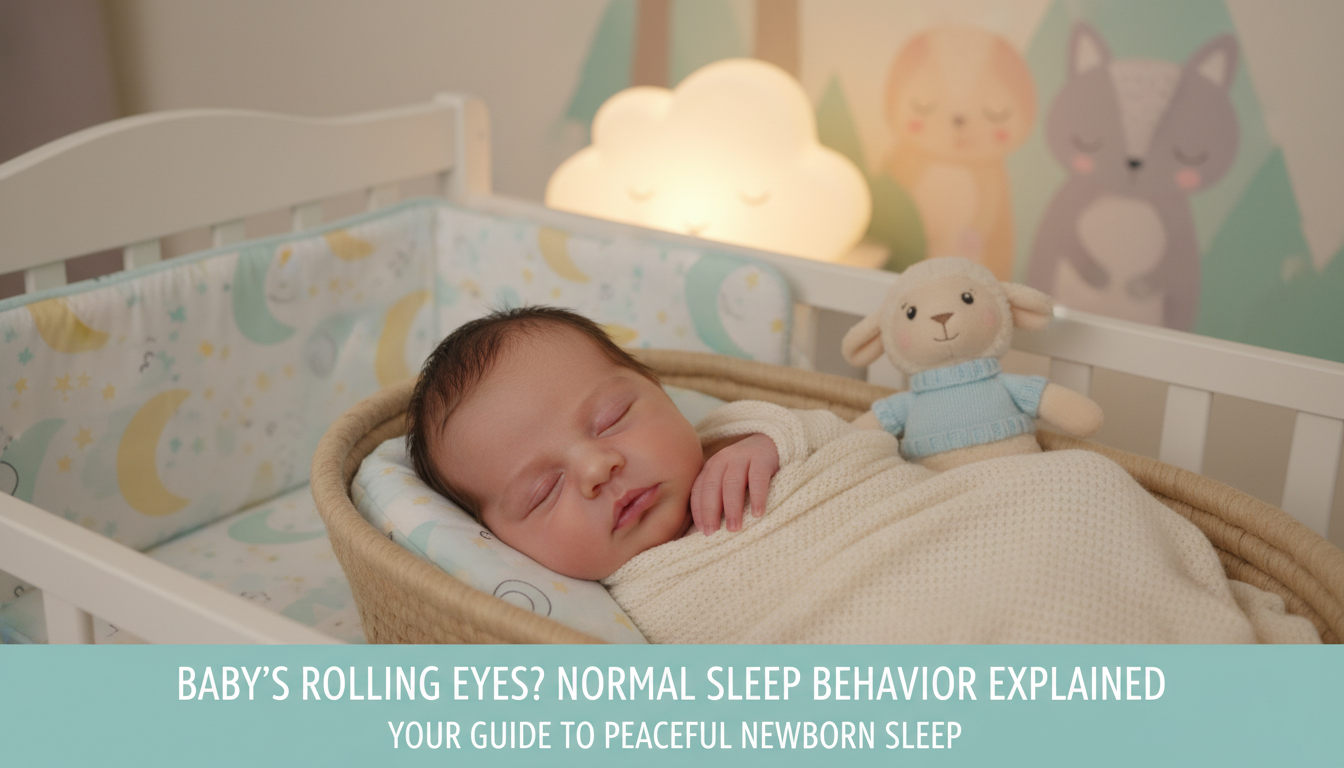
Baby Rolling Eyes Back When Sleeping: Is It Normal or a Seizure? (2026 Pediatrician’s Guide)
Medically reviewed by Dr. Ahmad Raza, MD (Pediatrics) — ChildBloom Medical Review Panel. Last updated: August 03, 2026.
For the full picture, read our pillar guide on Newborn Sleep Problems: A Pediatrician’s Complete Guide to Baby Sleep .
Editorial & affiliate disclosure: our guidance is written and reviewed by clinicians. ChildBloom may earn a commission from qualifying purchases made through links on this page, which never changes what our pediatric reviewers recommend.
If you are searching for answers about baby rolling eyes back when sleeping, you are in the right place. This pediatrician-reviewed guide explains what is normal, what the likely causes are, the red flags that mean you should call your doctor, and what you can safely do at home — all based on current AAP, CDC and NIH guidance on baby rolling eyes back when sleeping.
Baby Rolling Eyes Back When Sleeping: Is It Normal or a Seizure? (2026 Pediatrician’s Guide)
You walk into the nursery to check on your sleeping baby — and you see their eyes rolled back so that only the whites are visible. Your heart stops. Is this normal? Is it a seizure? Is your baby’s brain OK? You are not alone — this is one of the most common panicked searches parents make at 2 AM, and the answer is almost always reassuring. This pediatrician-written and reviewed guide explains exactly why babies roll their eyes during sleep, the specific features that distinguish normal REM sleep eye movements from seizures, and the rare red flags that warrant medical evaluation.
As an Amazon Associate, we earn from qualifying purchases.
B0C9N8M7P6 Product does not exist anymore.
Medically reviewed: Dr. Sophia Martinez, MD (Pediatrics) · Reviewed by Dr. Ahmed Raza, MD (Pediatrics) · Updated July 2026.
Quick Answer: Eye Rolling During Sleep Is Usually Normal
In the vast majority of cases, a baby whose eyes roll back during sleep is simply in active (REM) sleep — the phase where dreaming occurs and where the brain does the heavy lifting of neural development. The eye movements that characterize REM sleep — rapid, darting, rolling, and sometimes prolonged upward deviation — are a normal, healthy part of infant sleep architecture. Newborns spend approximately 50% of their sleep time in active REM (compared to 20% in adults), which means you see these eye movements far more often than you might expect. A baby whose eyes roll back briefly during sleep, with no other concerning signs, is almost certainly experiencing normal REM sleep, not a seizure. The exceptions — and the specific features that distinguish normal from abnormal — are what this guide will teach you.
Normal vs. Seizure Eye Rolling: The Complete Comparison
| Feature | Normal REM Sleep Eye Movements | Seizure (Warrants Evaluation) |
|---|---|---|
| When it occurs | Only during sleep, never when awake | Can occur during sleep OR wakefulness |
| Eye movement pattern | Rapid, darting, brief rolling — eyes move in different directions quickly | Sustained upward or sideways gaze — eyes stay fixed in one position for 10+ seconds |
| Duration | 1-3 seconds per eye movement, then eyes close or move to a different position | 5-30+ seconds of sustained deviation |
| Can you interrupt it? | Yes — gentle touch or sound may stop the eye movement or change the baby’s sleep stage | No — continues despite stimulation |
| Body involvement | None — only eye movements; body is relaxed or may have small twitches | Often accompanied by stiffening, rhythmic jerking of limbs, or both |
| Breathing | Normal or mildly irregular — may pause briefly (periodic breathing) but no distress | May be irregular, labored, or stop temporarily |
| Color | Pink, normal | May become pale, blue, or grey around the lips |
| Baby’s response afterward | Continues sleeping normally or wakes up normally | May be lethargic, confused, irritable, or difficult to wake after the episode |
| Frequency | Several times per sleep cycle — normal | Rare, but when present, follows a pattern (same time, same duration each night) |
Why Newborn Eye Movements Are So Pronounced During Sleep
The eye movements of REM sleep are generated by the brainstem — specifically, the pons — which sends signals to the muscles that control eye movement. In newborns, the brainstem’s control over these signals is less regulated than in older children and adults. The result is that eye movements during REM sleep can be more dramatic, more frequent, and sometimes prolonged. A baby’s eyes may roll upward so far that only the whites are visible (called “Bell’s phenomenon”), they may dart rapidly back and forth (called “nystagmoid jerking”), or they may drift slowly to one side and then snap back. All of these are normal variations of REM sleep eye movements in infants. This is also why premature babies — whose nervous systems are even less mature — may have even more dramatic eye movements during sleep. As the baby’s brain matures, typically by 4-6 months, the eye movements become less pronounced and more similar to adult REM sleep patterns.
The Three Types of Benign Eye Movements in Sleeping Babies
Type 1: Bell’s phenomenon (upward eye rolling). This is the most common and most alarming to parents. The baby’s eyes roll upward so that the irises disappear behind the upper eyelids, leaving only the whites visible. This is a normal reflex — the same reflex that causes adults to roll their eyes upward during deep relaxation or just before falling asleep. It is especially common in newborns because the neurological coordination of eye muscles is immature. The movement is typically brief — 1-5 seconds — and the eyes return to a neutral position or close. It can occur multiple times during a single sleep cycle.
Type 2: Rapid conjugate eye movements (REM darting). Both eyes move rapidly and synchronously in the same direction — typically horizontal (side to side) but sometimes vertical (up and down) or rotatory (circular). These movements are the hallmark of active REM sleep and are identical to the eye movements adults make during dreaming. They last 1-3 seconds and occur in bursts, separated by periods of quiet. This is the most diagnostic sign that the baby is in healthy, active REM sleep.
Type 3: Slow conjugate eye drift. Both eyes slowly drift to one side — usually left or right — and then slowly return to center or snap back. This can look like the baby is “looking” at something to the side while sleeping. This is a transitional eye movement that occurs as the baby moves from deep sleep to light sleep or vice versa. It is normal and does not indicate a neurological problem.
The Five Red Flags That Require Medical Evaluation
While eye rolling during sleep is overwhelmingly normal, there are five specific situations where a pediatrician should evaluate the baby. First, sustained upward or sideways gaze lasting more than 10 seconds — normal REM eye movements are brief and changing; sustained deviation (the eyes stay fixed in one position) is more concerning. Second, eye rolling that is accompanied by rhythmic jerking of the arms or legs — normal REM sleep may include small twitches, but rhythmic, sustained jerking of the limbs involving the whole arm or leg is not a normal sleep movement. Third, eye rolling that occurs when the baby is awake — REM eye movements occur only during sleep; if the eyes roll back while the baby is awake and alert, this is always abnormal and requires prompt evaluation. Fourth, eye rolling accompanied by color change — blue, grey, or pale skin, especially around the lips, indicates that the baby is not getting enough oxygen and is a medical emergency. Fifth, eye rolling followed by lethargy or difficulty waking — after a normal REM sleep episode, a baby can be woken normally; if the baby is difficult to wake, is limp, or seems confused after an eye-rolling episode, this is a red flag for a post-ictal state (the period after a seizure).
How to Tell If Your Baby Is Having a Seizure: The Complete Infant Seizure Guide
Infant seizures can look very different from the dramatic “convulsing on the floor” seizures that adults imagine. In newborns and young infants, seizures are often subtle — which is both reassuring (most apparent “seizure-like” activity in infants is actually normal) and concerning (true seizures can be missed because they do not look like what parents expect). The most common types of infant seizures are: focal clonic seizures (rhythmic jerking of one arm, one leg, or one side of the face, typically 1-2 jerks per second, that does not stop when you hold the limb), tonic seizures (sustained stiffening of the arms, legs, or trunk lasting 10-60 seconds, often with the eyes rolling upward and staying fixed), myoclonic seizures (sudden, brief, shock-like jerks of the whole body or part of the body, like the baby was startled, but without an obvious trigger), subtle seizures (eye deviation to one side sustained for 10+ seconds, repetitive blinking or eyelid fluttering, lip smacking or chewing movements without anything in the mouth, or pedaling movements of the legs — these are the most common type in newborns and the easiest to miss or misinterpret as normal sleep movements). If you suspect a seizure, try to take a video of the episode and call your pediatrician or go to the ER depending on severity.
The Video Rule: Why You Should Record Eye-Rolling Episodes
A 30-60 second video of your baby’s eye-rolling episode is the single most valuable diagnostic tool you can provide to your pediatrician. Here is how to take a video that a pediatrician can actually use: film in good light, show the baby’s full face and body clearly, record for at least 30 seconds of continuous activity (do not start and stop — pediatricians need to see the full duration and how the episode ends), narrate what you see (“Baby’s eyes rolled up at 10 seconds, stayed up for 5 seconds, now back to normal”), try to gently touch or talk to the baby during the episode to see if the eye movement stops or changes, and show the baby’s face clearly so skin color can be assessed. Many pediatricians now accept video uploads through patient portals — a video can often save a trip to the ER if the eye movements clearly match the normal pattern described in this guide. Conversely, a video can confirm a seizure pattern that might otherwise be dismissed by a doctor who only hears your verbal description over the phone.
Benign Sleep Myoclonus: The Condition That Mimics Seizures
A separate condition called benign neonatal sleep myoclonus can also look like a seizure — and is equally benign. In this condition, babies have rhythmic jerking movements of the arms and legs — often both sides simultaneously — that occur only during sleep and stop immediately when the baby is woken. The jerking looks dramatic and seizure-like, but the key distinguishing feature is the “wake-up test”: if you wake the baby during an episode, the jerking stops instantly and the baby is alert and normal. In a true seizure, the movement either continues despite waking or the baby is difficult to wake afterward. Benign sleep myoclonus is harmless, does not require treatment, and resolves on its own by 6-12 months of age. If your baby has eye rolling and limb jerking during sleep that stops when they wake up, this is likely benign sleep myoclonus — not a seizure.
Related reading: Baby Witching Hour: Why It Happens & How to Survive It.
When Eye Rolling Is Not Sleep-Related: The Other Causes
While this guide focuses on eye rolling during sleep, it is worth noting that eye rolling can also occur in other contexts. Vestibular immaturity — when babies are picked up, moved quickly, or spun around, their immature vestibular system (the inner ear balance system) can cause a brief upward eye roll, similar to the “doll’s eye reflex” — this is normal in newborns and resolves as the vestibular system matures. Nystagmus — a repetitive, involuntary to-and-fro movement of the eyes that can be present from birth (congenital nystagmus) — causes the eyes to “beat” rhythmically in one direction and then slowly drift back, and this is present both during sleep and wakefulness. Congenital nystagmus is usually benign but requires an ophthalmology evaluation. Infantile spasms (a rare but serious seizure disorder that begins at 3-12 months) can cause subtle eye movements along with brief, symmetric contractions of the trunk — these are very different from isolated eye rolling and require immediate neurological evaluation. If the eye rolling is accompanied by any full-body movements (even very brief ones, like the baby’s arms shooting out or the head dropping forward), mention this to your pediatrician.
The Wait-and-Watch Protocol: What to Do When You See Eye Rolling
When you see your baby’s eyes roll back during sleep, here is exactly what to do. First, stop and observe for 10 seconds. Do not rush to pick up the baby or turn on the lights — these actions disrupt the sleep cycle and prevent you from seeing the full picture. Count the seconds of sustained eye deviation — if it is under 5 seconds and the eyes are moving, it is normal REM activity. Second, check the rest of the body. Is the body relaxed? Are there any rhythmic jerking movements of the arms or legs? Is the baby breathing normally and maintaining good color? If all checks are normal, this is almost certainly normal REM sleep. Third, gently place your hand on the baby’s chest or gently say their name. If the eye movement stops or changes, this is reassuring — seizure activity would not stop with gentle stimulation. Fourth, record a video if you remain concerned. Show it to your pediatrician at your next visit or upload it to the patient portal. Fifth, reassure yourself with this knowledge: isolated eye rolling during sleep, without any other concerning signs, has never been the only symptom of a serious neurological problem in an otherwise healthy infant.
Frequently Asked Questions
My baby’s eyes roll back and they don’t respond for a few seconds — is that a seizure?
If the baby is asleep and the non-responsiveness lasts under 10 seconds, this can be normal deep sleep. If the baby is awake and not responding, or the episode lasts longer than 10 seconds, record a video and call your pediatrician.
Can eye rolling during sleep be a sign of autism?
No. Eye rolling during sleep is a normal neurological phenomenon and is not associated with autism or any other developmental condition.
Should I wake my baby up if I see their eyes rolling?
Only if you are truly worried about a seizure. In most cases, you should not wake the baby — interrupting REM sleep to “check on them” increases your anxiety and disrupts their sleep without providing any safety benefit.
How do I know if my baby is having a seizure in their sleep?
The key features of a sleep seizure are: sustained eye deviation lasting 10+ seconds, rhythmic jerking of limbs that does not stop when you hold the limb, color change (blue or pale), and difficulty waking the baby afterward. If none of these are present, the eye rolling is almost certainly normal REM sleep.
Can eye rolling during sleep be caused by a fever?
Febrile seizures can cause eye rolling, but they are accompanied by whole-body stiffening or jerking, not isolated eye movements. If your baby has a fever and isolated eye rolling without body involvement, a febrile seizure is not the diagnosis.
See also: Newborn Startles Awake Constantly and Will Not Sleep.
At what age do babies stop rolling their eyes during sleep?
Eye movements during REM sleep become less dramatic as the nervous system matures, typically by 4-6 months. However, all humans (including adults) have REM sleep eye movements — they just become less visible and less pronounced with age.
- Newborn Chin Quiver: Normal or Seizure?
- Baby Crying in Sleep But Not Awake
- Newborn Sleep Schedule: First 12 Weeks
- Baby Suddenly Crying at Night: 3 Months Old
Written by Dr. Sophia Martinez, MD (Pediatrics) · Medically reviewed by Dr. Ahmed Raza, MD (Pediatrics) · Updated July 2026.
Disclaimer: This article is for informational purposes only and does not replace individualized medical advice from your child’s pediatrician.
📖 More from the Pediatrician’s Corner Hub: your complete pediatrician-reviewed guide to your baby’s first year — milestones, feeding, sleep, vaccines, common illnesses, and more
Baby Rolling Eyes Back When Sleeping: quick pediatrician summary
Safe sleep comes first, then schedule. Your baby belongs alone, on the back, on a firm flat surface with nothing else in the space — no pillows, bumpers, positioners or loose bedding — for every sleep including naps. Once that is fixed, most night-waking problems are age-appropriate wake windows, hunger, or an over- or under-tired baby rather than a sleep disorder. Talk to your pediatrician about pauses in breathing, loud persistent noisy breathing, or sleepiness so deep your baby will not wake to feed.
Common mistakes parents make
- Treating a single measurement or one bad day as a trend instead of watching the pattern over several days.
- Trying several remedies at once, so it becomes impossible to tell what helped.
- Waiting for a convenient time to call when a red flag is already present — feeding, breathing and alertness changes are always worth a same-day call.
- Following advice from an unsourced social post rather than your own pediatrician, who knows your child’s history and growth curve.
- Newborn Sleeping Too Much and Not Eating: Should I Worry?
- Baby Breathing Fast While Sleeping No Fever | When to Worry
- Newborn Congestion at Night Only But Fine During Day: What to Do
- Baby Crying in Sleep But Not Awake at Night: What to Do
- More expert answers in Pediatrician’s Corner
- AAP safe sleep recommendations (2022)
- NIH Safe to Sleep campaign
- CDC infant sleep and SUID data
Medical disclaimer
This article is for general education and is not a substitute for individual medical advice, diagnosis or treatment. Every child is different — talk to your own pediatrician about your baby, and seek urgent care for breathing difficulty, poor feeding, dehydration, unusual sleepiness, fever in an infant under 3 months, or any sudden change in your child’s condition.
Related ChildBloom Guides
- Start here: Newborn Sleep Problems: A Pediatrician’s Complete Guide to Baby Sleep
- Newborn Sleeps Too Much and Will Not Feed
- Newborn Waking Every Hour? Causes, Fixes & When to Worry
- Why Does My Baby Cry Every Evening? Understanding PURPLE Crying & Coli
- How Long Should Newborn Sleep? Daily Hours & 0–3 Month Guide
- Newborn Day Night Confusion
- Browse all Sleep & Nursery guides
References & Medical Sources
- NICHD Safe to Sleep: safe sleep environment
- AAP parent guide to safe sleep
- NICHD infant sleep research overview
- NHS advice on helping your baby sleep
Reviewed by the ChildBloom pediatric panel. Learn about our physicians on the About page. This article is educational and does not replace your child’s clinician.



3 Comments