Baby Eyes Crossed Sometimes: Is It Normal or a Sign of Strabismus? (2026 Pediatrician’s Guide)
Medically reviewed by Dr. Ahmad Raza, MD (Pediatrics) — ChildBloom Medical Review Panel. Last updated: August 03, 2026.
Editorial & affiliate disclosure: our guidance is written and reviewed by clinicians. ChildBloom may earn a commission from qualifying purchases made through links on this page, which never changes what our pediatric reviewers recommend.
If you are searching for answers about baby eyes crossed sometimes, you are in the right place. This pediatrician-reviewed guide explains what is normal, what the likely causes are, the red flags that mean you should call your doctor, and what you can safely do at home — all based on current AAP, CDC and NIH guidance on baby eyes crossed sometimes.
Baby Eyes Crossed Sometimes: Is It Normal or a Sign of Strabismus? (2026 Pediatrician’s Guide)
Medically reviewed: Dr. Sophia Martinez, MD (Pediatrics) · Reviewed by Dr. Ahmed Raza, MD (Pediatrics) · Updated July 2026.
You look at your baby and notice their eyes are not pointing in the same direction. One eye drifts inward while the other looks straight ahead. Your heart drops. You immediately think of lazy eye, vision problems, or something wrong with their brain. The truth is that intermittent crossing of the eyes is extremely common in newborns and young infants and is almost always normal. But there is a critical difference between normal newborn eye crossing and strabismus that requires treatment.
Quick Answer: Intermittent Eye Crossing in Newborns Is Usually Normal
In newborns and infants under 4 months, intermittent crossing of the eyes is called transient infantile esotropia and is a normal finding. It occurs because the baby’s visual system is still developing. The muscles that control eye position are not yet coordinated, and the part of the brain that fuses the images from both eyes into a single picture (binocular vision) is not fully developed. Most babies outgrow this by 4-6 months of age. However, there are specific features that distinguish normal infant eye crossing from pathologic strabismus (a misalignment that requires treatment), and understanding the difference can help you know when to watch and when to act.
Normal Eye Crossing vs. Strabismus: How to Tell the Difference
| Feature | Normal Newborn Eye Crossing | Strabismus (Needs Evaluation) |
|---|---|---|
| When it occurs | Intermittently — comes and goes, not constant | Constant or very frequent — the eye is crossed most or all of the time |
| Age | Resolves by 4-6 months | Persists beyond 4-6 months or appears for the first time after 6 months |
| Which eye crosses | Alternates — sometimes the left, sometimes the right | Always the same eye — this is called unilateral strabismus |
| Eye alignment at rest | Eyes are straight when the baby is looking at something far away or when relaxed | Misalignment is present even when the baby is not actively focusing |
| Baby’s response | Baby does not seem bothered, both eyes move together when tracking | Baby may tilt or turn their head to use one eye, may close one eye in bright light |
| Family history | No specific family history | Family history of strabismus, amblyopia (lazy eye), or childhood eye surgery |
| Causes | Immature visual system, wide nasal bridge (pseudostrabismus) | Muscle imbalance, refractive error, neurological condition |
Pseudostrabismus: When a Crossed Eye Is Not Actually Crossed
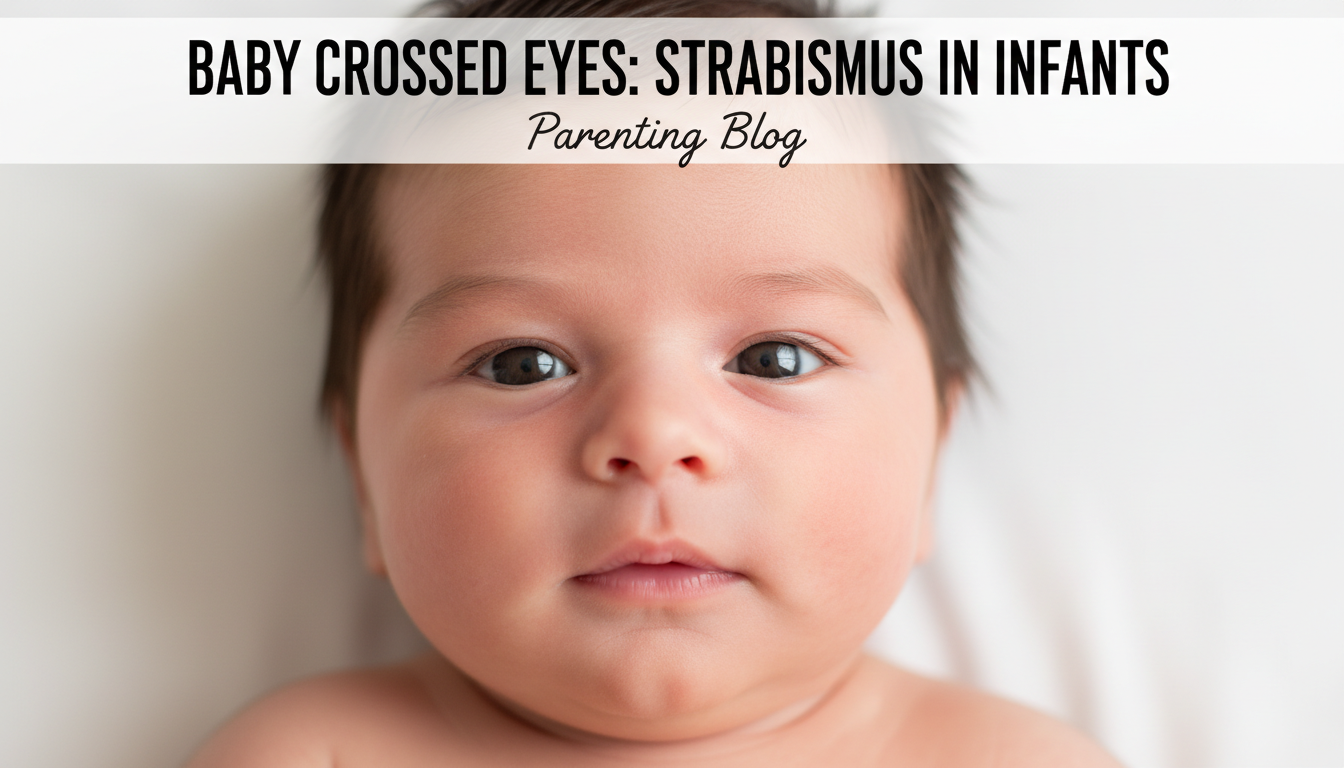
Many babies who appear to have crossed eyes actually have pseudostrabismus (false strabismus). Pseudostrabismus occurs when a baby’s wide, flat nasal bridge and prominent skin folds at the inner corners of the eyes (epicanthal folds) cover part of the white of the eye, making the eye look like it is turned inward when it is actually perfectly straight. This is extremely common in infants of Asian, Hispanic, and Native American descent, and in babies with wide-set eyes. To test for pseudostrabismus: use a small flashlight and shine it directly at the baby’s eyes from about 12-18 inches away. Look at the light reflection on each cornea (the front of the eye). If the light reflection is in the same position on both eyes (center of each pupil), the eyes are aligned and the crossing is an illusion caused by the facial structure. If the light reflection is off-center in one eye (closer to the inner or outer corner of the eye), there is true misalignment. This is called the Hirschberg corneal light reflex test and is the same test your pediatrician uses.
When Does Eye Coordination Develop?
Eye alignment follows a predictable developmental timeline. Birth to 2 months: eyes may appear to wander independently. Brief, intermittent crossing or drifting is normal. The baby can focus on objects 8-12 inches away but coordination is poor. 2-4 months: eye coordination improves significantly. The baby can track a moving object with both eyes together for brief periods. Intermittent crossing may still occur, especially when the baby is tired or focusing on something very close. 4-6 months: binoculary vision (the ability to fuse images from both eyes) develops. Eye crossing should resolve or become very rare. By 6 months, eyes should be aligned and move together consistently. Beyond 6 months: any persistent or new-onset eye crossing requires evaluation by a pediatric ophthalmologist.
The Different Types of Strabismus
Esotropia (eyes turn inward): The most common type of strabismus in infants. One or both eyes turn toward the nose. Intermittent esotropia in newborns is normal. Constant esotropia after 4-6 months requires treatment. Exotropia (eyes turn outward): One eye drifts outward, toward the ear. This is less common in infants and more common in toddlers. Intermittent exotropia that appears when the baby is tired or looking at something far away is often normal. Constant exotropia requires evaluation. Hypertropia (one eye higher): One eye is positioned higher than the other. This is less common and more likely to be associated with a neurological condition or muscle imbalance. Any persistent vertical misalignment requires evaluation. Also note that accommodative esotropia is a type of strabismus that appears around 2-3 years of age when the child develops farsightedness and the eyes cross when focusing on near objects. This is treated with glasses and sometimes surgery.
Why Treating Strabismus Matters: The Amblyopia Risk
The reason strabismus requires treatment is not cosmetic — it is functional. When the eyes are misaligned, the brain receives two different images and cannot fuse them into a single picture. To avoid double vision, the brain begins to ignore (suppress) the image from the crossed eye. If this suppression continues for weeks or months, the brain permanently loses the ability to see from that eye, a condition called amblyopia (lazy eye). Amblyopia is treatable if caught early (before age 5-7) but becomes irreversible after that. The earlier strabismus is treated, the better the visual outcome. Treatment options include: patching (covering the stronger eye to force the brain to use the weaker eye), glasses (to correct refractive errors that cause the eye to cross), eye drops (atropine drops in the stronger eye to blur vision and force use of the weaker eye), and strabismus surgery (to adjust the eye muscles). Most children with strabismus who are treated early achieve normal or near-normal vision.
The Age-By-Age Guide to Crossed Eyes
0-4 Months:
Intermittent eye crossing is normal. No evaluation needed unless the crossing is constant (the eye is always turned in) or one eye is always the one that crosses. If the crossing is intermittent and alternates between eyes, it is almost certainly normal.
4-6 Months:
Eye crossing should be decreasing. If crossing is still frequent at 5 months, mention it to your pediatrician. Most pediatricians perform a formal eye alignment screening at the 6-month well-child visit.
6-12 Months:
Any eye crossing at this age is abnormal and requires evaluation by a pediatric ophthalmologist. The crossing may be subtle — the eye may drift inward only when the baby is tired or looking at something close. Even intermittent crossing at this age should be evaluated.
12+ Months:
Any new-onset eye crossing in a toddler requires evaluation. Even if the crossing is intermittent, it can still cause amblyopia if left untreated.
Crossed Eyes in Babies: When to Refer to a Specialist
Your pediatrician will screen for eye alignment problems at well-child visits, but you should request a referral to a pediatric ophthalmologist in certain situations. If your baby’s eyes are crossed at all times, not just intermittently, after 4 months of age, a specialist evaluation is needed. If one eye is consistently crossed while the other eye is straight, or if the crossing alternates between eyes, these patterns suggest a vision problem rather than normal newborn eye alignment. If your baby has a family history of strabismus, amblyopia, or other eye conditions in a first-degree relative, early evaluation is recommended even if the eyes appear straight. If your baby tilts or turns their head frequently to look at things, this can be a compensatory mechanism for double vision caused by misaligned eyes. If your baby closes one eye in bright light, this can indicate that one eye is more sensitive to light or that the brain is suppressing the image from one eye to avoid double vision. If your baby seems to have difficulty tracking objects or does not make eye contact, these are additional reasons for evaluation. Early referral is important because the brain’s visual system is most plastic in the first 7 years of life, and early treatment leads to better outcomes. Most children with strabismus who are treated early achieve normal or near-normal vision.
Frequently Asked Questions
My baby’s eyes cross when they are tired — is that normal?
Yes. Eye coordination is one of the first skills to decline with fatigue. A baby whose eyes cross only when tired but are straight when well-rested is almost certainly normal. However, mention it at your next well-child visit for documentation.
Will my baby outgrow crossed eyes without treatment?
Babies outgrow normal newborn eye crossing (which resolves by 4-6 months). They do not outgrow true strabismus. If your baby has true strabismus (constant crossing, same eye always crossing, or persistence beyond 6 months), treatment is needed.
Can screen time cause crossed eyes in babies?
There is no evidence that screen time causes strabismus. However, excessive screen time in young children is associated with other vision problems, including digital eye strain and myopia. The American Academy of Pediatrics recommends no screen time for children under 18 months.
Does eye crossing at 2 months mean my baby needs glasses?
No. Eye crossing at 2 months is almost always due to immature eye coordination, not refractive error. Glasses are not typically prescribed for infants under 6 months unless there is a significant refractive error detected by specialized testing.
Related Reading on ChildBloom
- Baby Rolling Eyes Back When Sleeping: Normal or Seizure?
- Newborn Chin Quiver: Normal or Seizure?
- Baby Not Smiling at 2 Months
When to Call Your Pediatrician
Call your pediatrician if: your baby’s eyes are crossed constantly (not intermittently), one eye always crosses while the other stays straight, the crossing persists beyond 4-6 months, the crossing appears for the first time after 6 months, or if your baby seems to have difficulty seeing (not tracking faces, not reaching for objects, bumping into things). For intermittent crossing in a baby under 4 months, no action is needed — but take a photo or video to show your pediatrician at the next well-child visit.
Written by Dr. Sophia Martinez, MD (Pediatrics) · Medically reviewed by Dr. Ahmed Raza, MD (Pediatrics) · Updated July 2026.
Disclaimer: This content is for informational purposes only.
Vision Development in Babies: A Timeline
Understanding the normal timeline of vision development helps parents know when eye alignment concerns warrant evaluation. At birth, your baby vision is blurry and limited to a distance of 8 to 10 inches, which is approximately the distance to your face during feeding. Newborns can see light, shapes, and movement but cannot see details or distinguish between similar colors. By 2 months, your baby can track moving objects with their eyes and is starting to coordinate eye movements, though some temporary misalignment is normal as the eye muscles strengthen and learn to work together. By 3 months, your baby can follow objects more smoothly and is starting to reach for things they see. By 4 months, your baby depth perception is developing, and their eyes should be working together consistently. This is the age when intermittent crossed eyes should be resolving. By 5 to 6 months, your baby vision is significantly improved. They can see across the room, recognize familiar faces from a distance, and accurately reach for objects. By 7 to 8 months, your baby eye color may be settling into its permanent shade and their vision is approaching adult levels. By 9 to 12 months, your baby vision is almost fully developed, and they can recognize small details and track fast-moving objects. The critical window for treating vision problems is the first 7 years of life, but the earlier treatment starts, the better the outcome. For strabismus, treatment before 2 years of age offers the best chance for optimal vision development and binocular vision. Regular well-child visits include vision screening, but if you notice any concerns about your baby eye alignment or vision at any age, do not wait for the next scheduled visit to bring it up with your pediatrician.
📖 More from the Pediatrician’s Corner Hub: your complete pediatrician-reviewed guide to your baby’s first year
📖 More from the Health & Safety Hub: your A-Z pediatrician guide to baby health, common illnesses, fevers, rashes, allergies, safety
Baby Eyes Crossed Sometimes: quick pediatrician summary
Most of the time this is a normal newborn or infant variation that settles on its own, and the job of a parent is to know the small number of red flags that change the plan. Watch feeding, breathing, alertness and wet diapers — those four tell you more than the symptom itself. Call your pediatrician the same day for fever in a baby under 3 months, laboured or fast breathing, refusal to feed, fewer wet diapers, unusual floppiness or sleepiness, or a symptom that is clearly getting worse rather than better.
Common mistakes parents make
- Treating a single measurement or one bad day as a trend instead of watching the pattern over several days.
- Trying several remedies at once, so it becomes impossible to tell what helped.
- Waiting for a convenient time to call when a red flag is already present — feeding, breathing and alertness changes are always worth a same-day call.
- Following advice from an unsourced social post rather than your own pediatrician, who knows your child’s history and growth curve.
Related guides from our pediatric team
- Baby Crossed Eyes at 2 Months: When to See a Doctor
- Baby Breathing Sounds Squeaky: Is It Normal or Stridor?
- Baby Hands Shaking When Hungry: Is It Normal?
- When to Worry About a Baby Cough: Pediatrician’s Guide
- More expert answers in Pediatrician’s Corner
References and further reading
- AAP HealthyChildren: symptoms & when to call the doctor
- CDC child health & development
- NIH MedlinePlus infant and newborn care
Medical disclaimer
This article is for general education and is not a substitute for individual medical advice, diagnosis or treatment. Every child is different — talk to your own pediatrician about your baby, and seek urgent care for breathing difficulty, poor feeding, dehydration, unusual sleepiness, fever in an infant under 3 months, or any sudden change in your child’s condition.