Hotel Crib Safety: Is a Hotel Crib Safe for a Baby?
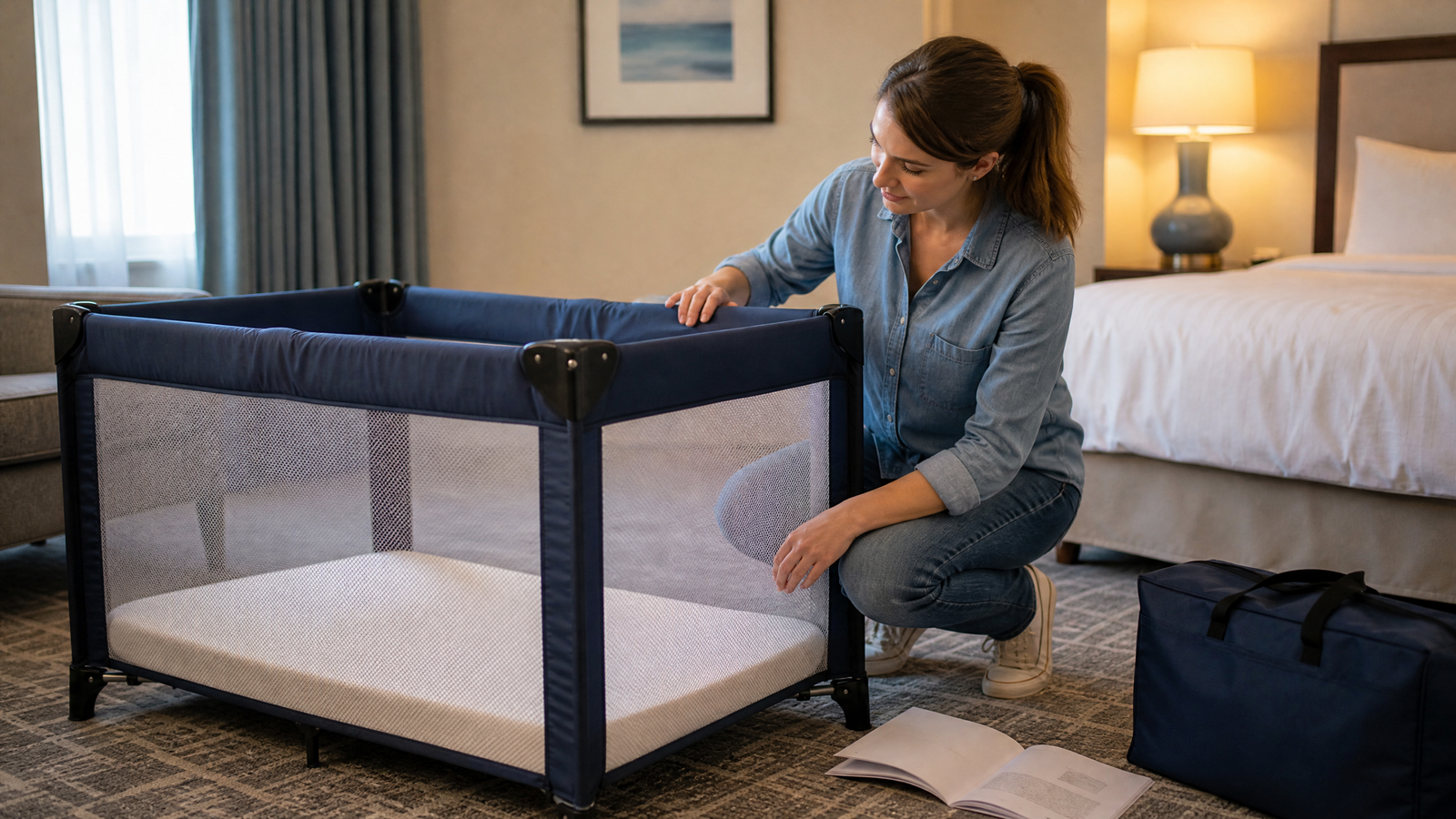
This hotel crib safety checklist starts with one rule: a hotel crib can be an appropriate sleep space for a baby only when the actual crib is intended for infant sleep, complete, stable, undamaged, and set up with a firm, flat surface and a fitted sheet only. Before using it, inspect the frame, locks, mattress fit, hardware, and bedding. If anything seems broken, missing, recalled, unstable, or unsuitable for sleep, ask the hotel for another option and use a safe alternative.
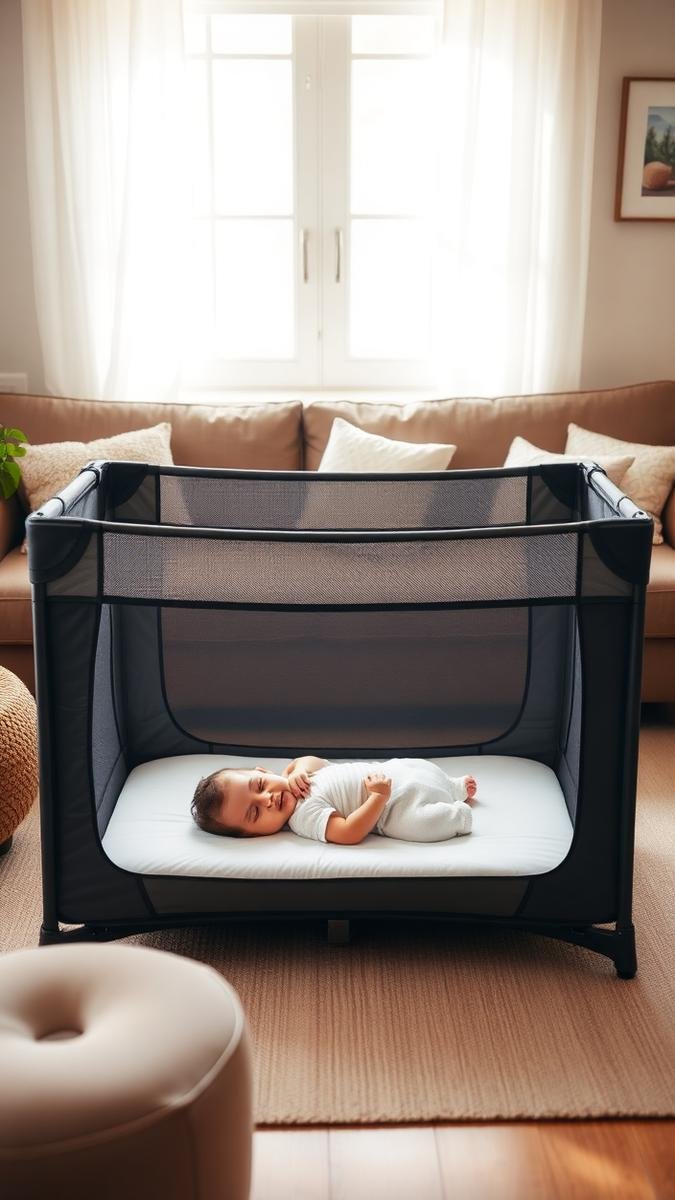
Short answer: Do not assume a hotel crib is safe simply because it is in a hotel room. Inspect it before every use. Your baby should sleep alone, on their back, in a crib, bassinet, portable crib, or play yard that meets applicable safety standards. The sleep space should have a firm, flat mattress with a fitted sheet and no pillows, loose blankets, bumpers, toys, positioners, or added padding.[1] [2]
This guide focuses on hotel-provided cribs and portable cribs supplied by accommodations. It is not another travel-crib buying guide. ChildBloom’s existing travel crib guide covers choosing a portable crib, while this article explains what to do when a hotel places an unfamiliar crib in your room.
What makes a hotel crib safe enough to use?
A hotel crib is not automatically safe or unsafe based on where it came from. The important question is whether the specific crib in your room provides a suitable sleep environment and is in good working condition.
The American Academy of Pediatrics recommends placing babies in a crib, bassinet, portable crib, or play yard that meets Consumer Product Safety Commission safety standards.[1] The CPSC similarly advises families to use products intended for sleep, including cribs, bassinets, play yards, and bedside sleepers that meet federal requirements.[2]
That means a hotel crib should not be treated as a decorative piece of furniture, a temporary playpen with unknown features, or a convenient place to store luggage. It must be a sleep product designed for an infant or young child, used according to its instructions.
A safe setup includes the following elements:
| Safety feature | What to look for |
|---|---|
| Intended use | The product is designed and labeled for infant or child sleep, not merely lounging, sitting, or supervised play. |
| Mattress | The original mattress or pad is firm, flat, and designed for that specific crib. |
| Fit | The mattress fits tightly with no concerning gaps around the edges. |
| Bedding | Only a correctly fitted sheet is present. |
| Frame | The crib opens fully and remains stable without leaning, folding, or wobbling. |
| Hardware | Locks, rails, hinges, legs, and fasteners are complete and functional. |
| Condition | There are no broken parts, sharp edges, tears, exposed hardware, strong odors, or visible contamination. |
| Location | The crib is on a flat, stable surface away from cords, windows, blinds, heaters, and other hazards. |
No inspection can guarantee that a product is safe. If you are uncertain, do not use it until the hotel resolves the concern or you arrange another approved sleep space.
Hotel crib safety checklist: inspect these seven areas
Use this checklist before your baby’s first nap or bedtime. Ask another adult to help if possible. A tired caregiver can miss a loose rail or misplaced accessory, especially after a long trip.
1. Confirm that the crib is intended for sleep
Ask the front desk or hotel staff what type of product they have delivered. The wording may vary. It could be called a crib, portable crib, play yard, pack-and-play, or travel cot. The name alone is not enough.
Look for a manufacturer label, model information, instructions, or a product marking that identifies the item. Do not use an improvised enclosure, a luggage cot, a stroller, a bassinet that is not intended for sleep, or an item designed only for supervised activity.
The AAP advises against using products for sleep that are not specifically marketed for infant sleep. If the staff cannot identify the product or provide basic instructions, request a different sleep arrangement.[1]
2. Check the frame, rails, and locking points
Set up the crib fully according to the manufacturer’s instructions or ask trained hotel staff to do it. The rails should be fully raised, and the frame should sit evenly on the floor or on the base designed for that model.
Look at each corner, hinge, leg, wheel, latch, and locking point. The crib should not partially fold when gently touched. It should not lean, rock excessively, or have a side that feels lower than the others.
Do not force a lock into place. Do not use tape, string, clips, household tools, or improvised repairs. If a rail will not lock or a frame part appears damaged, ask for the crib to be removed from the room.
3. Inspect the mattress or sleep pad
The mattress or pad should be firm and flat. It should be the original component designed for that specific crib. Check that it lies flat and that the fitted sheet does not pull it upward at the corners.
Do not add a hotel blanket under the sheet, a folded towel, a pillow, a foam topper, a mattress from home, or a second pad to make the surface feel softer. The AAP states that the mattress should fit tightly and that a fitted sheet is the only bedding recommended in the crib.[1]
A mattress that feels firm to an adult may be appropriate for infant sleep. Softness is not a safety feature. If the pad is sagging, torn, wet, heavily stained, unusually soft, or the wrong size, do not use the crib until the hotel provides a suitable replacement.
4. Remove unsafe bedding and accessories
The crib should be empty except for the baby and a correctly fitted sheet. Remove pillows, quilts, comforters, loose blankets, stuffed animals, bumper pads, sleep positioners, wedges, and decorative items.
The CPSC’s safe-sleep guidance uses the phrase “Bare is Best”: place the baby on their back with nothing but a fitted sheet in the crib.[2] Soft objects can cover a baby’s face, and babies may not be able to move away from them.
Do not assume an item is safe because it was placed in the crib by hotel staff. Ask staff to remove it, or remove it yourself before placing your baby down. If the hotel provides a special insert, raised attachment, or newborn accessory, confirm that it is designed for that crib and approved for the baby’s age, size, and sleep use. When in doubt, do not use the attachment.
5. Look for damage, missing parts, or contamination
Check the mesh, fabric, mattress cover, rails, seams, fasteners, wheels, and plastic parts. Look for tears, loose stitching, exposed metal, cracked plastic, rust, sharp edges, broken zippers, missing caps, or evidence that the frame has been repaired.
Check the mattress and sheet for moisture, mold-like spots, heavy staining, insects, or a strong chemical odor. You do not need to conduct a laboratory inspection, but you should not place a baby on a sleep surface that is visibly dirty or wet.
If the crib needs cleaning, ask the hotel to replace the sheet and professionally clean or replace the pad according to the manufacturer’s instructions. Do not cover a dirty or damaged mattress with extra bedding. A cover can hide a problem without correcting it.
6. Ask about the model and recall status when necessary
If the crib is older, borrowed, or difficult to identify, ask the hotel for the manufacturer and model number. The AAP recommends checking the CPSC recall database, especially when a crib is not new.[1] The CPSC also directs families to check for recalls and sign up for recall notifications.[2]
A recall check may not be practical at midnight, but it is reasonable to ask the hotel to confirm that its equipment is maintained and not subject to an unresolved recall. If hotel staff cannot answer and the product appears questionable, use another safe sleep option rather than taking a risk.
Do not rely on a hotel’s statement that a product is “standard” or “usually used.” Safety depends on the actual model, its condition, its setup, and the manufacturer’s instructions.
7. Check the room around the crib
Place the crib away from windows, blind cords, heaters, lamps, outlets, fans, televisions, loose furniture, and accessible shelving. Keep bags, chargers, toiletries, and small objects outside the sleep area.
The crib should not be placed on a bed, table, countertop, luggage rack, or other elevated surface unless the manufacturer specifically designed the complete product for that use. A standard portable crib or play yard should remain on the floor according to its instructions.
Keep the crib close enough for normal supervision but far enough from hazards that your baby cannot reach cords or pull objects into the sleep space. Room-sharing without bed-sharing is consistent with AAP safe-sleep guidance.[1]
Related reading: Baby Sleep in a Hotel Room.
What should be inside a hotel crib?
For most babies, the answer is simple: the baby, on their back, on the original firm and flat sleep surface, with one properly fitted sheet.
Do not add items to compensate for an unfamiliar room. Parents sometimes bring a favorite pillow, thick blanket, stuffed toy, nest, lounger, sleep positioner, or padded topper because the baby sleeps better with it at home. These items should not be placed in the crib if they are not part of the manufacturer-approved sleep setup.
If your baby uses a sleep sack, check that it fits properly and does not cover the face or create overheating concerns. Do not use weighted sleep products. The CPSC specifically advises against weighted blankets and weighted swaddles for infant sleep.[2]
Follow your pediatrician’s advice for swaddling, especially if your baby shows signs of rolling. This article does not replace an individualized sleep plan.
What if the hotel crib is missing instructions?
A missing instruction label removes important information about setup, weight limits, mattress use, and attachments. The AAP advises against using a crib that does not have instructions, is missing hardware, or is broken.[1]
Ask the hotel to identify the model and provide its instructions. If staff cannot do that, request another product or use your own approved portable crib. Do not use a random manual for a similar-looking model.
Is a hotel crib safer than letting a baby sleep in an adult bed?
An adult bed, couch, recliner, or improvised surface is not a substitute for an approved infant sleep product. If your baby falls asleep in a car seat, stroller, carrier, or adult bed, move them to a firm, flat sleep surface on their back as soon as possible.[1] [2]
Never place a standard hotel crib on an adult bed, table, or luggage rack, and never use it as a barrier around an adult mattress. If the crib is unsuitable, ask hotel staff for a replacement or arrange another approved sleep option rather than improvising.
How to handle a hotel crib when traveling with a newborn
Newborns depend on adults to create a safe sleep environment and may not be able to move away from soft items or correct a slumped position. Before travel, ask the hotel what sleep product it provides, whether it can identify the manufacturer and model, whether a fitted sheet is available, and whether the crib will be ready for inspection before bedtime.
A reservation request does not guarantee a specific crib or model. If the hotel cannot describe the product or confirm that it will be available, bring an approved portable crib or arrange another safe sleep option. Keep a backup plan because an exhausted family should not have to improvise at night.
Hotel crib versus bringing your own portable crib
Both options can work when the product is intended for infant sleep and used exactly as directed. A hotel crib reduces luggage, but parents may not know its history or model. Your own portable crib offers a familiar setup, but it must be transported without damage and used with its original mattress and fitted sheet.
| Option | Main question to ask |
|---|---|
| Hotel-provided crib | Can staff identify, inspect, clean, and replace it if needed? |
| Your own portable crib | Can you transport it safely and use only its approved components? |
| Hotel bassinet | Is it specifically intended for infant sleep and within its limits? |
ChildBloom’s portable-crib safety guide explains how to evaluate a portable crib. This article focuses on inspecting an unfamiliar hotel crib.
Common hotel-crib mistakes to avoid
Do not add a softer mattress, foam pad, folded blanket, towel, topper, pillow, toy, bumper, or positioner. Extra padding can create gaps or change the sleep surface. A car seat, stroller, swing, rocker, bouncer, infant carrier, or inclined product is not a replacement for a crib. The CPSC warns that a seated or semi-reclined position can allow a baby’s head to tip forward and block the airway.[2]
Inspect the actual crib even when hotel staff has helped set it up. Request a replacement if anything is missing, broken, dirty, unstable, or unclear.
When should you refuse a hotel crib?
Do not use the crib if:
See also: Sleep Regression After Travel or Illness.
- The frame will not lock or stands unevenly.
- A rail, leg, hinge, wheel, or latch is broken or missing.
- The mattress is soft, sagging, torn, wet, heavily stained, or visibly damaged.
- The mattress does not fit the crib or leaves concerning gaps.
- The crib has an unknown or improvised mattress, insert, topper, or attachment.
- The crib lacks necessary instructions and staff cannot identify the model.
- There are sharp edges, exposed hardware, tears, broken mesh, or unstable parts.
- The product is not intended for infant sleep.
- The crib appears recalled or the hotel cannot address a recall concern.
- The hotel asks you to use pillows, blankets, towels, or other items to make it “more comfortable.”
If there is an immediate hazard, move your baby away from the product and contact hotel staff. Do not attempt a household repair.
When to call your pediatrician
Speak with your child’s pediatrician before travel if your baby was born prematurely, has breathing or airway concerns, has a medical condition affecting sleep, or has recently been ill. Your child’s clinician may recommend an individualized sleep or travel plan.
During the trip, seek urgent medical help if your baby has trouble breathing, turns blue or gray, is unusually difficult to wake, has a serious injury, or appears to be choking. Call emergency services for an emergency.
Contact your pediatrician if you have questions about swaddling, sleep clothing, room temperature, feeding-related sleep concerns, or whether a particular sleep product is appropriate for your baby. This article provides general education and cannot assess your baby or certify a hotel’s equipment.
Frequently asked questions
Are hotel cribs safe for babies?
A hotel crib may be safe when it is a sleep product in good condition, correctly assembled, complete, and used with a firm, flat mattress and fitted sheet only. Inspect it before use and request a replacement if anything is damaged, missing, dirty, unstable, or unclear.[1] [2]
Can a baby sleep in a hotel pack-and-play?
A pack-and-play or play yard may be used for sleep only when that specific product is intended for infant sleep, correctly assembled, and used with its original sleep surface and a fitted sheet. Do not add an aftermarket mattress, topper, blanket, or pillow.
Should I bring my own sheet for a hotel crib?
A fitted sheet made for the exact crib model may be useful, but it must fit tightly and should not change the mattress fit. Ask the hotel what model it provides. Do not use a sheet that is loose, oversized, or designed for another mattress.
Can I put a hotel crib on a bed?
Do not place a standard hotel crib or portable play yard on an adult bed, table, or other elevated surface. Use it only in the configuration and location specified by the manufacturer.
What should I do if the hotel crib is broken?
Do not use it or attempt to repair it. Ask the hotel to remove it and provide a complete replacement. If no suitable option is available, use an approved portable sleep product or contact your pediatrician for guidance on the safest available plan.
Can my baby sleep in a car seat in the hotel room?
No. A car seat is designed for travel in a vehicle, not routine sleep in a hotel room. If your baby falls asleep in the car seat, move them to an appropriate firm, flat sleep surface on their back as soon as possible.[1] [2]
The bottom line
A hotel crib can be a reasonable option, but inspect before you use it. Confirm that it is intended for infant sleep, fully assembled, stable, undamaged, and paired with its original firm, flat mattress and a tight-fitting sheet. Keep the crib bare, place your baby on their back, and ask for a replacement rather than improvising if anything is missing or questionable.
Author and medical review
Written by: ChildBloom Editorial Team
Medically reviewed by: Dr. Ahmad Raza, MD (Pediatrics)
Medical review date: August 26, 2026
This article provides general education about infant sleep safety while traveling. It does not replace individualized advice from your child’s pediatrician, the crib manufacturer’s instructions, or current safety guidance.
- HealthyChildren.org / American Academy of Pediatrics: How to Keep Your Sleeping Baby Safe: AAP Policy Explained
- U.S. Consumer Product Safety Commission: Safe Sleep – Cribs and Infant Products
- American Academy of Pediatrics: Safe Sleep
Related ChildBloom Guides
- Hotel Bottle Washing: How to Wash Baby Bottles Safely
- How Often to Stop on a Road Trip With a Baby
- Minimal Baby Travel Gear Checklist for Flying
- Best Newborn Strollers with Bassinets for Safe Use
- International Travel With a Baby
- Browse all Travel guides
References & Medical Sources
Reviewed by the ChildBloom pediatric panel. Meet our physicians on the About page. This article is educational and does not replace your child’s clinician.
2 Comments