Push Toys Before Walking: When They Help and When They
Push Toys Before Walking: When They Help and When They Do Not
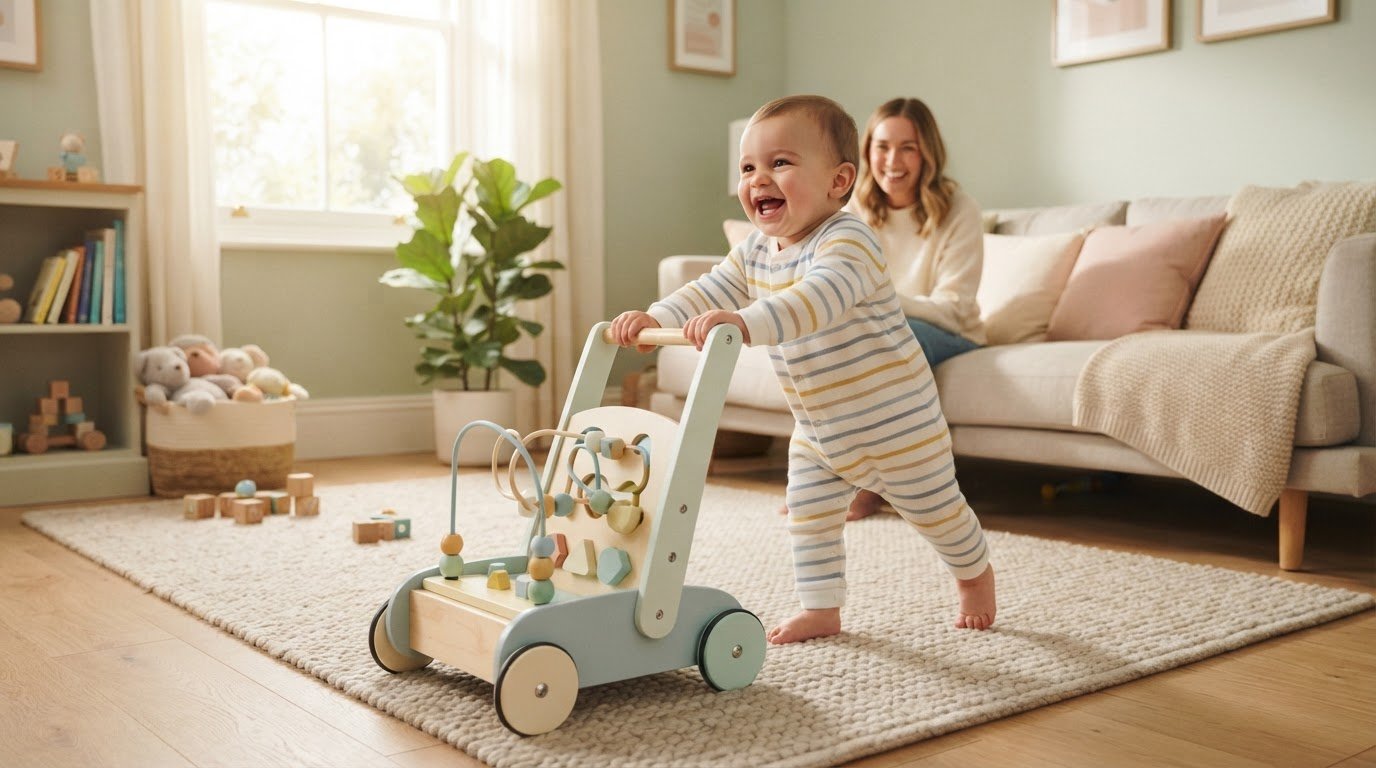
Push toys may be useful after a child can stand and cruise with control, but they are not required to teach walking and can be unsafe when they roll too quickly. Choose a heavy, stable toy with a controllable handle, use it only on a clear level surface, and stay close enough to stop it. A push toy should supplement—not replace—floor mobility and furniture cruising. If the child leans heavily, falls repeatedly, cannot control the toy, or is not yet standing independently, put it away and return to simpler play. A wheeled walker is a different product and should not be confused with a supervised push toy. This guide explains what parents can watch for, how to support the skill safely, and when a clinician should take a closer look.
Key Takeaways
– Push toys may be useful after a child can stand and cruise with control, but they are not required to teach walking and can be unsafe when they roll too quickly. Choose a heavy, stable toy with a controllable handle, use it only on a clear level surface, and stay close enough to stop it.
– The child’s overall pattern, symmetry, comfort, and progress matter more than one exact age or posture.
– Use safe, supervised floor play and child-led practice; do not force positions or rely on wheeled walkers.
– Contact the pediatrician for skill loss, sudden weakness, pain, marked asymmetry, unusual stiffness or floppiness, or stalled progress.
The short answer
Push toys may be useful after a child can stand and cruise with control, but they are not required to teach walking and can be unsafe when they roll too quickly. Choose a heavy, stable toy with a controllable handle, use it only on a clear level surface, and stay close enough to stop it. A push toy should supplement—not replace—floor mobility and furniture cruising. If the child leans heavily, falls repeatedly, cannot control the toy, or is not yet standing independently, put it away and return to simpler play. A wheeled walker is a different product and should not be confused with a supervised push toy. Parents often assume that one milestone must precede another, but motor development is not a single staircase. Healthy children may use different strategies, pause between skills, or skip a familiar stage. The CDC’s milestone materials are designed to help families observe and communicate, not to diagnose a child from a checklist.1
What the skill looks like in everyday life
Look beyond the label. A child may show the underlying ability through several related behaviors. Notice how the child starts a movement, shifts weight, reaches, turns, stops, and returns to the floor. A baby who is learning may move slowly, repeat one part of a sequence, or choose the easier direction. Those attempts are valuable information.
Parents can keep a brief observation log. Write the date, the setting, what the child initiated, whether both sides participated, and what happened afterward. Short natural videos can help a pediatrician understand movement that does not appear during a brief office visit. Avoid coaching the child repeatedly for a recording.
| Observation | More reassuring pattern | Discuss with the clinician when… |
|---|
|—|—|—|
| Initiation | Child begins the movement spontaneously | Child never attempts it or must always be placed |
| Symmetry | Both arms and legs participate | One side is consistently inactive or fisted |
| Control | Child can pause, adjust, or return down | Child repeatedly collapses, locks, or appears painful |
| Progress | New strategies appear over time | Skills stop developing or are lost |
| Comfort | Child is engaged and recovers after effort | Crying, pain, color change, or breathing trouble occurs |
<!– [CALLOUT] Observation is more useful than comparison: describe what the child does, not what the child “should” do. –>
A gentle practice plan
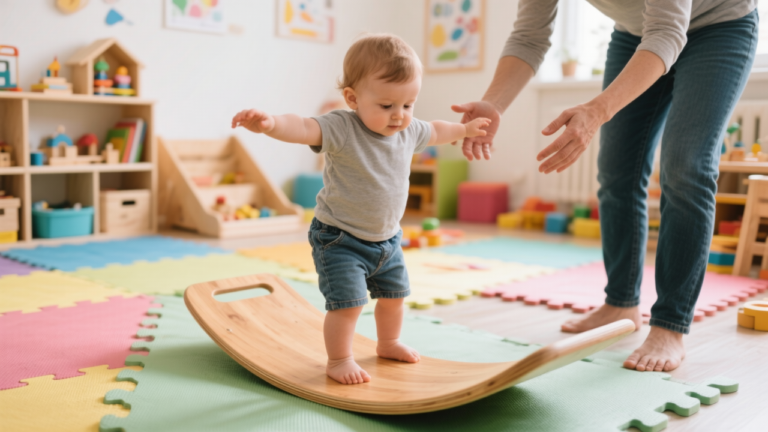
Choose a time when the child is rested, fed, and alert. Clear a firm floor and stay within arm’s reach. Start with a familiar position, then place an interesting object slightly beyond reach. Give the child several seconds to look, reach, rotate, or shift weight before helping. If the challenge is too hard, bring the object closer. If it is too easy, change its angle rather than moving it far away.
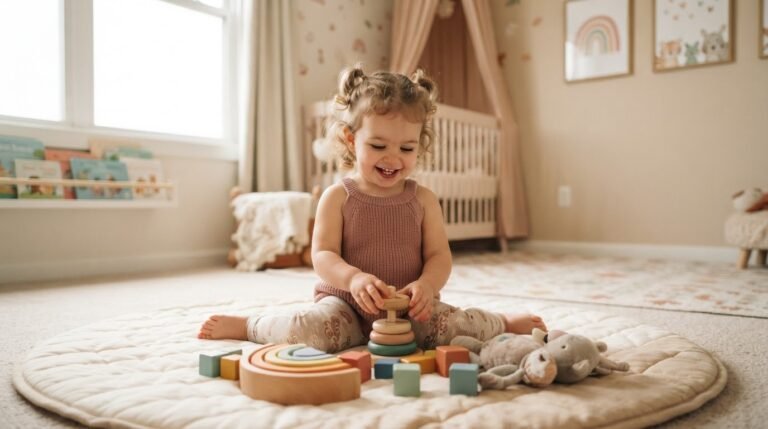
Repeat the activity in short sessions. A baby may practice for two minutes and then need a break; an older infant may return to the same challenge several times. Talk, sing, imitate the child’s sounds, and celebrate attempts. Responsive interaction makes practice social rather than mechanical.
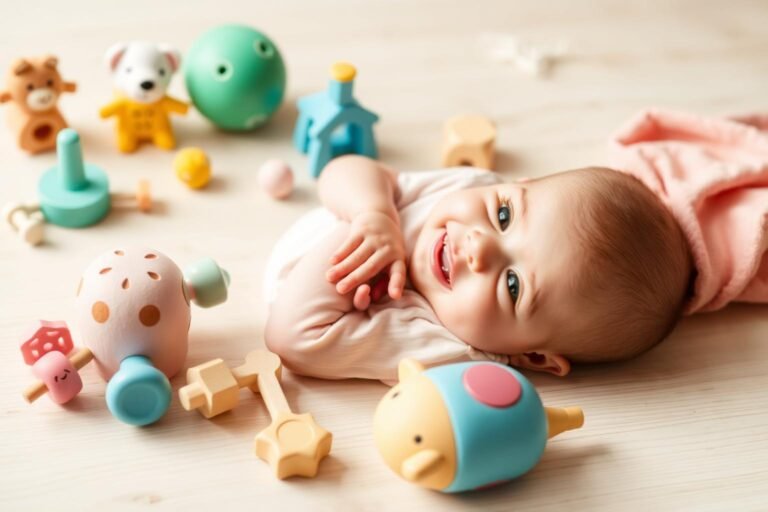
Offer variety across the day: back play for reaching and kicking, tummy play for pushing and turning, side-lying for bringing hands together and rolling, and supported sitting for rotation and balance. Children should not be left in one posture for long periods simply because it looks advanced. The best position is one the child can enter, explore, and leave with appropriate support.
Common mistakes and safer alternatives
The most common mistake is treating the milestone as a performance goal. Adults may pull the child into standing, hold the legs in a crawl, repeatedly correct a preferred posture, or use equipment that promises faster development. These actions can create distress and may remove opportunities for self-initiated transitions.
A safer alternative is to arrange the environment. Use stable furniture, a clear floor, attractive objects, and close supervision. Let the child decide when to move. Offer a hand or trunk support only as much as needed, and reduce support gradually as control improves. Never swing or lift a child by the arms.
If a device is involved, distinguish products carefully. A stationary activity center is not a wheeled walker. A push toy is not a device that carries the child. Product labels and marketing claims are not substitutes for safety instructions or pediatric advice.
Feeding, reflux, fatigue, and temperament
Movement practice can be affected by ordinary daily factors. A hungry, sleepy, recently fed, constipated, or overstimulated child may resist a position that they tolerate at another time. Babies with reflux may need a longer upright period after feeds and shorter, gentler sessions. Ask the clinician about persistent vomiting, poor growth, choking, or significant discomfort rather than assuming every protest is a normal dislike.
Temperament also matters. Some children approach new movement boldly, while others observe first. A cautious child may benefit from a caregiver’s face, a familiar toy, and a very small challenge. Respecting temperament does not mean avoiding practice; it means making the challenge manageable.
Safety checklist
Before active play, check that furniture cannot tip, stairs are blocked, outlets and cords are managed, and small or toxic objects are removed. Keep hot drinks, heaters, fireplaces, pools, buckets of water, and pet hazards away from the play area. Stay close when the child is near a height or attempting a new transition.
For sleep, always use a safe, uncluttered sleep space and place infants on their backs.9 Do not use a developmental positioner, pillow, inclined sleeper, or loose bedding during sleep. A child who rolls or crawls during awake play still needs a separate safe-sleep setup.
What a pediatric evaluation may include
The clinician will ask about birth history, corrected age if premature, current and prior milestones, feeding, sleep, pain, illness, and what the child does at home. They may observe movement in several positions and assess head and trunk control, muscle tone, strength, joint range, posture, symmetry, and balance. A standardized developmental screen may be completed.
If needed, the pediatrician may recommend early intervention, physical therapy, developmental pediatrics, orthopedics, neurology, or another service. Early intervention can focus on function and family coaching even before a final diagnosis is known.7 Asking for an evaluation is not labeling the child; it is a way to understand strengths and barriers early.
Signs to call sooner
Call the pediatrician for persistent one-sided movement, inability to sit or control the head and trunk, lack of weight-bearing when expected, pain, unusual stiffness or floppiness, repeated falls without protective responses, or no meaningful progress. Report a lost skill promptly.
Urgent care is appropriate for sudden weakness, a newly limp arm or leg, significant injury, severe pain, a seizure, breathing difficulty, or acute illness. Do not wait for an online milestone article to resolve an emergency symptom.
Frequently asked questions
Is there one correct age or technique?
No. There are broad developmental ranges and many movement strategies. The quality of progress, comfort, symmetry, and skill retention matter more than a single date or textbook form.
How many minutes should practice last?
There is no universal prescription. Several short sessions are usually easier than one long session. Follow the child’s cues and stop before exhaustion or distress.
Can I use a pillow to position my baby?
Use positioning supports only when a clinician has advised them and only during awake, directly supervised play. Never use pillows, wedges, or positioners for infant sleep.
Does a late or unusual movement predict future problems?
Not by itself. Some children develop normally through a different pathway. Persistent asymmetry, regression, pain, and stalled progress are more important reasons to seek assessment.
Should I buy special equipment?
Usually not. A safe floor, stable furniture, and responsive interaction are enough for most practice. Equipment can introduce hazards and should never replace supervision or free movement.
What should I bring to the appointment?
Bring short natural videos, an observation log, the child’s birth and medical history, and specific questions. Describe what happens across several days rather than focusing on one isolated attempt.
How to read movement milestones
Movement milestones are best understood as a pattern of emerging abilities rather than a race. The CDC defines milestones as things that most children—at least 75%—can do by a certain age, and its checklists are conversation tools rather than diagnostic tests.1 The World Health Organization describes broad windows of achievement for major motor skills, recognizing that healthy children do not all move through the same sequence or at the same speed.2
A baby may spend several weeks consolidating one skill, then make rapid progress. Another baby may use a different route altogether. Crawling, bottom-shuffling, rolling, kneeling, cruising, and walking are all strategies for exploration. A child can skip a familiar stage and still develop normally, while a child who performs a milestone early can still have a separate concern in another developmental area.
When observing your child, ask five questions. Can the child hold the head and trunk steady? Can the child move into and out of positions? Do both sides of the body participate? Is the child adding skills over time? Has any previously acquired skill been lost? These questions are more clinically useful than comparing the child with a sibling, neighbor, or video online.
Safe setup for active floor play
Use a firm, uncluttered floor in a childproofed room. Anchor dressers, televisions, and bookcases. Block stairs, cover or manage cords, remove small objects, and keep medicines, cleaning products, hot drinks, pet bowls, and choking hazards out of reach. As babies become mobile, assume that anything within reach will be touched, pulled, tasted, or carried.
Awake floor play is different from sleep. For sleep, place an infant on the back on a firm, flat, empty surface and follow current safe-sleep recommendations.9 Do not use pillows, wedges, positioners, or loose bedding as developmental equipment. During play, stay close enough to intervene if the child rolls near a hazard or loses balance.
Bare feet are often useful indoors when the floor is safe because they provide sensory feedback and reduce slipping. When shoes are needed outdoors, choose flexible, properly fitted footwear. Clothing should allow free movement at the hips, knees, shoulders, and elbows.
A practical progression for supporting movement
Start with connection. Get down at the child’s level, use a calm voice, and offer a face, toy, or sound as motivation. Place the object just beyond reach—not so far away that the child must become upset. Allow time for problem-solving before helping. Reaching, rotating, pushing, rocking, and changing position are meaningful practice even when the child does not travel.
Vary the direction of play. Put toys to the right, left, front, and slightly behind the shoulder so the child can practice looking, reaching, and shifting weight in multiple directions. Let the child repeat successful movements, then add a small challenge. Stop when the child is tired, hungry, distressed, or losing control.
Do not pull a child forward by the hands, lift by the wrists, force the knees under the body, or hold a child in a posture they cannot reach independently. If a pediatrician or physical therapist gives a home program, follow that individualized plan rather than combining it with generic online exercises.
A systematic review in *Pediatrics* found associations between tummy time and several early motor outcomes, but it did not establish that tummy time guarantees earlier walking.8 The useful conclusion is modest: provide regular opportunities for movement, but do not promise a specific result or deadline.
When should parents call the pediatrician?
Call the child’s clinician if movement is persistently one-sided, the child cannot sit or hold the head and trunk as expected, the child never attempts to move, the body seems unusually stiff or floppy, the child does not bear weight when developmentally expected, or movement appears painful. Also call if progress stops or a child loses a skill already acquired.
The AAP recommends developmental surveillance during health supervision and standardized screening at specified ages, with additional assessment when parents or clinicians have concerns.5 Screening is not a diagnosis. It is a structured way to identify children who may benefit from a closer examination, early intervention, physical therapy, or specialist review.
Record short videos during ordinary play and write down specific observations. “Always rolls to the right,” “uses both hands,” “stands only on toes,” and “cannot lower from standing” are more helpful than a general statement that development seems late. Bring the child’s birth history, corrected age if premature, medical history, and a list of current skills.
Seek urgent care for sudden weakness, a newly limp limb, severe pain, significant injury, a seizure, breathing difficulty, or a child who appears acutely ill. A stable milestone question can usually be handled through routine pediatric care, but the child’s clinician can guide timing.
Why forcing milestones can backfire
Adults often try to accelerate movement by placing a child in standing, repeatedly moving the legs, or using equipment that promises fast progress. These approaches can make the child uncomfortable and may prevent the child from practicing the transitions that matter. Development is not a workout competition. The goal is functional, self-initiated movement with safe opportunities for exploration.
Wheeled infant walkers deserve particular caution. The AAP notes that they create injury hazards and are not necessary for learning to walk.6 They can move a child toward stairs, hot surfaces, cords, or objects that would otherwise be out of reach. A stationary activity center may be used briefly according to instructions, but it should not replace free floor play.
Frequently asked questions
Should I compare my child with a cousin of the same age?
Comparison can suggest a question but cannot answer it. Children vary in temperament, experience, body proportions, birth history, and sequence of skills. Compare the child with their own previous abilities and discuss the complete pattern with the pediatrician.
Are online milestone checklists enough?
No. They are useful for observation and conversation, but they are not substitutes for standardized screening or an examination.1 Use them to organize questions, not to diagnose.
Do developmental activities guarantee faster progress?
No activity guarantees a particular date. Safe, responsive practice supports opportunities for learning, but some children progress in bursts and some use different strategies.
What if my child becomes frustrated during practice?
Reduce the challenge, bring the toy closer, change positions, offer comfort, and try again later. Frustration is information about the difficulty or timing, not a reason to force repetition.
Can a child skip crawling?
Yes. Some children roll, scoot, shuffle, or move directly toward standing and walking. The broader pattern—symmetry, progress, postural control, and skill retention—matters more than whether a classic crawl appears.
Should I ask for a physical therapy referral?
Ask the pediatrician whether an assessment would be useful. Pediatric physical therapists can evaluate function and teach individualized activities, particularly when asymmetry, limited transitions, pain, or stalled progress is present.
Conclusion
The most helpful developmental support is a safe environment, frequent child-led floor play, responsive interaction, and timely communication with the child’s clinician. Milestones are guideposts, not deadlines. Celebrate effort and new strategies, protect the child from preventable hazards, and seek advice whenever your observation or intuition raises a persistent concern.
References
CDC developmental milestones at 9 months — https://www.cdc.gov/act-early/milestones/9-months.html
WHO motor-development milestones — https://www.who.int/tools/child-growth-standards/standards/motor-development-milestones
CDC developmental milestones at 1 year — https://www.cdc.gov/act-early/milestones/1-year.html
CDC developmental milestones at 15 months — https://www.cdc.gov/act-early/milestones/15-months.html
AAP developmental surveillance and screening — https://www.aap.org/en/patient-care/developmental-surveillance-and-screening-patient-care/
AAP prevention of walker-related injuries — https://publications.aap.org/pediatrics/article/142/4/e20181491/37381/Prevention-of-Walker-Related-Injuries-in-Infants
CDC early intervention resources — https://www.cdc.gov/act-early/early-intervention/index.html
AAP Pediatrics: tummy time and infant health outcomes — https://publications.aap.org/pediatrics/article-abstract/145/6/e20192168/76940
AAP safe sleep guidance — https://www.aap.org/en/patient-care/safe-sleep/
Medical note: This article is educational and does not replace an examination, diagnosis, or personalized medical advice. Seek prompt care for sudden weakness, serious injury, severe pain, seizure, breathing difficulty, or acute illness.
<!– [IMAGE] Add a licensed, locally stored hero image with descriptive alt text. –>
<!– [CHART] Add an educational progression or decision graphic; do not present it as a deadline. –>
<!– [VIDEO] Add a hospital or pediatric-therapy demonstration after editorial review. –>
Topic-specific guidance for push toy before walking
A push toy should supplement—not replace—floor mobility and furniture cruising. If the child leans heavily, falls repeatedly, cannot control the toy, or is not yet standing independently, put it away and return to simpler play. A wheeled walker is a different product and should not be confused with a supervised push toy. Start with the easiest version of the skill and build gradually. For example, offer a stable surface or comfortable position, invite a small reach or weight shift, and allow the child to return to a familiar posture. The purpose is not to produce a performance for adults; it is to give the child a safe reason to explore.
Parents sometimes ask whether they should correct every unusual movement. Usually, gentle variety is better than constant correction. Place toys on both sides, change your own position, and arrange the room so the child can make choices. If a movement is persistently one-sided, painful, rigid, or associated with loss of a skill, stop trying to solve it through home practice and ask the pediatrician for an examination.
A useful weekly check is to ask whether the child can do slightly more than before: reach farther, tolerate a position longer, move in another direction, lower with more control, or recover balance more effectively. Progress may be subtle. If there is no change over several weeks or the child loses a skill, contact the clinician.
A sample day
After a diaper change, offer a brief floor-play opportunity while the child is alert. During the next play period, repeat the skill with a different toy or caregiver position. Later, include a quiet movement game after rest. The rest of the day should include ordinary caregiving, feeding, cuddling, sleep, and free interaction. Developmental support works best as part of daily life, not as a stressful training schedule.
Final parent checklist
Ask yourself: Is the environment safe? Is the child awake and supervised? Does the child have a manageable challenge? Am I allowing the child to initiate? Am I observing both sides? Is the child comfortable? Is progress continuing? If the answer to the last two questions is no, contact the pediatrician.
*Medically reviewed by Dr. Ahmed Raza, MD, FAAP (Pediatric Emergency Medicine, ChildBloom Medical Review Board) on 2026-08-30.*
About the author: Dr. Sophia Martinez, MD, PhD is a developmental pediatrician specializing in developmental milestones, sensory processing, and neurodevelopmental screening. She reviews ChildBloom’s movement and milestone content against AAP, CDC, and WHO guidance. Meet the panel →