Baby Takes 30-Minute Naps: Causes and Age-Based Fixes
Baby short naps: the quick answer
If your baby takes only 30-minute naps, they are hitting the end of one sleep cycle and waking before linking to the next. This is developmental, not a behavior problem. The best fixes are age-based: protect total sleep under 6 months, teach cycle-linking at 5–6 months, and keep wake windows accurate at 7–12 months.
For the full picture, read our pillar guide on How Many Naps by Age? Baby Sleep Chart (0–24 Months).
Why baby short naps happens — the sleep science
Adult sleep cycles run about 90 minutes. Baby sleep cycles are much shorter — roughly 30–45 minutes in early infancy. At the end of each cycle, the baby passes through a light stage. A baby who needed help — rocking, feeding, a pacifier, or being held — to fall asleep at the start of the nap often needs that same help to return to sleep at the cycle break. Without it, they open their eyes at 30 minutes, fully “done” with that nap.
The cycle science
Baby short naps is why short naps almost always trace back to a sleep association rather than the baby “not needing sleep.” The baby does need the sleep; they just have not learned to bridge cycles independently. The good news is that the ability to link cycles is a skill the brain develops with age, and your daily habits can support it.
Sleep pressure and the wake window
Two other forces affect nap length. Sleep pressure builds during awake time; if a baby is put down too soon, pressure is low and the nap is fragile. A wake window is the time a baby is awake between sleep periods. Too short and the baby is undertired; too long and the baby is overtired and wired. Both extremes produce short naps. The art of good napping is landing the baby in the crib in that narrow “just right” window.
The circadian rhythm
Circadian rhythm also matters. The strongest natural nap pressure is mid-morning and early afternoon, which is why a well-timed first nap often lasts longer than a late, desperate one. Napping at the biological low points of the day makes the 30-minute cap more likely. This is why a baby who skips the morning nap and crashes at 1 p.m. often sleeps badly — they missed the peak.
Melatonin is lower by day
Melatonin, the sleep hormone, is low during daytime hours. Night sleep is therefore deeper and easier to maintain, while day sleep is lighter and more easily broken. A baby who links cycles at night may still wake at the 30-minute nap break until the skill generalizes to daytime. This gap is normal and closes with practice and maturity.
How sleep need changes with age
| Age | Total sleep 24h | Day sleep | Note on naps |
|---|---|---|---|
| —– | —————– | ———– | ————– |
| 3–4 months | 14–15 hours | 3–4 hours | 3–4 short naps common |
| 5–6 months | 13–15 hours | 2.5–3.5 hours | Best window to link cycles |
| 7–9 months | 13–14 hours | 2.5–3 hours | Two predictable naps |
| 10–12 months | 12–14 hours | 2–3 hours | Naps consolidate |
Total sleep need falls slowly over the first year, which is why “short naps” become less of a problem as the brain matures.
Step-by-step plan
Step 1: Build the right sleep pressure with accurate wake windows
Use the guide below, but watch your baby, not just the clock. Eye-rubbing, looking away, and fussing are cues that pressure is building. A baby who is placed down too early stares at the ceiling; a baby placed down too late screams and arches. The window is the sweet spot between the two.
| Age | Typical wake window | Notes |
|---|---|---|
| —– | ——————– | ——- |
| 3–4 months | 1–1.5 hours | Short windows; brain not yet linking cycles |
| 5–6 months | 2–2.5 hours | Best window to teach cycle-linking |
| 7–9 months | 2.5–3.5 hours | Two predictable naps |
| 10–12 months | 3–4 hours | Naps consolidate; one may lengthen |
Step 2: Set up the nap environment like night
Three things signal “sleep” to a baby: darkness, consistent sound, and routine.
- Darkness: blackout curtains for naps, just like nights. Light suppresses melatonin and makes the cycle break a bright, alert event.
- Sound: a white-noise machine at a safe volume, placed away from the crib, masks household and sibling noise.
- Routine: a short, predictable sequence — book, song, crib — tells the brain sleep is coming.
Step 3: Practice “drowsy but awake” at nap start
Put the baby down calm but awake at the start of every nap once they are past the newborn stage. This teaches them that the crib — not your arms — is where sleep happens. When the 30-minute wake comes, the surroundings feel familiar. If you always feed or rock to sleep, the nap break feels like a foreign place and the baby calls out.
Step 4: Wait at the 30-minute wake
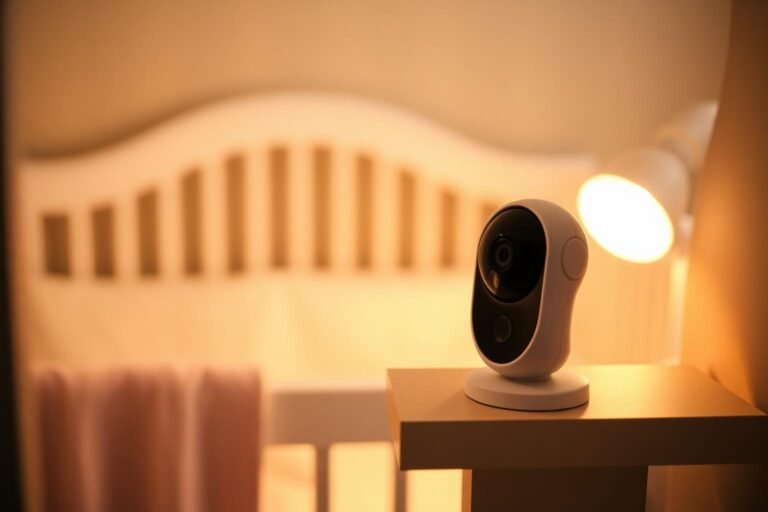
At 5–6 months, if the baby wakes at 30 minutes, pause 5–10 minutes before going in. Many babies resettle on their own in that window as they bridge into the next cycle. Rushing in can accidentally teach them that waking ends the nap. Use a monitor, not your ear at the door, so you do not disturb a baby who is merely stirring.
Step 5: Protect one longer nap per day (under 6 months)
Under 6 months the brain is not reliably linking cycles, so do not fight it. Bank sleep with one longer contact nap, stroller nap, or carrier nap each day. This protects total daily sleep and mood even if other naps stay short. A baby who gets one solid 90-minute block is far happier than one who takes five 30-minute snippets.
Age-specific fixes
- 3–4 months: Cycle length is naturally short and the brain is not ready to link cycles reliably. The goal is to protect total daily sleep, not to force long naps. Offer one longer contact nap daily, watch wake windows of about 1–1.5 hours, and keep the environment dark and calm.
- 5–6 months — the sweet spot: This is the best window to teach cycle-linking. Put the baby down drowsy but awake, wait 5–10 minutes at the 30-minute wake, and use darkness plus white noise so the cycle break is not a loud, bright event.
- 7–12 months: Two naps of about 1–1.5 hours each is typical. Cap the morning nap (often at 2 hours) so the afternoon nap is not shortened, keep a consistent pre-nap routine, and ensure the last wake window before bed builds enough sleep pressure.
Sample schedules at every age
| Age | Wake | Nap 1 | Nap 2 | Bed |
|---|---|---|---|---|
| —– | —— | ——- | ——- | —– |
| 4 months | 7:00 | 8:30–9:30 (contact) | 12:30–1:30; 3:30–4:00 | 7:30 |
| 6 months | 7:00 | 9:30–11:00 | 2:00–3:30 | 7:30 |
| 9 months | 7:00 | 9:30–11:00 | 2:00–3:30 | 7:30 |
| 12 months | 7:00 | 10:00–11:30 | 2:30–3:45 | 8:00 |
Adjust by 15–30 minutes based on your baby’s cues.
Decision checklist: why is this nap short?
- Is the wake window under the age guide? → Undertired; lengthen awake time slightly.
- Is the wake window over the age guide? → Overtired; shorten it and calm before bed.
- Did you feed or pick up at the last 30-minute wake? → New association; try waiting next time.
- Is the room bright or noisy? → Environment; add blackout and white noise.
- Is the baby under 6 months? → Normal; protect total sleep with a contact nap.
Troubleshooting scenarios
- ”My 5-month-old wakes at 30 minutes but falls back asleep if I hold him.” This is classic cycle-linking. Keep doing one contact nap for total sleep, and at the other naps place him down drowsy but awake and wait 10 minutes at the wake. He will learn the crib is fine.
- ”My 8-month-old naps 30 minutes in the crib but 2 hours in the car.” Motion is masking the association. Use the car for errands, but build at least one crib nap daily so the skill transfers.
- ”Every nap is 30 minutes no matter what I do.” Check total day sleep and the last wake window. If the baby is under 6 months, this is normal; protect mood with a contact nap and revisit at 5–6 months.
Myths about short naps
- Myth: A 30-minute nap means the baby is not tired. Fact: The baby is tired; they just have not learned to bridge cycles.
- Myth: Contact naps create a permanent dependency. Fact: They are a useful tool under 6 months and can be phased out later.
- Myth: You must extend every nap. Fact: Under 6 months, protecting total sleep with one long nap is enough; do not fight every short one.
- Myth: Short naps mean bad parenting. Fact: They are developmental and extremely common in the first half of the first year.
What to expect week by week
- Week 1 (5–6 months): Begin drowsy-but-awake at nap start and start waiting 5–10 minutes at the 30-minute wake.
- Week 2: Many babies begin linking one cycle; the first nap often lengthens first.
- Week 3–4: Two longer naps become more reliable as the brain matures and the routine sticks.
Common mistakes that keep naps short
- Wake window too short: an undertired baby will not link cycles.
- Wake window too long: an overtired, wired baby also wakes at 30 minutes.
- Rescuing every wake with a feed: this builds a new association rather than teaching self-settling.
- Inconsistent schedule: the brain learns patterns; randomness makes naps worse.
- Napping in motion only: a baby who only sleeps in a moving stroller or car may struggle to link cycles in a still crib.
Safety — where naps may NOT happen
Never let a baby nap unsupervised in a swing, car seat, or lounger. These are not safe sleep surfaces and are linked to breathing risks when a baby’s head drops forward. If the baby falls asleep in a car seat while driving, transfer them to a flat, firm surface once you are home. A contact nap on a caregiver is fine only while the caregiver is awake and alert; a dozing adult can lose the safe hold.
When to Call Your Pediatrician
Call if naps are always short AND night sleep is also poor, if weight gain is slow, or if there are signs of breathing pauses, loud snoring, or unusual fatigue during waking hours. Sometimes short naps reflect an underlying issue such as reflux or a respiratory concern rather than a scheduling one. A basic exam and weight check can tell the difference.
FAQ
Why does baby short naps happen even when nights are fine?
Day sleep is lighter and more easily broken than night sleep because melatonin is lower and the circadian drive to sleep is weaker mid-day. A baby who links cycles at night may still wake at the 30-minute nap break until the skill generalizes.
Will contact naps ruin them?
No. They are a helpful tool, especially under 6 months, not a life sentence. You can phase them out later as the brain matures.
When do naps naturally lengthen?
Usually around 5–6 months as cycle-linking matures, earlier for some babies.
Related reading: Nap Transition at 9 Months.
Should I wake a sleeping baby?
Sometimes yes — capping a long morning nap protects the afternoon one. Otherwise, let them sleep.
Is one 30-minute nap enough?
A single cycle is not enough for total sleep; that is why protecting a longer nap elsewhere matters for mood and night sleep.
Can teething shorten naps?
Yes, briefly. But teething also brings gum rubbing and daytime fussiness. If only naps are short and the baby is otherwise bright, it is developmental, not teething.
Safety reminders
Safe sleep rules apply to naps as well as nights.
- Always place your baby on the back to sleep, on a firm, flat surface made for infants.
- Use a crib, bassinet, or play yard with a tight-fitting sheet. No bumpers, loose blankets, pillows, or positioners.
- Keep the sleep space empty. No stuffed toys, no crib wedges, no inclined sleep products for routine sleep.
- Do not let the baby nap on a couch, armchair, or adult bed where they can roll into a soft gap. These are top suffocation risks.
- Do not bed-share on a soft surface. Room-sharing in a separate bassinet is the safer choice.
- Dress the baby for the room temperature; overheating is a risk factor. A light sleep sack is fine once rolling is established.
Sample schedule by age
| Age | Wake window | Naps per day | Example |
|---|---|---|---|
| — | — | — | — |
| 3–4 months | 1.5–2 hours | 3–4 | 7 a.m. wake, naps at 9, 12, 3, 5 |
| 5–6 months | 2–2.5 hours | 3 | 7 a.m. wake, naps at 9:30, 1, 4 |
| 7–9 months | 2.5–3 hours | 2 | 6:30 a.m. wake, naps at 9:30, 2 |
| 10–12 months | 3–4 hours | 2 | 6:30 a.m. wake, naps at 9:30, 2:30 |
These are guides, not rules. Watch your baby’s cues and shift by 15 to 30 minutes as needed.
Age-specific nap expectations
Short naps are normal at some ages and a problem at others.
- Under 5 months: A 30-minute nap is common because the sleep cycle is short. Do not fight every short nap; protect one longer morning nap.
- 5 to 8 months: Naps should start to link into 45 to 90 minutes. This is the best age to teach the crib-settle skill.
- 9 to 12 months: Two solid naps are typical. If one nap is short, check the wake window and bedtime, not just the nap.
More parent questions
Do short naps mean my baby is not getting enough sleep?
Not always. Total sleep across day and night matters most. A baby with short naps but an early, long night may be fine. Track the full 24 hours.
Should I contact-nap to extend a nap?
If your baby is behind on sleep, a contact nap now and then is fine. Just do not let it become the only way, or the short-crib-nap pattern stays.
Will an earlier bedtime fix short naps?
Often yes. An overtired baby takes shorter, lighter naps. Move bedtime 15 to 30 minutes earlier for a week and watch naps improve.
See also: Dropping the Morning Nap at 10–12 Months.
Quick wins to try this week
Pick two changes and hold them for a week. Most families see the biggest gain from (1) moving bedtime 15 to 30 minutes earlier and (2) putting the baby in the crib awake at the start of one nap. Those two shifts build the skills that turn a 30-minute nap into a 60-minute one. Add the wake-window table only after those stick. Small, steady steps beat a full overhaul that leaves everyone frustrated.
Common Myths vs Facts
Parents hear a lot of conflicting sleep advice. Here is a clear, pediatrician-aligned reality check:
- Myth: “A tired baby will just fall asleep anywhere.” Fact: Overtired babies produce more cortisol, which makes falling asleep and staying asleep harder, not easier.
- Myth: “Keeping the baby up later guarantees a longer night.” Fact: An over-late bedtime often backfires with early waking and night fragmentation. Anchor bedtime to the baby’s total sleep need.
- Myth: “One bad night means the plan failed.” Fact: Sleep habits shift over 1–2 weeks. Judge progress across several nights, not a single rough one.
- Myth: “You must sleep-train.” Fact: Many families resolve issues with consistent schedules, a dark room, and gentle boundaries alone.
If Nothing Works After Two Weeks
If you have held a consistent plan for two weeks and the problem persists:
- Re-check the total daytime sleep — too much or too little both fragment nights.
- Confirm the room is genuinely dark and quiet until your chosen wake time.
- Review the last nap’s timing so it does not steal the night.
- Rule out discomfort: illness, teething, reflux, ear pain, or a growth spurt.
- Call your pediatrician. A brief check can exclude underlying issues and reassure you.
You know your baby best. A quick professional review is always reasonable when something feels off.
- The 45-Minute Intruder
- Contact Naps: Are They Safe?
- Baby Wakes at 5 a.m. Every Day
- American Academy of Pediatrics — A Parent’s Guide to Safe Sleep
- NICHD Safe to Sleep — Safe Sleep Environment
- CDC — About Sudden Unexpected Infant Death
- World Health Organization — Newborn Care
About the author
Dr. Michael Anderson, MD (Pediatrics) is a board-certified pediatrician on the ChildBloom medical panel, focusing on infant sleep, safe sleep environments, and responsive routines. This article was medically reviewed and approved by Dr. Ahmad Raza, MD (Pediatrics) against current AAP safe-sleep guidance. Read our editorial and review standards.
This guide is general education, not a diagnosis. If you are worried about your baby’s breathing, feeding, growth, or sleep, contact your pediatrician. For any breathing emergency, call emergency services immediately.
Related ChildBloom Guides
- Start here: How Many Naps by Age? Baby Sleep Chart (0–24 Months)
- Infant Nap Transitions: 3 to 2 to 1 Naps (Age-by-Age Guide)
- Contact Naps All Day: How to Transition Safely
- Baby Short Naps: Why They Happen and How to Fix Them
- Newborn Won’t Sleep in Bassinet? 7 Fixes That Actually Work
- Best Video Baby Monitors for Peace of Mind
- Browse all Sleep & Nursery guides
References & Medical Sources
- AAP healthy sleep hours by age
- AAP guidance on getting your baby to sleep
- AASM pediatric sleep duration consensus
- NICHD Safe to Sleep: safe sleep environment
Reviewed by the ChildBloom pediatric panel. Learn about our physicians on the About page. This article is educational and does not replace your child’s clinician.