9-Month Feeding Schedule: Sample Daily Plan & Portions
Medically reviewed by Dr. Ahmad Raza, MD (Pediatrics) — ChildBloom Medical Review Panel. Last updated: September 27, 2026.
Written by Dr. Sarah Williams, MD (Pediatrics).
A 9-month feeding schedule with sample meals, milk amounts, and safe finger-food portions. Get pediatrician-approved tips for calmer, healthier mealtimes today.
📋 TL;DR — if you read nothing else
- 2-3 meals (about 3-5 tablespoons each) + 1-2 snacks + 3-4 milk feeds (20-28 ounces total, cap 32). Milk still carries most of the calories at 9 months.
- The sample day below is a template. Feed the baby, not the clock — a skipped meal with good milk intake is normal.
- Finger foods the size of a pencil eraser. Quarter grapes, hot dogs, and cherry tomatoes; skip whole nuts, popcorn, and hard raw vegetables.
- Cow’s milk waits until 12 months. Offer iron-rich foods at every meal, and expect new foods to take 10-15 exposures before they are accepted.
A 9-month feeding schedule that works is less about the clock and more about structure: two to three small meals, one or two snacks, and milk feeds that still carry most of the calories. This pediatrician-written guide gives you a sample day, the portion sizes behind it, and the milk math — then zooms out to show where 9 months sits in the first-year feeding journey. Our guidance follows current AAP and CDC recommendations.
Sample 9-Month Feeding Schedule: A Day That Works
Here is a sample day built around how 9-month-olds actually eat: 3-4 milk feeds totaling 20-28 ounces, 2-3 meals of about 3-5 tablespoons each, and 1-2 snacks as interest grows. Treat the times as a template, not a rule — responsive feeding still applies at every meal.
| Time | Milk | Meals and snacks |
|---|---|---|
| 7:00 AM. | Breast milk or formula. | — |
| 8:00 AM. | —. | Breakfast: iron-fortified cereal with soft fruit (about 3-5 tablespoons). |
| 10:30 AM. | Milk feed. | — |
| 12:00 PM. | —. | Lunch: soft vegetables plus soft protein (about 3-5 tablespoons). |
| 2:30 PM. | Milk feed. | Optional snack: soft finger food, such as banana or avocado. |
| 5:30 PM. | —. | Dinner: family food in soft pieces (about 3-5 tablespoons). |
| Bedtime. | Milk feed. | — |
Milk stays the anchor. Offer solids after milk at first, or between milk feeds as your baby settles into a rhythm. If your baby skips a meal but takes their milk well and keeps their wet diapers up, that is normal at this age.
How Much: Milk and Portions at 9 Months
- Milk: 20-28 ounces of breast milk or formula across 3-4 feeds. Some babies drop to 3 feeds as solids increase. Avoid exceeding 32 ounces — it crowds out iron-rich foods.
- Meals: about 3-5 tablespoons total per meal. Milk remains a major calorie source, so a few practiced bites still count as a successful meal.
- Progression: the usual path is one solid meal a day at 6 months, two at 8 months, and three by 10-12 months, with milk feeds continuing between meals. If your baby is behind that curve, ask your pediatrician rather than forcing the pace.
The Science of Infant Feeding: From Milk to Solids
The move from exclusive milk feeding to a varied solid-food diet is one of the biggest transitions of the first year, and it is often complicated by conflicting advice from well-meaning sources. In my clinical practice, the parents who navigate it most smoothly understand the developmental principles behind each stage and stay flexible rather than rigid. The World Health Organization, the American Academy of Pediatrics, and every major pediatric organization recommend exclusive breastfeeding or formula feeding for the first 6 months of life.
The newborn period — the first 8-12 weeks — is primarily about establishing the feeding relationship. For breastfeeding families that means building milk supply, achieving a good latch, and learning to recognize hunger cues. For formula-feeding families it means choosing the right formula, preparing bottles safely, and feeding responsively rather than on a rigid schedule. Responsive feeding applies to both breast and bottle: feed the baby, not the clock. A newborn who cluster feeds — feeding every 45 minutes to 2 hours for several hours in the evening — is not a problem to be solved. Cluster feeding typically peaks around 3 weeks and 6 weeks of age, and it resolves on its own.
Between 3 and 6 months the feeding relationship stabilizes. Most babies settle into a more predictable pattern, feeding every 2.5-4 hours during the day, and many begin to consolidate night sleep into longer stretches. For expert-reviewed guidance, the American Academy of Pediatrics offers reliable information on this topic. This is also the period when parents ask about starting solids, and the answer from every major pediatric organization is clear: wait until 6 months. Starting solids before 4 months is associated with increased risk of choking, obesity, and digestive issues. The signs of readiness include good head control, the ability to sit with support, loss of the tongue-thrust reflex — the reflex that pushes food out of the mouth — and genuine interest in food: watching you eat, reaching for food, and opening the mouth when food approaches.
The transition to solids at 6 months is gradual, and it should be guided by the baby’s developmental readiness rather than by a calendar. Some babies take to solids immediately; others need weeks of exposure before they accept anything beyond a few tastes. The evidence supports offering a wide variety of flavors and textures early, including bitter vegetables like broccoli and spinach, which may help prevent picky eating later. The order of food introduction does not matter for most babies. The old advice to start with rice cereal and move to vegetables before fruits — based on the theory that babies would develop a “sweet tooth” — has not been supported by research. What matters is nutritional content. Iron-rich foods should be among the first foods offered, because a baby’s iron stores begin to deplete around 6 months of age. Iron-fortified infant cereal, pureed meats, and cooked, pureed legumes are excellent first foods. The research also supports early introduction of common allergens — including peanuts, eggs, and fish — which has been shown to reduce the risk of food allergies.
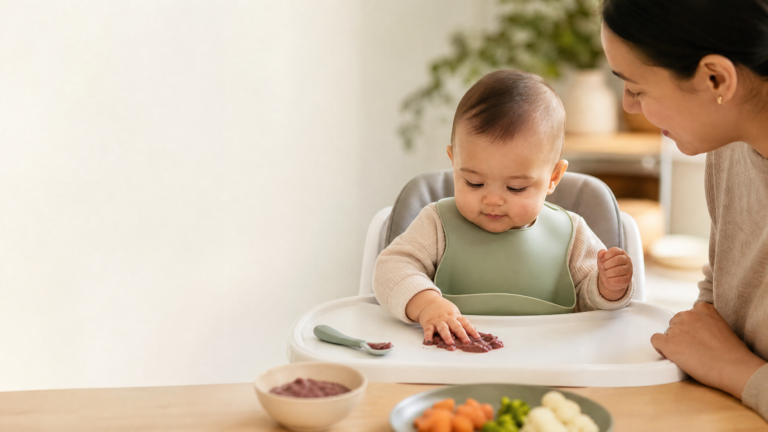
At 9 months you are squarely in the 9-to-12-month window, where the feeding landscape shifts dramatically. Babies develop the pincer grasp — the ability to pick up small objects between thumb and forefinger — around 9-10 months, which opens up the world of self-feeding. This is a messy, chaotic, and developmentally essential phase. The baby who smears sweet potato on the high chair tray is not misbehaving; they are exploring texture, temperature, and the properties of food through sensory play. The evidence strongly supports allowing babies to self-feed as much as possible, whether through baby-led weaning or a combination of finger foods and spoon-feeding. Self-feeding promotes oral motor development, hand-eye coordination, and healthy appetite regulation.
The debate between baby-led weaning and traditional spoon-feeding deserves a more nuanced answer than either extreme. Baby-led weaning — allowing the baby to self-feed from the beginning — has been associated with improved appetite self-regulation, earlier development of chewing skills, and less picky eating at age 2. It also carries a higher risk of choking if not implemented carefully, and it can be hard for parents who are anxious about gagging. The evidence supports a middle ground: offer a combination of finger foods the baby can self-feed and pureed foods that are spoon-fed, letting the baby take the lead as much as possible while ensuring they get enough calories and nutrients. Follow the baby’s cues. If they are reaching for the spoon, let them hold it; if they are pushing the spoon away, they are telling you they are full.
After 12 months, toddler feeding becomes a test of parental patience. Appetite naturally decreases as growth slows, and toddlers develop strong food preferences, often rejecting foods they loved the week before. This is normal and developmentally appropriate. The division of responsibility in feeding — parents provide what, when, and where; children decide whether and how much to eat — is the evidence-based framework that reduces mealtime battles and supports healthy eating habits. If your toddler eats well one day and barely touches food the next, or wants the same food for a week and then refuses it, those are normal patterns that do not require intervention as long as growth is on track.
Common Feeding Questions Answered
How many meals should a 9-month-old eat?
Most 9-month-olds do well with 2-3 solid meals plus 1-2 snacks daily, around 3-4 milk feeds. Start where your baby is comfortable and add meals as interest grows. Each meal is small — about 3-5 tablespoons total. Milk remains a major calorie source, so don’t worry if only a few bites are eaten while your baby practices self-feeding.
How much milk does a 9-month-old need?
Aim for 20-28 oz of breast milk or formula across 3-4 feeds daily at 9 months. Some babies drop to 3 feeds as solids increase. Avoid exceeding 32 oz, which can crowd out iron-rich foods. If your baby suddenly drops multiple feeds or seems constantly hungry, check in with your pediatrician to confirm growth and intake stay healthy.
What finger foods are safe at 9 months?
Choose soft, dissolvable, or easily mashed foods: banana, avocado, well-cooked carrot, scrambled egg, and soft pasta. Keep pieces about the size of a pencil eraser. Always cut grapes, hot dogs, and cherry tomatoes into quarters. Avoid whole nuts, popcorn, hard raw vegetables, and chunks of cheese or meat, which are top choking hazards for babies this age.
Can I give my 9-month-old cow’s milk?
Wait until 12 months for cow’s milk as a drink; the AAP notes it lacks the iron babies need and can reduce formula or breast milk intake. Small amounts of cheese or yogurt are fine from 6 months if there is no dairy allergy. Talk to your pediatrician before changing milk at 9 months, and ask about iron.
Is it normal for my 9-month-old to refuse food?
Yes, within reason. Babies this age are distractible and may eat little on some days, especially while teething or learning to self-feed. Offer the same foods repeatedly — acceptance can take 10-15 exposures. If refusal lasts over a week, weight gain stalls, or meals become a battle, consult your pediatrician to rule out issues and get tailored guidance.
How do I know if my baby is getting enough?
The most reliable indicators are weight gain — your baby should follow their growth curve — diaper output (at least 6-8 wet diapers per day after the first week), and your baby’s behavior after feeds: content and relaxed, not crying or rooting. If you are concerned, your pediatrician can perform a weighted feed to measure exactly how much milk your baby transfers during breastfeeding.
Can I switch between breast and bottle?
Yes, many babies successfully alternate between breast and bottle (combination feeding). The key is establishing breastfeeding first — usually 3-4 weeks — before introducing a bottle. Use a slow-flow nipple to maintain a feeding pace similar to breastfeeding. Have someone other than the breastfeeding parent offer the first few bottles, as babies can smell their mother’s milk and may refuse the bottle from her. If your baby resists the bottle, try different nipple shapes, temperatures, and timing.
When to Check In With Your Pediatrician
If you have specific concerns about your child’s health, development, or behavior that are not addressed in this article, please bring them to your next pediatrician visit. Every child is unique, and personalized medical advice — based on your child’s individual history, examination findings, and family context — is always more valuable than generalized guidance. Your pediatrician is your partner in navigating the complex and rewarding journey of raising a healthy, happy child.
🩺 Doctor’s Take
Print the sample day, then use it loosely. At 9 months the scoreboard is milk ounces that stay in the 20-28 range, wet diapers, and growth along the curve — not tablespoons finished. Put iron on every plate, keep pieces at pencil-eraser size, and let the mess happen: smearing food is how self-feeding gets learned. Expect to offer a new food 10-15 times before it counts as rejected. If milk intake suddenly drops, weight gain stalls, or meals turn into daily battles, bring that to me — those are the patterns worth an appointment.
References and further reading
- CDC infant and toddler nutrition.
- American Academy of Pediatrics — policy statement on breastfeeding and the use of human milk (Pediatrics, 2022).
- FDA: infant formula guidance for parents.
This article is general information, not individual medical advice. Every baby is different — talk to your own pediatrician about your child’s feeding, sleep, growth or development, and seek urgent care for breathing difficulty, poor feeding, dehydration, fever in an infant under 3 months, or any sudden change in your baby’s behaviour.
Medical review
Reviewed by Dr. Ahmad Raza, MD, Pediatrics. Last reviewed September 27, 2026. Written by Dr. Sarah Williams, MD (Pediatrics). Reviewed against CDC infant- and toddler-nutrition guidance and AAP breastfeeding policy — CDC page verified this date; the AAP policy statement is cited by name (403 through two fetch methods).
Learn about our physicians on the About page.




8 Comments