Crib Transition From Bassinet: A Safety-First Plan
Bassinet to crib transition: the quick answer
Move from bassinet to crib when your baby reaches the bassinet’s weight or height limit, starts rolling, or looks cramped — usually 3–6 months. You can go cold-turkey or gradual; keep safe sleep rules: back to sleep, firm mattress, no bumpers or loose bedding. A familiar routine and the same room ease the change.
For the full picture, read our pillar guide on Safe Sleep Checklist: Room Sharing, Firm Mattresses & SIDS Preventi.
Why bassinet to crib transition happens — the sleep science
The bassinet to crib transition is driven by your baby’s growth and developing motor skills, not by a calendar date. Knowing the biology behind the move helps you time it well and avoid both rushing and waiting too long.
Growth outpaces the bassinet
Bassinetes are designed for small, immobile newborns. Most have a weight limit between 15 and 20 pounds (about 7 to 9 kilograms) and a length limit tied to when a baby’s head nears the top. A baby approaching those limits makes the frame less stable and the sleep space cramped. Sleep pressure and comfort still matter, but once the structure is outgrown, safety requires a roomier, sturdier crib.
Rolling changes everything
Around 4 months, many babies learn to roll. A bassinet has low, flexible sides meant for a baby who stays put. Once a baby can roll, those low sides become a fall and entrapment risk. The crib’s taller, fixed rails and adjustable mattress height are built for a mobile baby. Rolling is the single most important developmental trigger for the move.
The maturing circadian rhythm
By 3 to 6 months, melatonin production strengthens and babies develop more predictable sleep cycles. This is also when a consistent bedtime routine starts to “stick.” Transitioning during this window lets you pair the new sleep space with an established routine, which lowers resistance.
Sleep associations and environment
Babies notice where they fall asleep. A change of location can briefly disrupt sleep because the association shifts. This is normal and temporary. The transition works best when you keep everything else constant — same sleep sack, same sound, same order of events — and change only the sleep surface.
Step-by-step plan
A safe, low-stress bassinet to crib transition follows these steps. Choose cold-turkey or gradual based on your baby’s temperament.
1. Confirm a trigger
Move when any one of these is true: the baby reaches the bassinet’s weight or height limit, begins rolling, or looks cramped with limbs pressing the sides. You do not need all three.
2. Set up the crib in the same room
If you are room-sharing, place the crib in your bedroom next to the bassinet first. Familiar surroundings soften the change. A crib in the nursery is fine too, as long as the room is safe and you are comfortable with the distance.
3. Keep the routine identical
Use the same sleep sack, the same white noise, the same dim light, and the same sequence — bath, book, feed, song, bed. The baby should feel that only the bed changed, not the whole world.
4. Start with the easiest nap
Begin with the late-morning nap, when sleep pressure is high and the baby is most likely to settle. Once that nap works in the crib, add others.
5. Practice “drowsy but awake”
Lay the baby down sleepy but not fully asleep so they learn to link sleep cycles in the new space. Stay nearby for reassurance at first.
6. Lower the mattress as mobility grows
Once the baby can sit or pull to stand, drop the mattress to the lowest setting so they cannot climb or fall out. Keep the crib clear of bumpers, pillows, and toys.
Cold-turkey versus gradual
- Cold-turkey: all sleep in the crib from one night. Simplest logistically; may cause a few disrupted nights.
- Gradual: naps in the crib first for a week, then nights. Easier for sensitive babies and cautious parents.
Age-specific subsections
- 2–3 months: Usually still in the bassinet. Transition only if the baby is large for the limit or rolls early.
- 4–5 months: The common window, especially once rolling starts.
- 6 months +: Most babies have moved by now; if not, rolling and size make it overdue.
Sample transition schedule (gradual, 5-month-old)
| Day | Naps | Night |
|---|---|---|
| —– | —— | ——- |
| 1–3 | One crib nap (late morning) | Bassinet |
| 4–7 | Two crib naps | Bassinet |
| 8–10 | All naps in crib | First night in crib |
| 11+ | All sleep in crib | Crib |
Decision checklist: is it time?
| Trigger | Action |
|---|---|
| ——— | ——– |
| At weight/height limit | Move now |
| Rolling started | Move now |
| Head/limbs press sides | Move now |
| None of the above | Stay in bassinet |
Safety reminders
- Always place the baby on the back to sleep.
- Use a firm, flat mattress with a fitted sheet only.
- No bumpers, pillows, blankets, or positioners in the crib.
- Keep the crib clear of toys and loose items under 12 months.
- Do not bed-share on a soft surface; if you bring the baby into your bed to settle them, return them to the crib before you sleep.
- Lower the mattress to the lowest safe setting once the baby can pull up.
- A safety-certified playard (with the bassinet insert removed for older babies) is an acceptable crib alternative; never add a lounger or soft nest inside.
When to Call Your Pediatrician
The transition itself is not a medical event, but call your pediatrician if:
- The baby seems in pain during or after the move.
- Sleep worsens sharply for more than two weeks with no improvement.
- Feeding or weight gain drops around the transition.
- You notice fever, breathing changes, a high-pitched cry, or dehydration signs (fewer than six wet diapers in 24 hours).
- You suspect an underlying issue such as reflux is surfacing and driving the unrest.
Why the crib is the safer next step
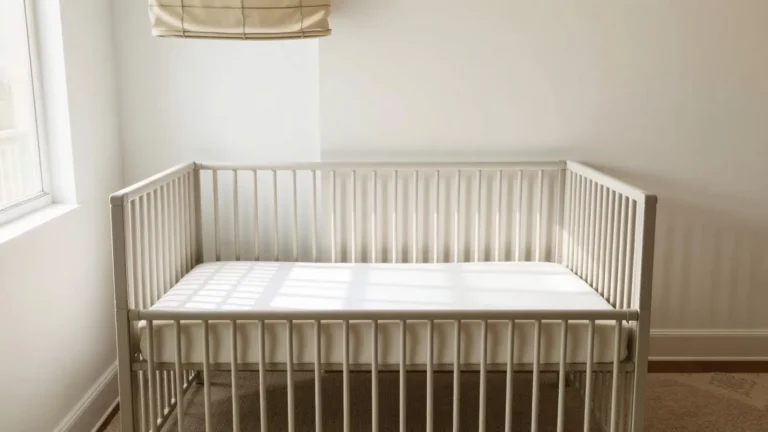
As babies grow and roll, the bassinet’s low, often flexible sides stop being appropriate. A crib has fixed, tall rails and an adjustable mattress that can be lowered as the baby stands. The crib is engineered for a mobile infant; the bassinet is not. Moving at the right time removes a fall and entrapment risk and gives the baby room to stretch and practice movement safely. This is a developmental upgrade, not a punishment for outgrowing the bassinet. The timing is driven by size and skill, not by a birthday.
Common transition mistakes
Rushing all sleep to the crib at once for a sensitive baby can cause overtiredness and a few hard nights. Changing the room, the sack, the sound, and the surface simultaneously overwhelms adjustment. Using a lounger or nest inside the crib recreates an unsafe surface. And lowering the mattress too late — after the baby can already pull up — risks falls. Avoid these by changing one thing at a time and following the step-by-step plan, and by lowering the mattress proactively rather than reactively.
Troubleshooting a baby who resists the crib
If the baby cries on contact or wakes after 20 minutes, check timing and environment first: dark room, white noise, appropriate sleep sack, and a catch of the sleep-pressure window. A hand on the chest and a shush, then stepping back, often helps. If the baby will not settle, finish that nap in the bassinet or arms, then try the crib again next time — protecting total sleep beats perfect method. If resistance with weight or feeding changes lasts beyond two weeks, call your pediatrician to check for reflux or another discomfort.
Reading readiness signs beyond the three triggers
Besides weight, rolling, and cramping, watch for the baby waking more at night because the bassinet feels small, or practicing rolling and bumping the sides. Some babies simply “outgrow” the cozy feel and sleep better with room to move. These softer signs support the move even if you have not hit a hard limit. Conversely, if your baby is thriving and content and well under the limits, there is no rush — the bassinet is safe until a trigger appears.
What if my baby hates the crib at first?
A few hard nights are common and temporary. Keep the routine identical, offer calm check-ins, and remember that protest is not harm. Some babies prefer the enclosed feel of a bassinet; a snug sleep sack and slightly warmer room can bridge that. If protest is intense every night for more than two weeks with no improvement, or feeding and weight suffer, check in with your pediatrician — occasionally the unrest signals reflux or another issue rather than the new bed.
Mattress height and the pull-to-stand stage
Once the baby can sit or pull to standing, lower the mattress to the lowest setting immediately. This prevents climbing out and falls, which become a real risk around 8–12 months. Keep the crib bare throughout; even a “decorative” pillow or blanket is a hazard under 12 months. The lowest setting with a fitted sheet is the safe standard for a mobile baby, and it should stay there until the child moves to a toddler bed.
Safe sleep products to skip during the transition
Skip crib bumpers (breathing hazard), positioners and wedges (entrapment and suffocation risk), inclined sleepers, and any soft nest or lounger placed inside the crib. A mesh “breathable” bumper is still not recommended. The safest crib contains only the baby, a fitted sheet, and a sleep sack. Marketing claims about “safer sleep” do not override standard guidance; when in doubt, choose the bare crib.
Related reading: Newborn Won’t Sleep in Bassinet? 7 Fixes That Actually Work.
How the circadian rhythm helps the move
By 3–6 months, melatonin production matures and babies develop predictable sleep cycles. This is why the transition is easier in that window: the baby’s internal clock supports a consistent bedtime and self-settling. Pairing the new crib with a fixed, calming routine leverages that biology. Before 3 months, the clock is too immature for a baby to “learn” the crib; after 6 months, habits are more set but the move is still very doable with patience and consistency.
Travel and the crib transition
A safety-certified playard is a fine travel crib; use it per the manual and keep it bare. Keep the same sleep sack and sound machine so the environment feels continuous. If you normally room-share, a playard beside your bed maintains the arrangement. Avoid soft travel nests or inclined sleepers, which are not safe for routine sleep. Consistency of routine, not the exact piece of furniture, is what helps the baby sleep away from home.
A note on room-sharing versus separate nursery
The American Academy of Pediatrics recommends room-sharing (baby in your room in their own sleep space) for at least the first 6 months, ideally the first year, because it lowers sleep-related risks. Moving to a crib does not mean moving to another room. You can place the crib in your bedroom. Move the baby to a separate nursery only when you and your pediatrician agree it is right for your family.
Tracking progress without anxiety
Use a simple log for the first two weeks: which sleeps happened in the crib, how long, and how the baby settled. Patterns emerge quickly — most babies accept at least one crib nap within days. Avoid reading too much into a single bad night. If, after two to three weeks, crib sleep is mostly working and the baby is happy and gaining weight, the transition is a success even if one contact nap remains.
When to pause and try later
If your baby is ill, teething, going through a developmental leap, or experiencing a major change (a move, a new caregiver), it is reasonable to pause the transition and return to the bassinet or contact for a week or two. Timing the move for a settled period reduces struggle. The goal is a safe, low-stress change — there is no prize for speed, and a pause is not a failure.
Reassurance about normal variation
Some babies transition in three days; others take three weeks. Both are normal. Temperament, age, and prior sleep associations shape the pace. As long as safe-sleep rules hold and the baby is growing and content, a slower path is perfectly fine. The crib is a tool for safe sleep, not a test the baby can fail, and your calm approach matters more than the calendar.
Signs the plan is working
The transition is succeeding when the baby accepts at least one crib sleep most days, settles with a brief check-in rather than prolonged crying, and total sleep stays steady. A few disrupted nights at the start are normal; look for the trend over two to three weeks, not any single evening. If the baby is happy, growing, and gaining weight while sleeping in the crib, the move has worked even if one bassinet or contact nap remains during the adjustment.
When progress stalls
If after two to three weeks the baby still refuses most crib sleeps, pause for a week during any illness or big change, then restart gently. A stall is usually a timing issue, not a failure — revisit the easiest nap and the pre-warmed crib, and keep the routine identical.
FAQ
Will my baby sleep worse in the crib?
Often for a few nights, then fine. The brief disruption comes from the change in surface and space, not from the crib being wrong. Keeping the routine constant shortens the adjustment.
Can I use a pack-n-play instead of a crib?
Yes. A safety-certified playard is an acceptable sleep space per manufacturer instructions. Remove the bassinet insert for older or rolling babies, and keep the space bare.
See also: Baby Rolls in Sleep and Gets Stuck.
Is a convertible crib okay?
Yes. Use it on the setting appropriate to your baby’s stage, with the mattress at the correct height and lowered as mobility increases.
What if my baby cries the moment I put them down?
Stay nearby, offer a hand on the chest and a shush, then step back. If distress is intense for more than two weeks, or feeding and weight suffer, check in with your pediatrician.
Should I keep the bassinet next to the crib during the switch?
Yes, if space allows. Having the familiar bassinet nearby while you build crib naps can reassure both you and the baby, and you can retire it once crib sleep is reliable.
Is the bassinet to crib transition the same as sleep training?
No. The bassinet to crib transition is a safety and equipment change, not sleep training. You move the baby to a safer sleep space while keeping the same comforting routine; you are not teaching self-soothing or delaying feeds.
Quick checklist before you start
Before the first night in the crib, confirm:
- [ ] The crib meets current safety standards and has a firm, flat mattress
- [ ] Only a fitted sheet is in the sleep space
- [ ] The baby is placed on the back, on their own surface, in your room if under 6 to 12 months
- [ ] You have a calm, short bedtime routine ready
- [ ] The room is dark, cool, and quiet
Running through this once removes the guesswork at 2 a.m. and keeps the first night calm for both of you.
- Bassinet Weight Limits
- When to Stop Swaddling
- When Baby Rolls in Sleep
- American Academy of Pediatrics — A Parent’s Guide to Safe Sleep
- NICHD Safe to Sleep — Safe Sleep Environment
- CDC — About Sudden Unexpected Infant Death
- World Health Organization — Newborn Care
About the author
Dr. Michael Anderson, MD (Pediatrics) is a board-certified pediatrician on the ChildBloom medical panel, focusing on infant sleep, safe sleep environments, and responsive routines. This article was medically reviewed and approved by Dr. Ahmad Raza, MD (Pediatrics) against current AAP safe-sleep guidance. Read our editorial and review standards.
This guide is general education, not a diagnosis. If you are worried about your baby’s breathing, feeding, growth, or sleep, contact your pediatrician. For any breathing emergency, call emergency services immediately.
Related ChildBloom Guides
- Start here: Safe Sleep Checklist: Room Sharing, Firm Mattresses & SIDS Preventi
- Is a Baby Lounger Safe for Sleep
- Room Sharing vs Separate Nursery
- Crib Bumpers & Weighted Sacks
- Safe Sleep for Preterm Babies
- Baby Choking Hazards: Prevention and Safer Mealtimes
- Browse all Sleep & Nursery guides
References & Medical Sources
- NICHD Safe to Sleep: safe sleep environment
- AAP parent guide to safe sleep
- CPSC safe sleep and crib product rules
- CDC data on SUID and SIDS
Reviewed by the ChildBloom pediatric panel. Learn about our physicians on the About page. This article is educational and does not replace your child’s clinician.