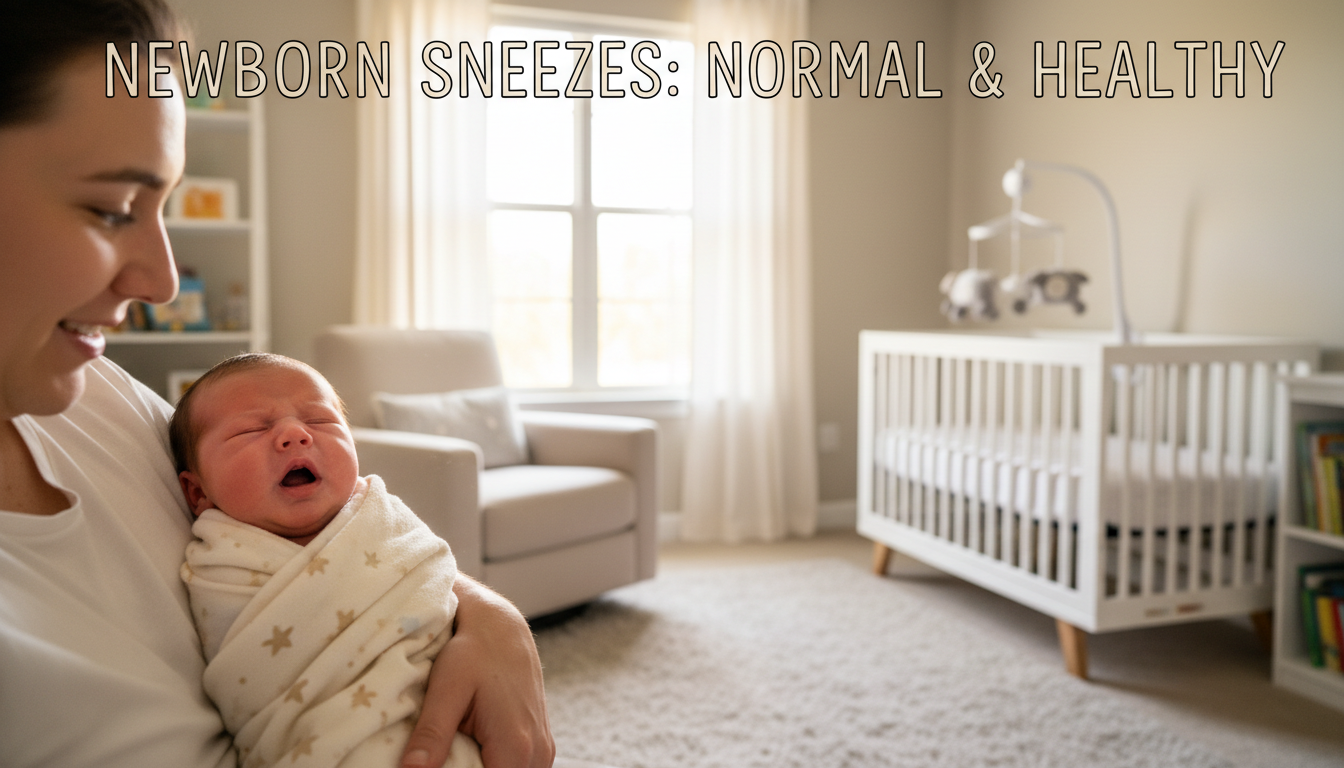
Newborn Sneezing a Lot But No Cold or Fever — Is It Normal?
Newborns Sneeze. A Lot. This Is Usually Completely Normal.
As a pediatrician, I consider frequent sneezing in a healthy newborn to be one of the most reliable signs that a baby’s nose is doing exactly what it should. If you have been watching your newborn sneeze multiple times in a row — tiny, explosive little sneezes that look alarming but seem to cause no distress — take a breath. In the vast majority of cases, you are watching a normal protective reflex, not the beginning of an illness. (For a shorter explainer on the same question, see why is my newborn sneezing so much?)
That said, sneezing can occasionally signal something worth watching. Here is how to tell the difference.
Why Newborns Sneeze More Than Older Babies or Adults
There are several physiological reasons newborns sneeze more than older children:
1. Nasal Passages Are Extremely Narrow
A newborn’s nasal passages are proportionally tiny compared to the volume of air and particles moving through them. The slightest accumulation of mucus, amniotic fluid residue, milk droplets after a feed, or dust from bedding will trigger a sneeze to clear the airway. This is not a malfunction — it is the system working correctly.
2. Newborns Are Obligate Nasal Breathers
For the first several months of life, babies breathe almost exclusively through their noses. This means any nasal congestion or irritation immediately impacts their breathing, and the sneeze reflex fires more readily to keep those passages clear. Noisy breathing is common too — see newborn breathing: what’s normal and what’s concerning and why newborns grunt at night.
3. Clearing Birth Residue
In the first days to weeks after birth, newborns continue to clear residual amniotic fluid from their nasal passages. Sneezing is one of the primary mechanisms for doing this.
4. New Environment, New Particles
The womb is a sterile, temperature-controlled environment. The outside world is full of dust, fabric fibres, pet dander, perfume molecules, and other particles that are entirely new to your baby’s airway. Their nose responds to these novel irritants with sneezing — exactly as it should.
5. After Feeding
Milk and formula droplets frequently enter the nasal passages of newborns, particularly during or after feeds. Sneezing immediately after eating is very common and completely normal. Some babies sneeze in small clusters after feeds, then settle quickly. (If sneezing comes with frequent spit-up, our spit-up vs reflux guide may help; hiccups are another harmless quirk — see newborn hiccups.)
Normal Newborn Sneezing: What It Looks Like
Normal sneezing in a healthy newborn has these characteristics:
- The baby sneezes and then returns to their normal state — feeding, sleeping, looking around — without distress.
- Breathing between sneezes looks comfortable and relaxed, without pulling in under the ribs or visible effort.
- Any mucus present is clear and thin.
- The baby is feeding normally for their age and producing the expected number of wet nappies.
- No fever — temperature is below 38°C (100.4°F).
- Colour is good — lips remain pink, no bluish tinge around the mouth.
Sneezing vs. A Cold: How to Tell the Difference
Sneezing alone is usually a healthy reflex. A cold is more likely when sneezing is accompanied by other symptoms. Use this checklist:
- Congestion or thick yellow/green mucus — suggests a viral infection.
- Cough — particularly a wet, rattling cough that seems different from occasional throat-clearing. See persistent cough in babies for warning signs.
- Reduced feeding — a baby who feeds significantly less than usual needs evaluation.
- Increased sleepiness — tiredness beyond normal newborn patterns can indicate illness.
- Fever — any temperature at or above 38°C (100.4°F) in a baby under 3 months is a medical emergency and requires immediate medical attention. Read newborn fever: when to call the doctor.
- Breathing difficulty — visible effort to breathe, fast breathing, or blue colouration around the lips requires emergency care. Our guide to baby breathing fast while sleeping explains how to count breaths.
Seattle Children’s Hospital guidance is helpful here: if a newborn sneezes occasionally but has no fever, no trouble breathing, no difficulty feeding, and no unusual sleepiness — it is probably not illness. It is healthy nasal clearing. Worried it could be RSV rather than a cold? See newborn cold vs RSV: how to tell the difference.
An Interesting Research Note: Sneezing and Future Allergy Risk
A 2018 prospective cohort study published in a peer-reviewed journal found that persistent sneezing without colds at 18 months of age was associated with increased rates of atopic dermatitis, allergic rhinitis, and asthma at 6 years of age. This does not mean your sneezing newborn will develop allergies — the association was statistical, not causal, and most children in the study who sneezed without illness did not develop all three conditions. However, it is a reason to mention persistent sneezing without apparent cause to your pediatrician, particularly if there is a strong family history of allergies.
What You Can Do to Help
If your baby’s nasal passages seem congested:
- Saline nasal drops: 2–3 drops in each nostril help thin and loosen mucus, making it easier for the baby to clear. Use saline first, wait a moment, then allow the baby to sneeze or use a gentle bulb syringe if needed.
- Cool-mist humidifier: in dry climates or during dry seasons, a humidifier in the nursery can reduce nasal irritation from dry air. Keep it clean — stagnant humidifier water grows mold and bacteria rapidly. See our baby room temperature guide for the ideal nursery climate.
- Reduce irritants: strong perfumes, fabric softener sheets, cigarette smoke, and strongly scented cleaning products near the baby’s sleeping area can increase sneezing through irritation. Keep the environment clean and well-ventilated (see our newborn home environment checklist).
- Keep the sleep surface flat: do not raise one end of the crib mattress or prop your baby’s head with pillows or wedges to ease congestion. The AAP advises a flat, firm, non-inclined sleep surface for every sleep, and inclined sleep is linked to suffocation risk. If congestion is affecting sleep, use saline drops and talk to your pediatrician. Learn more in Safe Sleep for Newborns: The ABCs of SIDS Prevention.
When to See Your Pediatrician Immediately
Do not wait if your baby:
- Has a fever of 38°C (100.4°F) or higher and is under 3 months old.
- Has breathing difficulty, is breathing very fast, or has ribs visible with each breath.
- Has blue or grey colouration around the lips or tongue.
- Is feeding significantly less than usual for more than 24 hours.
- Seems unusually difficult to wake, or is unusually lethargic.
These symptoms require same-day or emergency evaluation, not a wait-and-see approach. Your healthy newborn’s sneezing is almost certainly harmless — but your instinct as a parent is a valuable diagnostic tool. When something feels wrong beyond routine sneezing, trust it and call your doctor. For a full checklist, bookmark baby illness warning signs: when to call the doctor.
Related pediatrician-reviewed reading
- Newborn Cold vs RSV: How to Tell the Difference
- Newborn Breathing: What’s Normal and What’s Concerning
- Newborn Hiccups: Causes, Prevention, and When to Worry
- Newborn Fever: When to Call the Doctor (Under 3 Months)
- Newborn Visitors and Germs: A Practical Etiquette and Safety Guide
Sources and further reading
- American Academy of Pediatrics / HealthyChildren.org. Ear, Nose & Throat conditions and Fever: When to Call the Pediatrician.
- American Academy of Pediatrics / HealthyChildren.org. Symptom Checker.
- American Academy of Pediatrics. Updated safe sleep recommendations (flat, non-inclined sleep surface).
Medical disclaimer: this article is for general education and does not replace individual medical advice. Always follow your own pediatrician’s guidance for your child.

3 Comments