18-Month Sleep Regression: Separation Anxiety & Sleep Fixes
18-month sleep regression driven by separation anxiety? Learn connection-based strategies, predictable boundaries, and when to check for medical causes.
18-month sleep regression driven by separation anxiety? Learn connection-based strategies, predictable boundaries, and when to check for medical causes.
15-month-old refusing naps? Learn why the 15-month sleep regression happens, when to transition to one nap, and how to protect total sleep during the strike.
12-month sleep regression hitting hard? Understand why it happens (mobility, nap transitions, separation) and get a practical plan to get sleep back on track.

Introduction: When the Numbers Don’t Add Up You step on the scale at the pediatrician’s office, holding your baby close. The nurse records the weight, plots it on the growth chart, and pauses. Your heart sinks before she even speaks. Your baby hasn’t gained enough. Or worse—they’ve lost weight. In that moment, a thousand questions…
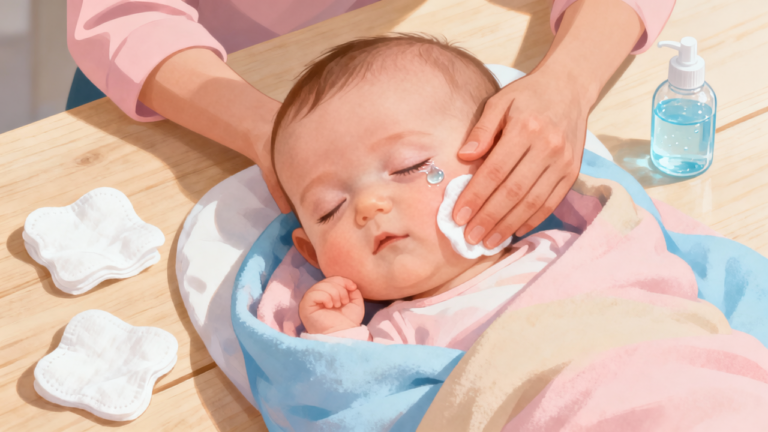
Introduction: The Eye That Won’t Stop Watering You’re wiping your baby’s eye for the fifth time today. The tears keep coming—sometimes clear, sometimes mixed with yellowish discharge that crusts on the eyelashes and glues the eyelids shut after naps. You’ve tried everything: warm compresses, different wipes, even switching detergents. But the watering persists, day after…

Introduction: The Rash That Doesn’t Fade You’re changing your baby’s diaper when you notice them: tiny red or purple spots scattered across their skin. At first, you think it’s a heat rash or a reaction to the new detergent. But when you press your finger against one of the spots, something unsettling happens—nothing. The spot…

Introduction: The Overlooked Danger When parents think about dangerous temperatures in babies, they almost always think about fever. The internet is flooded with articles about what to do when a baby’s temperature hits 100.4°F. But here’s what most parents don’t realize: in newborns, a low temperature can be just as dangerous as a high one—and…
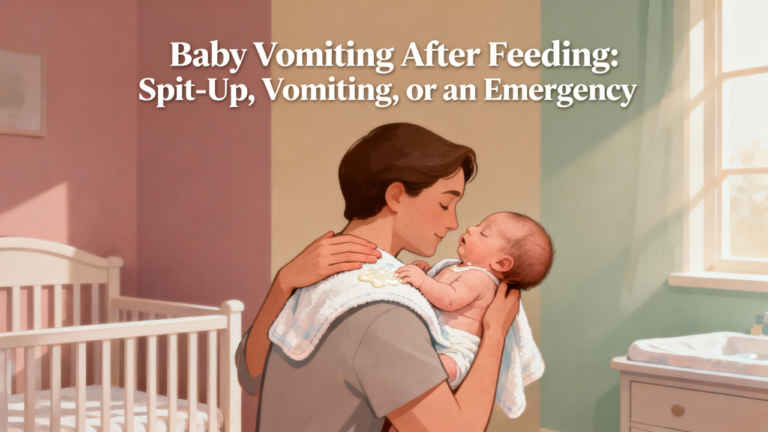
Introduction: The Parent’s Dilemma at 2 A.M. It’s 2 a.m. Your baby just finished a feed, and now there’s a puddle of milk on your shoulder. Your heart sinks. Is this normal spit-up? Is it vomiting? Should you call the doctor? Go to the ER? Or just change your shirt and go back to sleep?…

Introduction: When Feeding Time Turns Frightening You’re halfway through a bottle feed when it happens: your baby suddenly coughs, sputters, and pulls away from the nipple with wide, startled eyes. Your heart races. Is your baby choking? Should you stop? Is something seriously wrong? If this scenario sounds familiar, you’re not alone. Coughing and choking…

Introduction: Why Paced Bottle Feeding Matters Bottle feeding seems simple enough—mix the formula, pop in a nipple, and let gravity do the rest. But if you’ve ever watched a newborn gulp down a bottle in five minutes flat, only to spit up half of it ten minutes later, you’ve witnessed the problem with traditional bottle…

Introduction: Why Parents Need a Milk Intake Calculator “How much milk does my baby need?” It’s the question that keeps new parents awake at 2 a.m., staring at a half-empty bottle and wondering if their baby is getting enough—or too much. Unlike adults who can simply say “I’m full,” babies communicate through subtle cues that…

Introduction: Why Every Parent Needs a Feeding Roadmap “How much should my baby eat?” is arguably the most common question new parents ask—and for good reason. Unlike adults who can simply say “I’m hungry” or “I’m full,” newborns communicate their needs through subtle cues that take time to decode. Add to that the tiny size…

Introduction: Why Wet Diapers Are Your Baby’s Health Report Card In the whirlwind of early parenthood—sleepless nights, cluster feeding, and endless diaper changes—one question quietly haunts nearly every new parent: Is my baby getting enough to eat? While you can’t measure every ounce of breast milk or formula your little one consumes, there is one…

When Do Babies Start Cruising Along Furniture? Cruising usually appears after a baby can pull to stand and shift weight while holding a stable surface. Many babies cruise during the second half of the first year or around the first birthday, but the age range is broad. Some cruise before they walk, while others take…

Tummy Time for Babies With Reflux: Comfortable Positions Babies with reflux may tolerate tummy time better when it is gentle, brief, and timed away from a full feed. Upright cuddling after feeds, chest-to-chest play, side-lying play, and a supported prone position across an alert caregiver’s lap can offer alternatives. Never place a baby prone or…

Signs a Baby May Be Ready to Pull to Stand Pulling to stand is an exciting transition: a baby uses the arms, trunk, hips, and legs together to move from the floor into an upright position. It often appears after a period of sitting, reaching, crawling, scooting, or cruising, but babies do not all follow…

Sensory Play Without Food for 6–12 Months Sensory play for babies can be simple, clean, and food-free. Safe textures, water in a shallow container with an adult present, fabric squares, household sounds, mirrors, and temperature-neutral objects give babies ways to see, hear, touch, and explore without edible materials that create choking or allergy concerns. For…

Screen-Free Indoor Play for Toddlers in Small Spaces Toddlers can get rich screen-free play in a small home when activities use the floor, a few household objects, movement, imitation, and pretend play. A small space does not need a large toy collection. Rotating a few safe choices often creates more engagement than leaving everything out….
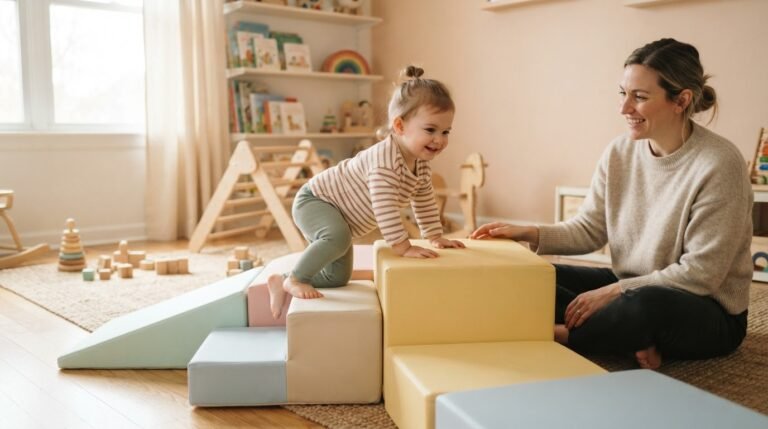
Safe Climbing Play for a 15-Month-Old Climbing is a normal way for a 15-month-old to practice strength, balance, planning, and confidence, but toddlers do not understand height or danger reliably. Safe climbing means creating low, stable challenges on the floor while blocking unsafe heights, stairs, windows, furniture, and playground hazards. Stay within arm’s reach, use…
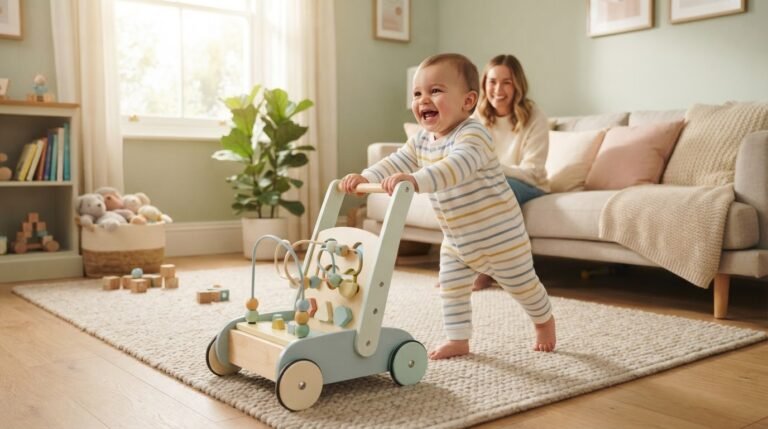
Push Toys Before Walking: When They Help and When They Do Not Push toys may be useful after a child can stand and cruise with control, but they are not required to teach walking and can be unsafe when they roll too quickly. Choose a heavy, stable toy with a controllable handle, use it only…

Premature Baby Milestones: Corrected Age for Movement Corrected age helps clinicians interpret developmental milestones for babies born prematurely. It adjusts chronological age by the number of weeks early, usually during the first two years. Corrected age is a tool for fair comparison, not a reason to ignore concerns or delay care when a parent sees…
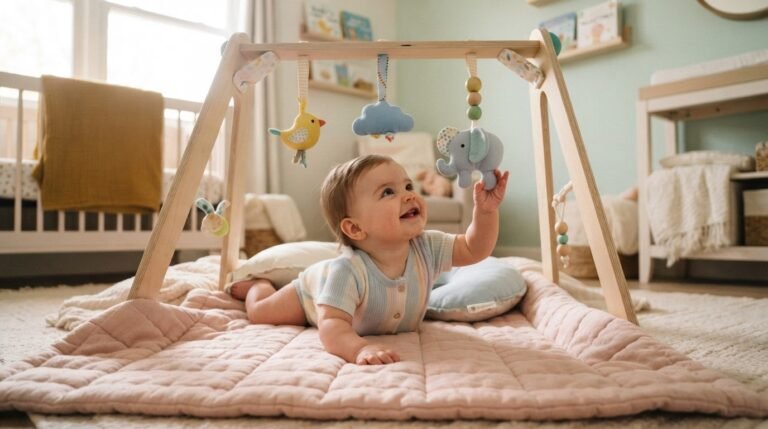
Play Ideas for Babies With Limited Mobility A baby with limited mobility can still enjoy rich play through looking, listening, reaching, grasping, vocal turn-taking, supported position changes, mirrors, books, and sensory exploration. The goal is not to make the baby perform a movement but to create accessible ways to participate and communicate. Place toys within…

Outdoor Play for a Baby Who Is Not Walking A baby does not have to walk to benefit from outdoor play. Supervised time on a clean blanket, looking at leaves, reaching for safe objects, rolling, crawling, sitting, supported standing, and listening to outdoor sounds can support exploration before independent walking. Choose a safe surface and…

How Much Floor Time Does a 6-Month-Old Need? There is no universally required number of minutes of floor time for every 6-month-old. Offer several short, supervised periods across the day, adjusted for sleep, feeding, temperament, and tolerance. Floor time should complement—not replace—sleep, feeding, cuddling, and responsive interaction. At 6 months, floor play can include back…

Fine-Motor Play for Babies Who Cannot Crawl Yet A baby does not need to crawl before practicing fine-motor skills. Reaching, grasping, transferring objects, banging safe toys together, looking toward a sound, and bringing hands to the middle all build useful coordination before or alongside crawling. Offer short, supervised floor-play games that encourage reaching, grasping, releasing,…
We use cookies to improve your experience on our site. By using our site, you consent to cookies.
Manage your cookie preferences below:
Essential cookies enable basic functions and are necessary for the proper function of the website.
These cookies are needed for adding comments on this website.
Statistics cookies collect information anonymously. This information helps us understand how visitors use our website.
Google Analytics is a powerful tool that tracks and analyzes website traffic for informed marketing decisions.
Service URL: policies.google.com (opens in a new window)