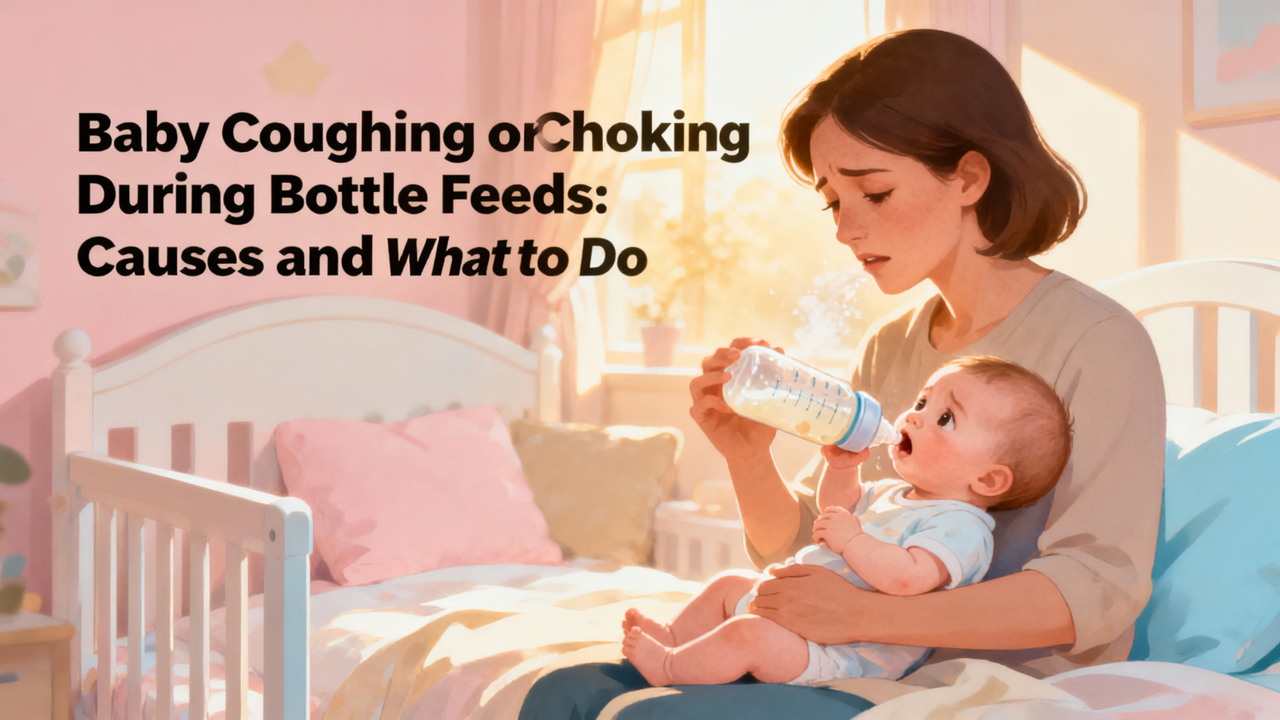
Baby Coughing or Choking During Bottle Feeds: Causes and Wha
Introduction: When Feeding Time Turns Frightening
You’re halfway through a bottle feed when it happens: your baby suddenly coughs, sputters, and pulls away from the nipple with wide, startled eyes. Your heart races. Is your baby choking? Should you stop? Is something seriously wrong?
If this scenario sounds familiar, you’re not alone. Coughing and choking during bottle feeding is one of the most common—and most anxiety-inducing—experiences new parents face. The good news? In most cases, it’s preventable and fixable with the right adjustments to flow rate, positioning, and feeding technique.
The bad news? Left unaddressed, repeated coughing and choking during feeds can lead to more serious problems: milk aspiration into the lungs, feeding aversions, poor weight gain, and even pneumonia. Knowing the difference between a harmless gag reflex and a dangerous choking episode—and knowing exactly what to change—is essential for every parent and caregiver.
This comprehensive guide draws on guidance from pediatricians, feeding specialists, lactation consultants, and institutions including the CDC, Healthline, and Nationwide Children’s Hospital. We’ll cover:
Whether your baby coughs occasionally or struggles with every feed, this article gives you the knowledge and confidence to feed safely.
Gagging vs. Choking: Know the Difference
Before diving into causes and solutions, you must understand the difference between gagging and choking. They look similar to a worried parent, but they require completely different responses.
Gagging: A Protective Reflex
Gagging is a normal, protective reflex that helps babies learn to manage food and liquid safely. It’s loud, dramatic, and actually a sign that your baby’s safety mechanisms are working.
Signs of gagging:
What to do: Stay calm. Allow the gag reflex to do its job. Sit baby upright and give them a moment to recover. Most gagging episodes resolve within seconds.
Choking: A Medical Emergency
Choking occurs when the airway is partially or completely blocked, preventing normal breathing. It’s often silent or much quieter than gagging, which makes it more dangerous.
Signs of choking:
What to do: Act immediately. Follow infant choking first aid (see Emergency Response section below). Call 911 if the obstruction doesn’t clear quickly.
The “Hyper-Gag Reflex” in Newborns
Babies are born with an exaggerated gag reflex that gradually matures over the first year. This means newborns gag more easily than older infants—not because something is wrong, but because their protective reflexes are extra-sensitive while their swallowing coordination develops.
Common Causes of Coughing and Choking During Bottle Feeds
Understanding *why* your baby is coughing is the first step to fixing it. Here are the most common causes, ranked from most to least common.
1. Nipple Flow Rate Too Fast
This is the #1 cause of coughing and choking during bottle feeding. When milk flows faster than your baby can swallow, it overwhelms their mouth and airway.
Why it happens:
Signs the flow is too fast:
The fix:
2. Incorrect Bottle Position or Angle
Gravity is your baby’s enemy when the bottle is held too vertically. A steep angle creates continuous flow that baby can’t control.
Why it happens:
Signs of poor positioning:
The fix:
3. Immature Suck-Swallow-Breathe Coordination
Newborns are learning to coordinate three complex actions: sucking, swallowing, and breathing. Until this coordination matures (typically by 4-6 weeks, sometimes longer), milk can slip into the airway.
Why it happens:
Signs of coordination issues:
The fix:
4. Overfeeding or Too-Large Volumes
A baby’s stomach is tiny. When too much milk is offered too quickly, the stomach overfills and milk backs up into the esophagus and airway.
Why it happens:
Signs of overfeeding:
The fix:
5. Reflux (GERD)
Gastroesophageal reflux occurs when stomach contents flow back into the esophagus. When refluxed milk reaches the throat, it triggers coughing.
Why it happens:
Signs of reflux-related coughing:
The fix:
6. Nasal Congestion
Babies are obligate nose breathers—they prefer to breathe through their nose, especially while feeding. A stuffy nose forces them to breathe through their mouth, disrupting the suck-swallow-breathe rhythm.
Why it happens:
Signs of congestion-related coughing:
The fix:
7. Milk Protein Allergy or Intolerance
In about 2-3% of infants, the immune system reacts to proteins in cow’s milk formula (or dairy in a breastfeeding mother’s diet), causing inflammation that can affect swallowing and breathing.
Signs of milk protein allergy:
The fix:
8. Anatomical or Medical Issues
Less commonly, coughing and choking can signal an underlying medical condition requiring evaluation.
Potential issues:
Red flags requiring medical evaluation:
The Troubleshooting Decision Tree
Use this step-by-step guide to identify and fix the cause of your baby’s coughing or choking.
Step 1: Observe the Pattern
| Question | If Yes | If No |
|---|---|---|
| Does coughing start immediately when bottle is tilted? | Likely flow too fast or position wrong | Go to Step 2 |
| Does coughing happen after several sucks without a pause? | Likely coordination issue | Go to Step 3 |
| Does coughing happen only when baby is congested? | Likely nasal obstruction | Go to Step 4 |
| Does coughing happen toward end of feeds? | Likely overfeeding | Go to Step 5 |
| Does coughing happen after feeds when lying down? | Likely reflux | Go to Step 6 |
Step 2: Check Flow Rate and Nipple
Do this first—it’s the most common cause.
Step 3: Adjust Positioning
Step 4: Clear Airways Before Feeds
Step 5: Reduce Volume and Increase Frequency
Step 6: Address Reflux
Emergency Response: What to Do If Your Baby Is Choking
Despite all precautions, choking can still happen. Knowing how to respond can save your baby’s life.
For a Coughing Baby (Airway Partially Clear)
For a Silent Choking Baby (Airway Blocked)
This is an emergency. Act immediately.
When to Call 911
Important: All parents and caregivers should take an infant CPR and choking first aid course. Contact your local Red Cross, hospital, or community center for classes.
Prevention: Building Safe Feeding Habits
Before Every Feed
During Every Feed
After Every Feed
Environment
When to See the Doctor
While occasional coughing is normal, certain patterns warrant medical evaluation:
Schedule a Pediatric Appointment If:
Seek Immediate Medical Care If:
Possible Medical Evaluations
Your pediatrician may recommend:
Frequently Asked Questions (FAQs)
Is it normal for newborns to cough during feeds?
Occasional coughing or gagging is normal in newborns due to their hyper-gag reflex and immature swallow coordination. However, frequent coughing during *every* feed, or coughing that causes distress, is not normal and should be addressed.
How do I know if my baby is aspirating milk?
Signs of aspiration include:
If you suspect aspiration, contact your pediatrician immediately. A swallow study may be needed.
Can a baby choke on breast milk too?
Yes. While less common than with bottles (because breast milk flow is baby-controlled), babies can choke on breast milk due to overactive let-down, poor positioning, or coordination issues. The same response applies: sit baby upright and let them recover.
Should I switch formulas if my baby coughs?
Don’t switch formulas repeatedly without medical guidance. First, rule out flow rate, positioning, and technique issues. If coughing persists and is accompanied by other symptoms (rash, blood in stool, extreme fussiness), consult your pediatrician about trying a hypoallergenic formula.
What if my baby only coughs with one caregiver?
This usually indicates a technique difference. Ensure all caregivers know:
Share this guide with anyone who feeds your baby.
My baby coughs when switching from breast to bottle. Why?
Breast milk flow is baby-controlled and variable. Bottle flow is gravity-driven and continuous. Babies used to breastfeeding may struggle with the faster, more constant bottle flow. Use paced bottle feeding, a preemie-flow nipple, and be patient—it often takes 1-2 weeks for babies to adapt.
How often should I replace bottle nipples?
Replace nipples every 4-6 weeks, or sooner if you notice:
Can teething cause coughing during feeds?
Teething increases drooling, which can trigger the gag reflex and cause occasional coughing. However, teething doesn’t typically cause choking or significant coughing during feeds. If coughing is frequent or severe, look for other causes.
What if my baby coughs up milk through their nose?
Milk coming out of the nose occasionally can happen when baby coughs or sneezes during a feed. It’s usually not serious. However, if it happens frequently, it may indicate:
Consult your pediatrician if it’s a regular occurrence.
Is my baby more likely to choke when drowsy?
Yes. A drowsy baby’s suck-swallow-breathe coordination is impaired. Try to feed when baby is alert and hungry—not exhausted or falling asleep. If baby dozes off during feeds, gently rouse them or end the feed.
Conclusion: Confidence Through Knowledge
Hearing your baby cough or choke during a feed is one of the most frightening sounds a parent can experience. But with the right knowledge, most causes are identifiable, fixable, and preventable.
The vast majority of coughing and choking episodes stem from three things: a nipple flow that’s too fast, a bottle position that’s too steep, or a feeding technique that doesn’t allow baby to pace themselves. Fix these, and you’ll likely fix the problem.
Remember the hierarchy of response:
Your baby is learning to eat, just as you’re learning to feed them. Both skills take time, patience, and practice. Trust your instincts, trust the process, and never hesitate to seek help when something doesn’t feel right.
Key Takeaways:
You’ve got this. One safe, calm feed at a time.
When to Call Your Pediatrician
Contact your pediatrician if you have concerns about your baby’s health, feeding, or development. If you believe your child has a medical emergency, call 911 or go to the nearest emergency department immediately.
This article is for general informational purposes only and is not a substitute for professional medical advice, diagnosis, or treatment. Always consult your pediatrician about your child’s individual health needs. If you believe your child has a medical emergency, call your local emergency number immediately.
Written by Dr. Anderson, MD (Pediatrics) | Medically approved by Dr. Ahmed Raza, MD (Pediatrics) | Updated for 2026