Newborn Cognitive Development: How Your Baby Learns 0–3 Months
Your newborn’s brain forms a million neural connections every second. The good news: the best ‘enrichment’ is free — your face, your voice, and responsive care.

Your newborn’s brain forms a million neural connections every second. The good news: the best ‘enrichment’ is free — your face, your voice, and responsive care.

Every newborn develops on their own timeline, but pediatric guidelines define what to expect at each well-child visit. Here’s the complete 1-, 2-, and 3-month milestone comparison.

Head control is the foundation for every motor skill that comes after — rolling, sitting, crawling. Here’s the developmental timeline and how to safely support it.

Newborns smile in their sleep almost from day one — but the first ‘social smile’ aimed at you is a true developmental milestone. Here’s when it happens and how to invite it.

Tummy time builds neck strength, prevents flat head, and lays the foundation for crawling. Here’s exactly how to do it from day one — even with a baby who screams.

Babies hear from about 25 weeks in utero — they’re born already recognizing your voice. Here’s how hearing develops in the first 3 months and what to do if you’re worried.

Newborns come pre-programmed with primitive reflexes that helped human ancestors survive. Here’s what each one does, when it fades, and which ones doctors check at every visit.

Gestational diabetes affects 2–10% of pregnancies. With proper monitoring and lifestyle changes, most women have healthy outcomes. Here’s what you need to know.

Newborns are born nearsighted with the ability to focus only 8–12 inches — exactly the distance to your face during feeding. Here’s how vision develops in the first 3 months and how to support it.

The umbilical cord stump dries and falls off in 1–3 weeks. Learn the modern dry-care method, what is normal in healing, and the signs of serious infection.

RSV is the leading cause of hospitalization in babies under 1 year. Learn how to spot the difference between a routine cold and bronchiolitis early.
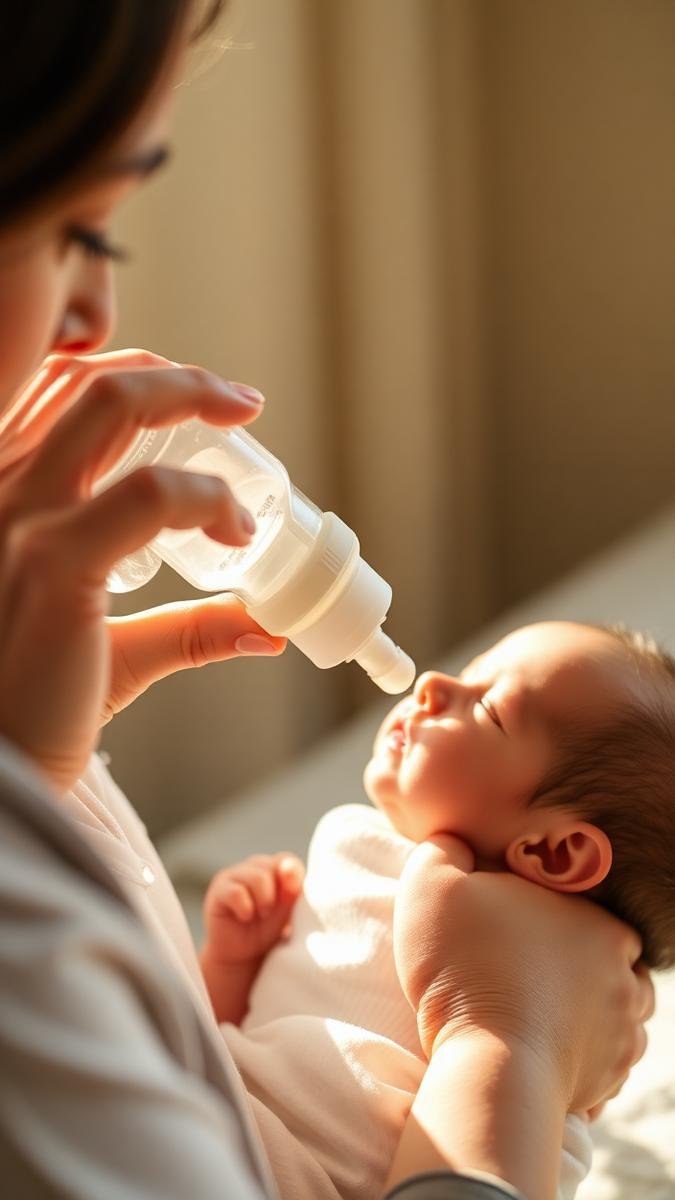
Newborns dehydrate fast. Learn the early signs — fewer wet diapers, sunken fontanelle, dry mouth — and what to do before it becomes an emergency.

Newborn diapers come in a surprising rainbow of colors. Here is what each one means, when to be reassured, and the three colors that always need a doctor.

Almost every newborn gets a rash in the first weeks. Most are harmless and resolve on their own — here is how to identify the common ones and spot the few that need treatment.

Newborn breathing is noisy, irregular, and often alarming to new parents. Most of it is completely normal — but a few signs always warrant urgent attention.

About 60% of newborns develop visible jaundice in the first week. Most cases resolve on their own — but a small number need urgent treatment to prevent harm.

Fever in a newborn is never wait-and-see. Learn the exact temperature threshold, how to measure correctly, and what doctors look for in a febrile infant.

Up to 80% of pregnant women experience nausea. For most it peaks around weeks 6–9 and resolves by week 14. For some, it’s far more severe. Here’s the evidence-based playbook.

Most newborns spit up — it is a laundry problem, not a medical one. But some spit-up is reflux disease, and some is true vomiting that needs urgent care. Here is how to tell.

A deep, asymmetric latch is the single biggest predictor of pain-free breastfeeding and good milk transfer. Here is how to get one — and the four positions worth learning in the first weeks.

Most newborn rashes are harmless and resolve without treatment. Knowing which is which saves both panic and unnecessary creams.

Swaddling can calm the startle reflex and extend sleep — but it must be done correctly, and it must be stopped at the first sign of rolling. Here is the safe-swaddling playbook.

Room-sharing for at least 6 months is recommended. Bed-sharing carries real SIDS risk — but if you choose it, there are evidence-based ways to reduce that risk. Here is the full picture.

Newborns sleep up to 17 hours a day because their brains, bodies, and immune systems are growing faster than at any other point in life. Here is what is happening, what is normal, and when to worry.

Compare popular sleep training options like Ferber and the gentle pat and shush method to find the absolute best fit for your baby’s nightly routine.
We use cookies to improve your experience on our site. By using our site, you consent to cookies.
Manage your cookie preferences below:
Essential cookies enable basic functions and are necessary for the proper function of the website.
These cookies are needed for adding comments on this website.
Statistics cookies collect information anonymously. This information helps us understand how visitors use our website.
Google Analytics is a powerful tool that tracks and analyzes website traffic for informed marketing decisions.
Service URL: policies.google.com (opens in a new window)