Baby Not Crawling at 9 Months: What Is Normal?
Baby Not Crawling at 9 Months: What Is Normal?
A baby not crawling at 9 months is often still within the broad range of typical development. Crawling is a familiar milestone, but it is not a required step for every healthy child, and the exact age at which babies begin moving varies widely. Some babies crawl on hands and knees, while others belly-crawl, scoot, roll, pivot, shuffle, move backward, or go directly from sitting and pulling up to cruising and walking. The more useful question is not simply, “Is my baby crawling?” It is whether your baby is making steady progress, using both sides of the body, sitting independently, exploring movement, and retaining skills already learned.
At the same time, a parent should not be told to ignore a concern. The Centers for Disease Control and Prevention (CDC) describes developmental milestones as skills that most children—at least 75%—can do by a certain age, and its 9-month checklist emphasizes getting into a sitting position and sitting without support rather than requiring crawling.1 If your baby is not meeting one or more milestones, has lost a skill, or simply moves in a way that worries you, contact the child’s doctor and ask whether developmental screening or an evaluation is appropriate.1
This guide explains what can be normal at 9 months, how to encourage movement safely, and which signs deserve prompt professional attention.
Key Takeaways
– Not crawling at 9 months alone does not prove that a baby has a developmental problem; many babies use different forms of mobility or crawl later.
– At this age, sitting independently, changing positions, reaching and pivoting, using both sides of the body, and continuing to gain skills are important clues.
– Do not force a crawl or place a baby in a position they cannot reach independently. Offer frequent supervised floor play and safe opportunities to move.
– Call the pediatrician if your baby cannot sit without support, shows persistent one-sided movement, seems unusually stiff or floppy, loses skills, or you have any ongoing concern.
Is it normal if a 9-month-old is not crawling?
Yes, it can be normal. Crawling has a broad and variable timeline, and some children never use a classic hands-and-knees crawl. The World Health Organization’s motor-development standards describe windows of achievement rather than one compulsory day on which a child should perform a skill.2 Research on infant motor development also shows that children use multiple pathways to mobility; crawling is one strategy, not a universal prerequisite for walking or healthy development.3
The CDC’s current 9-month movement checklist includes getting to a sitting position independently and sitting without support. Crawling is not listed as a universal 9-month requirement.1 That does not mean crawling is unimportant. It can be a useful way for a child to practice weight shifting, coordination, visual-motor planning, and exploration. It means that the absence of crawling at exactly 9 months should be interpreted alongside the rest of the developmental picture.
A baby may be preparing to crawl without looking like an adult’s idea of crawling. You might see the baby push up on straight arms, rock on hands and knees, pivot in a circle, move backward, drag forward with the arms, roll toward a toy, or scoot on the bottom. These patterns can be temporary stages. Some babies spend more time developing transitions—such as moving from sitting to the floor—before they travel across the room.
Premature birth also matters when interpreting early milestones. For a baby born before 37 weeks, clinicians may use a corrected age during the first two years, especially when considering developmental progress. Ask your pediatrician how corrected age applies to your child rather than trying to adjust every milestone yourself.
Why do some babies crawl later or skip crawling?
Normal variation is the most common explanation. Temperament, body proportions, opportunities for floor play, prior experience with movement, and the child’s preferred strategy all influence when mobility emerges. A baby who is highly interested in social interaction may spend more time sitting and reaching toward caregivers. Another baby may be content to roll or pivot because those methods are effective enough to reach a nearby toy.
Some babies are less motivated to move when toys, adults, or siblings routinely bring everything to them. This does not mean a parent has caused a delay. It simply suggests that creating a little space and placing an interesting, safe object just beyond reach may provide a reason to experiment with movement.
Medical factors can also affect motor progress. Illness, pain, vision or hearing concerns, differences in muscle tone, joint limitations, neuromuscular conditions, and broader developmental differences may influence mobility. A short article cannot determine which explanation applies to an individual child. That is why patterns, progress, and examination matter more than a single milestone date.
Which 9-month movement skills matter besides crawling?
At 9 months, consider the complete movement sequence. A baby may be developing typically even without crawling if they can sit steadily, use their hands purposefully, move in some way, and continue learning new skills. Keep notes or short videos to share with the pediatrician; a baby’s movement may look different in the clinic than it does at home.
| What to observe | Why it is useful | Examples of encouraging progress |
|---|
|—|—|—|
| Sitting balance | Provides a foundation for reaching and changing positions | Sits without support, turns to look, reaches and returns upright |
| Position changes | Shows motor planning and increasing control | Moves from sitting toward the tummy, rolls both ways, pivots |
| Mobility | Shows the child is finding ways to explore | Rolls, belly-crawls, scoots, shuffles, crawls, or moves backward |
| Symmetry | Helps identify persistent differences between sides | Uses both arms and legs and bears weight on both sides |
| Upper-body strength | Supports reaching, pushing, and future transitions | Pushes up, reaches for toys, shifts weight from one arm to another |
| Skill progression | Helps distinguish variation from regression | Adds new movements over time and does not lose skills |
The CDC also lists social, communication, and cognitive milestones at 9 months, such as responding to a name, making varied sounds, looking for a dropped object, and banging two things together.1 Development does not occur in isolated compartments. A concern in one area does not automatically predict a problem in another, but the whole pattern helps a clinician decide what to do next.
What if my baby sits but does not move?
A baby who sits independently but is not yet mobile may still be developing normally, particularly if they reach, rotate, lean and recover, roll, or try to get onto the tummy. Some babies remain stationary for a while and then progress quickly. Watch whether the baby can move out of sitting, tolerate tummy-down play, and use both hands and legs during play.
Mention it to the pediatrician if your baby sits like a “tripod” with hands on the floor most of the time, cannot turn or reach without falling, never attempts to change position, or seems uncomfortable on the tummy. These observations do not diagnose a condition, but they help the clinician assess strength, balance, tone, joint movement, and opportunities for practice.
What can parents do to encourage crawling without forcing it?
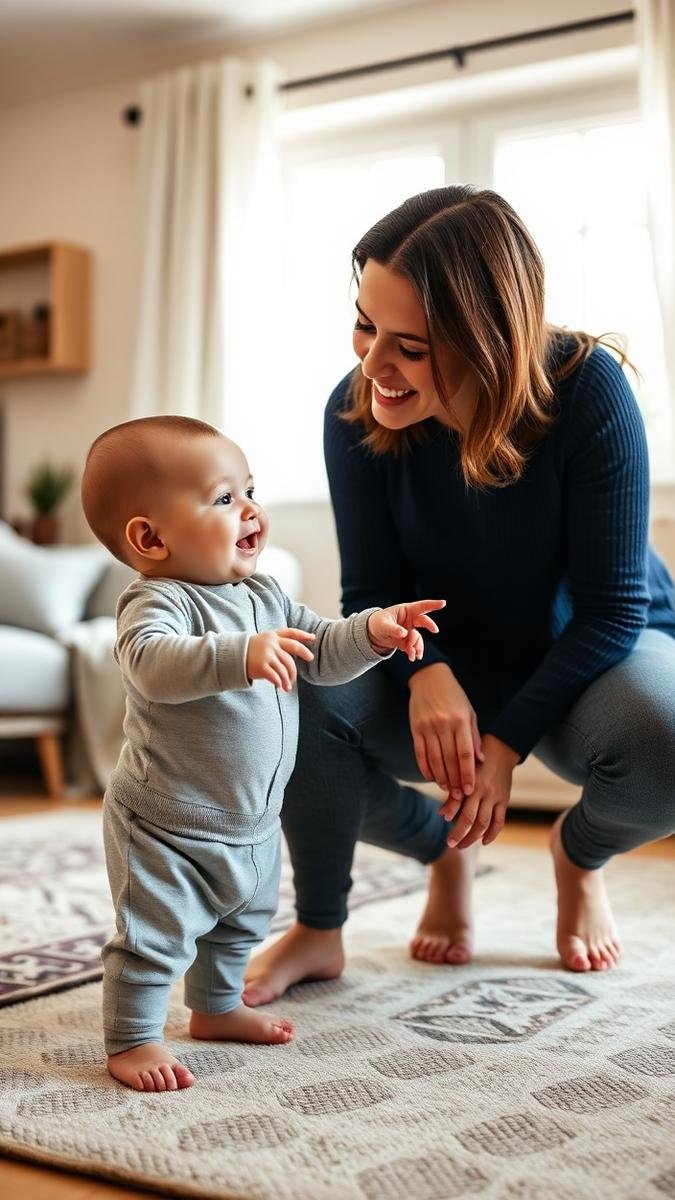
The best support is frequent, supervised, child-led floor play. Place your baby on a firm, uncluttered surface while awake and stay close. Put a favorite toy or your face slightly beyond reach so the baby has a reason to shift weight, reach, roll, pivot, or crawl. Celebrate effort rather than insisting on a particular form.
A few short sessions throughout the day are often more realistic than one long exercise period. Let your baby spend time in different positions: on the back, on the tummy, sitting with support nearby, and side-lying during play. If the baby becomes tired or frustrated, change the activity. Movement should feel like play, not a test.
Tummy time remains useful for awake, supervised practice. A systematic review published in *Pediatrics* found associations between tummy time and several early motor outcomes, although it did not show that tummy time guarantees earlier walking.4 The practical lesson is balanced: provide opportunities, but do not promise that a particular exercise will make a baby crawl by a specific date.
Try placing toys in a semicircle around the baby rather than always directly in front. This encourages turning and weight shifting. Put a toy on a low, stable surface for the baby to reach toward, but avoid creating a situation in which the child is pulled into standing before they are ready. You can lie on the floor at the baby’s level, imitate their movements, and use a cheerful voice to invite exploration.
Avoid devices that restrict movement for long periods. Walkers with wheels can create safety risks and do not teach independent walking; the American Academy of Pediatrics recommends against their use.5 Stationary activity centers, high chairs, swings, and bouncers may be useful briefly when used according to instructions, but they should not replace free movement on the floor.
How do I make floor play safe?
Crawling and pre-crawling exploration increase the need for childproofing. Get down at your baby’s eye level and look for electrical cords, small objects, unstable furniture, medications, cleaning products, pet food, and reachable hot liquids. Use safety gates at stairs, secure furniture to the wall, cover outlets where appropriate, and keep choking hazards out of reach. A toy large enough to fit through a toilet-paper tube may be a choking risk, but age labels alone are not a substitute for supervision.
Sleep safety is separate from awake floor play. Always place an infant on their back for sleep on a firm, flat, uncluttered surface. Do not use pillows, positioning wedges, or loose blankets to “teach” crawling or stabilize a sleeping baby. During awake play, supervise closely; during sleep, follow current safe-sleep recommendations from your health authority.6
When should I call the pediatrician about a baby not crawling at 9 months?
Call the pediatrician if your baby is not sitting without support, does not get into a sitting position, rarely moves or reaches, appears unusually stiff or floppy, uses one side much more than the other, keeps one hand fisted, does not bear weight through the legs when supported, seems to have pain, or has lost a skill they previously used. Also call if your concern persists even when the baby is meeting other milestones. Parents are important observers, and the CDC specifically advises families to act early when a child is not meeting milestones, loses skills, or raises concern.1
A single unusual movement is not the same as a persistent asymmetry. Babies may temporarily favor one side because a toy is positioned there, they are tired, or they are learning a new transition. The concern rises when the same pattern appears across days or weeks, especially if one arm or leg consistently does less work or the baby cannot turn toward the less-used side.
Seek urgent medical care for sudden weakness, a new inability to move an arm or leg, severe pain, breathing difficulty, a seizure, significant injury, or a child who is acutely ill. These situations are not routine milestone questions.
What happens at a developmental visit?
The clinician may ask when the baby was born, what skills are present, how the baby moves at home, whether there has been regression, and whether feeding, sleep, vision, hearing, or behavior raises additional concerns. They may observe the baby sitting, reaching, rolling, bearing weight, and transitioning between positions. They may complete or arrange a standardized developmental screen.
Screening is not a diagnosis. It is a structured way to identify children who may benefit from closer assessment. The AAP recommends developmental surveillance at health supervision visits and standardized screening at specific ages, including 9 months, with additional screening based on concerns.7 If a concern is identified, the next step may be early intervention, physical therapy, a developmental specialist, or follow-up monitoring, depending on the findings and local services.
Bring three useful things: a list of skills your baby can do, a description of what worries you, and two or three brief videos recorded during ordinary play. Do not coach the baby repeatedly for the video. Natural movement is more informative than a performance after many attempts.
Does not crawling at 9 months predict late walking?
Not necessarily. Crawling age does not reliably determine walking age, and some children skip crawling altogether. A child may walk within a typical range after using another form of mobility. Walking itself also has a broad range; the average age is not a deadline, and individual pathways vary.3
What matters more is whether the child is building the underlying abilities needed for future movement: trunk control, balance, weight shifting, reaching, bilateral coordination, and the ability to move between positions. A baby who is not crawling but is steadily improving may need only time and opportunity. A baby who is not crawling and also shows regression, marked asymmetry, poor head or trunk control, or difficulty sitting deserves assessment sooner.
It is also important not to compare siblings or social-media videos. A neighbor’s baby may crawl at 6 months, while another healthy child begins at 11 months or never uses that pattern. Comparisons can be emotionally powerful but clinically weak. Use age-based guidance as a prompt for observation and communication, not as a competition.
Frequently asked questions
Should I be worried if my baby is not crawling at exactly 9 months?
Usually, not from that fact alone. At 9 months, look at sitting, transitions, reaching, mobility in any form, symmetry, and overall progress. Discuss it with the pediatrician if other concerns are present or if your intuition says something is not right.
Is scooting instead of crawling normal?
Scooting can be a normal mobility strategy. Some babies bottom-shuffle, roll, belly-crawl, or move backward before crawling, and some go from scooting to pulling up. Tell the pediatrician if scooting is strongly one-sided, persists with other asymmetries, or occurs alongside difficulty sitting or using a limb.
Can I teach my baby to crawl?
You cannot and do not need to teach a specific crawl style. You can provide safe floor time, place interesting objects within a manageable challenge, vary positions, and respond positively to attempts. Do not pull the baby forward by the arms or force the knees under the body.
Do baby walkers help babies crawl or walk?
No. Wheeled walkers do not provide a safe or necessary developmental advantage and can increase injury risk, especially near stairs or hot surfaces.5 Use supervised floor play and stable, age-appropriate furniture instead.
Does a baby have to crawl before walking?
No. Some children skip crawling. Walking readiness depends on a broader set of skills, including balance, postural control, and weight-bearing. A pediatrician can help if a child is not progressing or shows red flags.
What if my baby used to roll but stopped?
Loss of a previously acquired skill should be reported promptly to the child’s doctor. Regression is more important than a simple difference in timing and should not be explained away online.1
Conclusion
A 9-month-old who is not crawling may still be developing typically, especially if the baby sits independently, reaches, changes positions, moves in another way, uses both sides, and continues to gain skills. Crawling is one possible route to exploration—not a universal exam that every baby must pass.
Give your baby daily supervised opportunities for floor play, keep the environment safe, and focus on progress rather than a specific crawling style. Contact the pediatrician if your baby cannot sit without support, shows persistent asymmetry, seems unusually stiff or floppy, loses skills, appears uncomfortable, or simply causes you ongoing concern. Early questions are appropriate, and asking for developmental screening does not mean you have diagnosed your child. It means you are paying attention and seeking support at the right time.
References
CDC: Milestones by 9 Months — https://www.cdc.gov/act-early/milestones/9-months.html
World Health Organization: Motor Development Milestones — https://www.who.int/tools/child-growth-standards/standards/motor-development-milestones
Adolph and Hoch: The Development of Motor Behavior — https://pmc.ncbi.nlm.nih.gov/articles/PMC5182199/
Hewitt et al.: Tummy Time and Infant Health Outcomes — https://publications.aap.org/pediatrics/article-abstract/145/6/e20192168/76940
American Academy of Pediatrics: Prevention of Walker-Related Injuries — https://publications.aap.org/pediatrics/article/142/4/e20181491/37381/Prevention-of-Walker-Related-Injuries-in-Infants
American Academy of Pediatrics: Safe Sleep — https://www.aap.org/en/patient-care/safe-sleep/
American Academy of Pediatrics: Developmental Surveillance and Screening — https://www.aap.org/en/patient-care/developmental-surveillance-and-screening-patient-care/
Medical note: This article is educational and does not replace an examination, diagnosis, or personalized advice from your child’s pediatrician. If your baby loses skills, develops sudden weakness, has severe pain, or appears acutely ill, seek medical care promptly.
<!– [IMAGE: Hero image of supervised floor play; add licensed asset with descriptive alt text.] –>
<!– [CHART: A simple developmental pathway graphic showing sitting, transitions, varied mobility, pulling to stand, and cruising; label it as illustrative rather than a deadline.] –>
<!– [VIDEO: Embed a pediatric physical therapist or hospital-produced demonstration of safe floor play, after editorial review.] –>
*Medically reviewed by Dr. Ahmed Raza, MD, FAAP (Pediatric Emergency Medicine, ChildBloom Medical Review Board) on 2026-08-30.*
About the author: Dr. Sophia Martinez, MD, PhD is a developmental pediatrician specializing in developmental milestones, sensory processing, and neurodevelopmental screening. She reviews ChildBloom’s movement and milestone content against AAP, CDC, and WHO guidance. Meet the panel →