Baby Allergy Medicine: Antihistamine Safety
# Baby Allergy Medicine: Antihistamine Safety
**Quick answer:** Most babies with mild allergies don’t need medication — trigger avoidance and supportive care are usually enough. When medicine is necessary, antihistamines like diphenhydramine (Benadryl) may be used under pediatrician direction for babies over 6 months, dosed strictly by weight (1.25 mg/kg every 6 hours). Newer antihistamines (cetirizine/Zyrtec, loratadine/Claritin) are sometimes used off-label for babies 6+ months. Never give any allergy medicine to a baby without your pediatrician’s explicit guidance, and know the signs of anaphylaxis — which requires epinephrine and a 911 call, not antihistamines.
—
What Are Antihistamines and How Do They Work?
When your baby encounters an allergen — whether it’s a protein in food, pollen drifting through an open window, or dust mites in a carpet — their immune system may overreact. It identifies the substance as a threat and releases a chemical called **histamine**. Histamine binds to receptors on cells throughout the body, triggering the familiar symptoms of an allergic reaction: sneezing, runny nose, itchy eyes, hives, swelling, and in severe cases, breathing difficulties.
Antihistamines work by blocking those histamine receptors, essentially preventing the chemical from delivering its “attack” signal. Think of it like putting a piece of tape over a doorbell — the visitor (histamine) is still there, but the signal doesn’t get through. This can relieve itching, reduce nasal secretions, and calm hives, but it does **not** stop a reaction that has already progressed to anaphylaxis. That distinction matters enormously, and we’ll return to it in the section on emergency action.
According to the [American Academy of Pediatrics (AAP)](https://www.healthychildren.org), antihistamines are among the most commonly used over-the-counter medications in children, but their use in infants requires particular caution. A baby’s liver and kidneys — the organs responsible for metabolizing and clearing drugs from the body — are still maturing, especially in the first year of life. This means medications can linger longer, accumulate more easily, and produce unpredictable effects compared to older children or adults.
The [FDA](https://www.fda.gov) emphasizes that over-the-counter cough and cold products, including many antihistamine formulations, are **not recommended for children under 2 years of age** unless specifically directed by a physician. This warning exists because of serious and potentially life-threatening risks, including rapid heart rate, seizures, and even death from overdose in infants.
So when does antihistamine use make sense for a baby? The answer depends on the type of antihistamine, the baby’s age and weight, the severity of symptoms, and — critically — whether a pediatrician has evaluated the child and recommended a specific medication and dose.
—
Types of Antihistamines for Babies
Not all antihistamines are created equal. They fall into two broad categories, and understanding the difference helps explain why some are used in infants while others are not.
First-Generation Antihistamines (Sedating)
The oldest and most well-known antihistamine is **diphenhydramine**, sold under the brand name Benadryl. It’s a first-generation antihistamine, which means it readily crosses the blood-brain barrier. This produces the drowsiness that many adults associate with Benadryl — and it’s the same reason the medication is sometimes (controversially) used to help children sleep, a practice the AAP explicitly discourages.
For babies, diphenhydramine is sometimes prescribed for:
– Acute allergic reactions (hives, mild swelling)
– Severe itching from eczema flares or insect bites
– Allergic rhinitis when other options aren’t suitable
**Important safety note:** Diphenhydramine is **not FDA-approved for children under 2 years of age**. The dosing that appears on over-the-counter labels for infants was removed years ago after safety concerns emerged. When pediatricians do prescribe it for babies, they calculate the dose based on the child’s weight: **1.25 mg per kilogram of body weight, given every 6 hours as needed**. This is significantly different from the dosing instructions you might find on a store-bought package, which is exactly why you should never guess.
Another first-generation antihistamine sometimes used in hospital settings is **hydroxyzine** (Atarax, Vistaril), but this is rarely prescribed for home use in infants and typically requires specialist involvement.
Second-Generation Antihistamines (Non-Sedating)
Newer antihistamines were developed to minimize the drowsiness and cognitive side effects of first-generation drugs. They don’t cross the blood-brain barrier as easily, so they cause far less sedation. The two most commonly considered for babies are:
**Cetirizine (Zyrtec):** Sometimes used off-label for infants 6 months and older for chronic allergic conditions like persistent allergic rhinitis or chronic urticaria (hives). Some pediatricians consider it a preferred option for babies who need ongoing antihistamine therapy because it has a better safety profile than diphenhydramine for prolonged use. However, it is not FDA-approved for children under 2, so any use in infants is off-label and should be guided by a physician.
**Loratadine (Claritin):** Also used off-label for babies 6+ months in some clinical scenarios. It tends to cause less drowsiness than cetirizine but may be less potent for some children. Again, this is not FDA-approved for infants and requires pediatrician guidance.
**Fexofenadine (Allegra):** Generally not recommended for children under 2 years of age, and most pediatricians avoid it in infancy.
Why the Generational Difference Matters for Babies
The choice between first- and second-generation antihistamines isn’t just about drowsiness. First-generation antihistamines have **anticholinergic effects** — they block acetylcholine, another neurotransmitter, which can cause dry mouth, constipation, urinary retention, blurred vision, and in babies, potentially dangerous changes in heart rate and body temperature regulation. These effects are less common with second-generation drugs, which is why many pediatricians prefer cetirizine or loratadine when ongoing treatment is needed.
However, in an **acute allergic reaction** where a baby has developed hives or mild swelling, a pediatrician may still recommend diphenhydramine because it acts quickly (within 15–30 minutes) and its sedative effect can be calming for a distressed infant. The key word is *recommended* — never initiated by a parent without medical guidance.
—
When Does Your Baby Need Allergy Medicine?
This is the question most parents want answered first, and the honest answer might surprise you: **most of the time, babies don’t need medication for mild allergies.** The foundation of allergy management in infancy is **trigger avoidance and supportive care**, not drugs.
Situations Where Medicine Is Usually NOT Needed
– **Mild seasonal sniffles** with clear nasal discharge and occasional sneezing — saline drops and a nasal aspirator are usually sufficient.
– **A few isolated hives** that appear briefly and resolve on their own without swelling or breathing changes.
– **Mild eczema** that responds to fragrance-free moisturizers and avoiding known irritants.
– **A single episode of spitting up** after a new food that doesn’t involve rash, swelling, vomiting, or breathing difficulty.
In these scenarios, the best “medicine” is patience, observation, and removing the trigger. For example, if you notice your baby gets a runny nose every time you visit a house with cats, the solution is to limit exposure — not to medicate your baby before the visit.
Situations Where Medicine MAY Be Needed
– **Persistent allergic rhinitis** causing significant sleep disruption, feeding difficulties, or day-to-day discomfort that doesn’t improve with environmental controls.
– **Chronic hives** (lasting more than 6 weeks) or recurrent acute hives that are itchy and distressing.
– **Moderate-to-severe eczema** that isn’t controlled with moisturizers and gentle skin care alone.
– **Acute allergic reactions** with widespread hives, facial swelling, or significant itching — under pediatrician direction.
– **Allergic conjunctivitis** with persistent itchy, watery, red eyes.
The decision to start any medication should always involve your pediatrician, who will weigh the benefits of symptom relief against the risks of medication side effects in a developing infant.
—
Dosing: Why Weight Matters More Than Age
This section could be the most important one in this entire article. **Giving your baby the wrong dose of antihistamine is one of the most dangerous mistakes a parent can make.**
The Weight-Based Dosing Rule
For diphenhydramine (Benadryl), the standard pediatric dose is:
> **1.25 mg per kilogram of body weight, every 6 hours as needed. Do not exceed 4 doses in 24 hours.**
This means a 5 kg (11 lb) baby would receive **6.25 mg** per dose, while a 10 kg (22 lb) baby would receive **12.5 mg** per dose. The liquid formulation of diphenhydrant is typically 12.5 mg per 5 mL, so these doses translate to **2.5 mL** for the smaller baby and **5 mL** for the larger one.
Here’s why this matters so much: if you give the dose appropriate for a 10 kg baby to a 5 kg baby, you’ve just **overdosed** them by a factor of two. In an infant, this can cause excessive sedation, respiratory depression, rapid heart rate, and in extreme cases, seizures or coma.
How to Measure Accurately
– **Never use kitchen spoons.** They are wildly inaccurate. A “teaspoon” from your drawer could hold anywhere from 2.5 to 9 mL.
– **Always use the measuring device** that comes with the medicine — the oral syringe or dosing cup — or purchase a separate oral syringe from your pharmacy.
– **Double-check the concentration** on the bottle. Infant and children’s formulations may differ. Read the label every single time.
– **Verify the dose with your pediatrician** before the first administration. Ask them to write down the exact dose in milligrams and milliliters.
Common Dosing Mistakes to Avoid
1. **Giving adult formulations.** Adult Benadryl capsules and tablets are dosed at 25–50 mg — two to four times the appropriate infant dose. Never split adult tablets for a baby.
2. **Combining multiple medications.** Many over-the-counter cold and flu products contain antihistamines alongside other active ingredients. Giving your baby a separate antihistamine on top of a multi-symptom cold medicine can result in accidental overdose.
3. **Dosing by age instead of weight.** Babies of the same age can vary enormously in weight. Always go by the number on the scale.
4. **Giving medicine more frequently than directed.** “Every 6 hours” means every 6 hours — not every 4, not “whenever she seems itchy.” Antihistamines accumulate in the body, and too-frequent dosing leads to toxicity.
5. **Using outdated medication.** Check expiration dates. Expired medications may lose potency or, rarely, degrade into harmful compounds.
The [AAP](https://www.healthychildren.org) maintains a comprehensive resource on proper medication dosing for children and strongly encourages parents to use oral syringes rather than spoons for liquid medications.
—
Safety Concerns Every Parent Should Know
Antihistamines are serious medications, not harmless supplements. In babies, the safety concerns are amplified by their small size and developing organ systems.
Paradoxical Reactions
In some infants and young children, diphenhydramine doesn’t cause drowsiness — it causes the opposite. Instead of becoming sleepy, the baby becomes **hyperactive, agitated, irritable, or inconsolable**. This paradoxical stimulant effect is well-documented but unpredictable. If it happens, stop the medication and contact your pediatrician.
Over-sedation and Breathing Risks
Excessive sedation is the most common serious side effect of first-generation antihistamines in babies. A baby who is too drowsy may feed poorly, have shallow breathing, or be difficult to wake. These are **medical emergencies** — if you cannot wake your baby or their breathing seems dangerously slow or shallow, call 911 immediately.
Anticholinergic Toxicity
In overdose, first-generation antihistamines produce a cluster of symptoms known as anticholinergic toxicity:
– Fever (because sweating is suppressed)
– Flushed, dry skin
– Dilated pupils
– Rapid or irregular heartbeat
– Urinary retention
– Severe constipation
– Agitation or hallucinations (in toddlers)
– Seizures
– Coma
If you suspect your baby has received too much antihistamine — whether from an accidental double dose, the wrong concentration, or a medication error — **call Poison Control immediately at 1-800-222-1222** (available 24/7 in the United States) or seek emergency care. Do not wait for symptoms to appear.
Long-Term Use Concerns
Some parents worry about giving antihistamines repeatedly over weeks or months for chronic conditions like eczema or allergic rhinitis. While second-generation antihistamines (cetirizine, loratadine) have a favorable safety profile for prolonged use in older children, their long-term safety in infants under 12 months has not been as thoroughly studied. This doesn’t mean they’re unsafe — it means the decision to use them should be made carefully with your pediatrician, who will periodically reassess whether the medication is still necessary.
Drug Interactions
If your baby is taking any other medications — prescription or over-the-counter — tell your pediatrician before starting an antihistamine. While significant interactions are uncommon in infants, the combination of antihistamines with other sedating medications can increase the risk of over-sedation.
—
Alternatives for Mild Allergies (Non-Medication Approaches)
Before reaching for the medicine cabinet, try these evidence-based strategies for managing your baby’s mild allergy symptoms.
For Nasal Allergy Symptoms
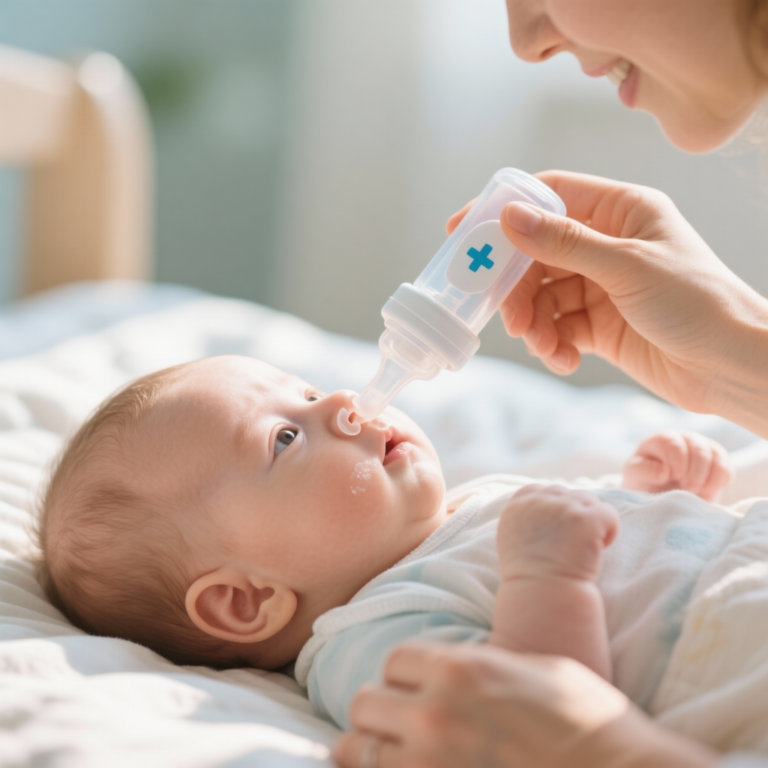
– **Saline nasal drops or spray:** Over-the-counter saline drops (like Little Remedies or Simply Saline) can loosen mucus and flush allergens from the nasal passages. Use 2–3 drops in each nostril, then gently suction with a bulb syringe or NoseFrida. This is safe for newborns and can be used multiple times a day.
– **Cool-mist humidifier:** Adding moisture to the air, especially in your baby’s sleeping area, can soothe irritated nasal passages. Clean the humidifier daily to prevent mold growth.
– **Elevate the head of the crib slightly:** Place a towel under the mattress (not a pillow in the crib, which is a SIDS risk) to create a gentle incline that helps with nasal drainage.
– **Reduce allergen exposure:** Keep windows closed during high-pollen days, use HEPA air filters, wash bedding weekly in hot water, and avoid having pets in the baby’s sleeping area.
For Skin Allergies and Hives
– **Cool compresses:** A clean washcloth soaked in cool water and applied to hives or itchy areas can provide immediate, medication-free relief.
– **Fragrance-free moisturizer:** Apply a thick, bland moisturizer (like plain petroleum jelly or a ceramide-based cream) to dry or irritated skin at least twice daily. This is the cornerstone of eczema management.
– **Avoid known triggers:** If you’ve identified a food, fabric, or environmental trigger, elimination is more effective than medication. Keep a symptom diary to help spot patterns.
– **Loose, breathable clothing:** Dress your baby in soft, 100% cotton clothing. Avoid wool and synthetic fabrics that can irritate sensitive skin.
For Mild Food Allergies
– **Strict avoidance:** Once a food allergy is identified, the primary treatment is complete avoidance of that food. Work with your pediatrician or a pediatric allergist to ensure your baby’s diet remains nutritionally complete.
– **Introduce new foods one at a time:** When starting solids, introduce a new food and wait 3–5 days before adding another. This makes it easier to identify the culprit if a reaction occurs.
When Supportive Care Isn’t Enough
If you’ve been diligently using non-medication strategies for 1–2 weeks and your baby’s symptoms are still disrupting sleep, feeding, or daily comfort, it’s time to talk to your pediatrician about whether medication might be appropriate. There’s no medal for suffering through — sometimes medicine genuinely improves quality of life for both baby and family.
—
Anaphylaxis Action Plan: When It’s an Emergency
This is the section every parent needs to read carefully and remember. **Anaphylaxis is a severe, life-threatening allergic reaction that cannot be treated with antihistamines alone.**
Recognizing Anaphylaxis in Babies
Anaphylaxis can be harder to recognize in infants than in older children because they can’t tell you what they’re feeling. Watch for:
– **Skin:** Widespread hives, flushing, or swelling of the lips, face, or eyelids
– **Breathing:** Noisy breathing (wheezing, stridor), repetitive coughing, difficulty breathing, or a bluish tint to the lips or face
– **Gastrointestinal:** Sudden, profuse vomiting or diarrhea
– **Circulatory:** Pale, floppy, or unresponsive appearance; weak pulse
– **Behavioral:** Sudden unusual drowsiness, inconsolable crying, or going limp
If your baby shows signs involving TWO or more body systems (for example, hives AND vomiting, or swelling AND breathing difficulty), assume anaphylaxis and act immediately.
What to Do
1. **Call 911 (or your local emergency number) immediately.** Do not drive yourself unless absolutely no ambulance is available — paramedics can begin treatment en route.
2. **If you have an epinephrine auto-injector (EpiPen Jr.), use it right away.** Inject into the outer thigh, even through clothing if necessary. Epinephrine is the only first-line treatment for anaphylaxis. Antihistamines do NOT work fast enough and do NOT protect the airway.
3. **Position your baby safely.** If breathing is difficult, hold them upright. If they’re vomiting or unconscious, place them on their side. If they appear floppy or shocky, lay them flat with legs slightly elevated.
4. **If symptoms don’t improve within 5 minutes and a second auto-injector is available, give a second dose.**
5. **Go to the emergency room even if symptoms seem to improve.** A biphasic reaction — where symptoms return hours later without re-exposure to the allergen — occurs in up to 5–20% of anaphylactic episodes and can be just as dangerous as the first wave.
Why Antihistamines Are NOT Enough for Anaphylaxis
This point cannot be overstated: **diphenhydramine and other antihistamines do not prevent or reverse airway swelling, low blood pressure, or shock.** They may help with hives and itching as an adjunct to epinephrine, but they are not a substitute. Relying on antihistamines during anaphylaxis while waiting to see if the reaction improves has contributed to preventable deaths.
The [AAAAI (American Academy of Allergy, Asthma & Immunology)](https://www.aaaai.org) has clear patient education materials on anaphylaxis action plans, and every parent of a child with known severe allergies should have a written plan on file with their pediatrician, daycare, and any caregivers.
—
When to Call the Pediatrician
Not every allergic reaction requires a 911 call, but many warrant a prompt conversation with your pediatrician. Call if:
– **This is your baby’s first allergic reaction** — even if it seems mild. Your pediatrician needs to evaluate, confirm the diagnosis, and discuss an action plan.
– **Hives are widespread** or lasting more than a few hours without improvement.
– **There is any swelling of the lips, tongue, or face** — even without breathing difficulty.
– **Your baby is wheezing, has noisy breathing, or is breathing faster than usual.**
– **Your baby vomits repeatedly** after eating a new food.
– **Your baby seems unusually drowsy, floppy, or difficult to wake** after a potential allergic exposure or after giving medication.
– **You’ve given an antihistamine and your baby develops a fever, rapid heartbeat, or paradoxical hyperactivity.**
– **You’re unsure whether a symptom is allergy-related** — when in doubt, call. Pediatricians would rather reassure you over the phone than have you manage something serious at home.
For any difficulty breathing, bluish color, or loss of consciousness — call 911 first, then notify your pediatrician.
—
Frequently Asked Questions
Can I give my 3-month-old Benadryl for allergies?
**No.** Diphenhydramine (Benadryl) is not recommended for infants under 6 months of age, and most pediatricians avoid it under 12 months unless there is a specific, compelling medical reason. It is not FDA-approved for children under 2. For a 3-month-old with allergy symptoms, the safest approach is saline nasal drops, environmental trigger avoidance, and a conversation with your pediatrician. Never give Benadryl to a baby this young without explicit medical direction.
Is Zyrtec safe for babies?
Cetirizine (Zyrtec) is sometimes prescribed off-label by pediatricians for babies 6 months and older for chronic allergy conditions. It has a better safety profile than first-generation antihistamines for ongoing use. However, it is not FDA-approved for children under 2, so any use in infants should be directed by your pediatrician with a specific dose calculated by weight. Do not give Zyrtec to a baby under 6 months.
Can I use adult Benadryl and just give a smaller amount?
**Absolutely not.** Adult formulations (25 mg capsules, tablets, or adult liquid concentrations) are not appropriate for babies. You cannot accurately split a 25 mg tablet into an infant dose. If your pediatrician prescribes diphenhydramine, use the children’s liquid formulation (12.5 mg/5 mL) with an oral syringe, and verify the exact dose in milligrams and milliliters with your doctor.
How long does it take for baby allergy medicine to work?
Diphenhydramine (Benadryl) typically begins working within **15–30 minutes**, with peak effect around 1–2 hours. Cetirizine (Zyrtec) may take **1–3 hours** for noticeable effect. Loratadine (Claritin) can take **1–3 hours** as well. If your baby’s symptoms are severe or worsening, do not wait for medication to “kick in” before seeking help — trust your instincts and contact your pediatrician or emergency services.
Can antihistamines make my baby hyper instead of sleepy?
Yes. Paradoxical hyperactivity — where a baby becomes agitated, restless, or hyper instead of drowsy — is a well-documented effect of first-generation antihistamines like diphenhydramine in young children. If this happens, stop the medication and call your pediatrician for an alternative.
Do I need an EpiPen for my baby?
An epinephrine auto-injector is prescribed when a baby has a history of anaphylaxis or is at high risk for severe allergic reactions (e.g., confirmed severe food allergy). If your baby has had a severe reaction involving breathing difficulty or multiple body systems, ask your pediatrician about a prescription. The AAP and AAAAI recommend that all children with known severe food allergies have access to epinephrine at all times — at home, at daycare, and during travel.
Can I give my baby allergy medicine every day?
Daily antihistamine use may be appropriate for babies with chronic conditions like persistent allergic rhinitis or chronic hives, but only under a pediatrician’s supervision. The dose, duration, and choice of medication should be periodically reassessed. Daily use should never be initiated by a parent without medical guidance.
What’s the difference between a cold and allergies in a baby?
This can be genuinely difficult to tell apart. Colds typically last 7–10 days and may include fever, thick yellow or green mucus, and gradual onset. Allergies tend to last longer (weeks to months), produce clear thin mucus, cause more itching (nose, eyes, throat), and don’t cause fever. When in doubt, your pediatrician can help distinguish between the two.
Is it safe to give my baby a combination cold medicine that contains an antihistamine?
The AAP and FDA both advise **against using multi-symptom cold and cough medicines in children under 4 years of age**. These products increase the risk of accidental overdose and side effects without proven benefit in young children. If your baby needs an antihistamine, use a single-ingredient product at the dose your pediatrician recommends.
—
*Written by Dr. Martinez, MD (Pediatrics) | Medically approved by Dr. Ahmed Raza, MD (Pediatrics) | Updated for 2026*
*Sources: [American Academy of Pediatrics — HealthyChildren.org](https://www.healthychildren.org) | [U.S. Food and Drug Administration (FDA)](https://www.fda.gov) | [American Academy of Allergy, Asthma & Immunology (AAAAI)](https://www.aaaai.org)*
Related Guides
Written by Dr. [Author], MD (Pediatrics) | Medically reviewed by Dr. Ahmad Raza, MD (Pediatrics) | Updated for 2026
This article is for general informational purposes only and does not constitute medical advice. Always consult your pediatrician with questions about your child’s specific health needs.