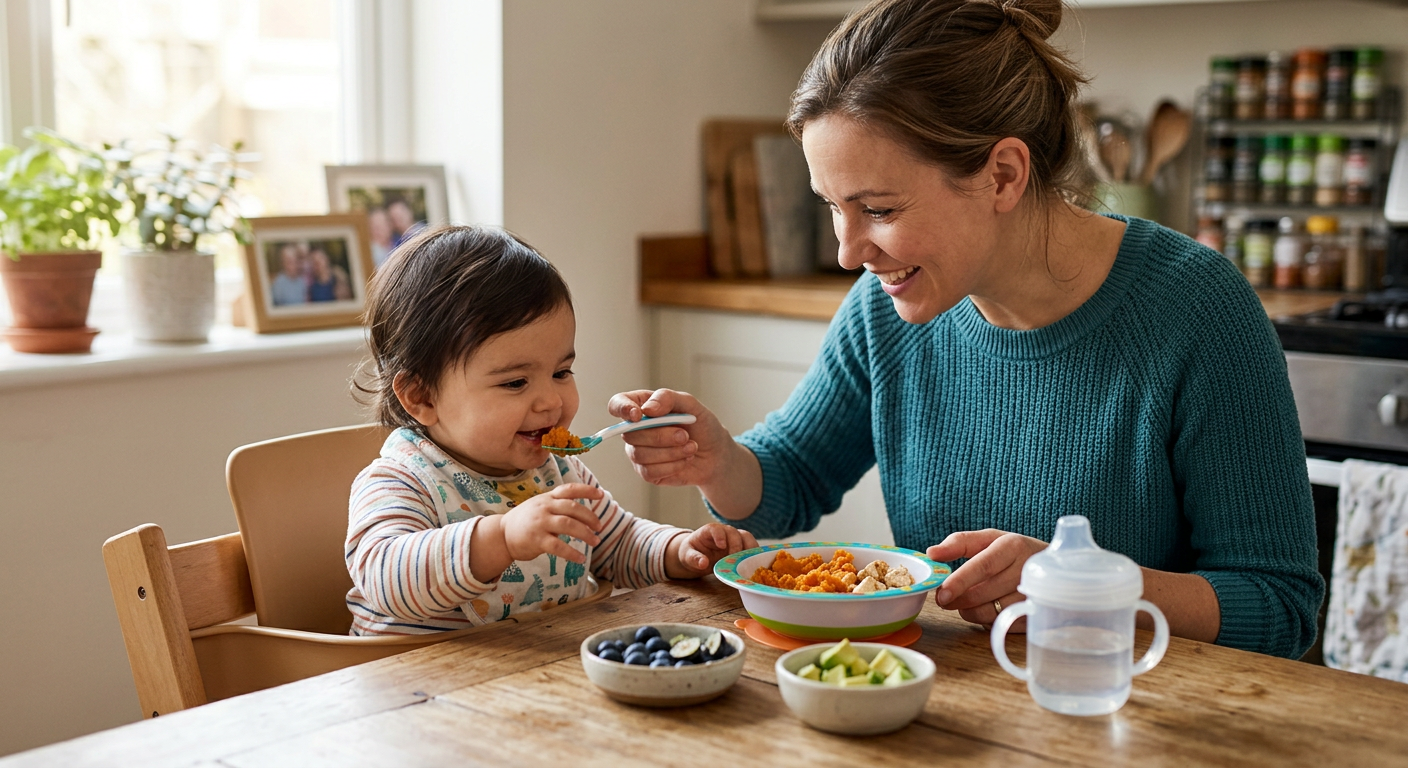
12-Month-Old Feeding Schedule: Sample Menu and Portion Guide
Medically reviewed by Dr. Ahmad Raza, MD (Pediatrics) — ChildBloom Medical Review Panel. Last updated: September 27, 2026.
Written by the ChildBloom Pediatric Panel. Affiliate disclosure: ChildBloom may earn a commission from qualifying purchases made through links on this page. It never changes which products our pediatric reviewers recommend. As an Amazon Associate, we earn from qualifying purchases.
Your baby is turning one, and feeding changes overnight: the bottle starts stepping back, solids move to center stage, and suddenly you are serving what looks like a tiny version of dinner. This 12-month feeding schedule turns that shift into a simple daily routine — sample meals, milk amounts, realistic portions, and snack ideas you can actually cook on a weeknight.
The short version: expect three meals and two snacks a day, about 16 to 24 ounces of whole milk in two or three sittings, and toddler-sized portions of one to two tablespoons per food. Everything else — cup transition, picky phases, honey, choking safety — is covered below in the order parents usually need it.
📋 TL;DR — feeding at 12 months
- Meals: 3 meals + 2 snacks, roughly 2.5 to 3 hours apart
- Milk: 16 to 24 oz whole milk (or breast milk) a day, served in a cup, never more than 24
- Portions: 1 to 2 tablespoons of each food — about a quarter of what is on your plate
- Every day: an iron-rich food, plus allergens kept in the rotation (peanut, egg, fish, dairy)
- Cups: open or straw cup for water between meals; bottle weaning runs 12 to 18 months
- Safety: honey is fine now; grapes and hot dogs cut lengthwise; nut butter always spread thin
What changes at 12 months
Twelve months is the handoff point from infant to toddler feeding. Cow’s milk joins the menu, breast milk or formula starts stepping back, and solids become the main source of calories and nutrients. In practice that means:
- Three meals and two to three snacks replace the graze-as-you-go baby pattern
- 16 to 24 ounces of whole milk spread across two or three servings — enough to support growth, small enough to leave room for iron-rich food
- Family textures: soft finger foods, mashed, minced — whatever the rest of the table eats, made safe
- Iron every day: meat, poultry, fish, fortified cereals, beans — infant iron stores run out around the first birthday
- Allergens stay in rotation: once peanut butter, egg, fish, and dairy are introduced, keep offering them regularly to maintain tolerance
- Self-feeding as much as possible — it builds fine motor skills and lets your child follow their own hunger cues
One principle carries over from the baby months unchanged: responsive feeding. Offer a balanced meal at a predictable time, then let your child decide whether and how much to eat. Watching the plate rather than the clock — and refusing to turn dinner into a negotiation — is the single best predictor of a relaxed eater at 18 months and beyond.
Sample 12-month feeding schedule
One realistic weekday, adjustable to your family’s rhythm:
- 7:00 AM — Wake and milk: 4 to 6 oz breast milk or whole milk
- 8:00 AM — Breakfast: scrambled egg, avocado strips, toast fingers
- 8:30 AM — Free play
- 9:30 AM — Morning nap
- 11:30 AM — Wake and milk: 4 oz
- 12:00 PM — Lunch: shredded chicken, steamed broccoli florets, pear slices
- 1:00 PM — Afternoon nap
- 3:00 PM — Wake and snack: full-fat yogurt with mashed berries, or hummus with soft pita
- 5:30 PM — Dinner: ground turkey with peas, roasted sweet potato wedges
- 7:00 PM — Milk: 4 to 6 oz
- 7:30 PM — Bedtime
This is a template, not a prescription. Shift meals if your mornings run late, drop a snack if dinner is close behind, and adjust for your child’s cues and your family’s schedule.
Easy meals and snacks for the week
The menu does not need to be complicated — most 12-month-olds eat the same dozen staples in different combinations:
- Breakfasts: scrambled egg strips, oatmeal with mashed banana, yogurt with soft berries, toast fingers with a thin spread of peanut butter
- Lunches: shredded chicken with steamed broccoli, hummus with soft pita, cheese cubes with ripe pear, lentil mash with rice
- Dinners: ground turkey with peas, baked salmon flaked over pasta, black beans with sweet potato, minced beef with soft-cooked carrots
- Snacks (two a day): full-fat yogurt, half a banana, ripe peach slices, avocado fingers, oat cereal, small cubes of cheese, dissolvable crackers, soft-cooked pasta
Rotate what is already on your plate and keep your toddler’s portion plain — no added salt, sweetened with fruit rather than sugar.
Portion guide for 12-month-olds
Toddler portions are roughly a quarter of an adult portion, and almost every parent underestimates them. A typical meal at 12 months looks like:
- 1 to 2 tablespoons of protein (meat, beans, egg)
- 1 to 2 tablespoons of vegetables
- 1 to 2 tablespoons of fruit
- 1 to 2 tablespoons of grains or starch
Some days your 12-month-old will clear the plate and ask for more; other days they will eat three bites and declare themselves done. Both are normal. Follow hunger and fullness cues rather than pushing a target quantity — the job is offering balanced variety, not measuring intake.
Foods to offer at 12 months
At 12 months your child can eat most family foods, modified for safety:
- Dairy: whole milk, full-fat yogurt, cheese, cottage cheese
- Fruits: banana, avocado, peach, mango, pear — soft and ripe
- Vegetables: broccoli, carrot, sweet potato, zucchini — well cooked
- Proteins: tender meats and poultry (shredded or minced), eggs (scrambled or hard-boiled), low-mercury fish such as salmon, cod, or trout
- Grains: toast, pasta, rice, quinoa, oatmeal
- Legumes: beans and lentils, mashed or softened
- Nut butters: thinly spread on toast — never served alone, because a spoonful is a choking hazard
Safety rules that still apply: honey is now allowed (the botulism risk ends at the first birthday), though use it sparingly. Cut grapes and hot dogs lengthwise — never in rounds — and avoid hard, round foods that match the size of your child’s airway. Skip added salt and keep added sugars low; sweeten with fruit instead.
Milk, cups, and saying goodbye to the bottle
The AAP recommends weaning from the bottle between 12 and 18 months. Prolonged bottle use is linked to dental caries — especially when a child sleeps with a bottle — plus overfeeding and speech development issues. The gentlest path that works for most families:
- Replace one bottle feeding per day with a cup, starting at the meal your child is least attached to the bottle
- Offer an open cup or a straw cup — feeding therapists generally steer away from hard-spout sippy cups, which do less for oral-motor development
- Finish the bedtime bottle last; it is usually the one with the strongest attachment
- Expect mess and practice — cup drinking is a new skill, and spillage is the tuition
- Serve milk at meals and at the evening top-up; offer water in a cup between meals for everyday thirst
About those 16 to 24 ounces: treat it as a ceiling, not a target. Milk that crowds past 24 ounces a day pushes out the iron-rich food your child now needs daily, and over-consumption can bring constipation and low iron along with it. If your child asks for more and meals are falling behind, offer water in the cup first and save the next milk serving for the next meal.
👩⚕️ Doctor’s Take
“The 12-month feeding transition is a marathon, not a sprint. Your baby may embrace some foods, reject others, eat everything one day and nothing the next. This is all normal. Focus on offering a variety of nutrient-dense foods in a low-pressure environment, and trust your baby to eat what they need. If you are concerned about iron levels, growth, or picky eating, bring it up at your 12-month well-child visit.”
Common mistakes at this age
- Filling up on milk. More than 24 ounces a day leaves little appetite for iron-rich solids — the food doing the nutritional heavy lifting now.
- Pressuring “one more bite.” Pressure reliably backfires and sets up the tug-of-war that becomes picky eating.
- Grazing all day. Endless snacking blunts hunger at meals. Two planned snacks, spaced about 2.5 to 3 hours from meals, work better.
- Serving only the safe three foods. Keep rotating variety and new textures — repeated, pressure-free exposure is how preferences form.
- Plating adult-sized portions. A quarter-plate is the goal; a heaped toddler plate just overwhelms.
- Skipping the cup practice because it is messy. The bottle window closes at 18 months — mess now buys an easier wean later.
When a meal goes badly
Offer the meal, sit together, and give it about 15 to 20 minutes. If the food is refused, end the meal without comment and simply offer the next scheduled meal or snack — no short-order cooking, no biscuit rescue, no bargaining with milk or pouches. Hunger is the teacher, and it only works if snacks are spaced far enough apart for appetite to build. One skipped meal never harms a growing child; the pattern around it is what matters.
Recommended products for feeding a 12-month-old
As an Amazon Associate, we earn from qualifying purchases.
| Product | Use | Highlights |
|---|---|---|
| Ezpz Mini Mat Silicone Placemat | Self-feeding containment | One-piece, suction base, divided compartments |
| Munchkin Miracle 360 Trainer Cup | Cup transition | Spill-proof, no spout, promotes natural drinking motion |
How much milk should a 12-month-old drink?
Should my toddler still take a bottle at 12 months?
What if my 12-month-old is a picky eater?
Can I give my 12-month-old honey now?
When to talk to your pediatrician
- Your child’s growth curve flattens or drops across percentiles
- Milk intake stays above 24 ounces a day and solid food interest is falling
- Texture refusal is getting worse rather than better after repeated exposure
- You are worried about iron — pale skin, low energy, or a restrictive diet that skips meat, beans, and fortified grains
- Picky eating narrows the menu to fewer than about ten foods for more than a few weeks
Related ChildBloom guides
- 6-Month Feeding Schedule: Sample Daily Plan
- 9-Month Feeding Schedule
- Newborn Feeding Schedule: Week-by-Week Guide (0–3 Months)
- Baby Solid Foods: When to Start — First Foods Guide
- First Foods Allergen Introduction: Your 4–12 Month Guide
- Picky Eating Toddler Strategies: A Complete Parent Guide
- Picky Eating Prevention for 6–12 Month Babies
- Baby Not Feeding Well but Not Sick? When to Worry
- Reflux vs. Spit-Up: When to Worry About GERD in Infants
- Best Twin Feeding Essentials
- Best Breast Pumps for Working Moms: 12 Top Picks for 2026
- More Feeding guides from our pediatric team
- Pediatrician’s Corner: evidence-based parenting answers
References and further reading
Medical disclaimer
This article is general information, not individual medical advice. Every child is different — talk with your own pediatrician about your toddler’s feeding, growth, and development, and seek urgent care for breathing difficulty, poor feeding, dehydration, or any sudden change in your child’s condition.
Medical review
Reviewed by Dr. Ahmad Raza, MD, Pediatrics. Last reviewed September 27, 2026. This page was reviewed for pediatric accuracy, including milk amounts, portion guidance, bottle-weaning timing, and choking-safety rules. It is educational information and does not replace individualized advice from a qualified clinician.





One Comment