Baby Crying in Sleep But Not Awake at Night: What to Do (2026 Pediatrician’s Guide)
Written by Dr. Sophia Martinez, MD (Pediatrics) · Medically reviewed by Dr. Ahmed Raza, MD (Pediatrics) — ChildBloom Medical Review Panel. Last updated: September 2026.
For the full picture, read our pillar guide on Evidence-Based Baby Sleep Solutions.
Editorial & affiliate disclosure: our guidance is written and reviewed by clinicians. ChildBloom may earn a commission from qualifying purchases made through links on this page, which never changes what our pediatric reviewers recommend.
If you are searching for answers about baby crying in sleep, you are in the right place. This pediatrician-reviewed guide explains what is normal, what the likely causes are, the red flags that mean you should call your doctor, and what you can safely do at home — all based on current AAP, CDC and NIH guidance on baby crying in sleep.
Baby Crying in Sleep But Not Awake at Night: What to Do (2026 Pediatrician’s Guide)
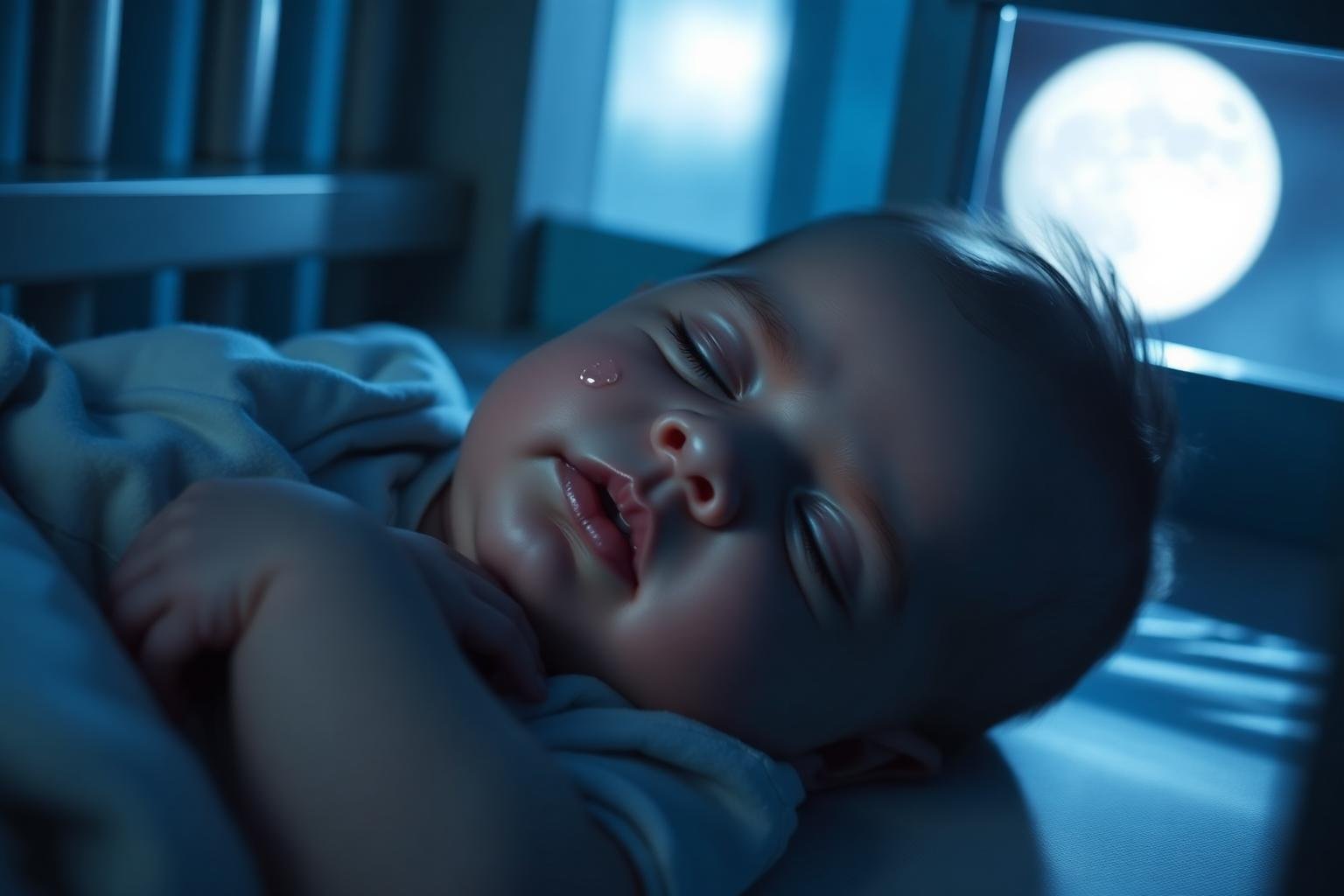
If your baby is crying in their sleep but not fully awake, you are almost certainly witnessing a normal — and self-resolving — phenomenon called partial arousal. This guide, written and medically reviewed by pediatricians, explains exactly what is happening in your baby’s brain at 2 AM, how to tell normal sleep crying apart from pain, reflux, night terrors, or a seizure, and gives you a step-by-step protocol to follow tonight.
Quick Answer: Is Sleep Crying Normal?
Yes — in the vast majority of cases, a baby who cries during sleep without truly waking up is transitioning between sleep cycles. Babies under 6 months cycle through light and deep sleep every 40–60 minutes, and vocalizations, whimpers, brief cries, grunts, and even short wails are completely normal at these transitions. The single most important rule: wait 2–3 minutes before intervening. Rushing in often wakes a baby who was about to resettle themselves.
Sleep Crying vs. Night Terrors vs. Pain vs. Seizure — At-a-Glance Table
| Sign | Sleep Crying (Normal) | Night Terror | Pain / Reflux | Seizure (Rare) |
|---|---|---|---|---|
| Age most common | 0–12 months | 18 months–6 years | Any age | Any age |
| Duration | <60 seconds | 2–20 minutes | Escalating, does not stop | 30 sec–3 min |
| Baby’s eyes | Closed or fluttering | May be open, glassy | Tightly shut, grimace | Rolled back, fixed gaze |
| Response to touch | Settles or continues sleeping | Worsens if disturbed | Continues crying | Unresponsive |
| Body movement | Small twitches | Thrashing but purposeless | Arching, drawing knees up | Rhythmic jerking |
| What to do | Wait & observe | Do not wake, ensure safety | Pick up, evaluate | Call 911, video if possible |
What Is Happening in Your Baby’s Brain
Infant sleep is structured very differently from adult sleep. A newborn spends roughly 50% of sleep in active (REM) sleep, compared to about 20% in adults. Active sleep is where dreams occur and where the brain does the heavy lifting of memory consolidation and neural pruning. It is also noisy: babies twitch, grimace, breathe irregularly, and vocalize.
Between each sleep cycle there is a brief arousal window — 30 to 90 seconds where the baby is neither fully asleep nor awake. In this window they may:
- Cry out once or twice
- Whimper, hum, or grunt
- Open their eyes briefly then close them
- Move arms or legs, sometimes vigorously
- Suck on their hands or make chewing motions
None of these mean the baby is awake or in distress. Left undisturbed, most infants transition back into deep sleep within 60–180 seconds. This is called self-soothing at the sleep boundary, and it is the developmental skill every good sleeper eventually masters.
The Top 7 Causes of Sleep Crying (Ranked by Frequency)
- Sleep cycle transitions (most common — 60% of episodes). Brief cry, no pattern, self-resolves.
- Active-sleep vocalizations. Whimpers or fussing during REM. Often occurs at predictable times (60–90 minutes after falling asleep).
- Gas or trapped wind. Especially in babies under 4 months. Grunting, drawing knees up, brief cry, then release.
- Reflux or milk regurgitation. Usually within 30–60 minutes of last feed. Cough, gulp, cry, then settle if positioned upright.
- Overtiredness. Ironically, an overtired baby cries more in their sleep because cortisol is elevated. Fix the daytime schedule and this fades within 3–5 nights.
- Room too warm or too cold. Ideal nursery temperature is 68–72°F (20–22°C). Check the back of the neck, not the hands.
- Wonder Weeks / developmental leaps. Cognitive surges at 5, 8, 12, 19, 26, 37, 46, 55, 64, and 75 weeks temporarily worsen sleep.
The 3-Step Pediatrician Soothing Protocol (For 2 AM)
Step 1: Pause and Observe (0–3 minutes)
Do not rush into the room. Watch the monitor or listen from the hallway. If the crying is under 60 seconds, quiets on its own, and there is no escalation, do nothing. This is the single hardest step for new parents, but it is the most important. Every unnecessary intervention teaches the baby they cannot resettle without you.
Step 2: Low-Intervention Response (3–5 minutes)
If crying continues past 3 minutes or escalates, enter the room quietly. Keep lights off. Place a firm, still hand on the baby’s chest or belly. Add a low “shhhhh” sound. Do not talk, do not lift, do not make eye contact. This mimics the containment of the womb without waking the baby fully. Hold for 60–90 seconds.
Step 3: Full Pickup and Check (5+ minutes)
If crying persists past 5 minutes or your instinct says something is off, pick the baby up. Run through the pediatrician checklist:
- Diaper — full, dirty, or leaking?
- Temperature — feel the back of the neck
- Feeding — was the last feed >3 hours ago?
- Swaddle — too tight, come undone, or arm loose and startling them?
- Signs of pain — arching back, drawing knees up, red face when horizontal
- Fever — take a temp if any doubt
Age-by-Age: What “Normal Sleep Crying” Looks Like
Newborn (0–3 months)
Expect frequent sleep vocalizations. Newborns cycle rapidly and spend up to half their sleep in active REM. Grunting, straining, and brief cries every 40–60 minutes are normal. This is also peak Moro (startle) reflex, which can wake them into a cry — a well-fitted swaddle usually solves this within one or two nights.
3–6 months
Around 4 months, sleep architecture matures — the famous “4-month sleep regression.” Babies gain adult-like sleep stages and become more aware of transitions. Sleep crying may temporarily increase for 2–6 weeks. This is developmental, not a problem to fix.
6–12 months
Separation anxiety peaks (8–10 months). Sleep crying often includes calling out for a parent. Response should be brief, low-key, and consistent — the goal is reassurance, not a full wake-up.
12–24 months
Language development means real words start appearing during sleep crying. Toddlers may sit up, call out, or even walk to the door while still not fully awake — this is a normal precursor to sleepwalking and does not require intervention beyond safety.
When Sleep Crying Is Not Normal — The Red Flags
Call your pediatrician within 24 hours if you notice any of the following:
- Sleep crying that lasts longer than 5 minutes despite soothing
- Baby is inconsolable when picked up
- Arching of the back, especially during or after feeds (reflux red flag)
- New pattern of nightly crying that started in the last 3 nights and is worsening
- Poor weight gain, refusing feeds, or fewer than 5 wet diapers in 24 hours
- Fever above 100.4°F (38°C) in a baby under 3 months — this is always an emergency
Call 911 or go to the ER immediately for: rhythmic jerking movements, blue lips or face, unresponsiveness, high-pitched shrill cry, or difficulty breathing.
Night Terrors vs. Sleep Crying — The Key Difference
True night terrors are rare before 18 months. When they do occur, they look dramatic — the child may sit up, scream, sweat, and appear terrified with open eyes — but the child is deeply asleep and will have no memory of the event. Trying to wake them prolongs and worsens the terror. The correct response is to keep them safe, do not turn on lights, do not talk, and simply wait. Episodes typically resolve within 5–15 minutes.
Sleep crying in a baby under 12 months is almost never a night terror. If you are wondering whether it is, it probably is not.
Reflux Pain Masquerading as Sleep Crying
Silent reflux is the most common medical cause of “sleep crying that shouldn’t be happening.” Clues include: crying most often within an hour of feeding, arching backward, gulping or coughing during sleep, frequent hiccups, and worsening when laid flat. If two or more of these are present, ask your pediatrician about a trial of upright post-feed positioning, thickened feeds, or evaluation for GERD.
Environmental Fixes That Often Solve Sleep Crying Overnight
- White noise at 50–65 dB — a continuous sound machine (not app on a phone) masks household noise that triggers arousals
- Blackout curtains — even small light changes can trigger a partial arousal
- Room temperature 68–72°F — check with a nursery thermometer, not by feel
- Appropriate sleep sack TOG for the temperature (0.5 TOG summer, 1.0 TOG spring/fall, 2.5 TOG winter)
- Swaddle for babies under 8 weeks; arms-out transition swaddle from 8 weeks until rolling begins
- Consistent bedtime routine lasting 20–30 minutes with the same 4–5 steps every night
The Overtired Baby: The Hidden Cause of Sleep Crying
Counterintuitively, one of the most common triggers for repeated sleep crying is an overtired baby. When infants stay awake longer than their developmental “wake window” allows, their bodies release cortisol and adrenaline to keep them alert. These stress hormones do not disappear the moment they fall asleep; they continue to circulate for hours, fragmenting sleep and producing frequent partial arousals with crying. If your baby cries in their sleep every 30–40 minutes, especially in the first half of the night, undertiredness is rarely the cause — overtiredness almost always is.
Age-appropriate wake windows (from last wake-up to next nap or bedtime):
- 0–6 weeks: 45–60 minutes
- 6–12 weeks: 60–90 minutes
- 3–4 months: 75–120 minutes
- 4–6 months: 2–2.5 hours
- 6–9 months: 2.5–3.5 hours
- 9–12 months: 3–4 hours
Bedtime for babies under 6 months should generally fall between 6:30 and 8:00 PM. Later bedtimes almost always increase night crying.
The Role of the Bedtime Routine
A consistent 20–30 minute bedtime routine repeated in the same order every night is one of the most powerful and underused tools for reducing sleep crying. The brain learns the sequence and begins releasing melatonin at the first cue. A pediatrician-recommended routine template:
- Bath or warm washcloth wipe-down (5 minutes)
- Pajamas and diaper change in dim light (3 minutes)
- Feed in a quiet room, lights low (10–15 minutes)
- Book, lullaby, or quiet cuddle (5 minutes)
- Into the crib drowsy but awake, white noise on, room dark
Consistency matters more than the specific steps. Whatever you choose, do it in the same order, at the same time, every night.
Related reading: Baby Wakes Every Hour: Is It Hunger, Habit, or Discomfort.
Sleep Crying vs. Hungry Crying: How to Tell the Difference at 2 AM
One of the hardest skills new parents develop is knowing whether a sleep cry means “I need food” or “I am just transitioning between sleep cycles.” The distinction matters because feeding at every sleep arousal creates a feed-to-sleep association that can persist for months. Here is how a pediatrician tells them apart:
| Cue | Sleep Crying | Hungry Crying |
|---|---|---|
| Timing relative to last feed | Any time, often 45-90 min after feeding | Typically 2-4 hours after last feed (age-dependent) |
| Cry pattern | Brief bursts (5-30 sec), then silence | Steady, escalating, rhythmic |
| Response to soothing hand | Usually settles within 30-60 seconds | Continues crying or roots toward hand |
| Sucking motion | Intermittent, without swallowing | Vigorous, rhythmic, with swallowing when offered feed |
| Eyes | Closed or fluttering, unfocused if open | May open wide, searching, focused |
| If picked up | May resettle in arms or continue sleeping | Roots, mouths, becomes more agitated if not fed |
The single most useful test: place a clean finger at the corner of the baby’s mouth. A hungry baby will turn toward it and open their mouth (rooting reflex). A baby who is simply sleep-crying will either ignore it or continue their sleep cry without latching onto the finger.
The Startle (Moro) Reflex Connection: Why Your Baby’s Own Body Wakes Them Up
One of the most common but underrecognized causes of sleep crying in young infants is the Moro reflex — the primitive startle reflex present at birth that causes a baby to throw their arms out, arch their back, and cry as if falling. This reflex peaks around 2 weeks of age, begins fading around 8-12 weeks, and is typically gone by 4-6 months. During sleep, a spontaneous Moro reflex can trigger a full arousal cycle that sounds exactly like the “crying in sleep but not awake” pattern described above.
Clues that the Moro reflex is the culprit: the cry is preceded by a sudden arm-flinging motion; the baby’s hands are open and extended before the cry; the cry is brief (often under 10 seconds) and followed by resettling; the pattern is more frequent when the baby is placed on their back. The solution is almost always a properly fitted swaddle that prevents the arm-fling motion while allowing hip-healthy leg movement. Once the baby begins rolling (typically 8-12 weeks), the swaddle must be transitioned to an arms-out sleep sack, which is when parents may temporarily see a resurgence of sleep crying as the reflex re-emerges in an unswaddled state for a few days.
Four Underappreciated Factors That Amplify Sleep Crying
Beyond the well-known causes, pediatricians recognize four factors that amplify normal sleep crying into a nightly problem:
1. Parental sleep deprivation itself. When parents are exhausted, their perception of sleep crying shifts — they respond faster, louder, and more inconsistently, which paradoxically reinforces waking. This is known as the “exhaustion amplification loop.” The fix: alternate night duty with a partner so each parent gets a 4-5 hour uninterrupted sleep block.
2. The white noise gap. Continuous white noise at 50-65 dB placed at least 7 feet from the crib can reduce night arousals by up to 30% by masking household noises that trigger partial arousals. Many parents use white noise inconsistently or at the wrong volume — too quiet to be effective or too loud to be safe.
3. Room temperature drift. Most nurseries are warmest at bedtime and coolest at 3-4 AM. A baby who falls asleep at 72°F and wakes at 68°F may experience a temperature drop large enough to trigger a partial arousal and cry. Use a room thermometer and a TOG-appropriate sleep sack to maintain consistent thermal comfort throughout the night.
4. Parental hyper-vigilance after a previous scare. Parents who had a health scare with their baby (a respiratory infection, a hospitalization, a close call) often develop heightened sensitivity to sleep sounds. This is a normal trauma response, but it can lead to over-intervention that disrupts the baby’s sleep for weeks. If this resonates with you, discuss it with your pediatrician — brief counseling or a single session with a pediatric sleep psychologist can be transformative.
Special Situations Worth Knowing
Sleep crying after vaccinations: Increased fussiness and disrupted sleep for 24–48 hours after routine vaccines is normal. Manage with age-appropriate acetaminophen only if fever is present and only per your pediatrician’s dosing.
Sleep crying with a new tooth: Real teething typically disrupts sleep for 2–3 nights per tooth. If sleep crying persists beyond a week, look elsewhere.
Sleep crying during travel or a schedule change: Expect 3–5 nights of adjustment. Keep the bedtime routine identical even in a new location.
Sleep crying in a second-time parent’s baby: Siblings often cry less in sleep because household background noise is higher and more consistent — a form of natural white noise.
Frequently Asked Questions
Why does my baby cry in their sleep every night at the same time?
Predictable sleep crying at a fixed time (often 90 minutes or 3–4 hours after bedtime) usually corresponds to a sleep-cycle transition. It resolves as the baby matures and consolidates sleep, typically between 4 and 6 months.
Should I feed my baby when they cry in their sleep?
Only if it has been longer than the expected feed interval for their age. Feeding at every whimper trains the baby to expect a feed at every arousal, which prolongs night waking.
My 3-month-old suddenly started crying in sleep — is this the 4-month regression?
Very possibly. The 4-month sleep regression can start as early as 12 weeks. Focus on falling-asleep-independently skills at bedtime rather than trying to fix each night waking.
Can teething cause sleep crying?
Yes, but teething is over-blamed. Real teething pain typically lasts 3–5 days per tooth. If sleep crying persists more than a week, look for other causes.
Is it OK to let my baby cry it out during sleep crying?
Sleep crying is not the same as cry-it-out sleep training. Not intervening for 60–90 seconds is not “cry it out” — it is respecting the baby’s ability to resettle.
Do sound machines really help?
Yes — continuous white noise at 50–65 dB, placed at least 7 feet from the crib, reduces night arousals and shortens crying episodes.
When to Call Your Pediatrician
Any sleep crying that lasts more than 5 minutes despite the 3-step protocol, is accompanied by feeding refusal, arching, poor weight gain, or occurs alongside fever in a baby under 3 months, warrants same-day evaluation.
Disclaimer: This article is for informational purposes only and does not replace individualized medical advice from your child’s pediatrician.
Related ChildBloom Guides
- Start here: Evidence-Based Baby Sleep Solutions
- Baby Cries in Sleep but Is Calm When Awake
- 8-Month Split Nights: What Causes Them and What Helps
- Night Feeding and Sleep
- Baby Wakes Every Hour but Is Not Hungry
- Baby Wakes at 5 a.m. Every Day
- Browse all Sleep & Nursery guides
References & Medical Sources
- AAP guidance on getting your baby to sleep
- AAP healthy sleep hours by age
- NICHD Safe to Sleep: safe sleep environment
- NICHD infant sleep research overview
Reviewed by the ChildBloom pediatric panel. Learn about our physicians on the About page. This article is educational and does not replace your child’s clinician.