Short answer: A newborn’s chin quiver or tremble during crying, feeding, or after a bath is almost always benign neonatal jitteriness — an immature nervous system firing extra signals as the brain and nerves finish wiring themselves. It stops the moment you gently hold the chin, cheek, or arm. Call your pediatrician the same day if the trembling continues while the baby is calm, cannot be stopped by touch, involves the eyes, or comes with poor feeding, fever, blue color, or a change in tone.
The 30-second check: jitteriness vs. seizure
Most parents who search this question at 2 a.m. are really asking one thing: “Is this a seizure?” Here is the fastest way to tell them apart at the bedside.
| Feature | Benign jitteriness (normal) | Seizure (call now) |
|---|---|---|
| Trigger | Crying, hunger, cold, startle, bath | None — happens at rest |
| Stops with gentle touch? | Yes, immediately | No, continues |
| Movement pattern | Fine, fast, rhythmic tremor | Jerky, may march up a limb |
| Eyes | Normal, may be crying tears | Staring, rolling, rhythmic blinking |
| Color / breathing | Pink, breathing normally | Blue lips, pauses in breathing |
| Baby’s state | Alert or fussy | May be unresponsive, floppy |
| After the episode | Back to normal instantly | Sleepy, poor feeding, floppy tone |
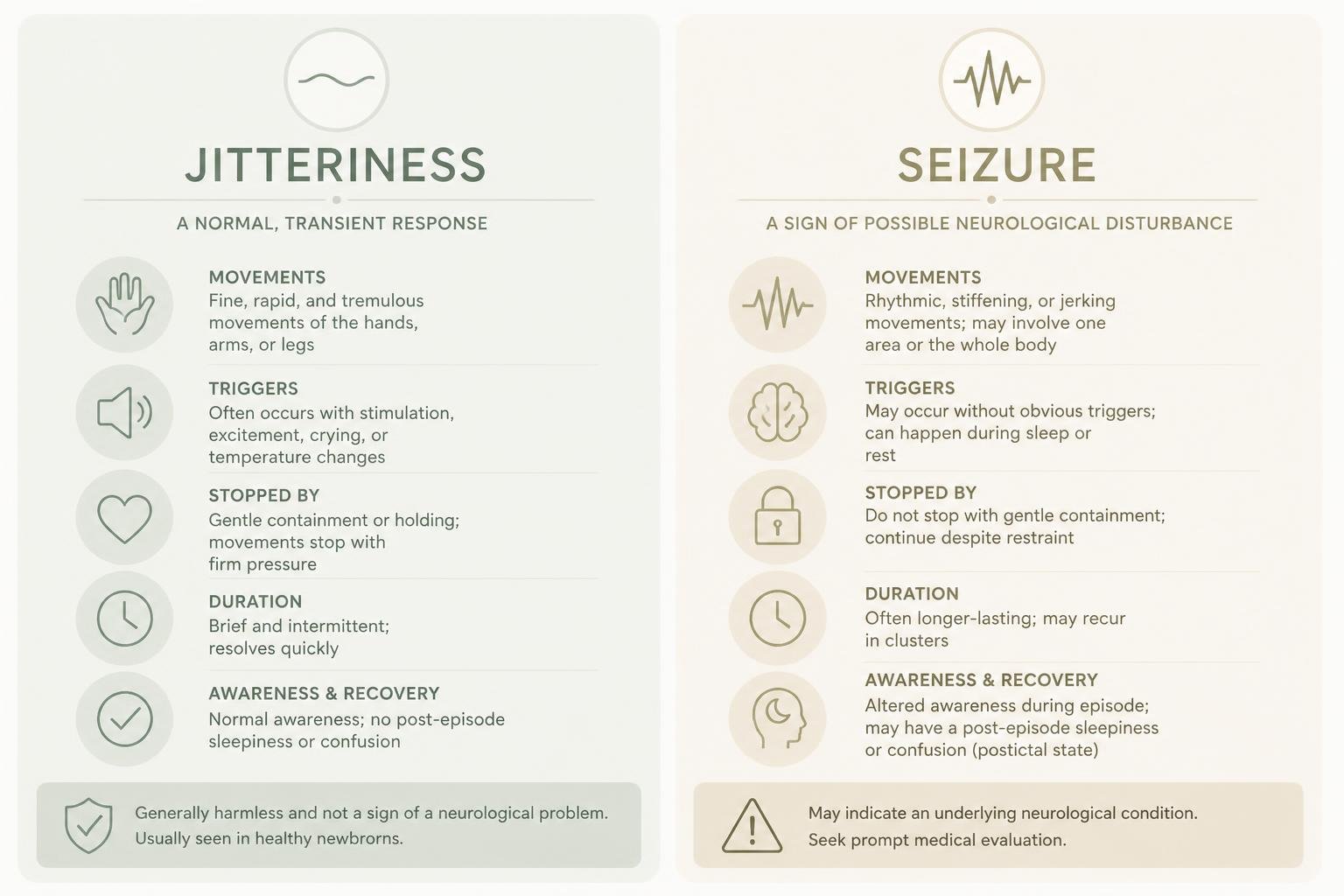
If holding the chin, cheek, or arm stops the movement, it is jitteriness — not a seizure. A true seizure cannot be interrupted by gentle touch or repositioning.
Why the chin is the most common quivering spot
Three anatomical and neurological facts converge on the newborn chin:
- The mentalis muscle is tiny. This small muscle in the center of the lower lip fatigues quickly, so a strong crying signal easily overwhelms it and produces visible tremor.
- The trigeminal-facial nerve pathway is one of the first to be tested by hard use. Every cry, latch, and lip curl activates it hundreds of times per day in the first month.
- Myelination is incomplete. Myelin is the fatty insulation around nerves that keeps electrical signals crisp and contained. In a newborn, myelin is patchy — signals “spill over” into neighboring nerves, and the chin is a favorite spillover target.
This is why parents report the same story worldwide: “His chin trembles like a little vibrator whenever he cries hard, but he stops the moment I touch his cheek.” That is textbook benign neonatal jitteriness.
What the medical literature calls it
Pediatricians and neonatologists use several overlapping terms — they all describe the same phenomenon in a healthy baby:
- Benign neonatal jitteriness (most common clinical term)
- Benign neonatal tremor
- Physiologic tremor of infancy
- Neonatal shudders (when the whole body trembles briefly)
All resolve on their own as the nervous system matures. None require treatment when they meet the “benign” criteria in the table above.
The 6 most common triggers
Understanding what sets off the quiver helps you decide whether to soothe or investigate.
1. Hard crying
The number-one trigger. Crying tenses the jaw, floods the facial nerves, and produces immediate chin tremor. Stops within seconds of calming.
2. Cold exposure
After a bath, a diaper change on a cold pad, or entering an air-conditioned room. The trembling here is the newborn version of shivering — a reflex the brain hasn’t fully refined yet. Warming stops it. See safe room temperature for newborn sleep for the target range.
3. Hunger
Low blood sugar or the mere anticipation of feeding can trigger a fine chin tremor. Feeding resolves it within a minute.
4. The Moro (startle) reflex
Loud sound, sudden movement, or being laid down too quickly triggers a Moro reflex — arms fly out, then a whole-body tremor may follow, sometimes concentrated in the chin.
5. Sleep transitions
As the baby drifts between light and deep sleep, brief tremors may appear. If your baby also grunts and strains during these transitions, read newborn grunting while sleeping.
6. Overtiredness
An overtired baby has a poorly regulated nervous system. Chin quivering can appear alongside back-arching, jerky arm movements, and hard-to-console crying. See overtired vs. undertired baby for the pattern to watch for.
Timeline: when will the quivering stop?
| Baby’s age | What to expect |
|---|---|
| 0–4 weeks | Frequent chin, lip, and limb tremor during crying, cold, and after baths. Fully normal. |
| 1–3 months | Episodes become less frequent and shorter. |
| 3–6 months | Nearly all healthy term babies stop entirely. |
| 6+ months | Persistent tremor at this age deserves evaluation. |
| Preemies | Add 4–8 weeks to the timeline (use corrected age). |
If your baby is 4 months old and still quivering only during hard crying, that’s still within the normal window. If a 4-month-old is quivering while calm and awake in the crib, get it checked.
When it’s NOT just jitteriness — the 8 red flags
Call the pediatrician the same day for any of the following. These are the signs that separate a benign nervous system quirk from something that needs a workup.
- Tremor at rest. Chin, arm, or leg shaking while the baby is calm, warm, and not crying.
- Cannot be stopped by holding the affected part. True jitteriness always stops with touch.
- Eye involvement. Staring, rolling upward, rhythmic blinking, gaze deviation to one side, or fluttering eyelids during the episode.
- Rhythmic jerks that march up a limb or alternate between arms and legs in a stereotyped pattern.
- Color change during the episode. Bluish lips, pale, or gray.
- A breathing pause longer than 15–20 seconds accompanying the shaking.
- Fever ≥100.4°F (38°C) rectally in a baby under 3 months — see when to worry about baby fever and use a rectal thermometer for accuracy under 3 months.
- Post-episode changes — poor feeding, floppy body tone, hard to wake, or excessive sleepiness in the hours after.
Go to the ER now if any of these occur:
- Shaking lasts more than 2 minutes
- Baby turns blue or gray during the episode
- Baby is unresponsive or cannot be roused afterward
- Repeated episodes in a short time (three or more in an hour)
- A high-pitched, weak cry combined with the trembling
What to try at home for benign jitteriness
For the vast majority of chin quivers, these calm the nervous system within seconds:
- Warm and swaddle. Loss of temperature control is a top trigger. A swaddle with arms tucked reduces Moro-related tremor by roughly 50%.
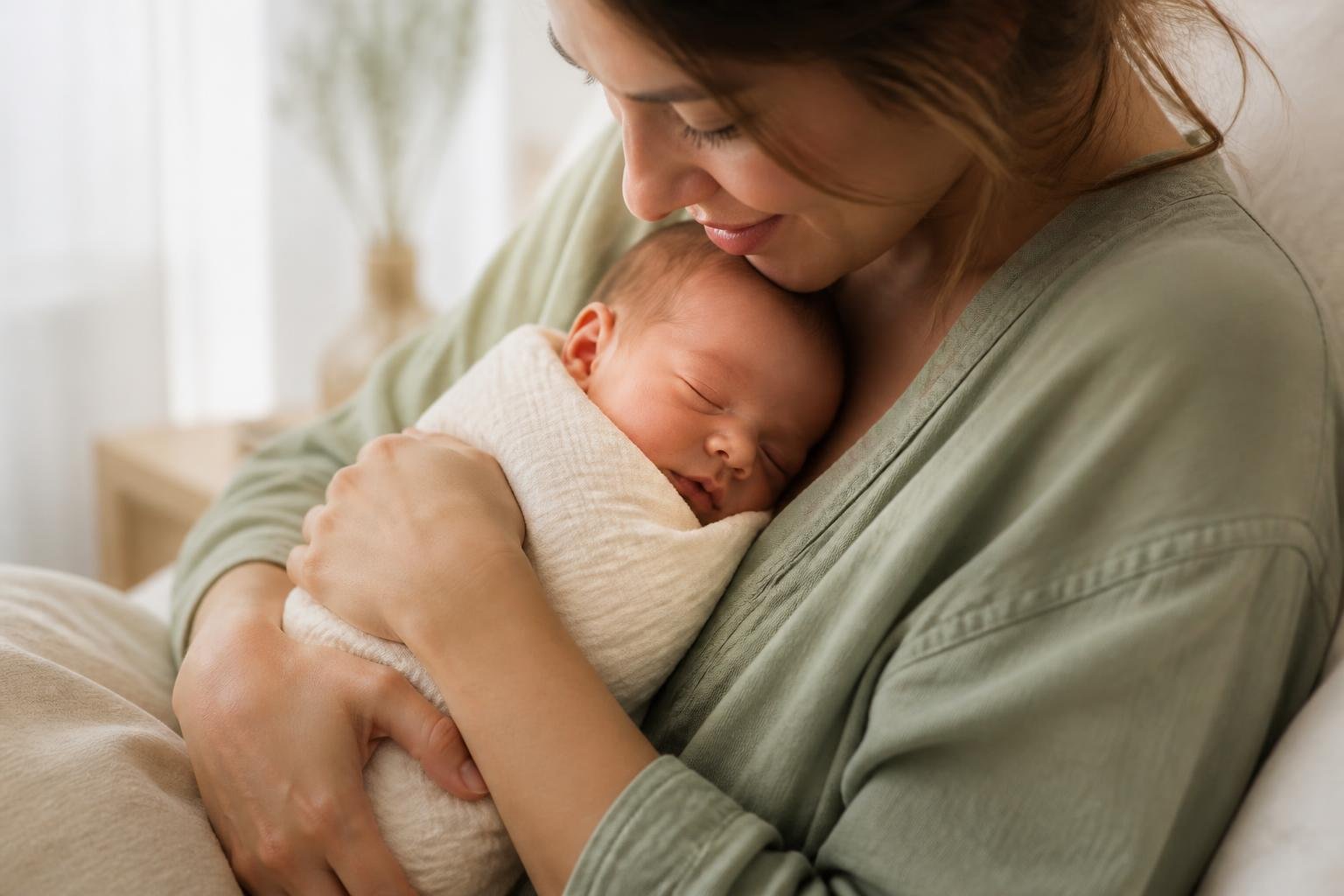
- Skin-to-skin. Regulates heart rate, breathing, blood sugar, and nervous-system tone in one intervention. Ten minutes is often enough.
- Feed on demand. Rules out hunger-driven tremor.
- Reduce startle input. White noise machine, dim lights, gentle handling, no sudden position changes.
- Support the chin gently. Placing two fingers under the jaw during a hard cry usually stops the tremor instantly and reassures you that it is nerve-signal spillover, not a seizure.
- Track duration and frequency. Note the trigger, how long the tremor lasted, and what stopped it. Bring the log to the next well-baby visit.
Take a 20–30 second phone video the next time it happens. A short clip is the single most useful thing you can bring to your pediatrician. In a matter of seconds a clinician can distinguish benign jitteriness from a seizure by watching the eyes, the rhythm, and whether the movement stops when the baby is picked up. This is faster and more reliable than any verbal description.
What causes the underlying immaturity?
The newborn nervous system is essentially a partly-wired house. Neurons are all present at birth (about 86 billion of them), but the “wiring” — myelination, synaptic pruning, and inhibitory control — is only about 25% complete. This means:
- Excitatory signals travel faster than inhibitory signals can catch them.
- Spinal-cord reflexes dominate because the cortex hasn’t taken full control.
- Small motor units, like the mentalis muscle, receive over-strong signals during effort or stress.
By 6 months, myelination has doubled. By 2 years, the balance between excitation and inhibition has matured enough that benign jitteriness is essentially gone in healthy children.
Special populations
Preemies
Babies born before 37 weeks have less myelin at birth and quiver longer. Use corrected age, not chronological age, when applying the timeline above. A baby born 8 weeks early who is now 4 months old is really 2 months corrected — expect ongoing jitteriness.
Low-birthweight babies
Under 2.5 kg (5 lb 8 oz), even at term, have less muscle mass and often more visible tremor. Same rules apply for red flags.
Infants of diabetic mothers
Watch closely in the first 48–72 hours. Maternal diabetes is the top risk factor for neonatal hypoglycemia, which can present as jitteriness that does not stop with touch, feeding difficulty, and low tone. Any tremor in a baby with this history in the first three days deserves a blood-sugar check.
Babies with in-utero medication or substance exposure
Neonatal abstinence syndrome (NAS) can look like severe, non-stopping jitteriness in the first two weeks. If the delivery team flagged any exposure, follow-up is arranged before discharge.
Babies with a rocky birth history
A history of birth asphyxia, cord problems, low Apgars, or NICU stay lowers the threshold for evaluating any new tremor. Discuss with your pediatrician.
What your pediatrician might do
For classic benign jitteriness, usually nothing beyond reassurance. When any red flag is present, the workup may include:
- Point-of-care glucose — rule out hypoglycemia.
- Calcium, magnesium, and electrolyte panel — rule out metabolic causes.
- Full sepsis workup — if fever is present in a baby under 3 months.
- EEG — the gold-standard test to confirm or rule out seizure activity. A single normal EEG doesn’t rule out seizures entirely but strongly supports benign jitteriness.
- Brain ultrasound or MRI — reserved for babies with abnormal exams, birth-history concerns, or repeated seizures.
If the exam and history are normal and the tremor fits the benign pattern, no testing is needed.
What you don’t need to do
- Do not swaddle tighter and tighter trying to suppress the tremor — a standard hip-safe swaddle is enough.
- Do not give any home remedies, herbal preparations, or gripe water for jitteriness.
- Do not stop breastfeeding or change formula because of chin tremor alone — see formula transition for a gassy baby only for genuine gut symptoms.
- Do not massage the jaw aggressively. Gentle chin support is enough.
- Do not skip well-baby visits — this is where a physician tracks tone, reflexes, and milestones over time.
When to Call Your Pediatrician
Same-day call for:
- Tremor while calm, warm, fed, and not crying
- Movement that does not stop when you hold the chin, cheek, or arm
- Any eye rolling, staring, or rhythmic blinking during the episode
- Fever ≥100.4°F (38°C) rectally under 3 months
- Poor feeding, floppy tone, or excessive sleepiness after
- Any tremor in the first 72 hours if the baby is a preemie, low-birthweight, or born to a mother with diabetes
ER now for shaking lasting more than 2 minutes, blue lips, a breathing pause, or a baby who cannot be roused afterward.
Frequently Asked Questions
The answers below are general educational guidance and not a substitute for evaluation of your specific baby by a physician.
Is chin quivering in a newborn a sign of a seizure?
Almost never when it happens only during crying, cold exposure, or hunger and stops the moment you gently touch the chin or cheek. A seizure typically occurs at rest, cannot be stopped by touch, and often involves the eyes, breathing, or a color change.
At what age does newborn chin quivering go away?
Most healthy term babies stop by 3 months, and nearly all by 6 months. Preemies and low-birthweight babies may quiver until 4–6 months corrected age.
Why does my baby’s chin shake when cold?
Cold triggers the same immature-nerve reflex that causes crying-related quiver — essentially the newborn version of shivering. Warm the baby with a hat, swaddle, or skin-to-skin contact and it usually stops within a minute.
Should I video the episode to show my doctor?
Yes. A 20–30 second phone video is the single fastest way for a pediatrician to distinguish benign jitteriness from a seizure, and it beats any verbal description.
Can low blood sugar cause chin trembling?
Yes, especially in the first 48–72 hours after birth, in preemies, in low-birthweight babies, and in infants of mothers with diabetes. Feeding usually stops it; if it does not, request a blood-sugar check.
Is jaw quivering the same as a chin quiver?
Yes. Both describe the lower jaw and lip trembling caused by the small mentalis muscle firing during crying, cold, or hunger.
Does chin quivering mean my baby is in pain?
No. The tremor is a nerve-signal spillover, not a pain response. Look for other pain cues like arched back, high-pitched cry, drawn-up legs, or refusal to feed.
When should I go to the ER for baby shaking?
Go immediately if the shaking lasts more than 2 minutes, cannot be stopped by touch, involves the eyes, causes blue lips or a breathing pause, or if the baby is hard to wake afterward.
Can teething cause chin quivering?
No. Teething typically starts around 4–6 months (see when do babies start teething) and does not cause tremor. If a 5-month-old is drooling and gnawing on their fists and their chin trembles only when they cry, it’s still residual benign jitteriness — not teething.
Is it normal for a newborn’s whole body to shake sometimes?
Brief full-body “shudders” during a startle, a bath, or a diaper change are common and benign in the first 3 months. The same red flags apply: if the shaking happens at rest, cannot be stopped by touch, involves the eyes, or comes with a color change, get it evaluated.
Medically reviewed by Dr. Zeeshan Salam, MD — Pediatrician & Neonatologist. Reviewed July 2026. About the author.
Internal links: Health & Safety pillar · Newborn grunting while sleeping · When to worry about baby fever · Best baby thermometer for newborns · Safe room temperature for newborn sleep · Overtired vs. undertired baby · When do babies start teething · Is gripe water safe for newborns
Citations: AAP HealthyChildren – Newborn Reflexes · Cleveland Clinic – Neonatal Jitteriness · NIH – Neonatal Seizures vs. Jitteriness · PMC – Benign Neonatal Tremor: A Review · AAP – Postnatal Glucose Homeostasis in Late-Preterm and Term Infants
📖 More from the Health & Safety Hub: your A-Z pediatrician guide to baby health, common illnesses, fevers, rashes, allergies, safety