As an Amazon Associate, we earn from qualifying purchases.


What Are Open-Ended Toys and Why Do Pediatricians Recommend Them?
Open-ended toys are play objects with no predetermined outcome, no fixed solution, and no single correct way to use them. A set of wooden blocks can become a castle, a tower, a road for cars, a bridge for animals, or nothing at all – the child decides. A shape sorter can be matched correctly OR used as a put-and-take game. A silicone ball can be rolled, thrown, squeezed, or loaded into a container.
As a pediatrician, I understand how concerning these moments can be for parents. My goal is to provide you with evidence-based guidance that helps you make informed decisions for your child, while also knowing exactly when to seek medical attention. This guide draws on current AAP recommendations and clinical experience to give you the clarity you need.
Open-ended toys stand in contrast to closed-ended toys – battery-operated toy phones that sing when you press specific buttons, single-function tablets, or toys with a single “right” way to play. The research on open-ended versus closed-ended play is consistent: children who play with open-ended toys develop stronger problem-solving skills, longer attention spans, and richer language environments.
The Developmental Science Behind Open-Ended Play
Research from the University of Michigan and the University of Minnesota found that children playing with open-ended toys generated significantly more conversational turns and used a wider vocabulary than children playing with electronic learning toys. Key developmental domains that open-ended play supports:
- Executive function: Open-ended play requires children to problem-solve, plan, and self-regulate. Building a tower and watching it fall teaches persistence and cause-and-effect.
- Language development: Research published in the journal Archives of Pediatrics and Adolescent Medicine found that children playing with open-ended toys generated significantly more words and conversational turns than children playing with electronic toys.
- Fine motor skills: Grasping and manipulating objects of various shapes and sizes builds the hand strength and coordination needed for writing, self-feeding, and daily independence.
- Cause-and-effect understanding: Pushing a toy car off a ramp and watching it roll teaches physics fundamentals through direct experimentation rather than passive observation.
Best Open-Ended Toys by Developmental Stage
0 to 3 Months: Exploring Through the Senses
At this stage, open-ended play is entirely sensory. Newborns explore through vision, touch, and sound. The goal is not to “teach” but to provide interesting sensory input that supports neural development:
- High-contrast black and white pattern cards: Newborns see high-contrast patterns most clearly. Place cards 8 to 12 inches from baby face. These support visual development and eye-tracking.
- Soft fabric balls with varied textures: A variety of textures provides diverse sensory input. Look for balls with tags, ribbons, and different fabric surfaces. Safe for mouthing.
- Fabric books with varied textures: Cloth books with crinkly pages, squeakers, and different fabric surfaces engage multiple senses simultaneously.
4 to 6 Months: Grasping and Exploring
At this stage, babies are developing pincer grasp and learning that their actions produce results. Sensory open-ended toys remain ideal:
- Silicone teething toys: Soft enough to gum, these come in shapes that are easy to grasp with one or two hands. Look for one-piece molded silicone without small parts.
- Soft rattles with comfortable grasp handles: Lightweight rattles with a comfortable grasp handle support cause-and-effect understanding. Look for rattles that are easy to grip with one hand.
- Textured links and soft chains: Thesecan be bent, stretched, and grabbed. Safe for mouthing and provide varied tactile feedback.
6 to 9 Months: Stacking, Filling, and Dumping
At this stage, babies discover that objects can be stacked, put into containers, and dumped out. The most developmentally valuable open-ended toys at this stage support these discoveries:
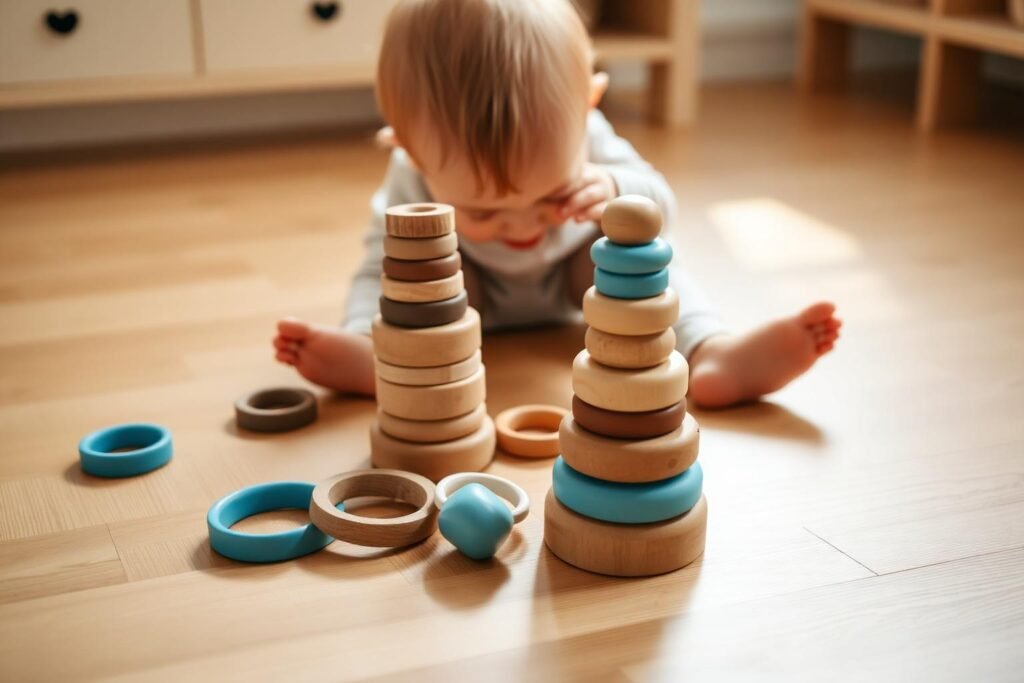
- Soft stacking blocks or fabric stacking cups: These teach size gradation and object permanence (an object that disappears into a cup still exists). Fabric stacking cups are safe for mouthing and washing.
- Wooden blocks (2-inch or larger): Simple wooden blocks offer thousands of configurations. At this age, mouthing is still the primary exploration method – 2-inch or larger blocks are safe. Look for unfinished natural wood without paint or coating.
- Tupperware and nesting containers: Kitchen containers provide real-world open-ended play experience. Supervised play only – choose containers without small lid parts.
9 to 12 Months: Building and Imagining
At this stage, babies begin symbolic play and gross motor exploration. Open-ended toys that support both are ideal:
- Shape sorters (basic, with 3 to 4 large shapes): Shape sorters with 3 to 4 large shapes develop spatial reasoning. At this age, children often use shape sorters incorrectly – putting shapes in and dumping them out repeatedly – which is developmentally valuable in itself.
- Push-to-walk toys: Push-to-walk toys support gross motor development and balance when baby is pulling to stand and taking first steps. Look for wide-based, stable toys that will not tip.
- Cardboard boxes and household items: At this age, the box a toy came in is often more interesting than the toy. Cardboard boxes, plastic containers, wooden spoons, and metal pots are excellent open-ended toys – and free.
The Merlin Magic Sleep Suit: When to Consider It
The Merlin Magic Sleep Suit (a Pampers product) is a weighted Cotton sleep sack that provides gentle pressure that some parents find helps their infant sleep longer stretches. It received significant attention after a 2019 study showed reduced infant arousals during sleep. The American Academy of Pediatrics notes that any weighted product used during infant sleep warrants caution, and the suit should be used only under close parental monitoring per manufacturer guidelines. Never use a weighted sleep product in a bassinet or face-down position.
Open-Ended Toys We Do Not Recommend
Despite widespread marketing, these toy categories do not align with developmental best practices:
- Electronic toys with single functions: Toy phones that sing when you press specific buttons provide no opportunity for imagination. Studies have found that children playing with electronic toys generated significantly fewer words than children playing with open-ended toys or books.
- Plastic play mats with designated interactive zones: These limit rather than expand possibilities. Open-ended play happens when the child drives the play.
- Baby walkers: The AAP advises against baby walkers as they delay motor development and increase injury risk. Stationary activity centers are marginally better but still limit the unrestricted movement that open-ended floor play provides.
How to Build a Simple Open-Ended Toy Library
You do not need to buy everything at once. A small collection of 10 to 15 high-quality open-ended toys can support development from birth through age 3:
- 5 to 8 wooden blocks building set
- 1 set of stacking cups or rings
- 2 to 3 sensory toys (balls, textured links)
- 2 to 3 fabric books or cloth books
- 1 set of wooden vehicles or animals
- 1 shape sorter
- 1 push-to-walk toy
Rotate toys in and out every 1 to 2 weeks to keep play fresh without buying more.
Choosing Developmentally Appropriate Toys
The right toys support your baby’s development at each stage, encouraging exploration, problem-solving, and motor skill development. The best toys for infants and toddlers are often the simplest — items that invite open-ended play rather than dictating how they should be used.
Age-by-Age Toy Guide
For newborns (0-3 months), high-contrast black-and-white images, unbreakable mirrors, and soft rattles engage developing vision and hearing. For 3-6 months, grasping toys, teethers, and activity gyms support reaching and batting skills. For 6-12 months, stacking cups, shape sorters, and cause-and-effect toys build problem-solving abilities. For 12-24 months, push-and-pull toys, simple puzzles, and pretend play items support mobility and imagination.
Safety Considerations for Baby Toys
All toys should be too large to fit through a toilet paper tube (the standard choke-test tool). Avoid toys with small parts that can detach, long cords or strings that pose a strangulation risk, and toys with sharp edges or points. Check recall lists regularly and inspect toys for wear and tear. Age recommendations on toy packaging are based on safety, not developmental ability, and should be followed.
Play-Based Learning for Development
The Role of Parent Interaction
The most valuable element of any toy is the interaction it encourages between parent and child. Narrate your play: “You stacked the red block on top of the blue block!” Ask questions even before your baby can answer. Follow your baby’s lead — let them choose which toy to engage with and how to play with it. These interactions build vocabulary, social skills, and the foundation for learning far more effectively than any electronic toy or educational video.
Avoiding Overstimulation
Too many toys can overwhelm a baby’s developing attention system. Rotate toys weekly, keeping only 4-6 options available at a time. Watch for signs of overstimulation: turning away, fussing, flapping arms, or becoming very still. When you see these signs, simplify the environment by reducing noise, moving to a quieter space, or offering a single, calming object. The goal of play is engagement and connection, not continuous stimulation.
The Bottom Line
The best open-ended toys for babies share three characteristics: they can be used in many different ways, they have no predetermined outcome, and they grow with the child. A set of wooden blocks can entertain a 6-month-old who mouths and grasps, a 12-month-old who stacks and dumps, and a 3-year-old who builds elaborate structures. Investing in a small set of high-quality, durable, open-ended toys pays developmental dividends across multiple years.
The AAP screen time guidelines recommend zero screen time for children under 18 to 24 months. Open-ended play is not just a passive alternative to screens – it actively builds the neural pathways for language, motor skills, and executive function that screens cannot replace.
When to Call Your Pediatrician About Feeding Concerns
While many feeding challenges resolve with time and patience, contact your pediatrician if:
- Your baby is not regaining birth weight by day 10-14
- Your newborn has fewer than 6 wet diapers per day after the first week
- Your baby seems consistently hungry after feeds or is not gaining weight appropriately
- There are signs of dehydration (sunken soft spot, dry mouth, fewer wet diapers)
- Your baby is vomiting forcefully (projectile vomiting) after every feed
- You notice blood or green mucus in your baby’s stool
- Your baby is refusing feeds for more than one feeding cycle
- You are concerned your milk supply is low and baby is not thriving
Your pediatrician can assess growth patterns, evaluate latch and feeding technique, and rule out underlying medical issues. Never hesitate to call.
Frequently Asked Questions
How do I know my baby is getting enough milk?
Look for at least 6-8 wet diapers per day, steady weight gain according to pediatrician growth charts, and audible swallowing during feeds. Your baby should seem satisfied and content after most feeds.
Can I overfeed my baby?
While it is possible to overfeed a bottle-fed baby (by pushing them to finish a bottle when they show fullness cues), breastfed babies rarely overfeed. Watch for cues like turning away, slowing suck, or falling asleep at the breast or bottle.
When should I introduce solid foods?
The American Academy of Pediatrics recommends starting solids around 6 months of age, when your baby shows signs of readiness: sitting with minimal support, good head control, and showing interest in what you are eating.
How do I know if my baby has a food allergy?
Signs of a possible food allergy include hives, facial swelling, vomiting, diarrhea, or difficulty breathing within minutes to 2 hours after eating a new food. Introduce new foods one at a time and wait 3-5 days before trying another.
Safety Considerations and Red Flags
Parents should be aware of the following safety considerations when managing their child’s health at home:
- Never ignore persistent or worsening symptoms
- Keep emergency numbers (pediatrician, poison control, emergency services) readily accessible
- Follow medication dosing instructions precisely — never estimate or use household spoons
- Trust your gut: if you feel something is seriously wrong, seek medical attention immediately
Medical Disclaimer: The information on this page is for educational purposes only and does not constitute medical advice. Always consult your pediatrician or healthcare provider for medical concerns specific to your child. If you suspect a medical emergency, call 911 immediately.
Clinical Pearl: What the Research Actually Says
One of the most valuable skills a parent can develop is the ability to evaluate health information critically. In the age of social media and parenting influencers, misinformation about child health spreads faster than evidence-based guidance. When you encounter a new parenting recommendation — whether about sleep, feeding, development, or safety — ask yourself three questions: Who is making this recommendation and what are their credentials? Is the recommendation supported by peer-reviewed research or is it based on anecdote and tradition? Does the recommendation align with guidance from major medical organizations like the American Academy of Pediatrics, the Centers for Disease Control and Prevention, or the World Health Organization? If a recommendation contradicts established medical guidance, it should be viewed with skepticism, regardless of how compelling the testimonial may be. When in doubt, bring what you have read or heard to your pediatrician. We are trained to help you separate evidence from anecdote and to make decisions that are right for your individual child.