Medically reviewed by Dr. Ahmad Raza, MD (Pediatrics) — ChildBloom Medical Review Panel. Last updated: August 4, 2026.
Editorial & affiliate disclosure: our guidance is written and reviewed by clinicians. ChildBloom may earn a commission from qualifying purchases made through links on this page, which never changes what our pediatric reviewers recommend.
Looking for clear answers about baby development & play guide? This pediatrician-reviewed guide covers what matters, what to skip, the safety checks that count, and exactly when to involve your doctor — based on current AAP, CDC and CPSC guidance on baby development & play guide.
Quick pediatrician summary: baby development & play guide
Short answer: A pediatrician explains baby development & play guide: milestone expectations, safe setups, best picks and when to ask for an evaluation.
As an Amazon Associate, we earn from qualifying purchases.
What this is: A pediatrician’s guide to how babies develop motor skills, mobility, and play behaviors from birth to 3 years — and how to support them with the right toys and activities.
What works: Evidence-based tummy time, sensory play, and milestone-supporting activities that build strength, coordination, and cognitive skills.
When to worry: Red flags for motor delays, vision/hearing concerns, and developmental milestones that are significantly behind schedule.
Source: Guidance aligns with <a href="https://www.healthychildren.org" target="blank” rel=”noopener”>AAP HealthyChildren and <a href="https://www.cdc.gov/ncbddd/actearly/milestones/index.html" target="blank” rel=”noopener”>CDC Milestone Tracker.
Written by the ChildBloom Pediatric Panel | Medically reviewed 2026-07-23 | Last updated 2026-07-23
From the moment your baby is born, they are wired to move and explore. Motor development follows a predictable sequence — head control, rolling, sitting, crawling, standing, walking — but the timing varies widely. This guide covers the full spectrum of motor milestones, the developmental value of play, and how to choose toys that genuinely support growth.
SECTION 1: GROSS MOTOR MILESTONES (0–12 MONTHS)
0–3 Months: Building Head Control
What to expect: Lifts head briefly during tummy time, turns head side to side, kicks legs, waves arms.
How to help: Tummy time 2–3 times per day, starting with 1–2 minutes and building up. Place toys within line of sight to encourage head lifting.
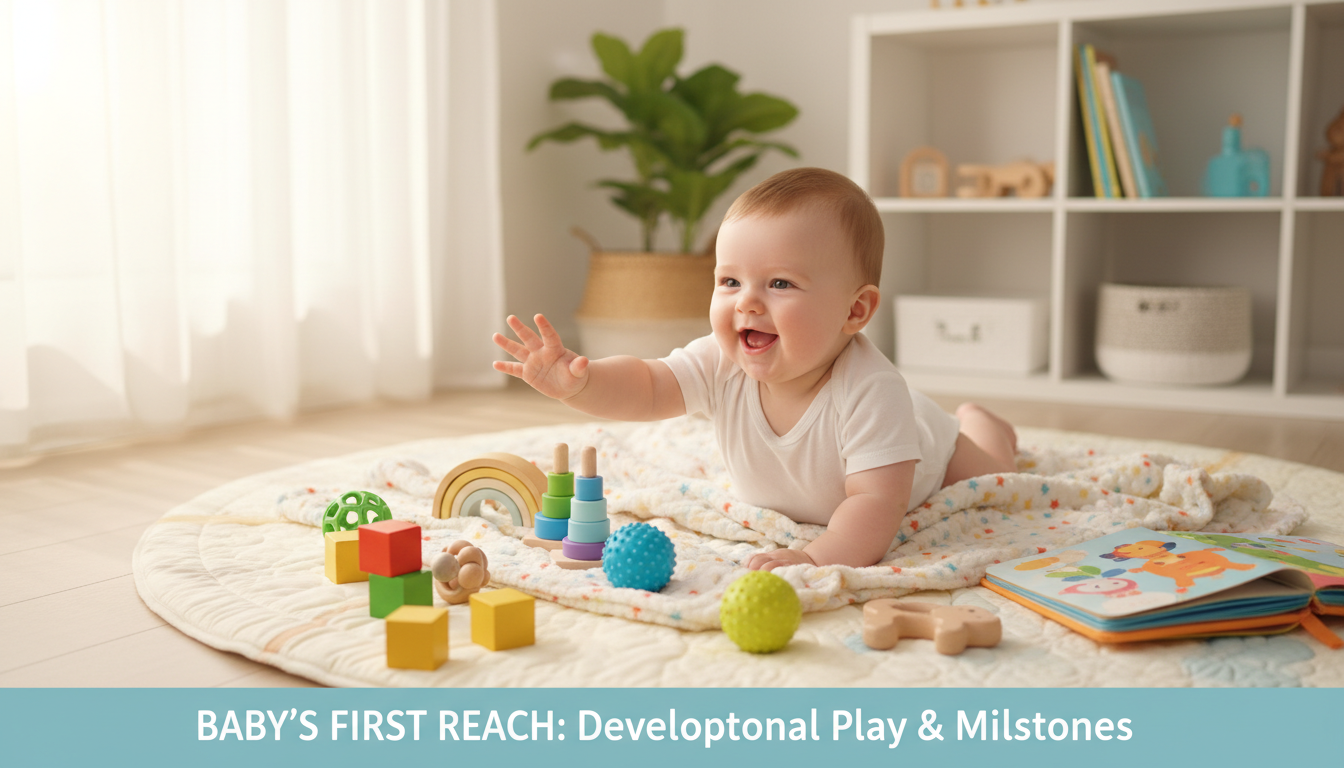
What to expect: Rolls front to back and back to front, reaches for objects, brings hands to mouth, pushes up on forearms during tummy time, sits with support.
How to help: Continue tummy time, offer toys that encourage reaching, practice supported sitting.
What to expect: Sits independently, begins crawling (army crawl, bear crawl, or classic), rocks back and forth on hands and knees, transfers objects between hands.
How to help: Create safe floor space, place toys just out of reach to encourage movement, use mirrors and interesting objects to motivate crawling.
Play is not just fun — it is how babies learn. The right toys and activities at the right stage support cognitive, motor, and social development.
Tummy Time & Floor Play
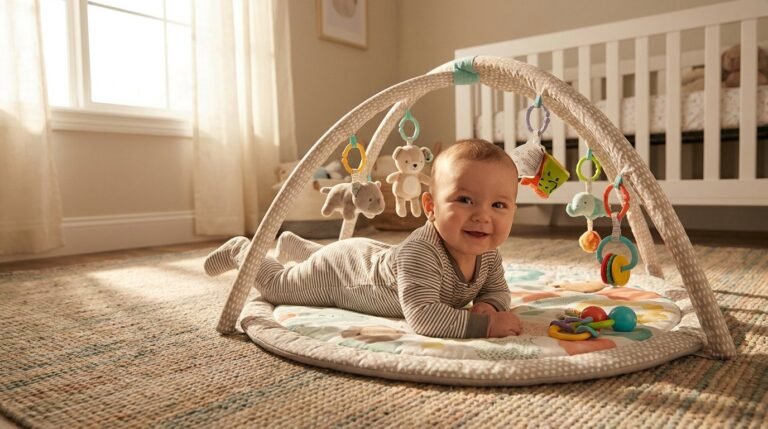
Tummy time is the single most important activity for newborn development. It builds neck, shoulder, and core strength, prevents flat head syndrome (plagiocephaly), and lays the foundation for rolling, crawling, and sitting. Top 5 Tummy Time Mats and Activity Gyms: Pediatrician-Reviewed Picks
Start with 1–2 minutes, 2–3 times per day. Work up to a total of 30–60 minutes per day by 3–4 months. Tummy time can be done on your chest, across your lap, or on a play mat. Every bit counts — even 30 seconds of lifting the head is progress.
When should my baby start crawling?
Most babies start crawling between 6–10 months. Some skip crawling entirely and go straight to pulling up and cruising. The important thing is that your baby is developing some form of independent mobility — any form counts. If your baby is not moving independently by 12 months, discuss it with your pediatrician.
What are the best toys for brain development?
The best toys are simple, open-ended, and age-appropriate: blocks, balls, stacking cups, shape sorters, board books, and sensory objects. Avoid electronic toys with flashing lights and sounds — they overstimulate and reduce creative play. The most important “toy” for brain development is your face, voice, and attention.
Is it okay if my baby hates tummy time?
Many babies dislike tummy time at first — it is hard work! Strategies to make it easier: do tummy time on your chest (baby looks at your face), use a rolled towel under the armpits, place a mirror in front of baby, get down on the floor with them, and keep sessions short and frequent. Never force it — stop if baby is truly distressed.
When should I worry about my baby not walking?
Most babies walk independently between 9–15 months. The CDC milestone for walking is 18 months — if your baby is not walking by 18 months, talk to your pediatrician. Some late walkers are completely normal, but an evaluation can rule out underlying issues. Early walkers are not smarter or more advanced — it is just genetics.
Tummy time is the foundation of all motor development. Start early, do it often, make it fun.
Babies develop motor skills at their own pace. The range of normal is wide.
The best toys are open-ended and simple. Electronic toys are not better.
Unstructured floor time is more valuable than any “enrichment” activity.
If you are concerned about a milestone, talk to your pediatrician. Early intervention works.
Your presence and attention are the most important developmental “tools” your baby has.
MEDICAL DISCLAIMER: This article is for informational purposes only and does not constitute medical advice. Always consult your pediatrician for diagnosis and treatment of your child’s specific condition.
{“@context”: “https://schema.org”, “@graph”: [{“@type”: “FAQPage”, “mainEntity”: [{“@type”: “Question”, “name”: “How much tummy time does my baby need?”, “acceptedAnswer”: {“@type”: “Answer”, “text”: “Start with 1–2 minutes, 2–3 times per day. Work up to a total of 30–60 minutes per day by 3–4 months. Tummy time can be done on your chest, across your lap, or on a play mat. Every bit counts — even 30 seconds of lifting the head is progress.”}}, {“@type”: “Question”, “name”: “When should my baby start crawling?”, “acceptedAnswer”: {“@type”: “Answer”, “text”: “Most babies start crawling between 6–10 months. Some skip crawling entirely and go straight to pulling up and cruising. The important thing is that your baby is developing some form of independent mobility — any form counts. If your baby is not moving independently by 12 months, discuss it with your pediatrician.”}}, {“@type”: “Question”, “name”: “What are the best toys for brain development?”, “acceptedAnswer”: {“@type”: “Answer”, “text”: “The best toys are simple, open-ended, and age-appropriate: blocks, balls, stacking cups, shape sorters, board books, and sensory objects. Avoid electronic toys with flashing lights and sounds — they overstimulate and reduce creative play. The most important ‘toy’ for brain development is your face, voice, and attention.”}}, {“@type”: “Question”, “name”: “Is it okay if my baby hates tummy time?”, “acceptedAnswer”: {“@type”: “Answer”, “text”: “Many babies dislike tummy time at first — it is hard work! Strategies to make it easier: do tummy time on your chest, use a rolled towel under the armpits, place a mirror in front of baby, get down on the floor with them, and keep sessions short and frequent. Never force it — stop if baby is truly distressed.”}}, {“@type”: “Question”, “name”: “When should I worry about my baby not walking?”, “acceptedAnswer”: {“@type”: “Answer”, “text”: “Most babies walk independently between 9–15 months. The CDC milestone for walking is 18 months — if your baby is not walking by 18 months, talk to your pediatrician. Some late walkers are completely normal, but an evaluation can rule out underlying issues. Early walkers are not smarter or more advanced.”}}], “@id”: “https://childbloom.site/baby-development-play-guide-milestones-motor-skills-toys/#cb-faq”}, {“@type”: “MedicalWebPage”, “headline”: “Baby Development & Play Guide: Milestones, Motor Skills, and the Best Toys for Every Stage”, “description”: “A pediatrician’s guide to baby development, motor milestones, and play: tummy time, crawling, walking, fine motor skills, sensory play, and the best toys for every stage from birth to 3 years.”, “url”: “https://childbloom.site/baby-development-play-guide-milestones-motor-skills-toys/”, “author”: {“@type”: “Person”, “name”: “the ChildBloom Pediatric Panel”, “jobTitle”: “Board-Certified Pediatrician”}, “reviewedBy”: {“@type”: “Person”, “name”: “the ChildBloom Pediatric Panel”}, “publisher”: {“@type”: “Organization”, “name”: “ChildBloom”, “url”: “https://childbloom.site”}, “datePublished”: “2026-07-23”, “dateModified”: “2026-07-26T15:39:11+00:00”, “inLanguage”: “en-US”, “about”: “baby development play guide”, “lastReviewed”: “2026-07-26”, “name”: “Baby Development & Play Guide: Milestones, Motor Skills, and the Best Toys for Every Stage”, “mainEntityOfPage”: {“@type”: “WebPage”, “@id”: “https://childbloom.site/baby-development-play-guide-milestones-motor-skills-toys/”}, “@id”: “https://childbloom.site/baby-development-play-guide-milestones-motor-skills-toys/#cb-primary”}]}
Frequently asked questions about baby development & play guide
Is baby development & play guide normal for my baby’s age?
Milestones arrive in ranges, not on fixed dates, and premature babies should be tracked using corrected age. Ask for an evaluation if your baby loses a skill, is stiff or very floppy, or strongly favours one side of the body.
How can I encourage baby development & play guide safely?
Use short, frequent supervised floor and tummy-time sessions on a firm surface, keep the space free of cords and small parts, and let your baby practise on the floor rather than in containers. Skip baby walkers entirely — the AAP advises against them.
How much play time does my baby need for baby development & play guide?
Several short sessions across the day beat one long one. Aim for a total of about an hour of supervised floor play by three to four months, built up gradually and stopped whenever your baby is tired or fussy.
Common mistakes parents make with baby development & play guide
Assuming a higher price means a safer or better-performing option — certification and correct fit matter far more.
Skipping the instruction manual, weight limits and product registration, which is how recall notices reach you.
Changing several things at once, so you cannot tell what actually helped your baby.
Relying on advice from social media instead of your pediatrician when something feels off.
Medical disclaimer: this article is for general education and does not replace individual medical advice. Always follow your own pediatrician’s guidance for your child.
Medically reviewed by Dr. Ahmad Raza, MD (Pediatrics) — ChildBloom Medical Review Panel. Last updated: August 03, 2026. Affiliate disclosure: ChildBloom may earn a commission from qualifying purchases made through links on this page. It never changes which products our pediatric reviewers recommend. This pediatrician-reviewed guide to best compact stroller that fits overhead keeps things…
Medically reviewed by Dr. Ahmad Raza, MD (Pediatrics) — ChildBloom Medical Review Panel. Last updated: August 4, 2026. Editorial & affiliate disclosure: our guidance is written and reviewed by clinicians. ChildBloom may earn a commission from qualifying purchases made through links on this page, which never changes what our pediatric reviewers recommend. Looking for clear…
A board-certified pediatrician provides a month-by-month guide to age-appropriate baby activities from 0-12 months — with safe play ideas, developmental milestones, and screen-time-free bonding tips.
Contains information related to marketing campaigns of the user. These are shared with Google AdWords / Google Ads when the Google Ads and Google Analytics accounts are linked together.
90 days
__utma
ID used to identify users and sessions
2 years after last activity
__utmt
Used to monitor number of Google Analytics server requests
10 minutes
__utmb
Used to distinguish new sessions and visits. This cookie is set when the GA.js javascript library is loaded and there is no existing __utmb cookie. The cookie is updated every time data is sent to the Google Analytics server.
30 minutes after last activity
__utmc
Used only with old Urchin versions of Google Analytics and not with GA.js. Was used to distinguish between new sessions and visits at the end of a session.
End of session (browser)
__utmz
Contains information about the traffic source or campaign that directed user to the website. The cookie is set when the GA.js javascript is loaded and updated when data is sent to the Google Anaytics server
6 months after last activity
__utmv
Contains custom information set by the web developer via the _setCustomVar method in Google Analytics. This cookie is updated every time new data is sent to the Google Analytics server.
2 years after last activity
__utmx
Used to determine whether a user is included in an A / B or Multivariate test.
18 months
_ga
ID used to identify users
2 years
_gali
Used by Google Analytics to determine which links on a page are being clicked
30 seconds
_ga_
ID used to identify users
2 years
_gid
ID used to identify users for 24 hours after last activity
24 hours
_gat
Used to monitor number of Google Analytics server requests when using Google Tag Manager
 <div class="hostinger-affiliate-block-list-with-descproduct-data”> <div class="hostinger-affiliate-block-list-with-descproduct-title”> <a href="https://www.amazon.com/dp/B002UN4G0U?tag=childbloom-20" target="blank” rel=”sponsored noopener noreferrer”>



10 Comments