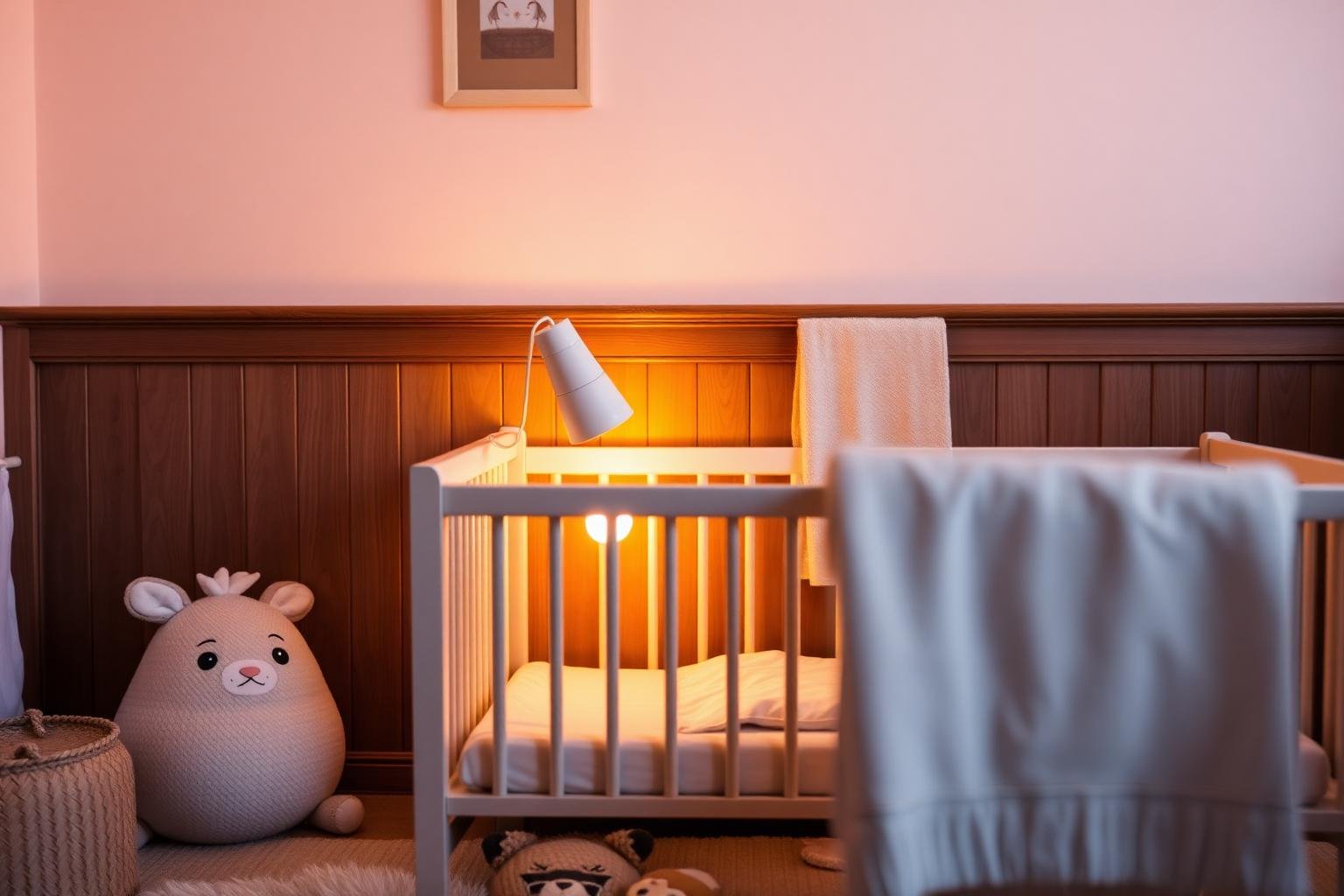
Best Nursery Lighting for Baby’s Circadian Rhythm
Medically reviewed by Dr. Ahmad Raza, MD (Pediatrics) — ChildBloom Medical Review Panel. Last updated: August 4, 2026.
For the full picture, read our pillar guide on Best Baby Monitor 2026: Ultimate Pediatrician-Approved Guide.
Editorial & affiliate disclosure: our guidance is written and reviewed by clinicians. ChildBloom may earn a commission from qualifying purchases made through links on this page, which never changes what our pediatric reviewers recommend.
Looking for clear answers about nursery lighting for baby’s circadian rhythm? This pediatrician-reviewed guide covers what matters, what to skip, the safety checks that count, and exactly when to involve your doctor — based on current AAP, CDC and CPSC guidance on nursery lighting for baby’s circadian rhythm.
Quick pediatrician summary: nursery lighting for baby’s circadian rhythm
Short answer: A pediatrician explains nursery lighting for baby’s circadian rhythm: safe-sleep rules, what genuinely helps tonight, product checks and when to get help.
Best Nursery Lighting for Baby’s Circadian Rhythm
As a pediatrician, I understand how concerning these moments can be for parents. My goal is to provide you with evidence-based guidance that helps you make informed decisions for your child, while also knowing exactly when to seek medical attention. This guide draws on current AAP recommendations and clinical experience to give you the clarity you need.
Written by the ChildBloom Pediatrician Panel, MD, FAAP, FAAP | Medically reviewed | Last updated July 2026
Light is the single most powerful cue for the circadian rhythm — the body’s internal 24-hour clock that regulates sleep, wakefulness, hormone production, and body temperature. Babies are born without a mature circadian rhythm. It develops over the first 3-6 months of life, and light exposure is the primary driver of that development.
The lighting in your nursery — the color temperature, the intensity, and the timing — directly affects your baby’s ability to develop healthy sleep-wake patterns. Getting this right can make the difference between a baby who sleeps well and one who fights every nap and wakes at 5 AM.
PART 1: HOW LIGHT AFFECTS THE CIRCADIAN RHYTHM
1.1 Melatonin and Blue Light
Melatonin is the hormone that signals “it is time to sleep.” It is produced by the pineal gland in response to darkness. Light — particularly blue light (wavelengths around 460-480nm) — suppresses melatonin production.
- Blue light is emitted by: daylight, screens (phones, tablets, TVs), cool-white and daylight LED bulbs (5000K+), and some energy-efficient lighting.
- Warm light (amber, red, candlelight) contains minimal blue light and does NOT suppress melatonin.
1.2 The Baby’s Developing Circadian Rhythm
- Birth to 6 weeks: No circadian rhythm. Sleep is distributed evenly across 24 hours.
- 6-8 weeks: Melatonin production begins. The baby starts to distinguish between day and night.
- 3-4 months: The circadian rhythm becomes more established. Regular light-dark cues help consolidate this development.
- 4-6 months: The circadian rhythm is mature enough to support consolidated nighttime sleep (longer stretches) and regular nap times.
The lighting environment in the nursery plays a critical role in supporting this development.
PART 2: NURSERY LIGHTING RECOMMENDATIONS
2.1 Main Room Light
- Use dimmable overhead lighting.
- Choose warm-toned bulbs: 2700K or lower (warm white / soft white). Avoid cool-white (4000K+) or daylight (5000K+) bulbs in the nursery.
- Dim the lights 1-2 hours before bedtime to support melatonin production.
- During daytime naps, keep the room dim but not completely dark (this helps the baby learn the difference between day sleep and night sleep).
2.2 Night Light
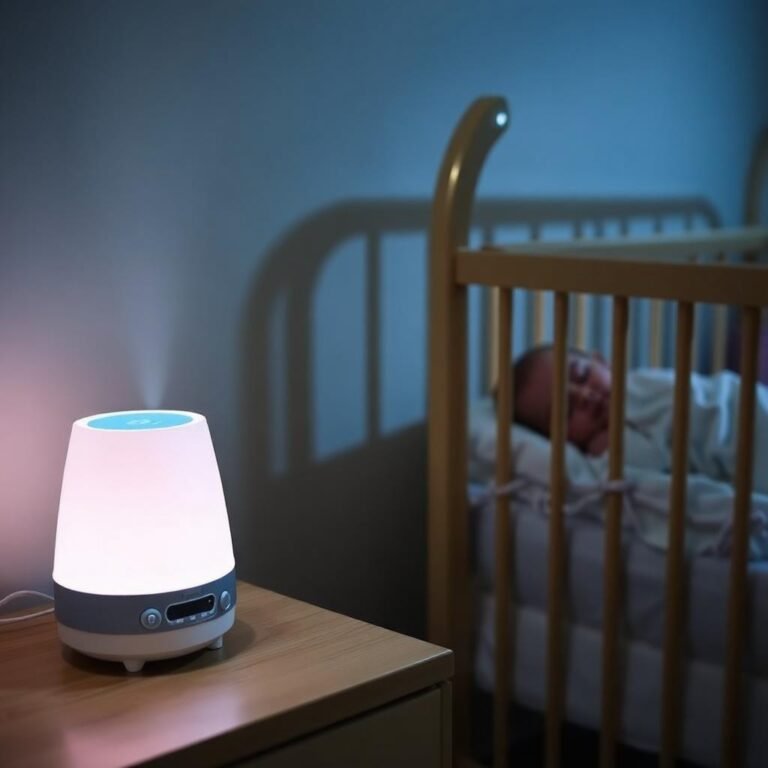
- Use a dim, warm-toned night light (amber, red, or warm white — 2200K or lower).
- Place it low (near the floor) to minimize light exposure to the baby’s eyes during nighttime feeds and changes.
- Avoid blue-white LED night lights.
- Motion-activated night lights are convenient — they turn on when you enter the room and do not require fumbling for a switch.
2.3 Blackout Solutions
- Blackout curtains or shades are essential for:
- Daytime naps (the room should be dark to support melatonin production)
- Preventing early morning wake-ups (sunrise can trigger waking)
- Maintaining a consistent sleep environment regardless of the season
- Look for curtains with a blackout lining (not just “room-darkening” — these still let some light through).
- Ensure the curtains fit the window tightly (light leaks around the edges can be enough to disturb sleep).
2.4 What to Avoid
- Screens in the nursery (TV, tablet, phone screens near the baby). The blue light from screens suppresses melatonin and stimulates the brain.
- Overhead bright lights during nighttime care. Use a dim, warm night light instead.
- Smart bulbs that automatically change color temperature — these can be useful but ensure they are set to warm tones in the evening.
PART 3: PRACTICAL TIPS
- Establish a “dim the lights” routine: Start dimming the nursery lights 1-2 hours before bedtime. This signals to the baby’s brain that it is time to start producing melatonin.
- Keep the room dark for sleep: For nighttime sleep and naps, the room should be as dark as possible. Use blackout curtains. If the room is not completely dark, the baby may wake earlier or have more fragmented sleep.
- Differentiate day from night: During the day, keep the room brighter (open curtains, use normal lighting). At night, keep it dark. This helps the baby’s circadian rhythm develop properly.
- Use warm light for all nighttime interactions: Feeds, diaper changes, and soothing should all be done under warm, dim light. This keeps melatonin production active and does not stimulate the baby’s brain.
- Be consistent: The circadian rhythm responds to regularity. Use the same lighting pattern every day — bright during the day, dim in the evening, dark at night.
PEDIATRICIAN’S TAKE
Lighting is one of the most impactful environmental factors for baby sleep. The key principles are simple: warm light in the evening, dark room for sleep, bright light during the day. Dim the lights 1-2 hours before bedtime. Use blackout curtains for naps and nighttime. And keep the night light warm and dim — not bright and blue. These are not small details. They are the foundation of healthy sleep development.
- Nursery Temperature: The Ideal Range for Safe Sleep & Comfort
- The Pediatrician’s Complete Nursery Setup Guide
RECOMMENDED PRODUCTS
Best Nursery Night Lights & Blackout Solutions (Warm-toned night lights, blackout curtains reviewed)
[See our top picks ->]
MEDICAL DISCLAIMER: This article is for informational purposes only and does not constitute medical advice. Always consult your pediatrician for guidance on your child’s sleep.
Explore more pediatrician-reviewed guidance from ChildBloom:
- The Pediatrician’s Complete Nursery Setup Guide: Safe Sleep, Air Quality & Essentials
- Nursery Temperature: The Ideal Range for Safe Sleep & Comfort
- Do You Need a Nursery Glider? Ergonomics for Feeding & Back Health
- Nursery Air Quality: VOCs, Formaldehyde & What an Air Purifier Actually Removes
Authoritative External Sources
- American Academy of Pediatrics
- HealthyChildren.org (AAP)
Recommended Products
1. Hatch Rest Mini Night Light — Check Price on Amazon →
2. Munchkin Shade Blackout Blinds — Check Price on Amazon →
3. Philips Ambient Wake Up Light — Check Price on Amazon →
4. Pottery Barn Kids Blackout Curtains — Check Price on Amazon →
5. Baby White Noise Night Light — Check Price on Amazon →
Frequently Asked Questions
Q: When should I call the pediatrician?
A: Call immediately for: fever in a baby under 3 months, difficulty breathing, signs of dehydration (no wet diapers for 8+ hours, no tears when crying), lethargy or difficulty waking, a rash that doesn’t fade when pressed, or if your baby seems to be getting worse. For non-urgent concerns, call during business hours.
Related reading: Best Video Baby Monitors for Peace of Mind.
Q: How do I know if my baby is developing normally?
A: Development varies widely, but babies should show progressive gains in motor skills, social interaction, and communication. If your baby isn’t meeting multiple milestones or is losing skills they once had, discuss with your pediatrician. Early intervention is highly effective if there are delays.
Q: What products do I really need for my baby?
A: The essentials are: a correctly installed car seat, a safe sleep space (crib or bassinet with firm mattress), diapers and wipes, appropriate clothing, and a digital thermometer. Beyond these, focus on products that address specific needs rather than marketing claims. Always prioritize safety certifications over features.
Related: Baby Developmental Milestones: Month-by-Month Guid
Clinical Pearl: What the Research Actually Says
One of the most valuable skills a parent can develop is the ability to evaluate health information critically. In the age of social media and parenting influencers, misinformation about child health spreads faster than evidence-based guidance. When you encounter a new parenting recommendation — whether about sleep, feeding, development, or safety — ask yourself three questions: Who is making this recommendation and what are their credentials? Is the recommendation supported by peer-reviewed research or is it based on anecdote and tradition? Does the recommendation align with guidance from major medical organizations like the American Academy of Pediatrics, the Centers for Disease Control and Prevention, or the World Health Organization? If a recommendation contradicts established medical guidance, it should be viewed with skepticism, regardless of how compelling the testimonial may be. When in doubt, bring what you have read or heard to your pediatrician. We are trained to help you separate evidence from anecdote and to make decisions that are right for your individual child.
Related: Best Twin Nursery Gear
No layout selected.
When to Call Your Pediatrician
While most fevers in children are harmless and resolve on their own, you should contact your pediatrician if:
- Your infant is under 3 months old with a rectal temperature of 100.4°F (38°C) or higher
- Fever persists beyond 3 days
- Your child is unusually irritable, confused, or difficult to wake
- There are signs of dehydration (dry mouth, no tears, fewer wet diapers than usual)
- The fever is accompanied by a stiff neck, severe headache, or rash
- Your child has a seizure (febrile seizure)
- You simply feel something is wrong — trust your instincts
When in doubt, call your pediatrician. It is always better to err on the side of caution.
Safety Considerations and Red Flags
Parents should be aware of the following safety considerations when managing their child’s health at home:
See also: Best Breast Pumps of 2026.
- Never ignore persistent or worsening symptoms
- Keep emergency numbers (pediatrician, poison control, emergency services) readily accessible
- Follow medication dosing instructions precisely — never estimate or use household spoons
- Trust your gut: if you feel something is seriously wrong, seek medical attention immediately
Understanding Baby Sleep Patterns
Newborn sleep is fundamentally different from adult sleep. Babies spend more time in REM (active) sleep, which is why they often seem restless, twitch, or make sounds during sleep. This is normal and protective, as REM sleep supports brain development.
Sleep Cycles and Wake Windows
Baby sleep cycles are shorter than adult cycles, lasting approximately 45-60 minutes. Wake windows — the amount of time a baby can comfortably stay awake between naps — vary by age. Newborns can manage only 45-60 minutes, while 6-month-olds may stay awake for 2-2.5 hours. Following age-appropriate wake windows prevents overtiredness, which paradoxically makes it harder for babies to fall and stay asleep.
Creating a Sleep-Friendly Environment
A dark, cool, and quiet room supports better sleep. White noise machines can help mask household sounds and mimic the whooshing sounds of the womb. The nursery temperature should be kept between 68-72°F (20-22°C), and your baby should be dressed in one more layer than an adult would wear comfortably.
Building Healthy Sleep Habits
Consistent Bedtime Routines
A predictable bedtime routine signals to your baby’s brain that sleep is coming. A good routine lasts 20-30 minutes and includes 3-5 calming activities: a warm bath, gentle massage, changing into pajamas and a sleep sack, reading a book, singing a lullaby, and a final feed with lights dimmed. Consistency matters more than the specific activities — performing the same sequence in the same order every night helps your baby transition from wakefulness to sleep more easily.
Self-Soothing and Sleep Independence
Babies who learn to fall asleep independently at bedtime are more likely to self-soothe when they wake during the night. You can support this by putting your baby down drowsy but awake rather than fully asleep, giving them a chance to practice settling. This does not mean leaving them to cry — you can offer comfort through gentle touch, shushing, or patting while encouraging them to find their own path to sleep. Gradually reduce the level of support as your baby develops this skill.
The Bottom Line
Best Nursery Lighting Circadian Rhythm is a common concern for parents, and most of the time it resolves with simple home care and patience. As a pediatrician, I encourage parents to trust their instincts, stay informed with evidence-based resources, and maintain open communication with their healthcare provider. You know your child best — if something does not feel right, speak up. Every question you ask is valid, and every concern you raise helps us provide better care for your little one.
Frequently asked questions about nursery lighting for baby’s circadian rhythm
Where should my baby sleep for nursery lighting for baby’s circadian rhythm?
Alone, on the back, on a firm flat mattress in a crib, bassinet or play yard that meets current CPSC standards, in your room for at least the first six months. Keep pillows, blankets, bumpers and toys out of the sleep space.
Is nursery lighting for baby’s circadian rhythm a sign of a sleep problem?
Frequent night waking, short naps and unsettled evenings are developmentally normal in the first year. It may need review if your baby snores or pauses in breathing, is not gaining weight, or is excessively sleepy and hard to wake.
What actually helps with nursery lighting for baby’s circadian rhythm tonight?
A predictable short wind-down, a dark cool room, white noise at a safe volume and distance, age-appropriate wake windows, and putting your baby down drowsy but awake. Give any change five to seven consistent nights before judging it.
Common mistakes parents make with nursery lighting for baby’s circadian rhythm
- Assuming a higher price means a safer or better-performing option — certification and correct fit matter far more.
- Skipping the instruction manual, weight limits and product registration, which is how recall notices reach you.
- Changing several things at once, so you cannot tell what actually helped your baby.
- Relying on advice from social media instead of your pediatrician when something feels off.
- Best air purifier for baby nursery
- Baby Witching Hour
- Best Baby Swing for Reflux
- Best Baby Monitor 2026
- baby sleep & nursery hub
- NICHD Safe to Sleep basics
- AAP 2022 safe sleep policy
- CPSC nursery recalls
Medical disclaimer: this article is for general education and does not replace individual medical advice. Always follow your own pediatrician’s guidance for your child.
Related ChildBloom Guides
- Start here: Best Baby Monitor 2026: Ultimate Pediatrician-Approved Guide
- Best Crib for Newborns 2026
- Best Baby Cribs That Meet Current Safety Standards
- When to Stop Using a Baby Monitor (And What to Watch For)
- Best Baby Swing for Reflux
- Best Nursery Humidifiers & Thermometers for Optimal Sleep
- Browse all Sleep & Nursery guides
References & Medical Sources
- CPSC safe sleep and crib product rules
- NICHD Safe to Sleep: safe sleep environment
- AAP parent guide to safe sleep
- AAP Safe Sleep clinical resources
Reviewed by the ChildBloom pediatric panel. Learn about our physicians on the About page. This article is educational and does not replace your child’s clinician.




10 Comments