Fever in Babies: When to Call the Doctor & How to Measure Accur
Medically reviewed by Dr. Ahmad Raza, MD (Pediatrics) — ChildBloom Medical Review Panel. Last updated: August 4, 2026.
Editorial & affiliate disclosure: our guidance is written and reviewed by clinicians. ChildBloom may earn a commission from qualifying purchases made through links on this page, which never changes what our pediatric reviewers recommend.
Looking for clear answers about fever in babies? This pediatrician-reviewed guide covers what matters, what to skip, the safety checks that count, and exactly when to involve your doctor — based on current AAP, CDC and CPSC guidance on fever in babies.
Quick pediatrician summary: fever in babies
Short answer: A pediatrician explains fever in babies: what is normal, the real risks, red flags to watch for and exactly when to call your doctor.
When it comes to the fever, parents need clear, evidence-based guidance. Written by the ChildBloom Pediatric Panel, FAAP | Medically reviewed | Last updated July 2025
Your baby feels warm. You grab a thermometer. The number on the screen sends a spike of adrenaline through your body. Now what?
Fever is the single most common reason parents call their pediatrician in a panic — and the single most common reason parents go to the ER unnecessarily. The problem is that fever is not a disease. It is a symptom. And the appropriate response depends on three things: the baby’s age, the temperature, and the baby’s overall behavior.
This article will give you a clear, evidence-based framework for managing fever in babies — including how to measure temperature accurately, when to treat it, and when to seek emergency care.
Part 1: What Is a Fever — And Why It Happens
1.1 The Definition
A fever is defined as a core body temperature of 100.4°F (38°C) or higher when measured rectally. This is the gold standard definition. Other measurement sites (forehead, ear, armpit) can give different readings, but the clinical threshold for “fever” is based on rectal temperature.
1.2 Why Fever Occurs
Fever is not the enemy. It is a physiological response to infection. When the immune system detects a pathogen, it releases chemical signals (cytokines) that reset the body’s thermostat (the hypothalamus) to a higher temperature.
The elevated temperature serves a purpose:
- Many viruses and bacteria replicate more slowly at higher temperatures.
- The immune system functions more efficiently at elevated temperatures.
- Fever is a sign that the immune system is working.
Key clinical insight: The height of the fever does not necessarily correlate with the severity of the illness. A baby with a temperature of 104°F from a common virus may be less sick than a baby with a temperature of 101°F from a serious bacterial infection. The baby’s overall behavior (alertness, feeding, hydration, responsiveness) is a more important indicator than the number on the thermometer.
1.3 What Fever Is NOT
- Fever does not cause brain damage. The body will not allow its temperature to rise to a level that causes injury (above 107°F / 41.7°C) from infection alone.
- Fever does not cause seizures in most children. Febrile seizures occur in approximately 2-5% of children between 6 months and 5 years. They are frightening but generally harmless.
- Fever will not continue rising indefinitely. The body’s thermostat has a ceiling. Infection-related fever rarely exceeds 105°F (40.6°C).
Part 2: How to Measure Temperature Accurately
2.1 Rectal Temperature (Gold Standard for Under 3 Months)
Why rectal is the gold standard:
- The rectum provides the closest measurement to core body temperature.
- It is the most reliable and consistent method for infants.
- The AAP recommends rectal temperature measurement for all infants under 3 months with suspected fever.
How to take a rectal temperature:
- Use a digital thermometer with a flexible tip (designed for rectal use).
- Clean the thermometer with soap and water or rubbing alcohol.
- Apply a small amount of petroleum jelly to the tip.
- Place the baby on their back and lift their legs toward their chest.
- Gently insert the thermometer 1/2 to 1 inch into the rectum. Do not force it.
- Hold the thermometer in place until it beeps.
- Remove and read the temperature.
- Clean the thermometer thoroughly after use.
Accuracy: Rectal temperature is within 0.3°F (0.2°C) of true core temperature.
2.2 Temporal (Forehead) Temperature
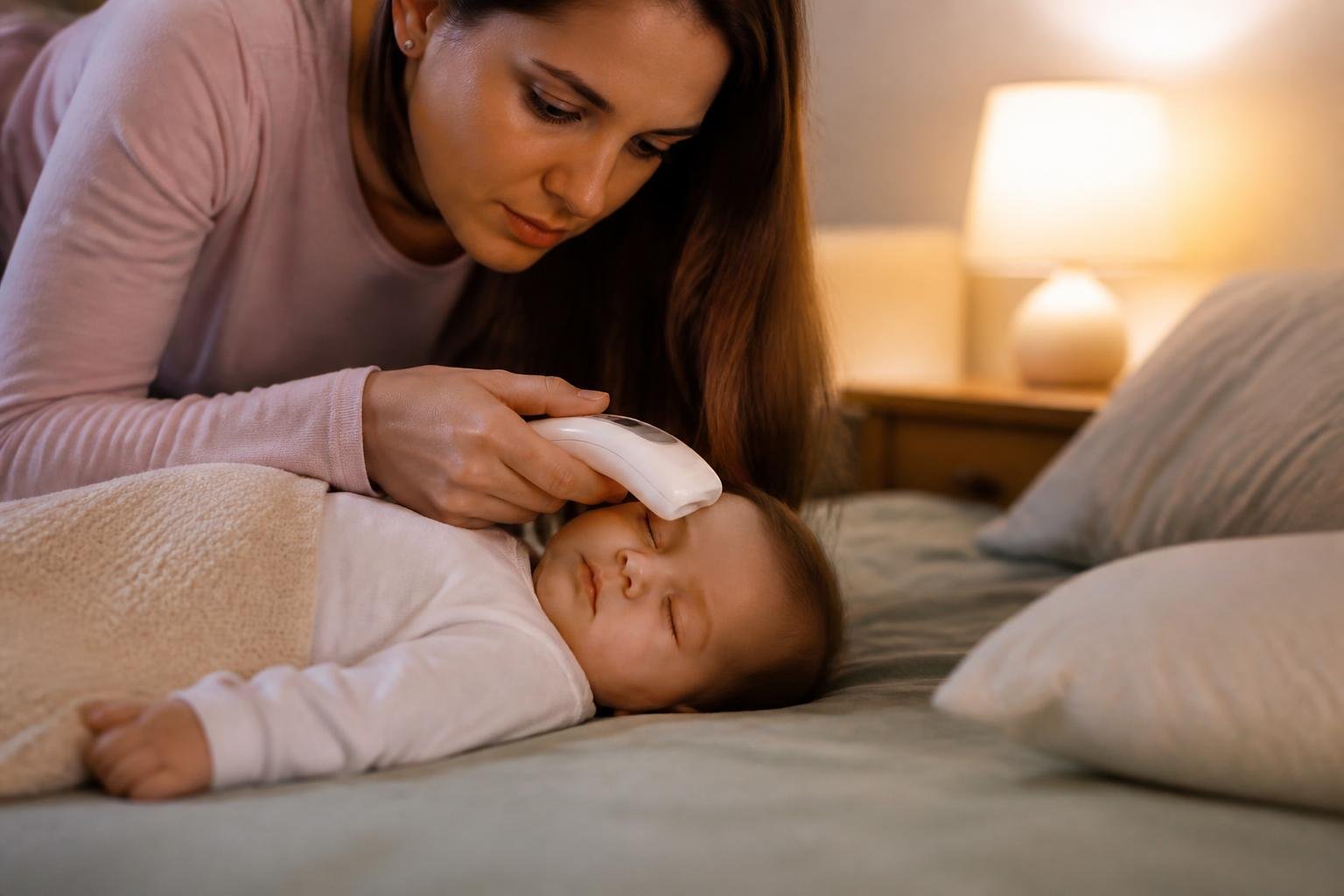
An infrared scanner measures the heat emitted by the temporal artery on the forehead. Appropriate for babies over 3 months as a screening tool.
Accuracy: Generally within 0.5-1.0°F of rectal temperature when used correctly. Can be affected by ambient temperature, sweating, direct sunlight, and recent bathing.
2.3 Ear (Tympanic) Temperature
Appropriate for babies over 6 months. Accuracy: Within 0.5°F of rectal temperature when used correctly.
2.4 Armpit (Axillary) Temperature
Screening tool only. The least accurate method. Armpit temperatures are typically 1-2°F LOWER than rectal temperatures.
2.5 Summary: Which Method to Use When
| Age | Recommended Method | Confirmatory Method |
|---|---|---|
| 0-3 months | Rectal (always) | N/A — rectal is the standard |
| 3-6 months | Rectal or temporal | If temporal is elevated, confirm with rectal |
| 6-12 months | Temporal, ear, or rectal | If non-rectal is elevated, confirm with rectal |
| 12+ months | Temporal, ear, or oral | Clinical judgment |
Part 3: Fever Thresholds by Age — The Decision Tree
3.1 Under 3 Months (0-90 Days) — AUTOMATIC MEDICAL ATTENTION
Any rectal temperature of 100.4°F (38°C) or higher in a baby under 3 months requires IMMEDIATE medical evaluation.
Why: Young infants have immature immune systems. A fever in this age group can be the only sign of a serious bacterial infection — including bacteremia, meningitis, urinary tract infection, or pneumonia.
What to do:
- Call your pediatrician immediately (day or night).
- If you cannot reach your pediatrician, go to the ER.
- The baby will likely need blood tests, a urine test, and possibly a lumbar puncture to rule out serious infection.
3.2 3-6 Months — CALL YOUR PEDIATRICIAN
A rectal temperature of 101°F (38.4°C) or higher warrants a call to your pediatrician.
3.3 6-24 Months — MONITOR AND MANAGE
A fever of up to 102.2°F (39°C) can be managed at home if the baby is otherwise well.
3.4 Over 24 Months — MONITOR BEHAVIOR
For toddlers over 2 years, the fever height is less important than the behavior.
Part 4: How to Manage Fever at Home
4.1 Fever-Reducing Medication
Acetaminophen (Tylenol):
- Appropriate for babies 2 months and older.
- Dose: 10-15 mg per kg of body weight every 4-6 hours. Maximum 5 doses in 24 hours.
- Available as liquid (160 mg per 5 mL). Use the dosing syringe — not a kitchen spoon.
Ibuprofen (Motrin/Advil):
- Appropriate for babies 6 months and older.
- Dose: 5-10 mg per kg of body weight every 6-8 hours.
- Give with food to reduce stomach irritation.
NEVER give aspirin to a child or teenager. Aspirin is associated with Reye’s syndrome — a rare but life-threatening condition.
Important: The goal of fever medication is COMFORT, not normalization. You do not need to bring the temperature to 98.6°F.
4.2 Non-Medication Strategies
- Dress the baby lightly (one layer more than you would wear).
- Keep the room at a comfortable temperature (68-72°F).
- Offer fluids frequently.
- A lukewarm (not cold) bath can help. Do NOT use cold water, ice, or alcohol baths.
Part 5: Red Flags — When to Go to the ER
Seek emergency medical attention if the baby has a fever AND any of the following:
- Age under 3 months with a temperature of 100.4°F (38°C) or higher
- Temperature of 104°F (40°C) or higher at any age
- Lethargy (difficult to wake, not responding normally)
- Difficulty breathing (rapid breathing, grunting, nasal flaring, retractions)
- Stiff neck
- Rash that does not fade when pressed (petechiae or purpura)
- Seizure
- Signs of dehydration (no wet diapers for 8+ hours, no tears when crying, sunken fontanelle)
- Persistent vomiting
- The baby seems to be getting worse, not better
- You are concerned — trust your instincts
Pediatrician’s Take
“The most important thing for parents to understand about fever is that the number on the thermometer is less important than the baby’s behavior and age. A baby under 3 months with ANY fever (100.4°F or higher rectally) needs immediate medical evaluation — no exceptions. For older babies, the behavior tells you more than the number. Always treat the baby, not the thermometer.”
Related Articles
- Car Seat Safety: Correct Angle, Harness Tightness & Common Mistakes
- Baby-Proofing 101: Hidden Hazards in Every Room
- Essential Baby Safety Gear: A Pediatrician’s Checklist
Recommended Products
Best Digital Thermometers for Babies — Rectal, temporal, and multi-use options reviewed for accuracy and speed. See our top picks →
MEDICAL DISCLAIMER: This article is for informational purposes only and does not constitute medical advice. A fever in a baby under 3 months is a medical emergency. Always consult your pediatrician for guidance on your child’s specific condition.
Related: Best Safe Teething Relief Products: Pediatrician-Approved Picks
Related: Top 5 Baby Toothbrushes & Finger Brushes for First Teeth: Pediatrician-Reviewed
Related: Best Silicone Teethers by Teething Stage: A Pediatrician’s Guide
Reference: World Health Organization – Maternal & Child Health
Understanding The Fever: What Parents Need to Know
The Fever is a topic that comes up frequently in pediatric practice. Here is what the current evidence tells us, and what you should know as a parent.
Related Resources
Explore more pediatrician-reviewed guidance from ChildBloom:
- Teething Rash on Chin & Cheeks: Drool Dermatitis or Allergy?
- When to Start Brushing Baby Teeth: Fluoride Rules by Age
Authoritative External Sources
Fever in Babies: Age-by-Age Decision Guide
The approach to fever depends heavily on your baby’s age. For babies under 3 months, any rectal temperature of 100.4 degrees Fahrenheit or higher requires immediate medical evaluation. Newborns have immature immune systems and can deteriorate rapidly from infections that would be mild in older babies. These babies need blood tests, urine tests, and sometimes a lumbar puncture to rule out serious bacterial infections. For babies 3 to 6 months with a fever of 102 degrees Fahrenheit or higher, call your pediatrician within 24 hours. For babies 6 to 12 months, most fevers are viral and can be managed at home, but call if the fever lasts more than 3 days, if your baby is not drinking well, or if they seem unusually lethargic or irritable. For all ages, seek emergency care if the fever is accompanied by difficulty breathing, a stiff neck, a rash that does not blanch when pressed, seizure, or signs of dehydration. Understanding these age-specific guidelines helps parents make confident decisions about when to call and when to wait.
Frequently Asked Questions
Q: When should I call the doctor for a baby fever?
A: Call immediately if your baby is under 3 months with a rectal temperature of 100.4°F (38°C) or higher. For older babies, call if the fever lasts more than 24-48 hours, reaches 104°F (40°C) or higher, or is accompanied by lethargy, difficulty breathing, or a rash that doesn’t fade when pressed.
Q: How do I accurately take my baby’s temperature?
A: For babies under 3 months, use a rectal digital thermometer (the gold standard). For babies 3-6 months, rectal or temporal (forehead) thermometers work well. For babies over 6 months, temporal, ear, or rectal thermometers are all appropriate. Always follow the manufacturer’s instructions for accurate readings.
Q: What is the best way to reduce a baby’s fever?
A: Dress your baby lightly (one layer more than you’d wear), keep the room at 68-72°F, offer plenty of fluids, and consider age-appropriate fever-reducing medication (acetaminophen for 2+ months, ibuprofen for 6+ months) if your baby is uncomfortable. The goal is comfort, not necessarily bringing the temperature to normal.
Related Articles
- Parent Guide: Baby Safety Gear Checklist
- Car Seat Safety: Correct Angle & Harness
- Baby Carrier Ergonomics: Preventing Hip Dysplasia
- How to Cut Newborn Nails Safely
- Baby-Proofing 101: Hidden Hazards in Every Room
- Best Digital Thermometers for Babies
- Best Ergonomic Baby Carriers
- Best Infant Car Seats for Safety
Clinical Pearl: When Symptoms Warrant a Second Look
In pediatric practice, we teach parents to assess the “whole baby” rather than fixating on individual symptoms. A baby who has a fever but is smiling, making eye contact, feeding reasonably, and has normal skin color is far less concerning than a baby with a normal temperature who is lethargic, difficult to rouse, and not feeding. This concept — sometimes called clinical gestalt — is actually a more sensitive predictor of serious illness than any single vital sign or laboratory value in isolation. The most important tool in your parenting toolkit is not a thermometer or an app; it is your ability to observe whether your baby is acting like themselves. If your baby is behaving normally, you can generally monitor a mild symptom at home with symptomatic care. If your baby is not behaving normally — if they are unusually sleepy, fussy, or “off” — that is the time to call your pediatrician, even if you cannot pinpoint exactly what is wrong. Trust that instinct.
📖 More from the Health & Safety Hub: your A-Z pediatrician guide to baby health, common illnesses, fevers, rashes, allergies, safety
Frequently asked questions about fever in babies
Is fever in babies normal in babies?
Mild, short-lived episodes are common and usually settle with simple home care. It is not normal if your baby is feeding poorly, unusually sleepy, breathing fast, has a fever under 3 months of age, or the problem is getting worse instead of better.
When should I call the doctor about fever in babies?
Call the same day for fever in a baby under 3 months, breathing difficulty, repeated vomiting, dehydration signs such as very few wet diapers, unusual floppiness or a rash that does not fade with pressure. Trust your instinct — if something feels wrong, get your baby seen.
What can I safely do at home for fever in babies?
Focus on comfort, hydration, feeding and rest, and use only medicines and doses your pediatrician has approved for your baby’s age and weight. Avoid honey under 12 months, avoid over-the-counter cough and cold products under 6 years, and never give aspirin.
Common mistakes parents make with fever in babies
- Assuming a higher price means a safer or better-performing option — certification and correct fit matter far more.
- Skipping the instruction manual, weight limits and product registration, which is how recall notices reach you.
- Changing several things at once, so you cannot tell what actually helped your baby.
- Relying on advice from social media instead of your pediatrician when something feels off.
Related pediatrician-reviewed reading
- Baby Illness Warning Signs
- When Does a Baby Fever Require the ER? Age-Based Fever Rules Every Pare
- Teething Fever
- Best Digital Thermometers for Babies
- baby health & safety hub
References & further reading
Medical disclaimer: this article is for general education and does not replace individual medical advice. Always follow your own pediatrician’s guidance for your child.



One Comment