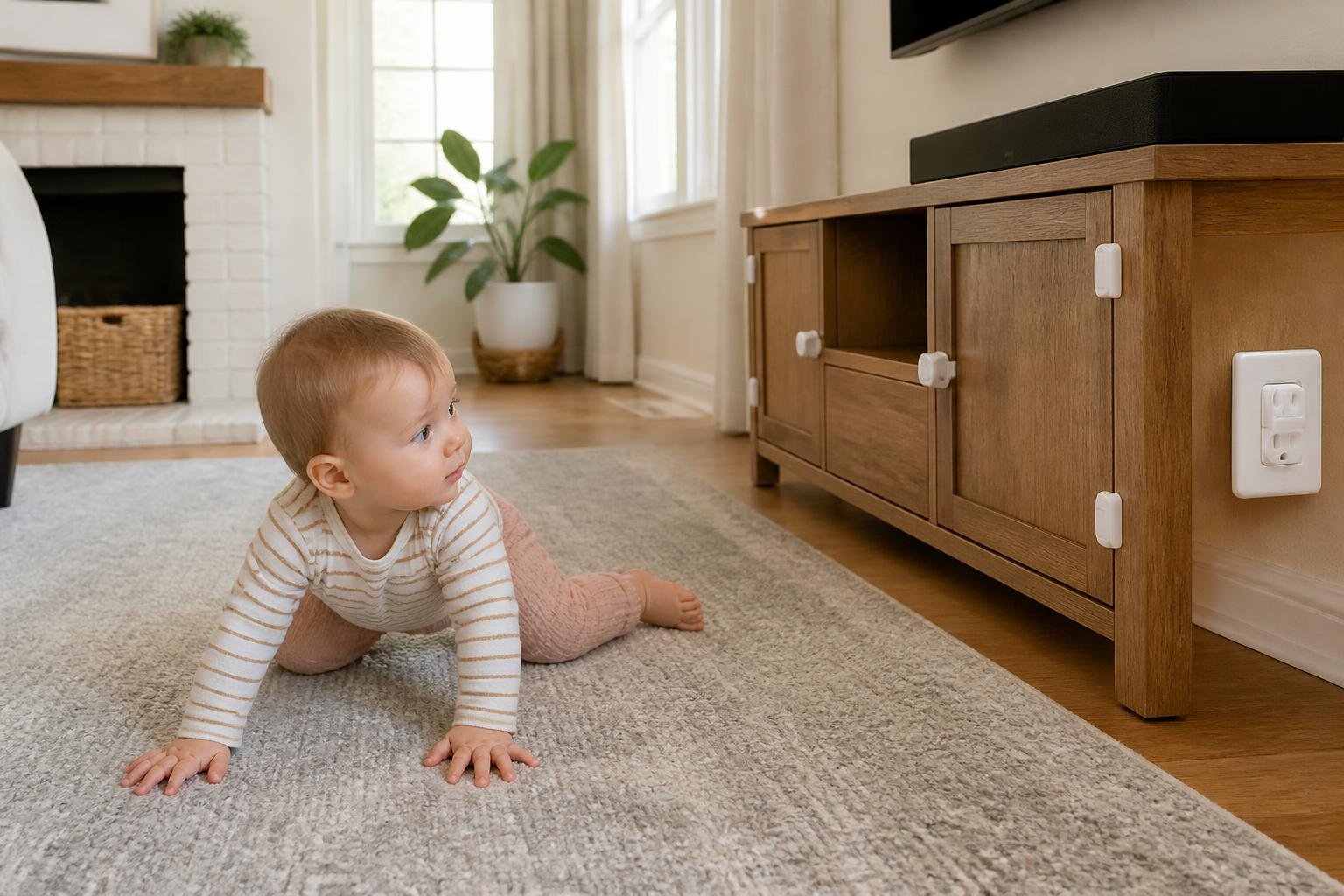
Baby-Proofing 101: Hidden Hazards and Safety Checklist
Medically reviewed by Dr. Ahmad Raza, MD (Pediatrics) — ChildBloom Medical Review Panel. Last updated: August 4, 2026.
Editorial & affiliate disclosure: our guidance is written and reviewed by clinicians. ChildBloom may earn a commission from qualifying purchases made through links on this page, which never changes what our pediatric reviewers recommend.
Looking for clear answers about baby-proofing 101? This pediatrician-reviewed guide covers what matters, what to skip, the safety checks that count, and exactly when to involve your doctor — based on current AAP, CDC and CPSC guidance on baby-proofing 101.
Quick pediatrician summary: baby-proofing 101
Short answer: A pediatrician explains baby-proofing 101: what is normal, the real risks, red flags to watch for and exactly when to call your doctor.
When it comes to hidden hazards, parents need clear, evidence-based guidance. Written by the ChildBloom Pediatric Panel, FAAP | Medically reviewed | Last updated July 2025
As a pediatrician, I understand how concerning these moments can be for parents. My goal is to provide you with evidence-based guidance that helps you make informed decisions for your child, while also knowing exactly when to seek medical attention. This guide draws on current AAP recommendations and clinical experience to give you the clarity you need.
You have covered the outlets, locked the cabinets, and put gates on the stairs. You feel prepared.
But there are hazards in your home that most parents do not think about — and some of them are among the most dangerous. Tip-over furniture kills approximately 20 children per year. Blind cords have strangled hundreds. Button batteries can burn through a child’s esophagus in 2 hours. Toilets are a drowning risk for babies and toddlers.
Room 1: Living Room & Common Areas
1.1 Tip-Over Furniture (CRITICAL)
The data: Approximately 20 children die each year from furniture tip-overs. A child is injured by a tip-over every 24 minutes in the United States.
The solution:
- Anchor ALL tall furniture (anything over 30 inches) to the wall using anti-tip straps.
- Anchor to a wall stud (not drywall alone).
- Do not place tempting items on high shelves.
- Mount TVs to the wall or use low, stable stands.
1.2 Blind Cords (CRITICAL)
The hazard: Horizontal blind cords are a strangulation hazard. Babies can become entangled and strangle silently.
The solution:
- Replace corded blinds with cordless blinds (the safest option).
- Use cord cleats to secure cords high on the wall.
- Move cribs and furniture away from windows with corded blinds.
1.3 Corner and Edge Guards
Apply foam or rubber guards to sharp corners and edges at baby-head height.
Room 2: Kitchen
2.1 Cabinet and Drawer Locks
Install locks on ALL lower cabinets containing anything dangerous. Magnetic locks are the most secure.
2.2 Stove and Oven
- Use stove knob covers.
- Use an oven lock.
- Cook on back burners with pot handles turned inward.
2.3 Dishwasher
- Store detergent pods in a locked cabinet (never in the dishwasher).
- Load sharp utensils pointing down.
Room 3: Bathroom
3.1 Toilet Drowning (CRITICAL)
Babies can fall into toilets head-first and cannot pull themselves out. A toilet bowl contains enough water to drown a baby.
- Install a toilet lock.
- Keep the bathroom door closed at all times.
- Never leave a baby or toddler unattended in the bathroom.
3.2 Scald Burns
- Set your water heater to 120°F (49°C) or below.
- Install anti-scald devices on faucets and showerheads.
- Always turn cold water on first, then add hot. Turn cold off last.
3.3 Medication Storage
Store ALL medications in a locked cabinet. Keep Poison Control posted: 1-800-222-1222.
Room 4: Bedroom / Nursery
4.1 Crib Safety
- Firm, flat mattress that fits snugly.
- Fitted sheet only — no blankets, pillows, stuffed animals, or bumpers.
- Crib slats no more than 2 3/8 inches apart.
- No drop-side cribs (banned by CPSC in 2011).
4.2 Window Guards
Install window guards or stops that limit opening to no more than 4 inches. Window screens do NOT prevent falls.
4.3 Monitor Cords
Keep all cords at least 3 feet from the crib.
Room 5: Stairs and Hallways
Baby Gates
- Top of stairs: HARDWARE-MOUNTED gate only. Pressure-mounted gates can be dislodged.
- Bottom of stairs: Pressure-mounted is acceptable.
- Bar spacing no more than 2 3/8 inches.
- Gate should be at least 22 inches tall.
Universal Hazards — Every Room
Button Batteries (CRITICAL)
If swallowed, a button battery can burn through the esophagus in as little as 2 hours.
- Secure ALL devices with tape or screw-secured battery compartments.
- Store spare batteries in a locked container.
- If swallowed: Go to the ER immediately. Do NOT induce vomiting.
Small Objects (Choking Hazards)
Any object that fits inside a toilet paper roll (1.25 inches diameter) is a choking hazard.
Poisonous Plants
Move all toxic plants (pothos, philodendron, dieffenbachia, sago palm) out of the house.
Pediatrician’s Take
“The three hidden hazards I most want parents to address are: tip-over furniture (anchor everything tall to a wall stud), button batteries (secure every device that contains one), and blind cords (replace with cordless blinds). These three hazards cause death and serious injury. Get down on your hands and knees and look at your home from the baby’s perspective.”
Related Articles
- Fever in Babies: When to Call the Doctor & How to Measure Accurately
- Car Seat Safety: Correct Angle, Harness Tightness & Common Mistakes
- Essential Baby Safety Gear: A Pediatrician’s Checklist
MEDICAL DISCLAIMER: This article is for informational purposes only and does not constitute medical advice. In a poisoning emergency, call Poison Control at 1-800-222-1222. In a button battery ingestion, go to the ER immediately.
Frequently Asked Questions
Q: When should I start baby-proofing my home?
A: Before the baby starts crawling — ideally during pregnancy or shortly after birth. Babies develop faster than parents expect, and by 2-4 months they can roll, scoot, and reach low shelves.
Q: What are the most critical baby-proofing measures?
A: The three most critical are: (1) Anchor all tall furniture to wall studs, (2) Replace corded blinds with cordless blinds, and (3) Secure all devices containing button batteries. These three hazards cause death and serious injury.
Q: Are outlet covers necessary?
A: Yes. Use sliding outlet covers (the type that replace the outlet plate) rather than plug-in caps, which babies can remove and choke on.
Q: What do I do if my baby swallows a button battery?
A: Go to the ER immediately. Do NOT induce vomiting. Do NOT give the baby anything to eat or drink. Tell the medical staff you suspect button battery ingestion — this is a time-critical emergency.
Related Articles
- Fever in Babies: When to Call the Doctor & How to Measure Accurately
- Car Seat Safety: Correct Angle, Harness Tightness & Common Mistakes
- How to Cut Newborn Nails Safely: Tools & Techniques to Avoid Injury
- Essential Baby Safety Gear: A Pediatrician’s Checklist
Related: Best Safe Teething Relief Products: Pediatrician-Approved Picks
Related: Top 5 Baby Toothbrushes & Finger Brushes for First Teeth: Pediatrician-Reviewed
Related: Best Silicone Teethers by Teething Stage: A Pediatrician’s Guide
Reference: American Academy of Pediatrics (AAP)
Understanding Hidden Hazards: What Parents Need to Know
Hidden Hazards is a topic that comes up frequently in pediatric practice. Here is what the current evidence tells us, and what you should know as a parent.
Related Resources
Explore more pediatrician-reviewed guidance from ChildBloom:
- Teething Rash on Chin & Cheeks: Drool Dermatitis or Allergy?
- When to Start Brushing Baby Teeth: Fluoride Rules by Age
Authoritative External Sources
Related Articles
- Parent Guide: Baby Safety Gear Checklist
- Fever in Babies: When to Call the Doctor
- Car Seat Safety: Correct Angle & Harness
- Baby Carrier Ergonomics: Preventing Hip Dysplasia
- How to Cut Newborn Nails Safely
- Best Digital Thermometers for Babies
- Best Ergonomic Baby Carriers
- Best Infant Car Seats for Safety
Clinical Pearl: What the Research Actually Says
One of the most valuable skills a parent can develop is the ability to evaluate health information critically. In the age of social media and parenting influencers, misinformation about child health spreads faster than evidence-based guidance. When you encounter a new parenting recommendation — whether about sleep, feeding, development, or safety — ask yourself three questions: Who is making this recommendation and what are their credentials? Is the recommendation supported by peer-reviewed research or is it based on anecdote and tradition? Does the recommendation align with guidance from major medical organizations like the American Academy of Pediatrics, the Centers for Disease Control and Prevention, or the World Health Organization? If a recommendation contradicts established medical guidance, it should be viewed with skepticism, regardless of how compelling the testimonial may be. When in doubt, bring what you have read or heard to your pediatrician. We are trained to help you separate evidence from anecdote and to make decisions that are right for your individual child.
📖 More from the Health & Safety Hub: your A-Z pediatrician guide to baby health, common illnesses, fevers, rashes, allergies, safety
Safety Considerations and Red Flags
Parents should be aware of the following safety considerations when managing their child’s health at home:
- Never ignore persistent or worsening symptoms
- Keep emergency numbers (pediatrician, poison control, emergency services) readily accessible
- Follow medication dosing instructions precisely — never estimate or use household spoons
- Trust your gut: if you feel something is seriously wrong, seek medical attention immediately
Essential Safety Practices
Keeping your baby safe is the highest priority of infant care. Many common injuries are preventable with awareness of age-appropriate risks and consistent safety practices.
Safe Sleep Environment
The safest sleep environment is a firm, flat mattress in a crib or bassinet with a tight-fitting sheet and nothing else — no blankets, pillows, bumpers, stuffed animals, or sleep positioners. Room-sharing (baby sleeps in the parent’s room) is recommended for the first 6 months but bed-sharing is not. Always place your baby on their back for every sleep, including naps.
Preventing Falls and Injuries
Never leave a baby unattended on elevated surfaces like changing tables, beds, or sofas — falls can happen in seconds. Install baby gates at the top and bottom of stairs once your baby begins to crawl. Secure heavy furniture, TVs, and bookshelves to walls with anti-tip anchors. Keep window blind cords and curtain pulls out of reach to prevent strangulation.
Emergency Preparedness for Parents
Creating a Family Emergency Plan
Every family should have an emergency plan. Post emergency numbers (pediatrician, poison control, emergency contacts) visibly in your home and save them in your phone. Learn infant CPR and choking rescue — classes are available through the American Red Cross, American Heart Association, and many local hospitals. Keep a well-stocked first aid kit accessible but out of children’s reach. Know your home’s address and the fastest route to your nearest emergency room.
Water Safety
Drowning is the leading cause of injury-related death in children ages 1-4. Never leave a baby or young child unattended near any water source — bathtubs, buckets, kiddie pools, toilets, or swimming pools. Empty all water containers immediately after use. Install four-sided pool fencing with a self-latching gate if you have a pool. Learn CPR specifically for infants and children. Water safety is not seasonal — vigilance is needed year-round, even during bath time.
Everyday Safety Checklist for Parents
Daily Safety Checks
Incorporate a quick safety scan into your daily routine. Check that crib hardware is tight and the mattress is at the correct height. Ensure all cleaning products and medications are in locked cabinets. Verify that window cords are tied up and out of reach. Test smoke and carbon monoxide detectors monthly. Check that the water heater is set to 120°F maximum. These quick checks take 2 minutes and prevent common household injuries.
Car Seat Safety on Every Trip
Before every car ride, do a quick harness check: the chest clip should be at armpit level, the harness should be snug (you cannot pinch any webbing at the shoulder), and the car seat should not move more than 1 inch at the belt path. Avoid bulky clothing under the harness. Never leave a child alone in a car, even for a minute. Rear-face as long as your car seat allows — the AAP recommends until at least age 2 or the maximum height/weight of the seat.
Baby-Proofing for Different Home Types
Whether you live in an apartment, a two-story house, or a multi-generational home, baby-proofing adapts to your space. Apartments may need extra attention to window safety and balcony access. Two-story homes require gates at both the top and bottom of stairs. Multi-generational homes mean baby-proofing spaces used by older adults too — secure medication cabinets, oxygen tanks, and walkers that a curious baby could pull on.
The Bottom Line
Baby Proofing Hidden Hazards is a common concern for parents, and most of the time it resolves with simple home care and patience. As a pediatrician, I encourage parents to trust their instincts, stay informed with evidence-based resources, and maintain open communication with their healthcare provider. You know your child best — if something does not feel right, speak up. Every question you ask is valid, and every concern you raise helps us provide better care for your little one.
Frequently asked questions about baby-proofing 101
Is baby-proofing 101 normal in babies?
Mild, short-lived episodes are common and usually settle with simple home care. It is not normal if your baby is feeding poorly, unusually sleepy, breathing fast, has a fever under 3 months of age, or the problem is getting worse instead of better.
When should I call the doctor about baby-proofing 101?
Call the same day for fever in a baby under 3 months, breathing difficulty, repeated vomiting, dehydration signs such as very few wet diapers, unusual floppiness or a rash that does not fade with pressure. Trust your instinct — if something feels wrong, get your baby seen.
What can I safely do at home for baby-proofing 101?
Focus on comfort, hydration, feeding and rest, and use only medicines and doses your pediatrician has approved for your baby’s age and weight. Avoid honey under 12 months, avoid over-the-counter cough and cold products under 6 years, and never give aspirin.
Common mistakes parents make with baby-proofing 101
- Assuming a higher price means a safer or better-performing option — certification and correct fit matter far more.
- Skipping the instruction manual, weight limits and product registration, which is how recall notices reach you.
- Changing several things at once, so you cannot tell what actually helped your baby.
- Relying on advice from social media instead of your pediatrician when something feels off.
Related pediatrician-reviewed reading
- Baby Clothing Guide
- The Pediatrician’s Guide to Baby Teething
- Baby Choking Hazards
- Baby Health & Safety A-Z
- baby health & safety hub
References & further reading
Medical disclaimer: this article is for general education and does not replace individual medical advice. Always follow your own pediatrician’s guidance for your child.
Quick answer: baby-proofing changes with mobility
Review safety as your baby begins rolling, crawling, pulling up, and walking. Secure furniture and televisions, lock away medicines and cleaning products, protect stairs and windows, cover or remove cords, and keep small batteries and magnets out of reach.
Use a room-by-room check
Look at floors, surfaces, water, heat, choking hazards, poisons, electrical outlets, and furniture in every room. Repeat the check after moving furniture or when your child learns a new skill. Safety guidance is prevention, not a substitute for emergency care.
Medical review
Reviewed by Dr. Ahmad Raza, MD, Pediatrics. This page was reviewed for pediatric accuracy and safety. It is educational information and does not replace individualized advice from a qualified clinician.






One Comment