Baby Carrier Ergonomics: Preventing Hip Dysplasia & Back Pain
Medically reviewed by Dr. Ahmad Raza, MD (Pediatrics) — ChildBloom Medical Review Panel. Last updated: August 4, 2026.
Editorial & affiliate disclosure: our guidance is written and reviewed by clinicians. ChildBloom may earn a commission from qualifying purchases made through links on this page, which never changes what our pediatric reviewers recommend.
Looking for clear answers about baby carrier ergonomics? This pediatrician-reviewed guide covers what matters, what to skip, the safety checks that count, and exactly when to involve your doctor — based on current AAP, CDC and CPSC guidance on baby carrier ergonomics.
Quick pediatrician summary: baby carrier ergonomics
Short answer: A pediatrician explains baby carrier ergonomics: what is normal, the real risks, red flags to watch for and exactly when to call your doctor.
When it comes to baby carrier, parents need clear, evidence-based guidance. Written by the ChildBloom Pediatric Panel, FAAP | Medically reviewed | Last updated July 2025
As a pediatrician, I understand how concerning these moments can be for parents. My goal is to provide you with evidence-based guidance that helps you make informed decisions for your child, while also knowing exactly when to seek medical attention. This guide draws on current AAP recommendations and clinical experience to give you the clarity you need.
Baby carriers are one of the most valuable parenting tools. They keep the baby close, soothe through rhythmic motion, free your hands, and support bonding. But a poorly designed carrier — or incorrect use of a good carrier — can cause two problems: hip dysplasia in the baby and back pain in the wearer.
Both are preventable. This article will explain the clinical requirements for a hip-healthy carrier, the biomechanics of comfortable carrying, and how to choose a carrier that protects both you and your baby.
Part 1: The Hip-Healthy Carrier — The “M-Position”
1.1 What Is the M-Position?
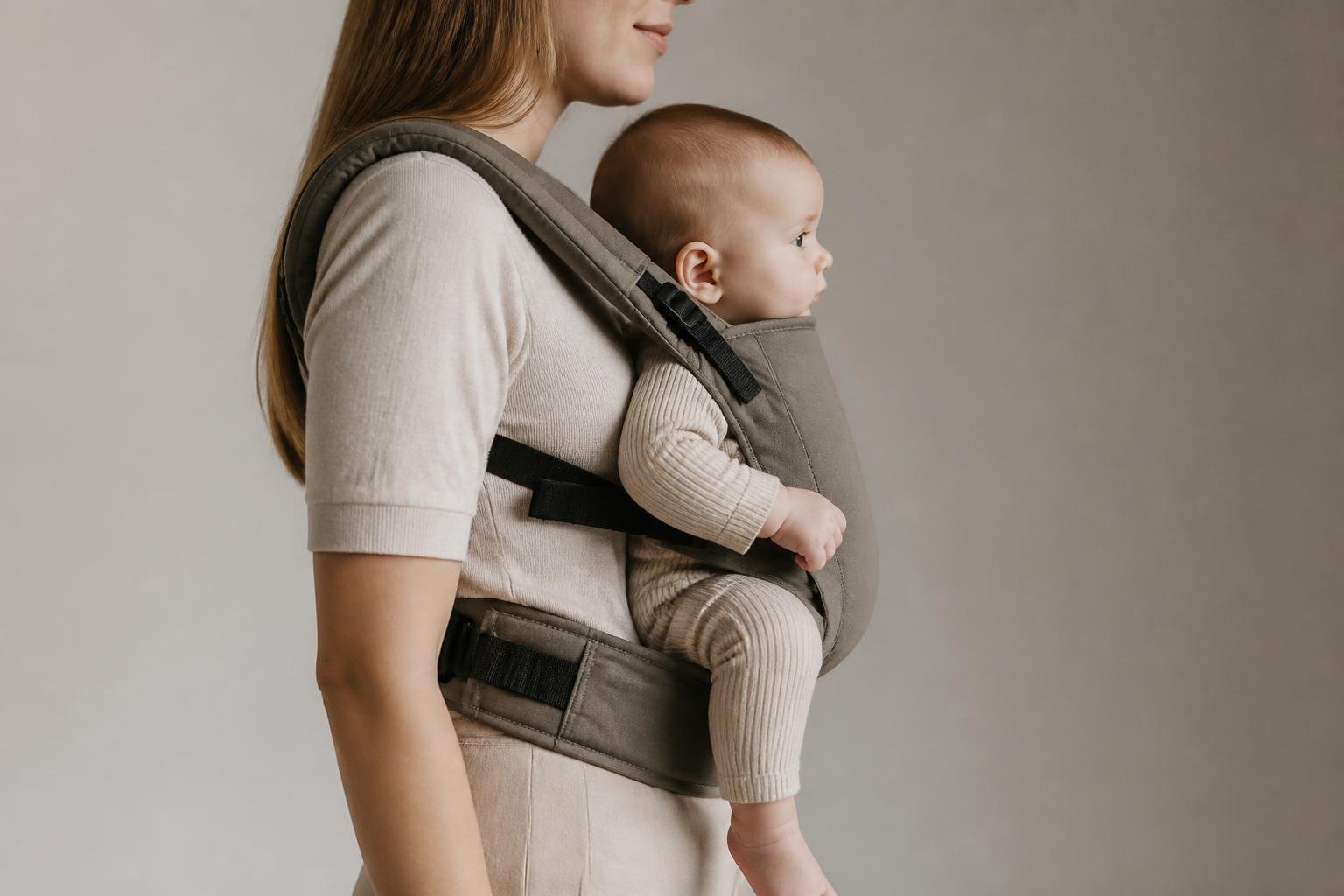
The M-position (also called the “jockey position” or “frog position”) is the anatomically correct position for a baby’s legs in a carrier:
- The baby’s knees are higher than their bottom (hips flexed).
- The baby’s legs spread outward (hips abducted).
- The thighs are supported from knee to knee.
- The legs form an “M” shape when viewed from the front.
This position keeps the femoral head centered in the acetabulum, promoting healthy hip development.
1.2 Why the M-Position Matters
Developmental dysplasia of the hip (DDH) occurs when the hip joint does not form correctly. Carriers that hold the baby’s legs straight down and pressed together push the femoral head against the back of the acetabulum, potentially causing abnormal development.
1.3 Signs That a Carrier Is NOT Hip-Healthy
- The baby’s legs hang straight down (not in an M-position).
- The carrier only supports the baby under the buttocks.
- The baby’s knees are at or below the level of the bottom.
- The carrier is a “crotch-dangler.”
1.4 The International Hip Dysplasia Institute (IHDI)
The IHDI reviews and endorses carriers that meet the criteria for hip-healthy design. Look for the IHDI seal when shopping. Endorsed carriers include Ergobaby, Baby Bjorn (ONE and Harmony), Tula, Lillebaby, Boba, and Solly Wrap.
1.5 How to Check the M-Position
- Look from the front: The baby’s legs should form an “M” — knees higher than the bottom, legs spread.
- Check the seat: Fabric should extend from the back of one knee to the other (knee-to-knee support).
- Feel the hips: The thigh should be fully supported, not just the buttocks.
- Check the spine: The baby’s back should be in a natural “C” curve for young infants.
Part 2: Parent Comfort — Weight Distribution
2.1 Why Carriers Cause Back Pain
The key to comfort is WEIGHT DISTRIBUTION:
- Shoulders: Padded, wide shoulder straps distribute weight across a larger area.
- Hips/Waist: A padded waist belt transfers weight from the shoulders to the hips and core.
- Back: The baby should be carried close to your body (not hanging away).
2.2 Common Mistakes That Cause Back Pain
- Not tightening the waist belt.
- Carrying the baby too low.
- Not adjusting the shoulder straps properly.
- Wearing the carrier for too long without breaks.
Part 3: Carrier Types — Pros and Cons
3.1 Structured Carriers (Buckle Carriers)
Examples: Ergobaby Omni 360, Tula Explore, Baby Bjorn ONE
Pros: Easy to use, built-in support, multiple positions, padded straps.
Cons: Bulkier, less customizable fit than wraps.
Best for: Most families.
3.2 Wraps (Stretchy and Woven)
Examples: Solly Wrap, Didymos
Pros: Customizable, lightweight, excellent for newborns.
Cons: Requires learning to tie, can be warm.
Best for: Newborns, breastfeeding in carrier.
3.3 Ring Slings
Pros: Quick to use, lightweight.
Cons: One-shoulder strain, requires practice.
Best for: Quick carries, older babies.
Part 4: Safety Rules for Carrier Use
- Always ensure the baby’s airway is open and visible.
- The baby should be close enough to kiss (high on your chest).
- For newborns, ensure adequate head and neck support.
- Never carry in front-outward position for extended periods.
- Do not use while cooking, biking, or driving.
- Check the carrier regularly for wear.
- Follow the manufacturer’s weight and age guidelines.
Pediatrician’s Take
“The two non-negotiable requirements for a baby carrier are: hip-healthy design (the M-position with knee-to-knee support) and a clear airway (you should always be able to see the baby’s face). If the carrier holds the baby’s legs straight down, it is contributing to hip dysplasia risk.”
Related Articles
- Car Seat Safety: Correct Angle, Harness Tightness & Common Mistakes
- Baby-Proofing 101: Hidden Hazards in Every Room
- Essential Baby Safety Gear: A Pediatrician’s Checklist
Recommended Products
Top 5 Ergonomic Baby Carriers for Hip Health — IHDI-endorsed carriers reviewed. See our top picks →
MEDICAL DISCLAIMER: This article is for informational purposes only and does not constitute medical advice. Always follow the carrier manufacturer’s instructions. If you have concerns about your baby’s hip development, consult your pediatrician.
Frequently Asked Questions
Q: How do I know if my carrier is hip-healthy?
A: Look for the IHDI (International Hip Dysplasia Institute) seal. The carrier should support the baby’s legs in the M-position — knees higher than the bottom, legs spread, thighs supported from knee to knee.
Q: Is front-outward carrying safe for hips?
A: Front-outward carrying does not support the M-position as effectively. Limit it to 15-20 minutes and ensure the baby’s legs are in at least a partial M-position.
Q: When can I start using a baby carrier?
A: You can start using a hip-healthy carrier from birth, as long as it provides adequate head and neck support for newborns. Stretchy wraps like the Solly are excellent for newborns.
Q: Can I breastfeed in a baby carrier?
A: Yes, with practice. Stretchy wraps are the easiest for breastfeeding. Always ensure the baby’s airway is open and visible during and after feeding.
Related Articles
- Car Seat Safety: Correct Angle, Harness Tightness & Common Mistakes
- Baby-Proofing 101: Hidden Hazards in Every Room
- Essential Baby Safety Gear: A Pediatrician’s Checklist
Related: Best Safe Teething Relief Products: Pediatrician-Approved Picks
Related: Top 5 Baby Toothbrushes & Finger Brushes for First Teeth: Pediatrician-Reviewed
Related: Best Silicone Teethers by Teething Stage: A Pediatrician’s Guide
Reference: CDC – Children’s Health
Understanding Baby Carrier: What Parents Need to Know
Baby Carrier is a topic that comes up frequently in pediatric practice. Here is what the current evidence tells us, and what you should know as a parent.
Related Resources
Explore more pediatrician-reviewed guidance from ChildBloom:
- Teething Rash on Chin & Cheeks: Drool Dermatitis or Allergy?
- When to Start Brushing Baby Teeth: Fluoride Rules by Age
Authoritative External Sources
Related Articles
- Parent Guide: Baby Safety Gear Checklist
- Fever in Babies: When to Call the Doctor
- Car Seat Safety: Correct Angle & Harness
- How to Cut Newborn Nails Safely
- Baby-Proofing 101: Hidden Hazards in Every Room
- Best Digital Thermometers for Babies
- Best Ergonomic Baby Carriers
- Best Infant Car Seats for Safety
Clinical Pearl: What the Research Actually Says
One of the most valuable skills a parent can develop is the ability to evaluate health information critically. In the age of social media and parenting influencers, misinformation about child health spreads faster than evidence-based guidance. When you encounter a new parenting recommendation — whether about sleep, feeding, development, or safety — ask yourself three questions: Who is making this recommendation and what are their credentials? Is the recommendation supported by peer-reviewed research or is it based on anecdote and tradition? Does the recommendation align with guidance from major medical organizations like the American Academy of Pediatrics, the Centers for Disease Control and Prevention, or the World Health Organization? If a recommendation contradicts established medical guidance, it should be viewed with skepticism, regardless of how compelling the testimonial may be. When in doubt, bring what you have read or heard to your pediatrician. We are trained to help you separate evidence from anecdote and to make decisions that are right for your individual child.
Related: Is Swaddling Safe Hip Dysplasia Risks The Arms Out Transition
📖 More from the Health & Safety Hub: your A-Z pediatrician guide to baby health, common illnesses, fevers, rashes, allergies, safety
Safety Considerations and Red Flags
Parents should be aware of the following safety considerations when managing their child’s health at home:
- Never ignore persistent or worsening symptoms
- Keep emergency numbers (pediatrician, poison control, emergency services) readily accessible
- Follow medication dosing instructions precisely — never estimate or use household spoons
- Trust your gut: if you feel something is seriously wrong, seek medical attention immediately
Babywearing Safety and Best Practices
Babywearing offers numerous benefits, including bonding, hands-free convenience, and soothing for fussy babies. However, safe babywearing requires attention to positioning and carrier selection.
The TICKS Rule for Safe Babywearing
The TICKS rule summarizes safe positioning: Tight enough that the baby is secure against your body, In view at all times (you should be able to see your baby’s face by glancing down), Close enough to kiss (baby’s head should be within kissing distance), Keep chin off chest (ensure baby’s chin is not compressed against their chest), and Supported back (baby’s back should be supported in a natural position).
Hip-Healthy Positioning
The International Hip Dysplasia Institute recommends carriers that support the baby’s thighs and allow the hips to spread naturally with the knees higher than the bottom (the M-position). Narrow-based carriers that force the legs to hang straight down can increase the risk of hip dysplasia, especially in babies with a genetic predisposition.
Choosing and Using Baby Carriers Safely
Types of Carriers
Wraps (stretchy or woven) are versatile and distribute weight evenly but have a learning curve for wrapping. Ring slings are quick to put on and great for newborns but can cause shoulder discomfort with heavier babies. Soft structured carriers buckle on and are easy to use but less customizable. Mei tais combine the wrap feel with buckled convenience. Consider your primary use case — quick errands vs. long walks — when choosing a carrier type.
Weight Limits and Transition Points
Each carrier has specific weight limits for front facing in, front facing out, and back carrying. Most soft carriers support front-facing-in from birth (with a newborn insert) to 25-35 pounds. Front-facing-out is typically appropriate starting at 5-6 months when your baby has strong head and neck control. Back carrying is generally suitable from 6-12 months onward. Always follow the manufacturer’s weight and age guidelines for each carrying position.
Babywearing Across Different Ages
Newborn Positioning
Newborns should be carried in a high, tummy-to-tummy position where you can easily kiss the top of their head. Their legs should be in the natural M-position with knees higher than bottom. The carrier should support from knee to knee, not just at the crotch. Their face should be visible and clear of fabric at all times. Check frequently that their airway is clear, especially if they fall asleep in the carrier.
Toddler Carrying
As your baby grows into a toddler, carrying options expand. Back carrying distributes weight more evenly and allows you to carry a heavier child for longer periods. Hip carries (using a ring sling or hip seat) work well for quick ups and downs. The same safety principles apply at any age: the airway must be clear, the child should be visible, and the carrier should be properly adjusted for weight and size.
The Bottom Line
Baby Carrier Ergonomics Hip Dysplasia is a common concern for parents, and most of the time it resolves with simple home care and patience. As a pediatrician, I encourage parents to trust their instincts, stay informed with evidence-based resources, and maintain open communication with their healthcare provider. You know your child best — if something does not feel right, speak up. Every question you ask is valid, and every concern you raise helps us provide better care for your little one.
Frequently asked questions about baby carrier ergonomics
Is baby carrier ergonomics normal in babies?
Mild, short-lived episodes are common and usually settle with simple home care. It is not normal if your baby is feeding poorly, unusually sleepy, breathing fast, has a fever under 3 months of age, or the problem is getting worse instead of better.
When should I call the doctor about baby carrier ergonomics?
Call the same day for fever in a baby under 3 months, breathing difficulty, repeated vomiting, dehydration signs such as very few wet diapers, unusual floppiness or a rash that does not fade with pressure. Trust your instinct — if something feels wrong, get your baby seen.
What can I safely do at home for baby carrier ergonomics?
Focus on comfort, hydration, feeding and rest, and use only medicines and doses your pediatrician has approved for your baby’s age and weight. Avoid honey under 12 months, avoid over-the-counter cough and cold products under 6 years, and never give aspirin.
Common mistakes parents make with baby carrier ergonomics
- Assuming a higher price means a safer or better-performing option — certification and correct fit matter far more.
- Skipping the instruction manual, weight limits and product registration, which is how recall notices reach you.
- Changing several things at once, so you cannot tell what actually helped your baby.
- Relying on advice from social media instead of your pediatrician when something feels off.
Related pediatrician-reviewed reading
- Best Baby Carrier 2026
- Top 5 Ergonomic Baby Carriers for Hip Health
- Baby Clothing Guide
- The Pediatrician’s Guide to Baby Teething
- baby health & safety hub
References & further reading
Medical disclaimer: this article is for general education and does not replace individual medical advice. Always follow your own pediatrician’s guidance for your child.






3 Comments