Music & Baby Brain Development: Why Nursery Rhymes Are Ne
Medically reviewed by Dr. Ahmad Raza, MD (Pediatrics) — ChildBloom Medical Review Panel. Last updated: August 4, 2026.
Editorial & affiliate disclosure: our guidance is written and reviewed by clinicians. ChildBloom may earn a commission from qualifying purchases made through links on this page, which never changes what our pediatric reviewers recommend.
Looking for clear answers about music & baby brain development? This pediatrician-reviewed guide covers what matters, what to skip, the safety checks that count, and exactly when to involve your doctor — based on current AAP, CDC and CPSC guidance on music & baby brain development.
Quick pediatrician summary: music & baby brain development
Short answer: A pediatrician explains music & baby brain development: milestone expectations, safe setups, best picks and when to ask for an evaluation.
As an Amazon Associate, we earn from qualifying purchases.
Music & Baby Brain Development: Why Nursery Rhymes Are Neurologically Powerful
Written by the ChildBloom Pediatric Panel, FAAP | Medically reviewed July 14, 2026 | Last updated July 14, 2026
You do not need a degree in neuroscience to sing to your baby. But if you had one, you would be very impressed by what happens in your baby’s brain when you do.
Music is one of the few activities that activates virtually every region of the brain simultaneously — auditory cortex, motor cortex, language centers, emotional processing areas, memory structures, and executive function networks. For a baby whose brain is forming hundreds of new connections per second, music is not entertainment. It is a full-brain workout.
And the most powerful musical experiences for babies do not require any equipment, any app, or any special talent. They require your voice.
PART 1: THE NEUROSCIENCE OF MUSIC AND THE BABY BRAIN
Looking for the best options? Check out Top 12 Baby Musical Instruments for Growth Pediatrician-Reviewed Picks.
1.1 Music Activates the Whole Brain
Neuroimaging studies show that listening to and producing music engages:
- Auditory cortex (processing pitch, rhythm, timbre)
- Motor cortex (moving to rhythm, clapping, bouncing)
- Broca’s area (language production — music and language share neural pathways)
- Wernicke’s area (language comprehension)
- Prefrontal cortex (attention, working memory, pattern recognition)
- Amygdala and hippocampus (emotional processing and memory)
- Cerebellum (timing, coordination, balance)
When a baby hears a song, bounces to the rhythm, and watches your face as you sing — they are engaging virtually their entire brain.
1.2 Music and Language Development
Music and language share neural circuitry. The brain regions that process musical rhythm also process the rhythmic structure of speech (prosody — the patterns of stress and intonation in language).
Research findings:
- Babies who are exposed to regular musical rhythm (through songs, nursery rhymes, and clapping games) show enhanced processing of speech rhythm, which is a predictor of later reading ability.
- Nursery rhymes are particularly effective because they combine rhythm, rhyme, repetition, and vocabulary — all the elements that build phonological awareness (the ability to recognize and manipulate the sounds of language).
- A study from the University of Washington found that babies who participated in regular music sessions showed enhanced brain responses to both music and speech at 12 months compared to babies who did not.
1.3 Music and Emotional Regulation
Music activates the brain’s emotional processing centers. Lullabies, in particular, have been shown to:
- Reduce cortisol levels (stress hormone)
- Promote relaxation and sleep
- Strengthen the caregiver-infant bond
- Provide a predictable, soothing structure that helps the baby regulate their emotional state
1.4 Music and Social Development
Musical activities that involve turn-taking (clapping games, call-and-response singing) build the neural foundations for social interaction:
- Joint attention (sharing focus on the same thing)
- Turn-taking (the foundation of conversation)
- Synchronization (moving together in time, which builds social bonding)
PART 2: WHY NURSERY RHYMES ARE SPECIAL
Nursery rhymes are not just cute songs. They are sophisticated cognitive tools:
2.1 Rhyme and Phonological Awareness
- Rhyming words (cat/hat, star/far) teach the baby’s brain to recognize sound patterns. This is the foundation of phonological awareness, which is the strongest predictor of reading success.
2.2 Repetition and Memory
- Nursery rhymes are repetitive by design. This repetition allows the baby to predict what comes next, which builds working memory and pattern recognition.
2.3 Vocabulary Building
- Nursery rhymes often contain words that are not commonly used in everyday conversation (twinkle, sparrow, thimble, tuffet). This exposes babies to a richer vocabulary than everyday speech alone.
2.4 Rhythm and Timing
- The rhythmic structure of nursery rhymes (the meter, the beat) trains the baby’s brain to process temporal patterns, which is foundational for both language and mathematics.
PART 3: PRACTICAL MUSIC ACTIVITIES BY AGE
0-6 MONTHS:
- Sing lullabies during feeding and bedtime routines.
- Play gentle music in the background during awake time (not constant — allow quiet time too).
- Bounce the baby to rhythm on your knee.
- Use a soft, calm voice. The baby is processing the melody and rhythm more than the words.
6-12 MONTHS:
- Clapping games: pat-a-cake, so big, itsy bitsy spider (with finger motions).
- Simple instruments: shakers, drums, bells. Let the baby explore making sounds.
- Sing action songs: wheels on the bus, head-shoulders-knees-and-toes.
- Dance with the baby — hold them and sway to music.
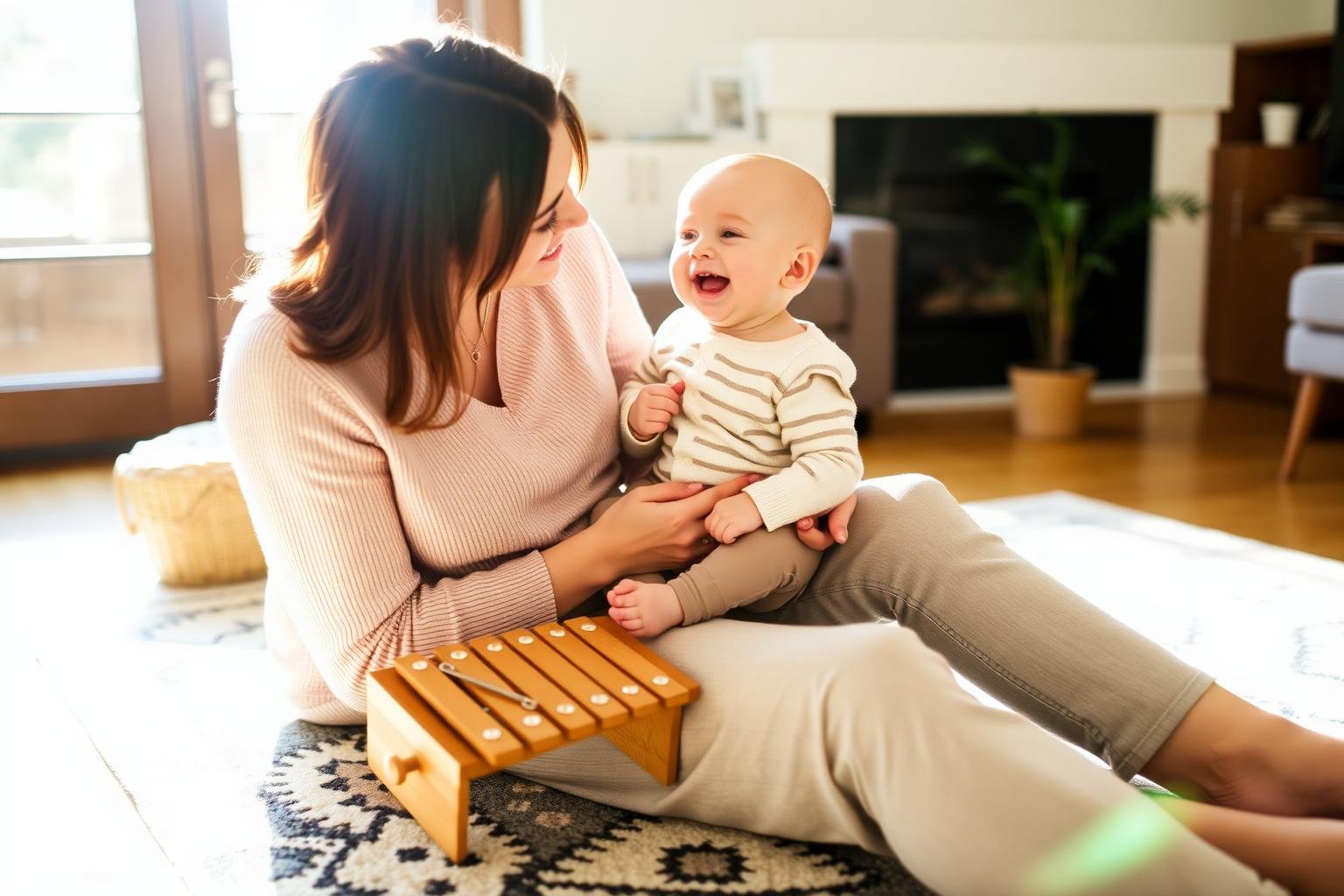
- Introduce simple musical toys: xylophone, maracas, tambourine.
12-24 MONTHS:
- Encourage the toddler to sing along (even if the words are not correct).
- Provide simple instruments for independent exploration.
- Play freeze dance (dance when the music plays, stop when it stops).
- Sing familiar songs and pause before the last word — let the toddler fill it in.
PART 4: LIVE MUSIC vs. RECORDED MUSIC
Live music (you singing, you playing) is more powerful than recorded music for babies because:
- It involves face-to-face interaction (serve and return).
- The baby can see your mouth forming words, your facial expressions, your body movements.
- You can adjust the tempo, volume, and content in real time based on the baby’s responses.
- It builds the caregiver-infant bond.
Recorded music is not harmful — it is simply less developmentally rich. Use it as a supplement, not a replacement for live interaction. Background music during play is fine. But do not replace singing with a playlist.
PEDIATRICIAN’S TAKE
“If I could prescribe one activity for every baby, it would be singing. Not expensive toys, not apps, not classes. Singing. Your voice is the most powerful developmental tool you have. Nursery rhymes build language, rhythm, memory, and emotional regulation simultaneously. The research is overwhelming: babies whose caregivers sing to them regularly have enhanced brain responses to both music and speech. You do not need to be a good singer. The baby does not care about pitch. They care about the interaction, the rhythm, and the love in your voice. Sing every day.”
RELATED ARTICLES
- Why Babies Need “Boredom”: The Case for Unstructured Play Time
- Screen Time for Babies Under 2: What the AAP Actually Says
- Age-Appropriate Baby Activities: A Pediatrician’s Month-by-Month Guide
RECOMMENDED PRODUCTS
Best Baby Musical Instruments for Brain Development (Safe, real-sound instruments reviewed)
[See our top picks ->]
MEDICAL DISCLAIMER: This article is for informational purposes only and does not constitute medical advice. Always consult your pediatrician for guidance on your child’s development.
Related Pediatrician-Reviewed Resources
This article is part of the pediatrician-reviewed Baby Development & Play series. Continue reading:
- Best Sensory Play Kits & Activity Tables by Age: Pediatrician-Reviewed Guide
- Top 5 Baby Musical Instruments for Brain Development: Pediatrician-Reviewed Picks
- Best Open-Ended Toys for Babies: No Batteries Required — A Pediatrician’s Guide
- Sensory Play Ideas by Age: What’s Developmentally Appropriate at 3, 6 & 9 Months
Trusted Authority Sources
- AAP – The Power of Play: How Play and Learning Go Hand in Hand
- AAP – Screen Time Guidelines for Babies and Toddlers
- CDC – Developmental Milestones
How to Incorporate Music into Your Baby’s Daily Routine
Incorporating music into your baby’s daily routine is simple and does not require any musical training. The most powerful musical experience for a baby is live singing from a caregiver. Your baby does not care if you are off-key or do not know the words. Your voice is the most familiar and comforting sound in their world. Sing lullabies during bedtime routines, sing silly songs during diaper changes, and sing simple nursery rhymes during playtime. The repetition of the same songs establishes predictability and comfort. In addition to singing, expose your baby to a variety of recorded music. Choose music with simple melodies, clear rhythms, and a moderate tempo. Classical music, especially Mozart and Bach, is often recommended for its complex but predictable structure. Folk music, children’s music, and world music all provide valuable auditory experiences. Avoid music that is overly loud, fast, or chaotic, as this can be overstimulating. Play music at a moderate volume, and use it as background rather than the main focus. The best musical experiences are interactive. Clap your baby’s hands to the beat, bounce them gently in rhythm, dance around the room, and point out instruments when you hear them. These interactions build the neural connections that make music a powerful tool for brain development. The most important rule is that musical experiences should be joyful and pressure-free.
Frequently Asked Questions
Q: When should my baby start crawling?
A: Most babies start crawling between 6-10 months, but some skip crawling entirely and go straight to pulling up, cruising, or walking. The range of normal is wide. What matters more than the specific timeline is progressive development—your baby should show increasing mobility and strength over time. If your baby isn’t showing any form of mobility by 12 months, discuss with your pediatrician.
Q: When should my baby start talking?
A: Babies typically say their first words (like “mama” or “dada” with meaning) around 12 months. By 18 months, most have 10-20 words. By 2 years, they typically have 50+ words and start combining words into simple phrases. If your baby isn’t using any words by 16 months or isn’t combining words by 24 months, discuss with your pediatrician.
Q: How can I support my baby’s development?
A: Talk to your baby constantly (narrate what you’re doing), read together daily (even from birth), provide tummy time when awake and supervised, offer age-appropriate toys that encourage exploration, and respond to your baby’s cues. The most important factor is responsive, engaged caregiving—not expensive toys or programs.
Musical Instruments for Different Ages
Introducing age-appropriate musical instruments enhances your baby musical experience and supports their motor development. For newborns to 3 months, your voice is the most important instrument. Sing simple lullabies and nursery rhymes. Musical mobiles with gentle, classical music can provide auditory stimulation during awake time. For 3 to 6 months, introduce rattles and shakers that your baby can grasp and shake. The cause-and-effect relationship of shaking and hearing sound is fascinating to babies at this age. For 6 to 9 months, introduce instruments that require more complex motor skills, such as drums that your baby can bang with their hands, bells that jingle when shaken, and xylophones with large, colorful keys. For 9 to 12 months, your baby may enjoy instruments that require more precise movements, such as egg shakers, maracas, and small tambourines. For 12 to 18 months, introduce instruments that require coordinated movements, such as rhythm sticks that your baby can tap together, small keyboards with large keys, and harmonicas or kazoos that require blowing. For 18 to 24 months, add more complex instruments like small drums with beaters, triangles, and simple wind instruments. Always choose instruments that are age-appropriate, with no small parts that could be choking hazards, no sharp edges, and no toxic paints or finishes. Supervise instrument play to ensure safety. The goal is not to create a musical prodigy but to provide rich, varied auditory experiences that support brain development and foster a lifelong love of music.
📖 More from the Mobility & Play Hub: your guide to baby motor milestones, tummy time, sensory play, toys, and gear
Frequently asked questions about music & baby brain development
Is music & baby brain development normal for my baby’s age?
Milestones arrive in ranges, not on fixed dates, and premature babies should be tracked using corrected age. Ask for an evaluation if your baby loses a skill, is stiff or very floppy, or strongly favours one side of the body.
How can I encourage music & baby brain development safely?
Use short, frequent supervised floor and tummy-time sessions on a firm surface, keep the space free of cords and small parts, and let your baby practise on the floor rather than in containers. Skip baby walkers entirely — the AAP advises against them.
How much play time does my baby need for music & baby brain development?
Several short sessions across the day beat one long one. Aim for a total of about an hour of supervised floor play by three to four months, built up gradually and stopped whenever your baby is tired or fussy.
Common mistakes parents make with music & baby brain development
- Assuming a higher price means a safer or better-performing option — certification and correct fit matter far more.
- Skipping the instruction manual, weight limits and product registration, which is how recall notices reach you.
- Changing several things at once, so you cannot tell what actually helped your baby.
- Relying on advice from social media instead of your pediatrician when something feels off.
Related pediatrician-reviewed reading
- Baby Development Milestones
- Baby Tummy Time Benefits
- Baby Development & Play Guide
- Best Baby Carrier 2026
- mobility & play hub
References & further reading
Medical disclaimer: this article is for general education and does not replace individual medical advice. Always follow your own pediatrician’s guidance for your child.