
Baby sunscreen age: Baby Sun Protection: Why Sunscreen Isn’t Enough for Under 6 Months
Medically reviewed by Dr. Ahmad Raza, MD (Pediatrics) — ChildBloom Medical Review Panel. Last updated: August 4, 2026.
Editorial & affiliate disclosure: our guidance is written and reviewed by clinicians. ChildBloom may earn a commission from qualifying purchases made through links on this page, which never changes what our pediatric reviewers recommend.
Looking for clear answers about baby sunscreen age? This pediatrician-reviewed guide covers what matters, what to skip, the safety checks that count, and exactly when to involve your doctor — based on current AAP, CDC and CPSC guidance on baby sunscreen age.
Quick pediatrician summary: baby sunscreen age
Short answer: A pediatrician explains baby sunscreen age: what is normal, the real risks, red flags to watch for and exactly when to call your doctor.
It is a sunny day. You want to take the baby outside. You reach for the sunscreen — and your pediatrician has told you not to use it on babies under 6 months. So what do you do?
As a pediatrician, I understand how concerning these moments can be for parents. My goal is to provide you with evidence-based guidance that helps you make informed decisions for your child, while also knowing exactly when to seek medical attention. This guide draws on current AAP recommendations and clinical experience to give you the clarity you need.
The answer is: UPF clothing, wide-brimmed hats, and shade. These are the primary sun protection strategies for babies under 6 months — and they are more effective than sunscreen anyway.
PART 1: WHY SUNSCREEN IS NOT RECOMMENDED UNDER 6 MONTHS
1.1 The AAP Recommendation
The American Academy of Pediatrics advises against the routine use of sunscreen on infants under 6 months of age. The reasons:
- Infant skin is thinner and more permeable, meaning it absorbs chemicals more readily.
- The skin’s barrier function is not fully mature, increasing the risk of irritation and allergic reactions.
- Babies have a higher surface-area-to-body-weight ratio, meaning they absorb proportionally more of any chemical applied to their skin.
1.2 The Exception
If shade and clothing are not available, the AAP states that a minimal amount of mineral sunscreen (zinc oxide or titanium dioxide) can be applied to small exposed areas (face, backs of hands). Mineral sunscreens are preferred because they sit on the surface of the skin and have a lower risk of irritation.
But sunscreen should NOT be the primary sun protection strategy for babies under 6 months. UPF clothing and shade should be.
PART 2: UPF CLOTHING — THE SCIENCE
2.1 What Is UPF?
UPF (Ultraviolet Protection Factor) is a rating system for fabrics, similar to SPF for sunscreens. It measures how much UV radiation the fabric blocks.
| UPF RATING | UV BLOCKED | PROTECTION LEVEL |
|---|---|---|
| 15-24 | 93.8-95.9% | Good |
| 25-39 | 96.0-97.4% | Very Good |
| 40-50+ | 97.5-98%+ | Excellent |
A UPF 50+ fabric blocks at least 98% of UV radiation — both UVA and UVB.
2.2 How UPF Clothing Works
Unlike sunscreen (which needs to be reapplied every 2 hours), UPF clothing provides continuous protection as long as it is worn. The protection comes from:
- Tight weave: The tighter the weave, the less UV passes through.
- Fiber type: Synthetic fibers tend to block UV better than natural fibers.
- Color: Darker colors absorb more UV radiation than lighter colors.
- Chemical treatments: Some fabrics are treated with UV-absorbing compounds.
- Moisture: Wet fabric generally provides LESS UV protection than dry fabric.
2.3 Regular Clothing vs. UPF Clothing
A regular white cotton t-shirt has a UPF of approximately 5-7 — meaning it blocks only about 80-85% of UV radiation. A UPF 50+ garment blocks 98%+. For extended outdoor time, UPF clothing provides significantly more protection.
PART 3: CHOOSING SUN-PROTECTIVE CLOTHING
3.1 UPF Clothing
Look for:
- UPF 50+ rating (the highest available)
- Coverage: Long sleeves and long pants. One-piece UPF swimsuits or sun suits are ideal for babies.
- Breathability: Lightweight and breathable fabric to prevent overheating.
- Moisture-wicking: For swimming and hot weather.
- Fit: The garment should fit well — loose fabric can ride up and expose skin.
3.2 Hats
A wide-brimmed hat (brim at least 3 inches all around) protects the face, ears, and neck. Look for:
- Wide brim (3+ inches all around — not just a baseball cap style)
- UPF-rated fabric
- Chin strap (to keep the hat on a wiggling baby)
- Breathable fabric
- Neck flap (for additional neck protection)
3.3 Shade
- Use a stroller canopy or umbrella.
- Seek natural shade (trees) whenever possible.
- Remember that UV radiation reflects off sand, water, and concrete — shade reduces but does not eliminate UV exposure.
- The sun’s rays are strongest between 10 AM and 4 PM. Plan outdoor activities outside these hours when possible.
PART 4: SUN PROTECTION BY AGE
UNDER 6 MONTHS:
- Primary: Shade, UPF clothing, wide-brimmed hat
- Backup: Minimal mineral sunscreen on small exposed areas if shade and clothing are not sufficient
- Avoid: Direct sun exposure, especially between 10 AM and 4 PM
6-12 MONTHS:
- Primary: UPF clothing, wide-brimmed hat, shade
- Add: Mineral sunscreen (SPF 30+) on all exposed areas
- Reapply sunscreen every 2 hours and after water exposure
12+ MONTHS:
- Continue UPF clothing and hats
- Use mineral or chemical sunscreen (SPF 30+) on exposed areas
- Teach the child about sun safety habits
PEDIATRICIAN’S TAKE
“For babies under 6 months, sun protection means shade, UPF clothing, and a wide-brimmed hat — not sunscreen. The baby’s skin is too thin and permeable for routine sunscreen application. A UPF 50+ sun suit and a wide-brimmed hat with a neck flap provide better, more reliable protection than any sunscreen. For babies under 6 months, UPF clothing and shade are your primary defense. Sunscreen is only a backup for small areas (like the face and hands) when shade isn’t available. Clothing doesn’t need to be reapplied every 2 hours like sunscreen does.”
WHEN TO CALL THE DOCTOR
- Sunburn on a baby under 6 months (always seek medical advice)
- Sunburn with blisters, fever, or signs of infection
- Signs of heat exhaustion (lethargy, vomiting, rapid breathing) in hot, sunny conditions
RELATED ARTICLES
- Dressing Baby in Winter: Layers, Overheating Signs & Frostbite Prevention
- Organic vs. Regular Cotton for Babies
- What Your Baby Should Wear: A Pediatrician’s Guide
RECOMMENDED PRODUCTS
Best UPF 50+ Baby Sun Protection Clothing & Hats →
MEDICAL DISCLAIMER: This article is for informational purposes only and does not constitute medical advice. Always consult your pediatrician for guidance on your child’s specific needs.
Related Resources
Explore more pediatrician-reviewed guidance from ChildBloom:
- Dressing Baby in Winter: Layers, Overheating Signs & Frostbite Prevention
- Baby Clothing Fire Safety: Flame Retardants vs. Snug-Fit Pajamas
- How to Dress a Newborn for Sleep: The TOG Rating System Explained
- Organic vs. Regular Cotton for Babies: Does the Fabric Really Matter?
Authoritative External Sources
Frequently Asked Questions
Q: When should I call the pediatrician?
A: Call immediately for: fever in a baby under 3 months, difficulty breathing, signs of dehydration (no wet diapers for 8+ hours, no tears when crying), lethargy or difficulty waking, a rash that doesn’t fade when pressed, or if your baby seems to be getting worse. For non-urgent concerns, call during business hours.
Q: How do I know if my baby is developing normally?
A: Development varies widely, but babies should show progressive gains in motor skills, social interaction, and communication. If your baby isn’t meeting multiple milestones or is losing skills they once had, discuss with your pediatrician. Early intervention is highly effective if there are delays.
Q: What products do I really need for my baby?
A: The essentials are: a correctly installed car seat, a safe sleep space (crib or bassinet with firm mattress), diapers and wipes, appropriate clothing, and a digital thermometer. Beyond these, focus on products that address specific needs rather than marketing claims. Always prioritize safety certifications over features.
Clinical Pearl: What the Research Actually Says
One of the most valuable skills a parent can develop is the ability to evaluate health information critically. In the age of social media and parenting influencers, misinformation about child health spreads faster than evidence-based guidance. When you encounter a new parenting recommendation — whether about sleep, feeding, development, or safety — ask yourself three questions: Who is making this recommendation and what are their credentials? Is the recommendation supported by peer-reviewed research or is it based on anecdote and tradition? Does the recommendation align with guidance from major medical organizations like the American Academy of Pediatrics, the Centers for Disease Control and Prevention, or the World Health Organization? If a recommendation contradicts established medical guidance, it should be viewed with skepticism, regardless of how compelling the testimonial may be. When in doubt, bring what you have read or heard to your pediatrician. We are trained to help you separate evidence from anecdote and to make decisions that are right for your individual child.
Related: Baby Room Temperature Safe By Age
📖 More from the Health & Safety Hub: your A-Z pediatrician guide to baby health, common illnesses, fevers, rashes, allergies, safety
Safety Considerations and Red Flags
Parents should be aware of the following safety considerations when managing their child’s health at home:
- Never ignore persistent or worsening symptoms
- Keep emergency numbers (pediatrician, poison control, emergency services) readily accessible
- Follow medication dosing instructions precisely — never estimate or use household spoons
- Trust your gut: if you feel something is seriously wrong, seek medical attention immediately
Protecting Your Baby from the Sun
Sun protection is critical for babies because their skin has less melanin and a thinner outer layer, making it more vulnerable to UV damage. Sunburns during childhood significantly increase the lifetime risk of skin cancer, making prevention a lifelong health priority.
Sun Protection for Babies Under 6 Months
The AAP recommends avoiding direct sun exposure entirely for infants under 6 months. Instead, rely on physical barriers: lightweight long-sleeved clothing, wide-brimmed hats, umbrellas, and stroller shades. Sunscreen should be used sparingly on small areas like the face, hands, and feet if shade is not available, but is not recommended for full-body application at this age.
Sun Protection for Older Babies
For babies 6 months and older, apply a broad-spectrum, mineral-based sunscreen (zinc oxide or titanium dioxide) with at least SPF 30. Apply 15-30 minutes before sun exposure and reapply every 2 hours or after swimming or sweating. Avoid peak UV hours (10 AM to 4 PM), seek shade whenever possible, and dress your baby in UPF-rated clothing for extended outdoor time.
Sun Safety Beyond Sunscreen
Protective Clothing and Accessories
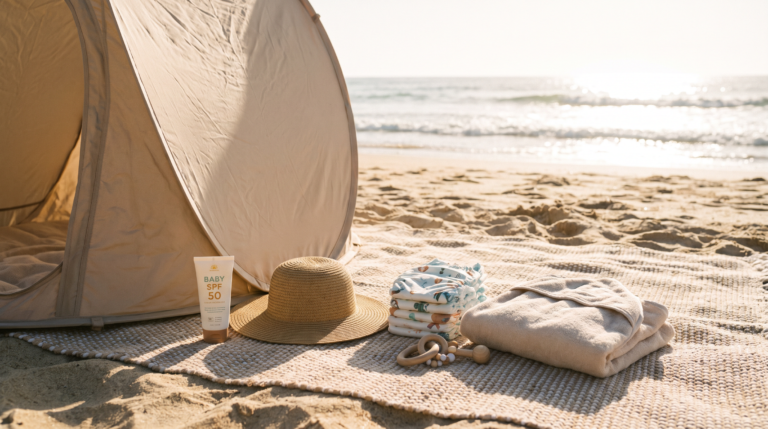
UPF (Ultraviolet Protection Factor) clothing provides reliable, chemical-free sun protection. Look for UPF 50+ ratings, which block 98% of UV rays. Rash guards, long-sleeved swim shirts, and wide-brimmed hats with neck flaps offer excellent coverage. UV-blocking sunglasses with elastic straps protect your baby’s eyes. UPF stroller shades and beach tents provide portable shade. Remember that clouds do not block UV rays — sun protection is needed even on overcast days.
Sun Safety in Special Situations
Water, sand, and snow reflect UV rays, increasing exposure risk. Apply water-resistant sunscreen and reapply after swimming or toweling off. At high altitudes and near the equator, UV intensity is greater, and protection needs to be more diligent. Certain medications, including some antibiotics and acne treatments, can increase photosensitivity — check with your pharmacist if your child is on any medication. Pay special attention to easily missed areas: ears, back of neck, tops of feet, and behind knees.
Year-Round Sun Protection
Sun Protection in Every Season
Sun protection is not just for summer. Snow reflects up to 80% of UV rays, significantly increasing exposure during winter activities. UV rays penetrate clouds, so protection is needed on overcast days. Autumn and spring sun, when the sun is lower in the sky, can still cause burns, especially during extended outdoor time. Make sun protection a consistent habit year-round, regardless of the weather or season.
Teaching Sun Safety Habits Early
Children learn sun safety habits from their parents. Model good sun protection by wearing sunscreen, a hat, and sunglasses yourself. Make applying sunscreen a normal part of the outdoor routine, like putting on shoes before going outside. Explain in simple terms why you protect your skin: “The sun is strong, and we need to protect our skin so it stays healthy.” As your child grows, involve them in choosing their own sun hat and applying their own sunscreen (with supervision).
The Bottom Line
Baby Sunscreen Age Guide is a common concern for parents, and most of the time it resolves with simple home care and patience. As a pediatrician, I encourage parents to trust their instincts, stay informed with evidence-based resources, and maintain open communication with their healthcare provider. You know your child best — if something does not feel right, speak up. Every question you ask is valid, and every concern you raise helps us provide better care for your little one.
Frequently asked questions about baby sunscreen age
Is baby sunscreen age normal in babies?
Mild, short-lived episodes are common and usually settle with simple home care. It is not normal if your baby is feeding poorly, unusually sleepy, breathing fast, has a fever under 3 months of age, or the problem is getting worse instead of better.
When should I call the doctor about baby sunscreen age?
Call the same day for fever in a baby under 3 months, breathing difficulty, repeated vomiting, dehydration signs such as very few wet diapers, unusual floppiness or a rash that does not fade with pressure. Trust your instinct — if something feels wrong, get your baby seen.
What can I safely do at home for baby sunscreen age?
Focus on comfort, hydration, feeding and rest, and use only medicines and doses your pediatrician has approved for your baby’s age and weight. Avoid honey under 12 months, avoid over-the-counter cough and cold products under 6 years, and never give aspirin.
Common mistakes parents make with baby sunscreen age
- Assuming a higher price means a safer or better-performing option — certification and correct fit matter far more.
- Skipping the instruction manual, weight limits and product registration, which is how recall notices reach you.
- Changing several things at once, so you cannot tell what actually helped your baby.
- Relying on advice from social media instead of your pediatrician when something feels off.
Related pediatrician-reviewed reading
- Baby Sunscreen When to Apply
- Baby Room Temperature
- Formaldehyde in Baby Furniture
- Flame retardant
- baby health & safety hub
References & further reading
Medical disclaimer: this article is for general education and does not replace individual medical advice. Always follow your own pediatrician’s guidance for your child.


4 Comments