Pediatrician Reviewed Baby Gear: What It Means and How to Verify
Pediatrician Reviewed Baby Gear: What It Means and How to Verify
What “pediatrician reviewed” really means, what evidence to look for, key CPSC/ASTM safety signals, and quick checks for bans, recalls, and complaints.
You’re building a registry and keep seeing “pediatrician reviewed” stamped on gear lists, as if it’s a simple safety green light. But the label rarely tells you what a pediatrician did—or didn’t do—before the product ended up on the page.
If you treat it as an endorsement when it’s really just a quick medical fact-check, the cost is real: false confidence, missed red flags, and money spent on gear you wouldn’t have chosen with better information. This guide shows you how these reviews typically work, what proof should appear on the page, and a quick set of checks to run before buying (with a special note for car seats).
Decoding “Pediatrician Reviewed”
On baby-gear pages, “pediatrician reviewed” isn’t one standard process. Depending on the publisher, it can mean a clinician reviewed the article’s medical/safety statements, signed off on a testing or screening method, or is being used as an implied endorsement without showing the standards behind it.
The practical move is to treat the phrase like a job title without a job description. Until the page tells you whether the pediatrician reviewed the product picks, the method, or only the health/safety language (and what they didn’t do), you’re guessing—and the label can’t carry the trust weight you’re putting on it.
Medical content review
This is the most literal meaning: the pediatrician reviews the medical or safety statements in the article text, not the product lineup.
Some publishers explicitly separate product testing/research from medical review. For example, The Bump says that articles with significant health/medical advice are sent to an ob-gyn or pediatrician for medical review before publication—language that frames the clinician’s role as checking the advice, not running the gear evaluation.
On-page, scope language that makes this meaningful is specific about the object of review: “medical advice reviewed,” “health claims reviewed,” or “safe-sleep guidance reviewed,” plus the reviewer’s name and credentials. If all you see is a badge or “pediatrician approved” with no scope, you can’t tell whether anyone touched the product picks at all.
Methodology sign-off
Here, the pediatrician is involved earlier: they help set the safety criteria, disqualifiers, or evaluation protocol, then sign off that the method matches those rules.
What proves this isn’t the label—it’s documentation. Look for a methodology section that says what was checked, who set the criteria, and what the pediatrician reviewed (for example: “Dr. X reviewed our test protocol and exclusion criteria”). A strong version reads like a procedure, not a seal.
If the page doesn’t describe the protocol, “reviewed” may simply mean “looked at it before we hit publish.”
Implied endorsement shortcut
Sometimes “pediatrician reviewed/approved” is used as shorthand for endorsement—without showing the standards, the reviewer’s role, or the disclosures that let you judge independence.
You’ll see this most when the page leans on authority language (“approved,” “recommended by doctors”) but doesn’t name the pediatrician, link to a methodology, or define what “approved” covers. In contrast, some sites do spell out their workflow: BabyGearLab’s About page says its founder, Juliet Spurrier, MD (a board-certified pediatrician), personally oversees reviews, describes selecting products, buying products at retail, and running side-by-side lab and real-world tests—and it also states the site earns money when readers click affiliate links and buy products reviewed (an affiliate link is a trackable link that can pay the publisher a commission).
Also watch how disclosures are presented. FTC staff guidance says a disclosure hidden behind a button like “DISCLOSURE” or “LEGAL” is “easily avoidable” and therefore not clear and conspicuous. If the page won’t show you scope, standards, and disclosures in plain sight, treat “pediatrician reviewed baby gear” as a marketing claim, not a process.
On-Page Evidence Signals
A “pediatrician reviewed baby gear” label only means something when the page leaves a paper trail you can inspect. Look for page elements like these:
A dated review artifact, not just a badge. A “last medically reviewed” date plus a link to what was checked (claims, warnings, contraindications), and what happens when guidance changes.
Clear disqualifiers tied to actual law. For sleep gear, the page should state that crib bumpers and infant inclined sleepers are banned hazardous products as of November 12, 2022 (regardless of manufacture date), and that they’re excluded.
Specific sleep-standard references. “16 CFR” is the federal safety rulebook; “ASTM” is a technical standard body. A strong page names the infant sleep products rule (16 C.F.R. part 1236) and that it incorporates ASTM F3118.
Angle limits stated in plain English. It should say infant sleep products must not exceed a 10° sleep-surface angle, and that bassinets/cradles must meet 16 C.F.R. part 1218 requirements.
A non-regulatory cross-check. If it mentions the JPMA Certification Seal, it should explain it’s voluntary and that certification involves independent-lab sample testing to verify safety/performance/functionality—covering minimum government requirements plus additional requirements.
Registration/recall readiness. For durable infant/toddler products, the page should note that required registration cards must be attached to the product so you’ll handle them after purchase.
Category-specific compliance named. For strollers, look for the federal requirement to comply with ASTM F833-21 (via 16 C.F.R. § 1227.2).
Alignment with pediatric safety guidance. For sleep space, it should reflect American Academy of Pediatrics (AAP) guidance to keep bumpers and other soft items out.
The U.S. Safety Floor
When a gear page says something is “safe,” start with a boring question: safe according to which rulebook? In the U.S., the baseline is legal compliance—not a reviewer’s opinion.
The key idea is that a lot of baby-gear “safety” is category-based. The government doesn’t certify one stroller as safer than another; it sets minimum requirements for the whole category. A “pediatrician reviewed baby gear” badge can only add value after that floor is met, because compliance is the entry ticket, not the winner’s circle.
CPSC, 16 CFR, ASTM
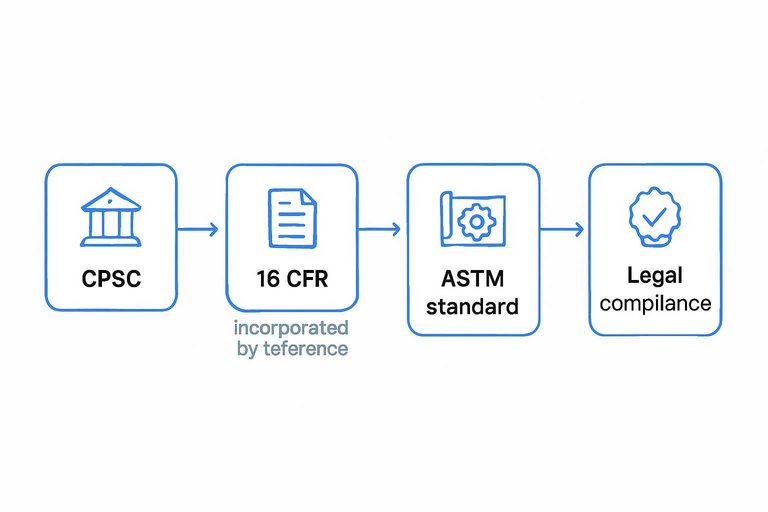
The CPSC (the U.S. Consumer Product Safety Commission) is the federal agency that regulates many consumer products—including many categories of baby gear—and it issues recalls and mandatory safety standards.
Those standards often live in 16 CFR (Title 16 of the Code of Federal Regulations), which is basically the federal rulebook where many consumer product safety requirements are written down.
Here’s the mechanical part people miss: many category rules in 16 CFR don’t reinvent every technical detail. They point to an ASTM standard (incorporated by reference)—a technical consensus standard that becomes legally mandatory for that product category once the regulation references it.
Example: the federal stroller rule at 16 CFR § 1227.2 says each carriage and stroller must comply with ASTM F833-21. In practice, that means the ASTM document is doing much of the engineering-level work, and 16 CFR is the legal hook that makes it enforceable.
That’s why “meets ASTM” isn’t a brag. In many categories, it’s the law.
Sleep rules in practice
Infant sleep is where the “floor” shows its teeth, because the rules don’t just require warnings—they define what can legally be sold.
Under CPSC guidance, the infant sleep products rule is codified at 16 C.F.R. part 1236 and incorporates ASTM F3118. The same guidance also says that if a product’s name implies it’s for infant sleep (for example, using words like “bed,” “bassinet,” or “crib”), and it isn’t already covered by another mandatory infant sleep standard, it’s treated as an infant sleep product under part 1236.
Then there are outright bans. The SSBA (Safe Sleep for Babies Act) is a federal law that makes infant inclined sleepers a banned hazardous product as defined in the law and CPSC guidance. CPSC defines an “inclined sleeper for infants” as a product with an inclined sleep surface greater than 10 degrees that’s intended, marketed, or designed to provide sleeping accommodations for an infant up to 1 year old.
So a credible review isn’t just asking “is this comfy?” It’s asking “is this even legal to sell as sleep gear?”
Concrete crib requirements
Cribs show how specific the safety floor can get.
CPSC’s full-size crib guidance ties safety to fit. To reduce head entrapment and suffocation between the mattress and crib sides, a mattress used in a full-size crib must be at least 27 ¼ inches x 51 ¼ inches, and the thickness must not exceed 6 inches. The same guidance says warning statements noting these dimensions must appear in the instructions, on the carton, and on the crib.
And the underlying category standard isn’t frozen in time. A May 4, 2026 Federal Register rule explains that CPSC’s full-size crib regulation updates its reference so it reflects the ASTM version that takes effect “by operation of law.” It states ASTM F1169–25 would take effect as the new CPSC standard for full-size baby cribs absent Commission action, and the update would become effective August 1, 2026 unless CPSC receives a significant adverse comment within 30 days.
That’s the baseline working as designed: specific requirements, updated over time, and still only the minimum a “best pick” should clear.
What Review Should Do
A defensible “pediatrician reviewed baby gear” workflow is less about taste and more about triage. You screen out products that shouldn’t be recommended at all, then you test and compare the short list, and you publish enough documentation that a reader can audit the process.
Screens and disqualifiers
If a methodology page doesn’t show these up front, the “review” is doing the easy part first.
- Name the applicable category safety standard before ranking anything. The page should cite the specific rule(s) it is screening against for that category (the legal baseline is the entry ticket).
- Run a banned-category check and disqualify immediately. If the category includes products that are banned hazardous products, they don’t belong in “best” lists—no “but we like this one.”
- Check recall history and exclude products with unresolved safety actions. Big recalls happen in baby gear; HealthyChildren.org describes a 2009 crib recall involving 2.1 million cribs.
- Scan complaints and incident reports in SaferProducts.gov. SaferProducts.gov is a CPSC-run site where the public can report and search complaints about unsafe consumer products; a credible review uses it as a reality check before recommending.
- Treat third-party seals as supporting evidence, not a substitute for screening. The JPMA Certification Seal is a voluntary certification program that says a juvenile product was sample-tested at an independent lab against applicable requirements, built on ASTM standards and other rules.
Testing and documentation
Once the screen is done, hands-on testing is where a pediatrician-involved process can add value—by translating “meets the floor” into “works safely in real homes.” But testing only counts if the review also shows its work.
| Review model | Inputs (what it uses) | Outputs (what it publishes) | What you can verify as a reader |
|---|---|---|---|
| Pediatrician-led testing model (BabyGearLab) | Stated safety criteria + side-by-side product comparisons + hands-on evaluation | Rankings tied to defined criteria; notes on tradeoffs and failure modes | A concrete test protocol, product-by-product reasoning, and whether exclusions were applied consistently |
| Medical review of claims only (The Bump) | Product list + article text; pediatrician checks health/safety statements in the content | “Medically reviewed” sign-off on the guidance language | A named reviewer and a clear statement that the clinician reviewed the content, not the gear evaluation |
The line you want a methodology page to cross is simple: it should make it hard for the publisher to sneak a weak or risky product back in after the fact.
Money and Ethics
When money enters the page, “pediatrician reviewed baby gear” stops being just a workflow description and starts functioning like an endorsement. That doesn’t automatically make the pick wrong. It changes what you need to know before you trust it.
Start by looking for a material connection—a relationship (money, commission, free product, or other benefit) that could affect how much weight you give the recommendation and therefore needs clear disclosure. In baby-gear publishing, that connection can be an affiliate link (a trackable link that can pay the publisher a commission if you buy), a paid placement where a brand pays to be featured, or licensing where a company pays to display an “award” seal on packaging or ads.
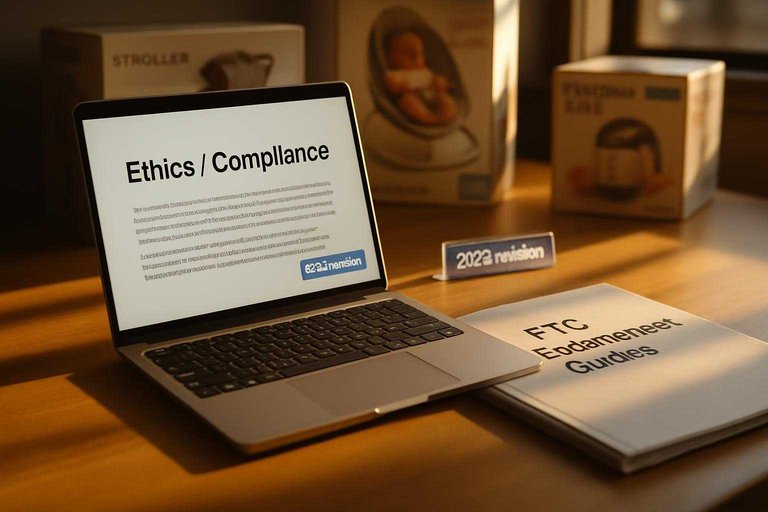
Disclosures aren’t optional “fine print.” The FTC Endorsement Guides (2023 revision)—FTC guidance describing when endorsements and testimonials can be deceptive and how disclosures must be made clearly and conspicuously—are built around a simple reader-first idea: if the financial tie could change how you interpret the recommendation, the disclosure needs to be hard to miss and easy to understand.
Clinician involvement raises the stakes, because a medical credential can amplify trust even when the underlying content is commerce. The American Medical Association’s Code of Medical Ethics on sale of health-related products treats “selling” health-related products broadly enough to include endorsing a product that results in remuneration for the physician, and it flags that as a conflict-of-interest concern. It also calls for full disclosure of the physician’s financial interest, and for offering only products whose benefit claims are grounded in peer-reviewed literature or other reliable scientific review.
That’s why some publishers avoid blending a clinical “reviewed” stamp with monetized product picks at all, framing clinician input as scoped guidance rather than an endorsement. As a reader, you don’t have to either dismiss the list or swallow it whole—you just have to read the money the same way you read the method.
Verify Before Buying
“Pediatrician reviewed baby gear” is only useful if you can independently verify the safety floor in a couple minutes. Here’s a fast routine you can run before you click Buy.
Five-minute checks
- Do a banned-item sanity check (sleep gear first). If the product is a crib bumper or an infant inclined sleeper, it’s a banned hazardous product under the Safe Sleep for Babies Act—don’t bargain with the label.
- Scan for active recalls. Search the product name + brand on the U.S. Consumer Product Safety Commission (CPSC) recall site. If you can’t tell whether a recall was fixed (refund/repair/replace), treat that as “not verified.”
- Search SaferProducts.gov for complaint patterns. SaferProducts.gov is a public CPSC database of consumer reports. You’re not “proving” a product is unsafe—you’re looking for repeat themes (breakage points, tip-overs, pinches) that a listicle won’t mention.
- Look for the actual rulebook citation for the category. A credible page (or the manufacturer’s materials) should be able to name the standard it’s claiming to meet. Example: strollers should point to 16 C.F.R. § 1227.2 compliance, which requires meeting ASTM F833-21. Full-size cribs are regulated under 16 C.F.R. part 1219.
- Expect a registration card on durable gear—and plan to use it. Registration cards are there so you can be contacted about recalls and safety notices. If the product photos, listing, and manual don’t even hint this exists, slow down and verify you’re buying from a real manufacturer listing—not a ghost listing with copied images.
Car-seat exception
Car seats deserve a different kind of “review.” In the U.S., the legal floor is FMVSS 213—Federal Motor Vehicle Safety Standard 213, the minimum safety standard that applies to child restraint systems—issued by the National Highway Traffic Safety Administration (NHTSA).
A pediatrician can help you think through fit and use, but installation and vehicle-specific setup is where you switch to a Child Passenger Safety Technician (CPST/CPS technician)—a nationally certified role that provides hands-on education and help with car-seat selection and installation at seat checks. The nationally standardized CPS certification course typically runs three to four days through National CPS Certification (Safe Kids Worldwide).
If your situation is medically specific (prematurity, oxygen, special positioning advice), ask your own pediatrician for individualized guidance—then bring that guidance to a CPST for the on-the-ground install.
Treat the label as a process
“Pediatrician reviewed” isn’t a safety green light unless the page shows you what the pediatrician actually reviewed, what standards and disqualifiers were applied, and how money flows through the recommendation. If you can’t find that paper trail—named reviewer, scoped role, real methodology, and clear disclosures—treat the stamp as marketing and do your own five-minute verification before you buy (bans, recalls, SaferProducts.gov patterns, and the category rule citation). And when the item is a car seat, treat “review” as secondary: get the fit/use advice you need, then switch to a CPST for the hands-on install that actually determines safety.
Frequently Asked Questions
- Does “pediatrician reviewed baby gear” count as an endorsement under FTC rules if the page uses affiliate links?
- It can function like an endorsement when a medical credential is used to boost trust while the publisher earns money from the recommendation. The FTC Endorsement Guides (2023 revision) require clear, conspicuous disclosure of any material connection that could affect how readers interpret the recommendation.
- Can a pediatrician ethically recommend specific baby gear if they get paid or earn commission?
- Yes—but the conflict has to be handled, not hidden: the AMA Code of Medical Ethics warns that endorsing products that results in remuneration for the physician is a conflict-of-interest concern and calls for full disclosure of the physician’s financial interest. It also says physicians should offer only products whose benefit claims are grounded in peer-reviewed literature or other reliable scientific review.
- Is the JPMA Certification Seal the same thing as “pediatrician reviewed baby gear”?
- No—JPMA Certification is a voluntary certification program for juvenile products, while “pediatrician reviewed” is an editorial label that may only describe a clinician’s role in reviewing content. Treat the seal as separate evidence you can check, not a substitute for a transparent review method.
- What’s one concrete spec I can verify myself on a crib listing when “pediatrician reviewed” feels vague?
- Check crib-and-mattress compatibility details, including that a full-size crib mattress must not be thicker than 6 inches. If a listing doesn’t clearly state the mattress thickness it supports, treat the “pediatrician reviewed baby gear” label as unverified and look for better documentation.
- If a pediatrician reviewed a car seat, do I still need a CPST for installation help?
- Yes—use a Child Passenger Safety Technician (CPST) for hands-on installation education and seat checks. The nationally standardized CPS certification course typically runs three to four days, which is why “pediatrician reviewed baby gear” isn’t a substitute for CPST support on car-seat setup.
Compare Gear Against Safety Standards
Once you’ve done your quick checks, the next challenge is keeping the same rigor across every category and stage without spending hours chasing sources.
childbloom organizes baby-gear guidance around pediatric safety standards, recall history, and real-family use notes so you can shortlist products with clearer documentation.
Sources
- How We Develop Our Product Reviews at The Bump | The Bump — referenced in Medical content review
- 16 CFR § 1227.2 – Requirements for carriages and strollers | Legal Information Institute — referenced in CPSC, 16 CFR, ASTM
- Sale of Health-Related Products (Opinion 9.6.4) | AMA Code of Medical Ethics — referenced in Money and Ethics
Written with Skribra