Every parent watches their toddler grow with a mixture of pride and curiosity. One day they are wobbling through their first steps, and before long they are climbing, jumping, and testing every surface they encounter. Among the many developmental tools available to families today, the balance board has earned a special place in homes, preschools, and pediatric therapy clinics alike. But the question many parents ask is simple: is my child actually ready for one, and how do I make sure those first experiences are safe and beneficial?
This guide walks you through everything you need to know about toddler balance boards, from what they are and why they matter developmentally, to the concrete signs that your child is ready, to the practical steps for introducing one without incident. Whether you are a first-time parent researching gross motor equipment or a seasoned caregiver looking to refine your approach, this article will give you the information you need to make confident, informed decisions.
What Is a Toddler Balance Board?
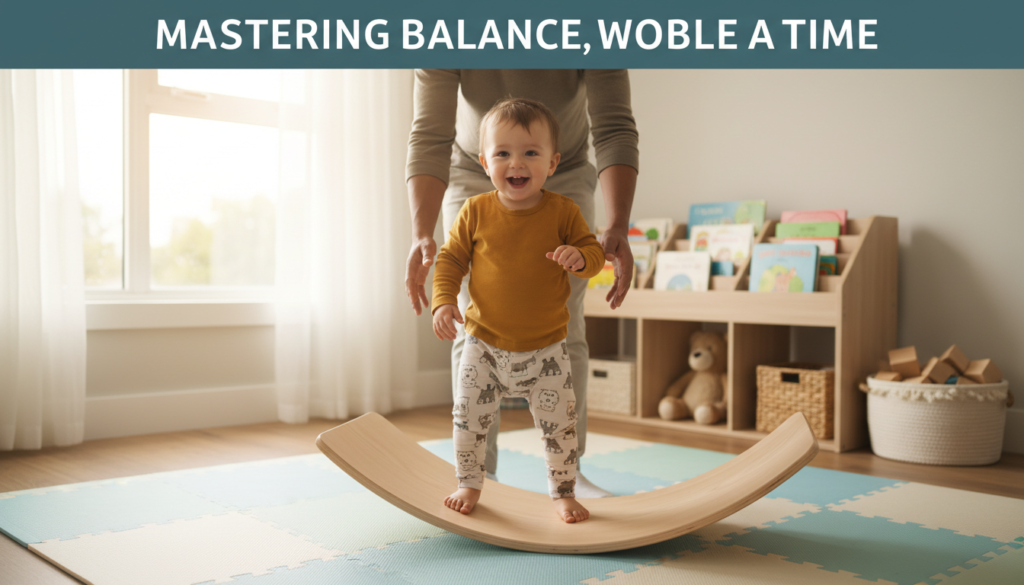
A balance board is a flat or slightly curved piece of equipment that rocks, tilts, or wobbles when a child stands, sits, or places weight on it. In the toddler world, the term most commonly refers to a rocker board — a curved piece of wood or molded plastic that allows side-to-side or front-to-back rocking motion. These are closely related to, and often used alongside, the Pikler triangle, a climbing frame developed by Hungarian pediatrician Emmi Pikler in the early twentieth century. Together, these tools form the backbone of many home-based gross motor play environments.
It is important to distinguish balance boards from other similar equipment. A wobble board typically has a flat base with an unstable fulcrum underneath, requiring the user to actively stabilize themselves. A balance beam is a narrow, elevated surface that challenges linear balance. A slack board mimics the feel of a balance board but with a softer, more forgiving surface. Each type has its own place in a child’s development, but for toddlers just beginning their balance journey, a simple rocker board with a gentle curve is almost always the best starting point.
The balance board is not a new invention. Versions of rocking boards have appeared in physical education and rehabilitation settings for decades. What has changed is the growing recognition among parents and educators that open-ended, child-directed physical play is essential for healthy development — and that a balance board is one of the simplest, most effective tools for delivering that kind of play in a home environment.
Developmental Benefits of Balance Board Use
The benefits of balance board use extend far beyond the obvious improvement in balance itself. When a toddler steps onto a balance board, multiple developmental systems are engaged simultaneously.
Vestibular System Development
The vestibular system, located in the inner ear, is the body’s primary balance and spatial orientation center. It tells the brain where the head is in space, how fast it is moving, and whether the body is upright or tilted. This system is still maturing throughout the toddler years, and activities that involve rocking, tilting, and shifting weight provide some of the richest stimulation it can receive. Regular, supervised use of a balance board gives the vestibular system repeated opportunities to calibrate, which supports not only physical balance but also visual tracking, attention regulation, and even the ability to sit still in a classroom years later.
Core Strength and Postural Control
Maintaining balance on an unstable surface requires constant micro-adjustments from the muscles of the abdomen, back, and pelvis. These are the same muscles that support good posture, coordinated movement, and endurance throughout the day. A toddler who regularly uses a balance board is quietly building the core strength that will later support writing at a desk, running on a playground, and participating in sports. The beauty of this work is that it happens through play, not exercise, which means the child is motivated and engaged rather than resistant.
Proprioception and Body Awareness
Proprioception is the sense of where your body parts are in space without looking at them. It is the reason you can touch your nose with your eyes closed. Toddlers are still developing this sense, and a balance board provides rich proprioceptive input because the child must constantly sense and respond to shifts in their center of gravity. Over time, this leads to better coordination, fewer collisions with furniture, and more confident movement in general.
Gross Motor Skill Development
Balance board use supports the development of virtually every major gross motor milestone of the toddler and preschool years. Standing on one foot, stepping over obstacles, squatting and rising, walking on uneven ground — all of these skills draw on the same neuromuscular pathways that a balance board exercises. Children who have regular access to balance-challenging activities often reach these milestones earlier and with more confidence than peers who spend most of their time on flat, predictable surfaces.
Confidence and Risk Assessment
Perhaps the most underrated benefit is psychological. When a toddler learns to balance on a board, they are learning to assess risk, test their limits, and recover from small failures — all in a controlled, low-stakes environment. A child who rocks too far and catches themselves is practicing the same kind of risk calculation they will use for the rest of their life. This builds a kind of physical confidence that transfers to every other area of development.
Age Recommendations and Readiness Signs
The question of when a child is ready for a balance board does not have a single numerical answer. Most manufacturers suggest ages two and up, but chronological age is a poor predictor of readiness compared to developmental markers. Here are the key signs to look for.
Physical Milestones
Your toddler should be able to walk independently and confidently on flat ground before attempting a balance board. They should be able to stand on one foot briefly, even if only for a second or two, and should be able to step up onto a low surface (such as a stair or a small step stool) without assistance. These milestones indicate that the foundational strength and coordination needed for balance board use are in place.
Balance Ability
Observe your child during everyday activities. Can they walk along a curb or a low wall without falling? Do they enjoy being swung, rocked, or spun without becoming distressed? These are strong indicators that their vestibular system is developed enough to benefit from balance board use. If your child still seems unsteady on uneven ground or becomes very dizzy with mild movement, it may be wise to wait a few more months.
Ability to Follow Simple Instructions
Safety on a balance board depends partly on the child’s ability to respond to verbal cues. If your toddler can understand and follow simple instructions like “hold on,” “step down,” or “wait your turn,” they are more likely to use the board safely. This does not mean they need to be perfectly obedient — just capable of processing and acting on basic directions in the moment.
Risk Awareness
Some toddlers have a natural caution that serves them well on new equipment. They test surfaces carefully, hold on when unsure, and do not immediately launch into risky behavior. Other toddlers are more impulsive and may need closer supervision and a more gradual introduction. Neither temperament is better, but the more cautious child may be ready sooner, while the impulsive child may benefit from waiting until they are slightly older and more receptive to safety guidance.
Interest and Motivation
Finally, readiness includes interest. If your toddler watches older children on a balance board with fascination, or if they enjoy rocking, swinging, or climbing, they are likely to approach the board with the kind of engaged motivation that makes the experience productive and enjoyable. Forcing a disinterested child onto a balance board is counterproductive and can create a negative association with physical challenge.
Types of Balance Boards for Toddlers
Understanding the options available will help you choose the right board for your child’s age, size, and developmental stage.
Rocker Boards
The most common type for toddlers, a rocker board features a curved base (usually a segment of a cylinder) that allows rocking side to side or front to back. They are typically made of wood with a non-slip surface on top. Rocker boards are excellent for beginners because the curve limits the range of motion and provides a natural stopping point. Many rocker boards can also be flipped over and used as a bridge, ramp, or quiet reading nook, which adds to their value.
Wobble Boards
Wobble boards have a flat platform mounted on a spherical or semi-spherical base, allowing movement in all directions. They require more active balance control than rocker boards and are generally better suited to children ages three and up who have some experience with balance challenges. Wobble boards are popular in physical therapy settings and can be very effective for targeted balance training.
Balance Beams
A balance beam is a narrow, elevated plank that the child walks along. These are typically low to the ground for toddlers (two to four inches high) and can be straight or curved. Balance beams challenge linear balance and coordination in a different way than rocker boards. They are excellent for children who have mastered basic rocking and are ready for a new challenge.
Slack Boards
Slack boards use a flexible surface suspended between two points, creating a dynamic, unstable platform. These are more advanced and are generally not recommended for children under three. They are most commonly found in physical therapy clinics and specialized gross motor play spaces.
Multi-Use Boards
Some products combine features of multiple board types. A rocker board that can be flipped to create a bridge or ramp is one example. Another is a modular system where boards can be connected, elevated, or reconfigured. These multi-use options offer excellent value and grow with the child, but they should be evaluated carefully to ensure that each configuration is safe for your child’s current ability level.
Choosing the Right Size and Material
Size Considerations
For toddlers, the board should be wide enough that their feet fit comfortably side by side with room to spare — typically at least twelve to fourteen inches wide. The length should be at least twenty-two to twenty-four inches to allow for a stable stance and some movement. The curve of a rocker board should be gentle, with a height of no more than three to four inches at the center. Boards that are too large or too steeply curved can be intimidating and unsafe for young children.
Material Matters
Wood is the traditional and most popular material for toddler balance boards. Hardwood boards (birch, beech, maple) are durable, have a pleasant weight, and provide good grip. They should be finished with non-toxic, water-based sealants. Some boards are made from molded plastic, which is lighter and easier to clean but may feel less substantial and provide less sensory feedback. Plywood boards can be affordable but should be checked for splinters and edge quality. Avoid boards with rough edges, exposed screws, or finishes that smell strongly of chemicals.
Weight Capacity
Check the manufacturer’s weight limit and ensure it accommodates your child with room to grow. Most toddler balance boards support between fifty and one hundred pounds, which is sufficient for children through the early elementary years. A board that is rated for higher weight is generally more durable and stable.
Surface Texture
The top surface should have some texture or a non-slip treatment to prevent feet from sliding. Some boards have a smooth finish that can become slippery when a child is wearing socks. If your board has a smooth surface, encourage barefoot use or invest in grippy socks designed for indoor play.
Safety Considerations
Safety is the foundation of every positive balance board experience. The following considerations should be addressed before your child ever steps on the board.
Non-Slip Surfaces and Feet
Both the top of the board and the floor beneath it need attention. The board’s surface should grip the child’s feet, and the bottom of the board (or the floor) should prevent the board from sliding out from under the child unexpectedly. Many parents place the board on a carpeted surface or a non-slip mat to add stability. If your floor is hardwood or tile, a rubber mat underneath is strongly recommended.
Weight Limits and Structural Integrity
Never exceed the manufacturer’s stated weight limit. Over time, check the board for cracks, splinters, loose hardware, or any sign of structural weakness. A board that has been heavily used or exposed to moisture may weaken and should be replaced if there is any doubt about its integrity.
Supervision Requirements
Children under three should always have an adult within arm’s reach when using a balance board. Children ages three to five should be supervised in the same room, with the adult actively watching (not just present). By age six, many children can use a balance board with periodic check-ins, but direct supervision is still recommended during initial use of any new board or new configuration.
Surrounding Environment
The area around the balance board should be clear of hard edges, sharp corners, and breakable objects. A soft surface such as a foam mat, carpet, or thick blanket should be placed around the board to cushion any falls. The board should be positioned away from walls, furniture, and other children to give the user adequate space.
Setting Up a Safe Environment for First Use
Preparing the environment is just as important as choosing the right board. Here is how to set the stage for a successful first experience.
Choose the right location. A carpeted living room or playroom is ideal. If the floor is hard, lay down interlocking foam mats or a thick area rug. The space should be at least six feet in every direction from the board.
Remove hazards. Clear the area of furniture with sharp corners, toys that could be tripped over, and anything breakable. Close doors to prevent the child from wandering into unsafe areas while focused on the board.
Position the board on a flat, stable surface. Ensure the board sits evenly and does not rock unexpectedly when unweighted. Test it yourself before inviting your child to try.
Have a soft landing zone. Place cushions, foam blocks, or a folded blanket on either side of the board. This is not about preventing falls entirely — falls are part of learning — but about ensuring that falls are gentle and non-frightening.
Keep the session short. For the first use, plan for five to ten minutes maximum. Young children fatigue quickly when engaging new muscle groups, and a short, positive experience is far more valuable than a long one that ends in frustration or tears.
Step-by-Step Introduction Guide
A thoughtful introduction sets the tone for your child’s entire relationship with the balance board. Follow these steps for the smoothest possible start.
Step 1: Familiarization
Before asking your child to stand on the board, let them explore it. Let them touch it, push it with their hands, sit on it, and watch it rock. If they are hesitant, place a favorite toy on the board and encourage them to retrieve it. The goal is to build comfort and curiosity.
Step 2: Seated or Kneeling Use
For the very first time bearing weight on the board, have your child sit on it while you hold it steady, then gradually allow it to rock as they gain confidence. Kneeling on the board is another low-stakes option that introduces the rocking sensation without the challenge of standing.
Step 3: Standing with Full Support
When your child is ready to stand, position yourself directly beside them. Offer both hands for them to hold, or stand close enough that you can catch them if they tip. Let them find their balance at their own pace. Do not rush this step.
Step 4: Standing with Minimal Support
As confidence grows, transition from holding both hands to holding one hand, then to hovering your hands nearby without touching. Your physical proximity is the safety net; your calm demeanor is the emotional one.
Step 5: Independent Use
Once your child can stand, rock gently, and step off independently, they are ready for supervised independent use. Continue to stay nearby and watch for fatigue, overconfidence, or unsafe behavior. Celebrate their progress without over-praising, which can create pressure. Let the intrinsic satisfaction of mastery be the reward.
Common Mistakes Parents Make
Even well-intentioned parents can stumble when introducing a balance board. Here are the most common missteps and how to avoid them.
Rushing the Process
The most frequent mistake is moving too quickly through the introduction steps. A child who is placed standing on a balance board before they are ready may fall, become frightened, and refuse to try again. Patience in the first week pays dividends for months to come.
Over-Supervising to the Point of Anxiety
Hovering, gasping, and repeatedly saying “be careful” can communicate to the child that the board is dangerous. Children take their emotional cues from adults. If you are calm and present, they will be too. If you are tense and alarmed, they will mirror that energy.
Comparing Children
Every child develops at their own pace. A neighbor’s two-year-old who is already rocking confidently on a balance board is not a benchmark for your child. Some children need weeks of gradual introduction; others take to it in a single session. Both outcomes are normal and healthy.
Using the Board as a Babysitter
A balance board is not a device to occupy a child while you attend to other tasks. Active supervision is essential, especially in the early weeks. If you need to step away, the board should be put away or stored in a location the child cannot access unsupervised.
Ignoring Fatigue Signals
A tired child is an accident-prone child. If your toddler’s balance starts to slip, their movements become clumsy, or they seem irritable, it is time to stop. Pushing through fatigue leads to falls and negative associations.
Choosing a Board That Is Too Advanced
A wobble board or balance beam may look appealing, but if your child has not mastered a basic rocker board, the added challenge can be discouraging and unsafe. Match the equipment to the child’s current ability, not their potential.
Activities and Games to Try
Once your child is comfortable standing and rocking on the board, you can introduce simple games and activities that build skills and keep the experience engaging.
Rock and Freeze
The child rocks back and forth, and when you call “freeze,” they must hold their balance in place. This builds core control and listening skills. Start with short intervals and gradually increase the hold time.
Reach and Grab
Place toys or objects just within arm’s reach on either side of the board. The child must shift their weight to reach for each item without stepping off. This challenges lateral balance and coordination.
Counting Rocks
Count each rock aloud together: “One, two, three…” This adds a cognitive element to the physical activity and helps the child develop a rhythm, which supports balance.
Color Calls
Place colored objects around the room. Call out a color, and the child must rock toward that side of the room or point in that direction while balancing. This integrates balance with visual scanning and decision-making.
Story Rocking
Rock gently while you read a short story or recite a poem. The rhythmic motion adds a soothing, multisensory element to the narrative experience.
Partner Balance
For children who are confident on the board, standing face-to-face with a parent or sibling and gently passing a ball back and forth while both balance adds a social and coordinative challenge.
When NOT to Use a Balance Board
Balance boards are beneficial for most children, but there are situations where use should be delayed or avoided entirely.
- Recent injury or illness. If your child has had a fall, ear infection (which affects the vestibular system), or surgery, wait until they have fully recovered and been cleared by a healthcare provider.
- Significant developmental delays. Children with gross motor delays, hypotonia, or certain neurological conditions may need a modified approach guided by a pediatric physical therapist. A standard balance board may not be appropriate without professional guidance.
- Extreme fear or distress. If your child becomes genuinely frightened — not just hesitant, but truly distressed — at the prospect of using the board, do not push. Put it away and try again in a few weeks. Forcing the issue can create a lasting aversion.
- Unsafe environment. If you cannot provide adequate supervision or a safe surrounding area, it is better to skip the session entirely.
- Fatigue or illness. A child who is overtired, hungry, or coming down with something should not be using equipment that requires full attention and coordination.
The Montessori Perspective on Balance Boards
The balance board fits naturally within the Montessori philosophy, which emphasizes child-directed activity, hands-on learning, and purposeful movement. In a Montessori environment, the balance board is considered a material for gross motor development that respects the child’s autonomy. The child chooses whether to use it, how long to use it, and how to challenge themselves within safe limits.
Maria Montessori identified sensitive periods for movement and coordination in early childhood, and balance board use aligns perfectly with these windows of heightened developmental readiness. The Montessori approach also emphasizes the prepared environment — which is why the safety setup described earlier is not just practical but philosophical. The environment must be ready for the child before the child is expected to engage with it.
In Montessori classrooms, balance boards are often available alongside Pikler triangles, climbing ramps, and low shelves with purposeful activities. The key principle is that the child is an active participant in their own development, not a passive recipient of adult instruction. The adult’s role is to prepare the environment, demonstrate safe use, and then step back to allow the child to explore.
Combining Balance Boards with Other Gross Motor Equipment
A balance board does not exist in isolation. It is most effective when used as part of a broader gross motor play environment. Here are some complementary pieces of equipment and how they work together.
- Pikler triangle: Develops climbing, gripping, and upper body strength. Used before or after the balance board, it provides a different type of physical challenge that builds complementary skills.
- Climbing ramp: Often attached to a Pikler triangle, a ramp adds a sliding and incline-walking element that challenges balance in a different way.
- Stepping stones: Foam or wooden stepping stones arranged in a path challenge dynamic balance and foot placement accuracy.
- Tunnel: Crawling through a tunnel develops spatial awareness and core strength, supporting the same systems that balance board use targets.
- Swing: A indoor sensory swing provides vestibular input in a different plane of motion, rounding out the child’s sensory diet.
The goal is not to fill a room with equipment but to provide a thoughtful, rotating selection of materials that challenge the child in varied ways. Too much equipment can be overwhelming; too little can limit development. Three to five pieces that can be combined in different configurations is an excellent range for a home environment.
Physical Therapy Applications
Balance boards are widely used in pediatric physical therapy for children with a range of conditions, from mild motor delays to more significant challenges related to cerebral palsy, Down syndrome, autism spectrum disorder, and vestibular dysfunction. In these contexts, the balance board is used as a therapeutic tool under the guidance of a licensed physical therapist.
Therapists may use balance boards to improve weight-shifting, postural responses, bilateral coordination, and sensory integration. The activities are carefully graded to match the child’s current ability and therapeutic goals, and progress is measured over time. If your child is receiving physical therapy, ask their therapist whether balance board activities would be appropriate for home use and what specific exercises to perform.
Even for typically developing children, a consultation with a pediatric physical therapist can be valuable if you have concerns about your child’s balance, coordination, or motor development. A therapist can assess your child’s readiness for a balance board, recommend the right type and size, and teach you how to support their use safely.
What to Expect in the First Few Weeks
Understanding the typical progression of balance board use can help you set realistic expectations and celebrate the small victories along the way.
Week One: Exploration and Hesitation
In the first week, expect your child to be curious but cautious. They may touch the board, sit on it, stand on it briefly with full support, and then lose interest. This is completely normal. The novelty of the equipment is new, and the child is gathering information about how it feels and what it does. Do not be concerned if progress seems slow.
Week Two: Growing Confidence
By the second week, most children begin to stand on the board with less support and for longer periods. They may experiment with rocking gently and may laugh or show delight when they discover the board’s movement. Some children will begin to use the board independently for short periods, while others still prefer to have a hand nearby.
Weeks Three and Four: Skill Building
By the third and fourth weeks, children who have had regular access to the board (even just ten to fifteen minutes a day) typically show noticeable improvement in their balance, confidence, and willingness to try new things on the board. They may begin to stand on one foot, reach for objects, or rock with more force and control. This is the stage where the developmental benefits become most visible.
Beyond the First Month: Continued Growth
After the first month, the balance board becomes a familiar tool, and the child will continue to find new ways to challenge themselves. They may use it as a bridge for toy cars, a stage for stuffed animal performances, or a platform for counting and singing. The open-ended nature of the board means it can grow with the child for years, continuing to provide physical and cognitive challenges well into the elementary years.
Practical Tips for Long-Term Success
To keep the balance board a positive and productive part of your child’s routine, consider these practical tips.
- Keep the board accessible. Store it in the child’s play area so they can choose to use it independently (with supervision). A board that is locked in a closet loses much of its developmental value.
- Rotate it out periodically. If your child seems bored, put the board away for a week or two and bring it back later. The novelty will be restored, and the child may approach it with fresh enthusiasm and new ideas.
- Model use. Children love to imitate adults. If you step on the board and demonstrate gentle rocking, your child is likely to want to try. This is especially effective for hesitant children.
- Avoid screens during board use. The balance board demands attention and physical engagement. Using it while watching television or using a tablet defeats the purpose and introduces a safety risk.
- Inspect regularly. Make it a habit to check the board for wear and tear every few weeks. Tighten any loose hardware, sand rough spots, and replace the board if it shows signs of structural compromise.
- Celebrate effort, not achievement. Praise the child for trying, for being brave, for getting back on after a fall. Avoid focusing only on milestones like “standing without help.” The process is where the development happens.
Conclusion
A balance board is one of the simplest, most effective, and most enjoyable tools available for supporting your toddler’s physical development. It engages the vestibular system, builds core strength, sharpens proprioception, and fosters the kind of physical confidence that carries over into every area of a child’s life. But like any developmental tool, its benefits depend on thoughtful introduction, appropriate equipment selection, and a safe, supportive environment.
The signs of readiness — independent walking, basic balance ability, the capacity to follow simple instructions, emerging risk awareness, and genuine interest — are more reliable guides than age alone. When those signs are present, a gradual, patient introduction that respects the child’s pace will lay the foundation for a positive, lasting relationship with the board.
Remember that the goal is not to produce a toddler who can perform impressive feats of balance. The goal is to provide rich, varied physical experiences that support the natural unfolding of your child’s development. A balance board is one wonderful way to do that — and when used wisely, it is an investment in your child’s strength, coordination, confidence, and joy of movement that will pay dividends for years to come.