
Medically reviewed by Dr. Sophia Martinez, MD — Pediatrician
Disclaimer: This content is for informational purposes only and does not substitute professional medical advice. Always consult your pediatrician for concerns about your baby’s health.
Newborn Startles Awake Constantly and Will Not Sleep — What to Fix
You carefully swaddle your newborn, dim the lights, and start the white noise machine. Fifteen minutes later, just as you’re tiptoeing out of the room — BANG — both arms fly up, and your baby is wide awake and crying. Again. For the fifth time tonight.
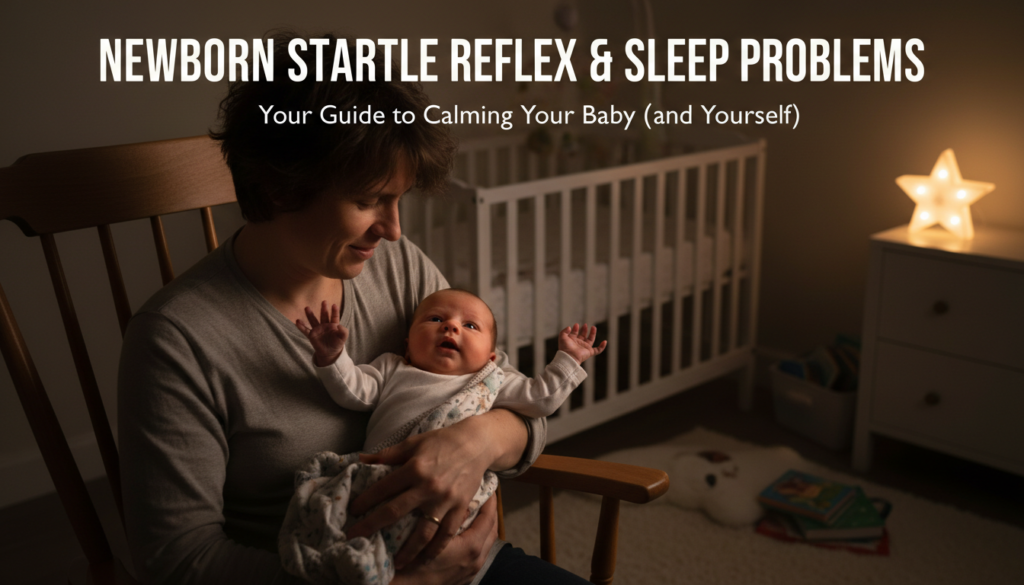
The Moro reflex (also called the startle reflex) is a normal newborn reflex present at birth. When a baby feels a sensation of falling or hears a loud noise, their arms fling outward, they arch their back, and then they pull their arms back in — often waking themselves up in the process. This reflex is strongest in the first 2 months and typically resolves by 4–6 months.
But when your baby startles awake constantly and will not sleep, it can feel like a crisis. In this guide, I’ll walk you through why this happens, how to manage it, and exactly what products (swaddles, sleep sacks, white noise machines) can help extend your baby’s sleep cycles.
What Is the Moro Reflex and Why Does It Wake Babies?
The Moro reflex is an involuntary response present at birth that typically disappears by 4–6 months of age. It works like this:
- Trigger: sudden movement, loud noise, sensation of falling, or a change in head position
- Response: arms fling outward (abduction), back arches, head tilts back
- Recovery: arms pull back in (adduction), often followed by crying
This reflex is most problematic during sleep transitions — those moments when your baby drifts from light sleep to deep sleep. As their body relaxes into a deeper stage, their muscles twitch and relax, which can trigger the reflex and cause a full startle-wake-cry cycle.
The Moro Reflex Timeline: Birth to 6 Months
| Age | Moro Reflex Status | What to Expect |
|---|---|---|
| Birth–2 weeks | Strongest, most easily triggered | Startles at every sound, movement, or position change |
| 2–6 weeks | Still strong but baby begins to self-soothe | Swaddling is most effective; baby may startle 5–10 times per sleep cycle |
| 6–12 weeks | Moderate intensity, beginning to fade | Time to start arms-out transition; fewer full wake-ups from startle |
| 3–4 months | Weakening significantly | Most babies can sleep with one or both arms free |
| 4–6 months | Gone or nearly gone | Reflex should be fully integrated; if persists, mention to pediatrician |
Why Some Babies Startle More Than Others
Not all babies experience the Moro reflex with the same intensity. Factors that can make it worse include:
- Prematurity: Premature babies often have a more pronounced Moro reflex that persists longer
- Birth trauma: Difficult deliveries can temporarily exaggerate the reflex
- Overstimulation: A baby who is overtired or overstimulated before sleep may have a more sensitive startle response
- Sleep environment: Noisy rooms, sudden temperature changes, or bright lights can trigger the reflex more frequently
- Reflux or gas pain: Discomfort can make babies more sensitive to external triggers
The Complete Swaddle Strategy: Step by Step
Swaddling is the single most effective intervention for the Moro reflex. Here’s the complete protocol:
Step 1: Choose the Right Swaddle
Not all swaddles are created equal. There are three main types:
| Type | Best For | Pros | Cons |
|---|---|---|---|
| Muslin blanket swaddle | Newborns 0–4 weeks | Adjustable tightness, breathable fabric, inexpensive | Learning curve, can come loose, requires re-swaddling |
| Velcro/fastener swaddle | Parents who want ease of use | Quick to apply, stays tight, consistent pressure | Less customizable, some brands run small |
| Sleep sack with swaddle wings | Transition period (6–12 weeks) | Easy swaddle-to-sleep-sack transition, zipper access for diaper changes | More expensive, less snug than blanket swaddle |
Product recommendations: The Love to Dream Swaddle Up allows arms-up positioning (which some babies prefer), while the Halo SleepSack Swaddle offers easy diaper access and a gradual arms-out transition.
Step 2: Master the Technique
The “diamond technique” for blanket swaddling:
- Spread the blanket flat in a diamond shape
- Fold the top corner down about 6 inches
- Place baby face-up with shoulders at the fold line
- Bring one arm down against the body, fold the blanket snugly across chest and tuck under baby’s back
- Tuck the bottom corner up over baby’s feet
- Bring the remaining side across, leaving room for hip flexion
Critical safety note: Swaddled babies must always be placed on their backs to sleep. Stop swaddling as soon as baby shows signs of rolling (typically 8–12 weeks for most, but some roll as early as 6 weeks).
Step 3: Add White Noise
White noise works synergistically with swaddling by masking the sudden sounds that trigger the Moro reflex. The key is to use consistent, loud-enough white noise throughout the entire sleep period.
White noise tips: Set volume to 50–65 dB (about as loud as a shower running). Place the machine 3–6 feet from the crib. Use continuous loop rather than timed shut-off to avoid startling baby when the noise stops. The Marpac Dohm-DS and LectroFan are pediatrician-recommended options.
Step 4: The Arms-Out Transition Schedule
Around 8–12 weeks, you’ll need to start transitioning out of the swaddle. This is often a challenging period because the Moro reflex hasn’t fully disappeared. Use this week-by-week schedule:
| Week | Swaddle Configuration | What to Expect |
|---|---|---|
| Week 1 | Both arms swaddled (usual) | Baseline sleep |
| Week 2 | One arm out (usually dominant arm) | Slightly more waking; baby may startle but self-soothe more quickly |
| Week 3 | Both arms out, chest still wrapped | More night waking; use white noise consistently |
| Week 4+ | Sleep sack (no swaddle) | Full transition; Moro reflex should be fading by now |
What If Swaddling Doesn’t Work?
Some babies resist swaddling from day one. If your baby consistently breaks out of swaddles or cries when swaddled, try these alternatives:
- Swaddle with arms up: Some babies prefer arms-up positioning (Love to Dream Swaddle Up or similar)
- Weighted sleep sack: The gentle pressure can provide calming sensory input (use only within safe weight limits for your baby)
- Side-lying position: Only for supervised awake time — never for sleep — but side-lying can calm a startle-prone baby during feedings
- Gentle containment: Rolled receiving blankets placed alongside baby (under the fitted sheet, never loose in crib) can provide boundary pressure
When the Startle Reflex Is Not the Problem
While the Moro reflex is the most common cause of constant startling in newborns, it’s not the only possibility. Consider these alternatives if swaddling and white noise don’t help:
- Overtiredness: An overtired baby has a more sensitive startle response. Watch wake windows: newborn 45–60 min, 1-month-old 60–75 min, 2-month-old 75–90 min.
- Reflux pain: Babies with GERD may startle and cry from pain when laid flat, mimicking the Moro reflex pattern
- Colic or gas: Abdominal discomfort can make babies hypersensitive to any trigger
- Neurological concerns: If the startle reflex is asymmetric (only one arm flings out), absent, or persists beyond 6 months, mention it to your pediatrician
Frequently Asked Questions
Q: Can I prevent the Moro reflex entirely?
A: No, it’s a normal neurological reflex. But swaddling and white noise can minimize its impact on sleep.
Q: My 3-month-old still startles constantly — is this normal?
A: The reflex should be fading by 3 months. If it’s still strong, mention it to your pediatrician. Some babies retain it slightly longer, especially if born prematurely.
Q: Is it safe to swaddle a baby who is trying to roll?
A: No. Stop swaddling as soon as your baby shows any signs of rolling. Use a sleep sack instead.
Q: Should I use a weighted swaddle?
A: Only if recommended by your pediatrician. Weighted sleep products have come under AAP scrutiny for potential safety concerns.
Q: My baby startles more when I lay her down — what can I do?
A: Try the “gradual release” technique: lay baby down bottom-first, then shoulders, then head. Keep a hand on baby’s chest for 30 seconds before slowly removing it.
Related Articles
- Pediatrician’s Complete Guide to Baby Sleep
- Baby Crying in Sleep But Not Awake
- Suddenly Crying at Night (3 Months)
- Best Baby Swaddles (Pediatrician Recommended)
📖 More from the Pediatrician’s Corner Hub: your complete pediatrician-reviewed guide to your baby’s first year — milestones, feeding, sleep, vaccines, common illnesses, and more