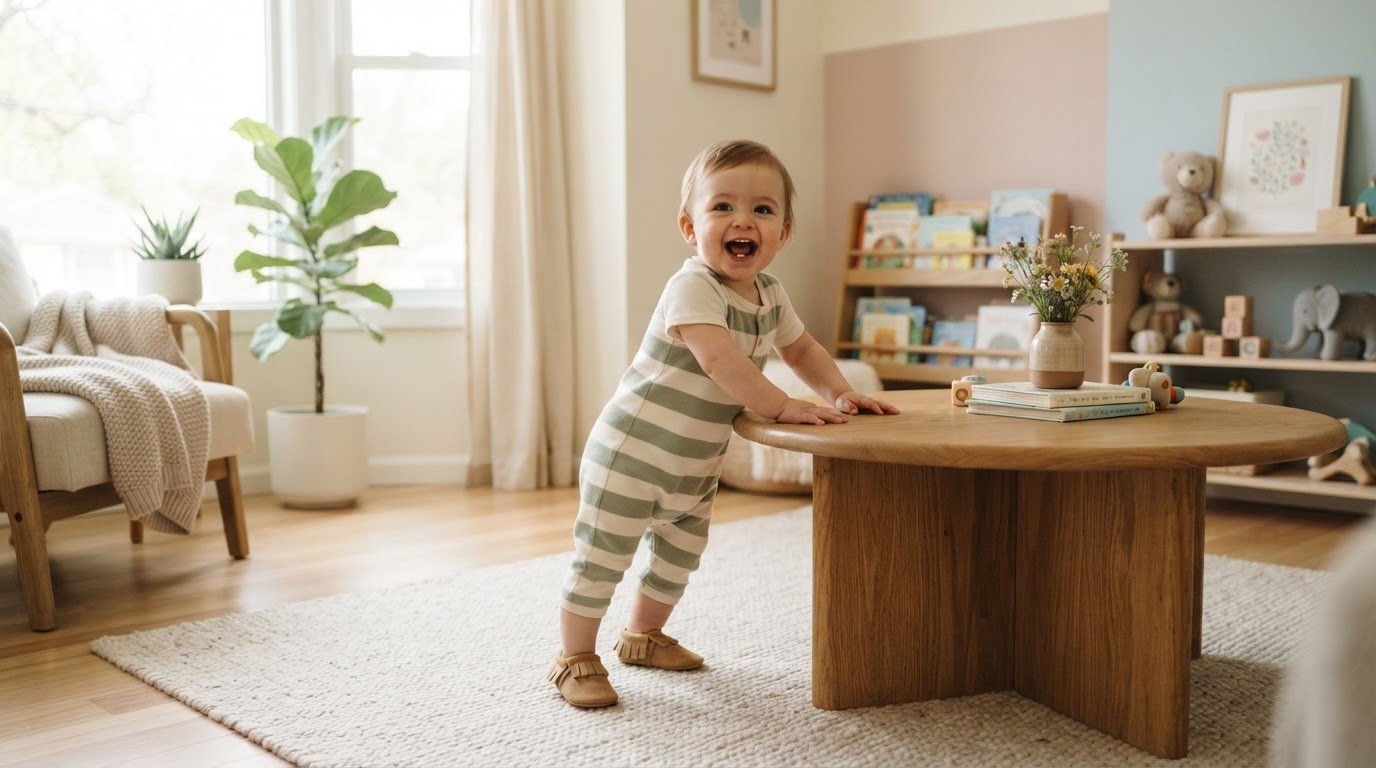
Signs a Baby May Be Ready to Pull to Stand
Signs a Baby May Be Ready to Pull to Stand
Pulling to stand is an exciting transition: a baby uses the arms, trunk, hips, and legs together to move from the floor into an upright position. It often appears after a period of sitting, reaching, crawling, scooting, or cruising, but babies do not all follow the same sequence. Some pull up early, some take longer to feel confident, and some move directly from floor mobility to standing with support.
Parents often ask how to tell whether a baby is ready. The clearest signs are not a particular birthday or a single trick. Readiness looks like stable sitting, purposeful movement toward furniture, the ability to bear weight through the legs with support, controlled reaching, and an interest in changing position. A baby may pull up before crawling, after crawling, or without ever using a classic hands-and-knees crawl.
The Centers for Disease Control and Prevention (CDC) lists pulling up to stand and walking while holding furniture among movement milestones around 1 year.1 Milestones describe what most children can do by a certain age, not a requirement that every child perform a skill on the same day. The World Health Organization likewise presents broad windows for motor development.2
Key Takeaways
– A baby may be ready to pull to stand when they sit steadily, reach without losing balance, move toward a stable surface, and bear weight through the legs with support.
– Let the baby initiate the pull. Use heavy, stable furniture at the correct height and supervise closely.
– Never use a wheeled walker to teach standing. Secure furniture, remove hazards, and keep hot objects and cords out of reach.
– Discuss concerns if the baby cannot sit, never bears weight, consistently uses one side, seems very stiff or floppy, has pain, or loses skills.
What are the signs a baby is ready to pull to stand?
Readiness usually develops gradually. You may notice a cluster of behaviors rather than one dramatic moment. The baby may crawl or scoot to a sofa, kneel beside it, place both hands on the edge, rock backward and forward, and look over the top. They may pull against your fingers, rise from the knees, or repeatedly attempt to lift the bottom while holding a stable surface.
The following signs suggest that the baby is building the ingredients for supported standing:
| Readiness sign | What you may see | What it tells you |
|---|
|—|—|—|
| Stable sitting | Sits without support and reaches in several directions | Trunk control is improving |
| Floor mobility | Rolls, pivots, crawls, or scoots toward a target | The baby can explore and choose a destination |
| Kneeling | Rests at a low surface with hips over knees | Practices weight-bearing before standing |
| Supported weight-bearing | Takes some weight through both feet when held | Legs and trunk are preparing for upright posture |
| Purposeful pulling | Uses the arms to bring the body toward furniture | Motor planning is emerging |
| Controlled lowering | Bends the knees or returns to the floor with help | Learning to manage the way down |
| Interest in height | Reaches for objects on a low table or sofa | Motivation supports practice |
Not every sign needs to appear before the first attempt. Babies learn by trying, and a brief pull to kneeling may be the beginning of the sequence. Avoid turning readiness into a test. If a baby is not interested, provide opportunities without repeatedly placing them at furniture.
At what age do babies pull to stand?
Many babies pull to stand during the second half of the first year or around the first birthday, but the range is broad. The CDC includes pulling up to stand on its 1-year milestone list.1 That checklist is based on skills most children can do by the age and should be used alongside clinical judgment. It is not a deadline for an individual baby.
Some babies pull up at 8 or 9 months; others begin later. A baby born prematurely may be considered using corrected age, especially in the first two years. Ask the pediatrician how the child’s birth history affects interpretation.
The timing of pulling to stand is also influenced by what the baby does before it. A cautious baby may spend more time sitting and reaching. A highly mobile baby may reach furniture sooner. Babies with different body proportions, muscle tone, temperament, or opportunities for free play may use different strategies. The timing alone cannot diagnose a delay.
What matters is whether the baby has the foundational skills and is making progress. If the baby is not yet pulling up but is rolling, sitting, reaching, changing positions, and using both sides, the clinician may recommend observation. If the baby is not pulling up and also cannot sit, bears no weight, is markedly asymmetrical, or has lost skills, assessment is more important.
How do I help a baby practice pulling up safely?
Create a clear floor area with one or two stable surfaces. A heavy sofa, securely anchored low table, or sturdy activity bar may work. The surface should not slide, tip, fold, or have sharp edges. Put a favorite toy on the surface at a height that invites reaching without requiring the baby to stretch dangerously.
Stay within arm’s reach. Babies who pull to stand often lose balance suddenly, especially when they become excited or try to turn. Place a soft, thin play mat on a firm floor rather than thick pillows that can make footing unstable. Keep stairs gated, cover sharp corners, secure televisions and dressers to the wall, and remove tablecloths that a baby could pull down.
Let the baby start the movement. You can offer your hands for balance, but do not hoist the child from sitting to standing by the arms. Pulling a baby up by the hands can place stress on the shoulders and does not teach the child how to organize the movement. If the baby reaches for your fingers, keep your hands low and stable and allow the child to decide how much weight to place through the legs.
Practice transitions in both directions. Parents naturally celebrate standing, but controlled lowering is equally important. When the baby is standing at a surface, place a toy at knee or floor level so they can bend, squat, kneel, or sit. Use words such as “down slowly” and provide support at the trunk if needed. Do not push the knees or force a squat.
Bare feet are often useful indoors because they allow the baby to feel the floor. If footwear is needed outdoors, choose a properly fitted, flexible shoe appropriate for the environment. Avoid stiff shoes or slippery socks during indoor standing practice.
What equipment is safe for standing practice?
Simple, stable environments are usually best. A heavy sofa, anchored furniture, or a well-designed stationary activity center can provide a handhold when used under supervision. Read product instructions, check for recalls, and inspect hardware regularly. No equipment can replace an attentive adult and a childproofed room.
Avoid wheeled infant walkers. They can move quickly, allow access to stairs and hot surfaces, and are associated with injury risk. The AAP recommends preventing walker-related injuries and does not consider wheeled walkers necessary for development.3 A push toy may be appropriate for an older child who can already stand and step with support, but it should be heavy enough not to roll away easily and used only with close supervision.
| Item | Practical guidance |
|---|
|—|—|
| Heavy sofa | Anchor nearby furniture and remove reachable cords or objects |
| Low table | Use only if stable, heavy, and free of sharp edges |
| Stationary center | Use briefly and exactly as directed; do not use as a substitute for floor time |
| Wheeled walker | Avoid because of injury risk and lack of developmental necessity |
| Push toy | Consider only after the child can stand and cruise; supervise closely |
| Baby gates | Use at stairs and other restricted areas; check installation often |
Do not place a baby in a standing device for long periods to “strengthen” the legs. Free movement gives the baby opportunities to choose posture, shift weight, and learn how to get down.
What if my baby pulls to stand but cannot get back down?
That is common. Standing can be easier to initiate than to end. A baby may cry because they are stuck at the sofa, with knees locked and no plan for lowering. Stay calm, move close, and offer support at the trunk. You can demonstrate bending your own knees and slowly help the baby return to kneeling or sitting, without pulling the arms.
Place toys lower on the furniture so the baby has a reason to bend. Practice from kneeling: let the baby hold the surface, shift the hips back, and come down with support. Keep sessions brief. As balance and confidence improve, the baby usually learns to lower more independently.
If the child repeatedly locks the knees, stands on tiptoes, appears painful, or cannot bear weight evenly, mention it to the pediatrician. Occasional toe-standing during excitement can occur, but persistent patterns deserve observation.
Is standing on tiptoes normal?
Brief toe-standing can be part of experimentation. Babies may rise onto the toes when excited, reaching, or trying to extend higher. Look at whether the heels can come down, whether both feet are used, and whether the pattern appears only occasionally or nearly all the time.
Discuss persistent toe-standing, rigid legs, crossing of the legs, inability to place the heels down, or clear asymmetry with the pediatrician. These signs do not identify a specific diagnosis, but they can help determine whether an examination or physical therapy assessment is appropriate.
Do not force the heels down or use braces without professional advice. A clinician should assess the child’s movement and recommend treatment only when indicated.
What are red flags around pulling to stand?
Call the pediatrician if your baby cannot sit without support, never attempts to move or reach, does not bear weight through the legs when supported, consistently uses one side, keeps one hand fisted, appears unusually stiff or floppy, or has pain with movement. Report regression—loss of a skill the baby previously used—promptly.
The CDC advises parents to speak with a child’s doctor if the child is not meeting one or more milestones, has lost skills, or raises any concern.1 The AAP recommends developmental surveillance at visits and screening at specified ages, with additional evaluation when concerns exist.4
Urgent care is appropriate for sudden weakness, a newly limp limb, significant injury, severe pain, a seizure, breathing difficulty, or acute illness. A stable delay in pulling to stand is generally a routine developmental question, but the child’s doctor can advise how quickly to be seen.
Does pulling to stand mean walking is close?
It often means the baby is moving toward more upright mobility, but it does not provide a precise timetable. After pulling up, a child may kneel, stand briefly, cruise sideways, lower down, crawl again, or pause for weeks. Some babies focus on standing and cruising before taking independent steps; others stand for a while before they feel ready to move.
Walking age has a broad normal range. The average is not a deadline, and the sequence is not identical for every child.5 Look for increasing control, symmetrical weight-bearing, changing positions, and gradual progress. Do not compare a baby who pulls up at 9 months with a sibling who walks at 10 months; they may be developing perfectly through different pathways.
How can I tell if my baby is standing symmetrically?
Watch whether both feet contact the floor, whether the knees and hips are aligned comfortably, and whether the baby shifts weight from side to side. When cruising, notice whether the child can move in both directions or always leads with the same foot. A brief preference is common. A consistent refusal to load one leg, dragging, leaning, or standing on one toe should be discussed.
Place toys on both sides of the furniture and observe without forcing a turn. Record a natural clip if needed. The goal is not to grade the baby but to give the pediatrician useful information.
Frequently asked questions
Should I pull my baby to standing to help them learn?
No. Let the baby initiate the movement. Offer stable furniture or your low, steady hands for support, but do not lift the child by the arms or repeatedly place them upright.
Is it okay if my baby skips crawling and pulls to stand?
Yes, some babies do not use a classic crawl. If the baby sits, transitions, reaches, uses both sides, and progresses, skipping crawling may be normal. Mention any concern at a routine visit.
Is a jumper helpful for standing?
A jumper is not required for standing development and limits the child’s ability to practice transitions on the floor. Use any device only according to safety instructions and for limited periods, not as a replacement for free movement.
What if the furniture moves when my baby pulls up?
Remove it from the practice area or anchor it securely. A lightweight table can tip toward the child. Stability is more important than appearance.
How long should standing practice last?
There is no required duration. Offer several short, playful opportunities and follow the baby’s cues. Stop when the child is tired, frustrated, hungry, or losing control.
Should my baby wear shoes indoors?
Bare feet are often practical indoors on a safe floor because they allow sensory feedback and reduce slipping. Shoes may be needed outdoors or for protection; choose a flexible, properly fitted pair.
Conclusion
A baby may be ready to pull to stand when they sit steadily, reach and rotate, move toward furniture, kneel, bear weight through both legs, and show interest in getting higher. Readiness does not require crawling first, and the exact age varies.
Support the skill with supervised floor play, stable anchored furniture, safe barefoot practice indoors, and opportunities to lower back down. Avoid lifting the baby by the arms, forcing a posture, using wheeled walkers, or leaving the child near stairs, cords, hot objects, or unstable furniture.
Ask the pediatrician if your baby cannot sit, never bears weight, consistently favors one side, appears stiff or floppy, has pain, loses skills, or shows no meaningful progress. The goal is not to accelerate a deadline; it is to make movement safe and to identify support needs early when they exist.
References
CDC: Milestones by 1 Year — https://www.cdc.gov/act-early/milestones/1-year.html
World Health Organization: Motor Development Milestones — https://www.who.int/tools/child-growth-standards/standards/motor-development-milestones
AAP: Prevention of Walker-Related Injuries in Infants — https://publications.aap.org/pediatrics/article/142/4/e20181491/37381/Prevention-of-Walker-Related-Injuries-in-Infants
AAP: Developmental Surveillance and Screening — https://www.aap.org/en/patient-care/developmental-surveillance-and-screening-patient-care/
Adolph and Hoch: The Development of Motor Behavior — https://pmc.ncbi.nlm.nih.gov/articles/PMC5182199/
Medical note: This article is educational and does not replace an examination or individualized medical advice. Seek urgent care for sudden weakness, severe pain, seizure, breathing difficulty, or significant injury.
<!– [IMAGE: Licensed image of safe supported standing with a caregiver nearby.] –>
<!– [CHART: Readiness ladder from sitting and reaching to kneeling, pulling up, cruising, and independent steps; label as a typical sequence, not a deadline.] –>
<!– [VIDEO: Pediatric hospital demonstration of childproofing furniture and supervising pull-to-stand practice.] –>
*Medically reviewed by Dr. Ahmed Raza, MD, FAAP (Pediatric Emergency Medicine, ChildBloom Medical Review Board) on 2026-08-30.*
About the author: Dr. Sophia Martinez, MD, PhD is a developmental pediatrician specializing in developmental milestones, sensory processing, and neurodevelopmental screening. She reviews ChildBloom’s movement and milestone content against AAP, CDC, and WHO guidance. Meet the panel →