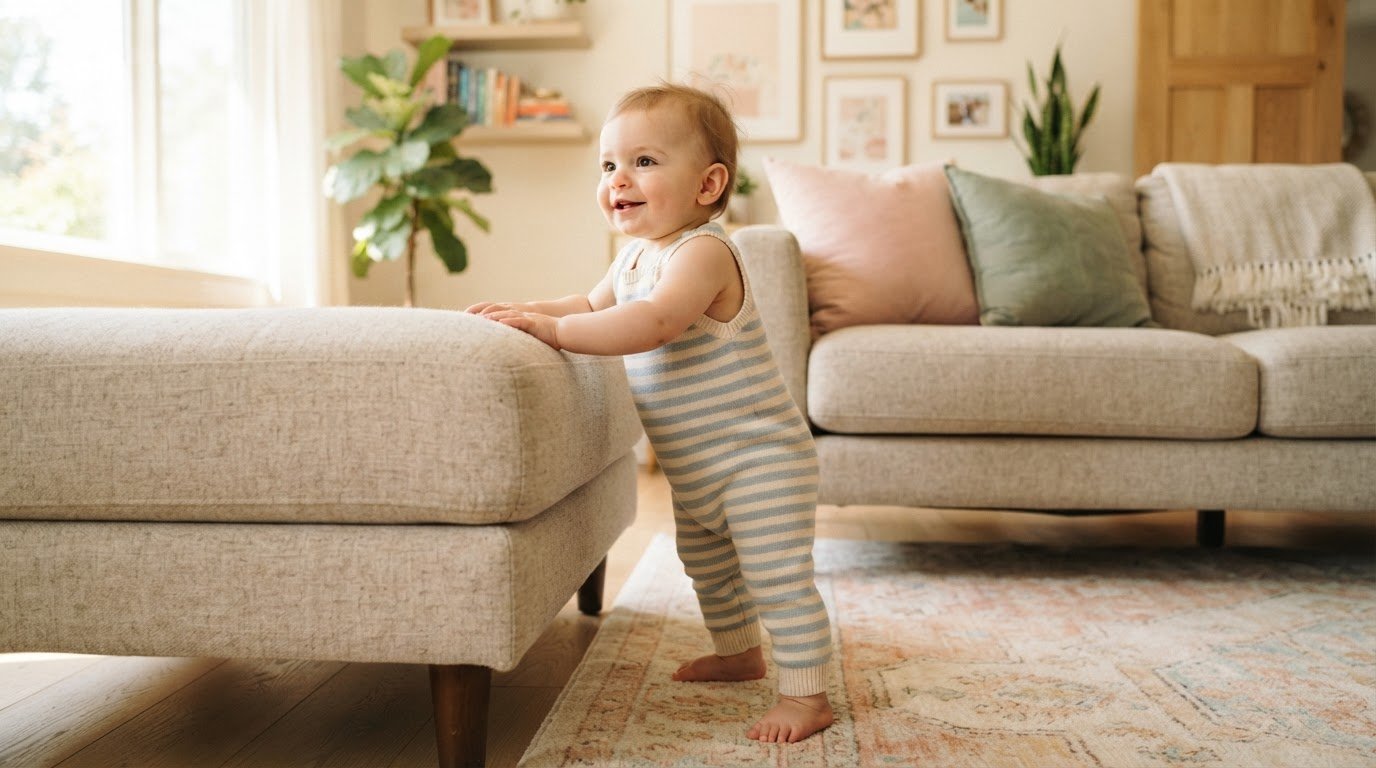
Baby Stands but Does Not Walk: Normal Range and Red Flags
Baby Stands but Does Not Walk: Normal Range and Red Flags
A baby who stands but does not walk is often practicing an important part of the process, not failing to reach a deadline. Standing, lowering, shifting weight, cruising, and taking independent steps require different combinations of balance, strength, confidence, coordination, and motor planning. A child may stand at furniture for weeks or months before deciding to let go.
Walking also has a broad normal range. The Centers for Disease Control and Prevention (CDC) lists pulling up to stand and walking while holding furniture among movement milestones at 1 year, and it lists taking a few steps independently by 15 months.1 These milestones describe what most children can do by those ages; they are not promises that every child will walk on the same schedule. The American Academy of Pediatrics (AAP) recommends developmental surveillance at health visits and additional screening or evaluation when concerns arise.2
The right response depends on the child’s age and the full pattern. A 12-month-old who stands at the sofa, cruises, squats, and uses both sides may simply need time. A 16- to 18-month-old who is not walking independently, does not bear weight, has marked asymmetry, seems painful, or has lost skills should be discussed with a pediatrician. A sudden change, weakness, serious injury, or acute illness requires prompt medical care.
Key Takeaways
– Standing without walking can be normal, particularly when a child cruises, lowers down, shifts weight, and continues gaining motor skills.
– Walking has a broad range; the 1-year and 15-month CDC milestones are reference points, not a reason to compare children or force steps.
– Red flags include regression, pain, inability to bear weight, persistent asymmetry, unusual stiffness or floppiness, or no meaningful motor progress.
– Offer safe barefoot floor practice, stable furniture, and playful opportunities to move. Avoid wheeled walkers and pulling a child by the hands.
Is it normal for a baby to stand but not walk?
Often, yes. Standing is not the same as walking, and children may master the skills in a different order. A baby may pull to stand, remain upright while holding furniture, and cruise sideways before taking a single step without support. Another child may stand briefly, sit down, and repeat this pattern for a long time. Caution, temperament, body proportions, previous mobility, and practice opportunities all influence the pace.
Independent walking is a complex task. The child must control the trunk, shift weight onto one leg, move the other foot, recover balance, and repeat the sequence. Holding furniture reduces the balance demand, so cruising may appear long before independent steps. Standing still may also be easier than walking because the child can keep both hands on a stable surface.
Research on motor development documents substantial individual variation in the timing and sequence of walking.3 The average age of first steps is not a cutoff. Some healthy children walk earlier and others later. A child’s skill quality and trajectory are more informative than comparison with a cousin, sibling, or social-media video.
What does the child do while standing?
Look for the smaller skills inside “not walking.” Does your child pull up using both sides? Stand with both feet supported? Shift weight from one leg to the other? Cruise along furniture? Turn from one piece of furniture to another? Squat to retrieve a toy? Lower from standing to the floor? Push a stable object? Take a step when holding one hand?
These behaviors suggest that the child is building toward independent walking. They do not guarantee a date, but they show active progress. A child who stands only when placed upright and cannot get into or out of the position has a different pattern from a child who independently pulls up, cruises, and squats.
| Skill to observe | More reassuring pattern | Pattern to discuss |
|---|
|—|—|—|
| Pulling up | Initiates the movement and uses both legs | Needs to be placed upright or cannot bear weight |
| Standing | Uses both feet and adjusts balance | Always stands on toes or one leg |
| Cruising | Moves in either direction along furniture | Refuses to load one side or drags a leg |
| Lowering | Bends knees or returns to kneeling/sitting | Locks rigidly or appears painful |
| Transitions | Moves between floor and standing | Cannot change position independently |
| Progress | Adds new abilities over time | No change, or skills are lost |
What age is considered late for walking?
There is no single universal age that defines “late walking” in every child, because clinicians consider corrected age, medical history, and the entire developmental examination. However, independent walking that has not emerged by around 18 months is commonly treated as a reason for professional evaluation rather than continued watchful waiting alone. The CDC’s 18-month milestone list includes walking without holding on.4
Earlier discussion is appropriate when other signs exist. Parents do not need to wait until 18 months if a child is not progressing, cannot stand with support, does not cruise, shows persistent asymmetry, or has lost skills. The AAP recommends responding to concerns with surveillance, screening, and referral when indicated.2
For children born prematurely, corrected age may be used during early development. A child born several weeks early may reach milestones according to corrected rather than chronological age, particularly in the first two years. Ask the pediatrician how this applies to your child.
Late walking can occur in an otherwise healthy child, sometimes as a familial pattern or a cautious temperament. It can also be associated with a wide range of medical or developmental factors. Only an examination can distinguish normal variation from a condition requiring treatment.
What are red flags when a child stands but does not walk?
Call the pediatrician if the child is not making progress toward mobility, cannot bear weight through the legs, does not pull up or cruise, repeatedly collapses through one side, uses one leg much less, stands only on tiptoes, appears unusually stiff or floppy, or seems to have pain. Also discuss concerns about balance, vision, hearing, communication, feeding, or loss of skills.
Regression is especially important. If a child who previously cruised, stood, or walked stops doing so, contact the clinician promptly. Do not assume that a temporary illness explains a lasting loss without asking.
Urgent medical care is appropriate for sudden weakness, a newly limp limb, significant injury, severe pain, a seizure, breathing difficulty, or an acutely ill child. These are not routine late-walking questions.
A child who stands but does not walk may still be progressing normally if they independently pull up, cruise, squat, lower down, use both sides, and gain skills. The same absence of walking is more concerning when the child has no effective way to move or has several additional red flags.
Why might a child stand before walking?
Confidence is a common factor. Standing while holding furniture offers stability, whereas letting go creates uncertainty. Some children need more time to understand how to shift weight, stop, or recover. A cautious child may wait until the skill feels reliable before taking a risk.
Strength and coordination also matter. A child may have enough strength to pull up but not yet enough balance to take steps. Cruising provides practice in lateral weight shifting, and squatting develops the ability to lower and rise. If these skills are emerging, the child may simply be in an intermediate phase.
Footwear and surfaces can influence experience. Bare feet on a safe indoor floor may provide useful sensory feedback. Slippery socks, thick rigid shoes, or uneven surfaces can make practice more difficult. This does not cause a developmental disorder, but it can change how comfortable a child feels.
Medical explanations include differences in muscle tone, strength, joints, vision, balance, or broader development. Hip problems, pain, neuromuscular conditions, and neurological conditions can affect walking. These possibilities should not be inferred from late walking alone. A pediatrician will consider history, examination, and other developmental domains.
How can I encourage independent walking?
Create safe opportunities rather than training a child through repeated drills. Arrange heavy, stable furniture close enough that the child can cruise from one support to another. Place a favorite toy at the end of a short, clear path. Sit nearby at the child’s level and invite a step, but do not pressure or coax after the child loses interest.
Practice transitions. Place a toy on the floor while the child stands at a sofa so they can bend their knees and lower down. Offer toys at different heights to encourage standing, squatting, kneeling, and reaching. Use a sturdy push toy only if the child can already stand and cruise and only when an adult is close enough to stop the toy from rolling away.
Offer hand support low at the child’s level. If the child holds one of your fingers, allow them to control the amount of weight and direction. Avoid pulling the child forward by both hands, because this can encourage leaning and removes opportunities to learn independent balance. Never swing a child by the arms.
Short, frequent play periods are better than exhausting sessions. Follow cues for fatigue, frustration, hunger, and fear. A child who is crying is not necessarily learning faster. Encouragement should be warm and low-pressure.
The AAP advises against wheeled infant walkers because they can cause injuries and do not provide a necessary developmental benefit.5 A walker can allow a child to move quickly toward stairs, hot surfaces, or objects that would otherwise be out of reach. It can also encourage a posture that does not resemble independent walking.
How should shoes fit?
Indoors, bare feet are often practical when the floor is safe, warm, and free of hazards. When shoes are needed outdoors, choose a flexible, properly fitted pair that protects the feet without restricting movement. Avoid using stiff shoes, heavy boots, or tight footwear as a way to “stabilize” the ankles unless a clinician has specifically recommended them.
Shoes do not make a child walk sooner. Their purpose is protection and comfort. Check fit regularly because feet grow quickly.
What happens at a late-walking evaluation?
The pediatrician will ask about birth history, family history, previous milestones, current movement, illness, pain, and the child’s abilities in communication, social interaction, fine motor skills, and problem-solving. The clinician may ask what the child does at home because some children are shy or less mobile in an unfamiliar room.
The examination may assess posture, muscle tone, strength, reflexes, joint range of motion, foot position, hip movement, balance, symmetry, and gait if the child takes supported steps. The clinician may complete a standardized developmental screen. Screening helps identify areas that need further assessment; it does not produce a final diagnosis by itself.
Depending on findings, the next step may be early-intervention services, pediatric physical therapy, developmental pediatrics, neurology, orthopedics, ophthalmology, or laboratory or imaging studies. Many children benefit from physical therapy focused on transitions, balance, strength, and safe practice even while the cause remains uncertain.
The AAP’s guidance on motor delays emphasizes early identification and timely referral for developmental intervention and diagnostic evaluation when appropriate.6 In the United States, families can contact their state early-intervention program, and eligibility may be based on functional need rather than a confirmed diagnosis.1
Bring videos showing the child standing, cruising, lowering, and attempting steps. Include the child’s feet and whole body. Write down whether the child uses the right and left sides similarly and whether the pattern changes with shoes or on different surfaces. This information can make a short appointment more informative.
Can late walking be normal if everything else is on track?
Yes. Some children are late walkers and otherwise develop typically. A family pattern may exist, or the child may have a cautious temperament and prefer secure furniture. Others spend longer mastering floor mobility, language, fine motor play, or social interaction before shifting attention to walking.
Nevertheless, “everything else is fine” should be based on a real developmental review rather than assumption. A child who is not walking but is communicating, playing, standing, cruising, and progressing may need reassurance and monitoring. A child who is not walking and also has language regression, poor hand use, difficulty seeing, feeding problems, or limited social response needs a broader assessment.
Developmental domains influence one another but do not move in lockstep. One late milestone is not a forecast of a child’s future, and one advanced skill does not cancel a concerning loss or asymmetry.
Frequently asked questions
My 12-month-old stands but does not walk. Should I worry?
Usually not based on standing without walking alone. At 12 months, note whether the child pulls up, cruises, squats, lowers down, bears weight evenly, and continues progressing. Discuss it at the next visit or sooner if other concerns exist.
My 15-month-old takes no steps but cruises. Is that normal?
Some children are still developing independent balance at 15 months. The CDC lists taking a few steps as a 15-month milestone, so it is reasonable to discuss the child’s progress with the pediatrician, especially if the child does not cruise, cannot lower down, or shows asymmetry.1
When should a child walk independently?
The normal range is broad. The CDC lists walking without holding on by 18 months.4 A child who is not walking independently around that age should receive professional evaluation, and earlier assessment is appropriate when red flags appear.
Is tiptoe standing a sign of a problem?
Occasional toe-standing can occur during excitement or experimentation. Persistent toe-standing, inability to place heels down, rigid legs, pain, or asymmetry should be discussed with a clinician.
Should I use a baby walker?
No wheeled walker is necessary for learning to walk, and it can increase injury risk.5 Use safe floor play, stable furniture, and close supervision instead.
What if my child walks only when holding one hand?
That can be a transitional step toward independent walking. Observe whether the child can bear weight on both legs, shift weight, and progress. Avoid pulling the child forward; let them control the movement. Mention persistent leaning or one-sided loading to the pediatrician.
Can physical therapy help a late walker?
A pediatric physical therapist can assess movement and provide individualized activities for balance, transitions, strength, and confidence. Referral decisions depend on the examination and local early-intervention criteria.
Conclusion
A baby who stands but does not walk may simply be consolidating balance and confidence. Standing, cruising, squatting, lowering, and shifting weight are meaningful steps toward independent walking, and not every child follows the same timetable. The CDC’s milestones provide useful reference points, but they are not a reason to force steps or compare children.
Offer safe, low-pressure practice with stable furniture, clear floors, and close supervision. Bare feet may be practical indoors, and wheeled walkers should be avoided. Call the pediatrician if the child cannot bear weight, does not progress, consistently favors one side, is persistently stiff or floppy, appears painful, loses skills, or is not walking independently around the 18-month milestone. Earlier assessment is appropriate whenever your concern is significant.
References
CDC: Milestones by 1 Year — https://www.cdc.gov/act-early/milestones/1-year.html
AAP: Developmental Surveillance and Screening — https://www.aap.org/en/patient-care/developmental-surveillance-and-screening-patient-care/
Adolph and Hoch: The Development of Motor Behavior — https://pmc.ncbi.nlm.nih.gov/articles/PMC5182199/
CDC: Milestones by 18 Months — https://www.cdc.gov/act-early/milestones/18-months.html
AAP: Prevention of Walker-Related Injuries in Infants — https://publications.aap.org/pediatrics/article/142/4/e20181491/37381/Prevention-of-Walker-Related-Injuries-in-Infants
AAP: Motor Delays—Early Identification and Evaluation — https://publications.aap.org/pediatrics/article/131/6/e2016/31072/Motor-Delays-Early-Identification-and-Evaluation
Medical note: This article is educational and cannot replace an examination or individualized advice. Seek urgent care for sudden weakness, severe pain, seizure, breathing difficulty, significant injury, or acute illness.
<!– [IMAGE: Licensed photograph of supervised standing and cruising.] –>
<!– [CHART: Typical progression from pull-to-stand to cruising, supported steps, and independent walking; label as a flexible pathway, not a deadline.] –>
<!– [VIDEO: Pediatric physical therapist demonstration of safe cruising and lowering.] –>
*Medically reviewed by Dr. Ahmed Raza, MD, FAAP (Pediatric Emergency Medicine, ChildBloom Medical Review Board) on 2026-08-30.*
About the author: Dr. Sophia Martinez, MD, PhD is a developmental pediatrician specializing in developmental milestones, sensory processing, and neurodevelopmental screening. She reviews ChildBloom’s movement and milestone content against AAP, CDC, and WHO guidance. Meet the panel →