
Newborn Sleep Problems: A Pediatrician’s Complete Guide to Baby Sleep (0-12 Weeks)
Medically reviewed by Dr. Ahmad Raza, MD (Pediatrics) — ChildBloom Medical Review Panel. Last updated: August 4, 2026.
Editorial & affiliate disclosure: our guidance is written and reviewed by clinicians. ChildBloom may earn a commission from qualifying purchases made through links on this page, which never changes what our pediatric reviewers recommend.
Looking for clear answers about newborn sleep problems? This pediatrician-reviewed guide covers what matters, what to skip, the safety checks that count, and exactly when to involve your doctor — based on current AAP, CDC and CPSC guidance on newborn sleep problems.
Quick pediatrician summary: newborn sleep problems
Short answer: A pediatrician explains newborn sleep problems: safe-sleep rules, what genuinely helps tonight, product checks and when to get help.
If you’re reading this at 3 a.m. with a squirming baby on your chest, you are not alone. Newborn sleep problems are one of the most common — and most exhausting — challenges parents face in the first weeks of life. Almost every new parent wonders: Is my baby’s sleep normal? Am I doing something wrong?
The short answer: you are not doing anything wrong. Newborn sleep is messy, unpredictable, and completely different from adult sleep. But understanding why your baby sleeps the way she does can make those early weeks feel less overwhelming.
This guide walks you through the science of newborn sleep, the eight most common newborn sleep problems (with practical solutions for each), safe sleep guidelines from the American Academy of Pediatrics, and clear signs that it’s time to call your pediatrician. Everything here is based on current medical evidence — not internet myths or outdated advice.
Quick note: This article is for general education. It does not replace advice from your child’s own doctor. Every baby is different, and your pediatrician knows your baby best.
Table of Contents
- How Newborn Sleep Actually Works (The Science Parents Need to Know)
- The 8 Most Common Newborn Sleep Problems (And What to Do About Each)
- The Safe Sleep Guidelines Every Parent Must Know (AAP 2022 Update)
- When Newborn Sleep Problems Signal Something More Serious
- Building Your Newborn Sleep Toolkit (Products, Routines, and Support)
- Key Takeaways
- Frequently Asked Questions About Newborn Sleep
- When to Call the Pediatrician
- Bottom Line
- References
How Newborn Sleep Actually Works (The Science Parents Need to Know)
Before you can solve newborn sleep problems, it helps to understand how newborn sleep actually works. Your baby is not giving you a hard time — she is having a hard time. The first 12 weeks of life are a period of rapid neurological development, and sleep looks very different than it will at six months or a year.
Newborn Sleep Cycles vs. Adult Sleep Cycles — Why Your Baby Wakes So Often
Adults move through sleep in roughly 90-minute cycles. Newborns cycle through sleep in just 45 to 60 minutes. That means your baby transitions between light and deep sleep about twice as often as you do.
Each time a baby transitions between sleep stages, she is at risk of briefly waking. Adults usually roll over and go back to sleep without remembering it. Newborns often cry out because they have not yet learned to connect sleep cycles on their own.
Newborns also spend about 50% of their sleep time in “active sleep” (the infant version of REM sleep). During active sleep, your baby may twitch, grunt, smile, or even open her eyes. This is normal and healthy — it does not mean she is awake or in pain.
Featured snippet answer: Newborns have sleep cycles lasting only 45–60 minutes (compared to 90 minutes for adults) and spend about half their sleep in active, light sleep. This is why they wake so frequently.
The Fourth Trimester: Why the First 12 Weeks Are So Hard
Pediatricians and developmental researchers often call the first 12 weeks the “fourth trimester.” Your baby spent nine months in a warm, dark, snug, constantly-moving environment. The outside world is bright, quiet, still, and cold by comparison.
During this period, your baby’s nervous system is still maturing. She cannot self-soothe the way an older baby can. She relies on you — your voice, your touch, your warmth — to help her regulate. This is not spoiling. This is biology.
Understanding the fourth trimester concept helps reframe newborn sleep problems. Your baby is not being difficult. She is adjusting to an entirely new world, and she needs your help to do it.
Circadian Rhythm Development: When Does “Day and Night” Kick In?
Your baby was born without a working circadian rhythm. The internal clock that tells adults when to feel sleepy and when to feel alert takes weeks to develop.
Here is a general timeline:
| Age | Circadian Rhythm Milestone |
| Birth–2 weeks | No day/night distinction. Sleep is evenly distributed across 24 hours. |
| 2–4 weeks | Melatonin production begins. Baby may start to show slight preference for longer stretches at night. |
| 6–8 weeks | Circadian rhythm starts to consolidate. You may notice the first longer nighttime stretch (3–4 hours). |
| 10–12 weeks | Day/night patterns become more predictable. Bedtime may start to settle into a routine. |
What you can do now: Expose your baby to natural daylight during the day. Keep nighttime feeds dim and quiet. These simple steps help her brain learn the difference between day and night.
How Much Sleep Does a Newborn Actually Need? (Evidence-Based Chart by Week)
Total sleep needs vary widely from baby to baby. The National Sleep Foundation and the American Academy of Sleep Medicine recommend the following ranges:
| Age | Total Sleep per 24 Hours | Typical Nighttime Stretch | Typical Naps |
| 0–2 weeks | 15–18 hours | 1–3 hours | 4–6 naps, 30 min–2 hours each |
| 2–4 weeks | 14–17 hours | 2–4 hours | 4–5 naps |
| 4–8 weeks | 14–17 hours | 3–5 hours | 3–4 naps |
| 8–12 weeks | 14–16 hours | 4–6 hours | 3–4 naps |
Important: These are averages. Some healthy newborns sleep more. Some sleep less. Focus on your baby’s overall pattern, wakefulness during feeds, and weight gain — not the clock.
The 8 Most Common Newborn Sleep Problems (And What to Do About Each)
Every new parent encounters at least a few of these. Below, you’ll find a clear explanation of each problem, why it happens, and evidence-based strategies to manage it.
Problem #1: My Newborn Won’t Sleep in the Bassinet
This is one of the most common newborn sleep problems parents report. Your baby sleeps peacefully in your arms but wakes the moment you put her down.
Why it happens: The bassinet is flat, still, and cool. Your arms are warm, snug, and gently moving. Your baby prefers the environment she spent nine months in. This is a normal preference, not a behavioral problem.
What helps:
- Warm the bassinet first. Place a hot water bottle in the crib for a few minutes, then remove it before laying baby down. The temperature change can trigger waking.
- Put baby down drowsy but awake. This is hard with a newborn, but even occasionally practicing this skill helps her learn.
- Try a contact nap during the day and focus on bassinet sleep for one nighttime stretch. You do not need to win every battle.
- Use a swaddle. A snug swaddle mimics the feeling of being held. See the safe swaddling section below for how to do it safely.
Problem #2: My Baby Only Sleeps When Held
Many newborns will only sleep on a parent’s chest or in someone’s arms. This is sometimes called “contact sleeping” or “wear sleeping.”
Why it happens: Holding provides warmth, heartbeat sounds, gentle movement, and the smell of a parent. All of these are powerful sleep cues for a newborn. Again, this is normal — not a bad habit.
What helps:
- Babywearing. A well-fitted wrap or carrier lets your baby sleep against your body while your hands are free. Follow safe babywearing guidelines (always keep baby’s face visible and kissable).
- Shift work with your partner. Take turns holding the baby so each of you gets at least one longer stretch of sleep.
- Gradual transition. Once your baby is deeply asleep in your arms, wait 15–20 minutes before transferring her. Lower her feet first, then her bottom, then her head — this reduces the startle reflex.
- Give yourself grace. This phase is temporary. Most babies outgrow the need for constant holding by 8–12 weeks.
Problem #3: My Newborn Wakes Every Hour at Night
Hourly waking is exhausting. But in the first few weeks, it is also completely expected.
Why it happens: Newborns have tiny stomachs (about the size of a cherry on day one, a walnut by day three, and a ping-pong ball by day ten). They need to eat frequently. On top of that, their 45–60 minute sleep cycles mean they naturally surface between cycles.
What helps:
- Cluster feeding in the evening. Many newborns nurse or bottle-feed very frequently between 6 p.m. and 10 p.m. This is normal and can help fill their belly before a longer stretch.
- Dream feed. Offer a feed around 10–11 p.m. while your baby is still mostly asleep. Some babies will take a full feed and then sleep a longer stretch.
- Check the latch or bottle flow. A poor latch or slow bottle nipple can mean your baby is not getting a full feed, leading to more frequent waking. A lactation consultant can help.
- Know this is temporary. The first longer stretch of 3–4 hours usually appears around 6–8 weeks.
Problem #4: My Newborn Has Day and Night Confusion
Your baby seems to sleep all day and party all night. She is wide awake at 2 a.m. and will not wake for feeds during the day.
Why it happens: Newborns are born without a circadian rhythm. In the womb, they often received stimulating signals from your movement during the day and calming signals when you rested at night. After birth, this can flip.
What helps:
- Light exposure during the day. Open curtains. Go for a walk. Let your baby experience natural light (never direct sunlight on a newborn’s skin).
- Keep daytime feeds interactive. Talk to your baby, change her diaper before feeds, and keep her somewhat alert during the day.
- Make night feeds boring. Dim the lights. Do not talk or make eye contact. Change the diaper only if soiled, not just wet.
- Be patient. Day/night confusion usually resolves by 4–6 weeks as the circadian rhythm matures.
Problem #5: My Newborn Grunts and Squirms All Night
Your baby sounds like she is straining to poop. She grunts, turns red, squirms, and sometimes cries — but then settles and seems fine.
Why it happens: This is called infant dyschezia. Newborns are learning to coordinate their abdominal muscles with relaxing their pelvic floor. They push when they should be relaxing. It sounds alarming, but it is a normal part of development.
What helps:
- Bicycle legs. Gently move your baby’s legs in a cycling motion to help gas move through.
- Tummy time while awake. This builds core strength and helps with gas.
- Wait it out. Infant dyschezia typically resolves on its own by 4–6 weeks as your baby learns to coordinate her muscles.
- When to worry: If your baby is truly in pain, has hard stools, blood in her stool, or is not gaining weight, contact your pediatrician.
Problem #6: My Baby Is Overtired and Won’t Fall Asleep
It seems backwards — your baby is exhausted, but she will not sleep. She cries, arches, and fights sleep.
Why it happens: When a newborn stays awake past her optimal “wake window” (usually 45–60 minutes in the first weeks), her body produces cortisol and adrenaline. These stress hormones make it harder — not easier — to fall asleep.
What helps:
- Watch for sleep cues. Early cues include staring off, yawning, red eyebrows, and fussiness. Crying is a late cue — by then, your baby is already overtired.
- Keep wake windows short. In the first 4 weeks, aim for no more than 45–60 minutes of awake time between sleeps.
- Create a calm wind-down. Dim lights, reduce noise, and use gentle motion. A few minutes of rocking or swaying can help your baby transition from alert to drowsy.
- The “reset.” If your baby is screaming and will not settle, take a 5-minute break. Step outside, run cool water over your wrists, or hand the baby to your partner. A short reset can help both of you.
Problem #7: My Newborn Is Congested and Can’t Sleep
Newborns are obligate nose breathers — they prefer to breathe through their noses. Even mild congestion can make feeding and sleeping difficult.
Why it happens: Newborns have very small nasal passages. Dried mucus, milk residue, or dry air can easily cause congestion. This is especially common in winter or in dry climates.
What helps:
- Saline drops + suction. Place 1–2 drops of saline in each nostril, wait 30 seconds, then gently suction with a bulb syringe or nasal aspirator. Do this before feeds and before sleep.
- Cool mist humidifier. Run a humidifier in the room where baby sleeps. Clean it daily to prevent mold.
- Upright holding before sleep. Hold your baby upright for 10–15 minutes before laying her down. This helps mucus drain.
- Never use medicated decongestants on a newborn without your pediatrician’s explicit instruction.
See also: Baby Congestion Relief: Safe Home Remedies
Problem #8: My Newborn Seems Hungry Every Hour at Night
Your baby eats, falls asleep, and then wakes 45 minutes later rooting and crying. It feels like she is never full.
Why it happens: Several factors can drive frequent nighttime hunger:
- Small stomach capacity. A newborn’s stomach is tiny. She physically cannot hold much milk at once.
- Cluster feeding. Especially around 2–3 weeks and again at 6 weeks, babies go through growth spurts and nurse almost constantly for a few hours. This is normal and helps boost your milk supply.
- Low milk supply or transfer issues. If your baby is not getting enough milk per feed, she will wake sooner to eat again.
- Reflux. Some babies with reflux eat frequently because swallowing soothes their esophagus.
What helps:
- Ensure effective milk transfer. If breastfeeding, listen for swallowing. If you hear rhythmic “ka” sounds, baby is likely getting milk. If not, a lactation consultant can assess.
- Offer both sides. If breastfeeding, offer the second breast after the first is drained.
- Paced bottle feeding. If formula feeding or combo feeding, use paced bottle feeding to help baby recognize fullness cues.
- Track wet diapers. Six or more wet diapers per day (after day 5) generally means baby is getting enough milk. Fewer than six warrants a call to your pediatrician.
The Safe Sleep Guidelines Every Parent Must Know (AAP 2022 Update)
No conversation about newborn sleep problems is complete without addressing safe sleep. In 2022, the American Academy of Pediatrics updated its safe sleep recommendations for the first time since 2016. These guidelines are based on decades of research into Sudden Infant Death Syndrome (SIDS) and sleep-related infant deaths.
The ABCs of Safe Sleep: Alone, on their Back, in a Crib/Bassinet
The safest sleep environment for every newborn follows three simple rules:
- A — Alone. Baby should sleep alone in her own sleep space. No blankets, pillows, stuffed animals, or other babies.
- B — Back. Always place baby on her back for every sleep — naps and nighttime. Side sleeping and stomach sleeping are not safe for newborns.
- C — Crib or Bassinet. Use a firm, flat sleep surface that meets current safety standards. A mattress should not indent when baby is placed on it.
Additional key points:
- Dress baby in a sleep sack or swaddle instead of using loose blankets.
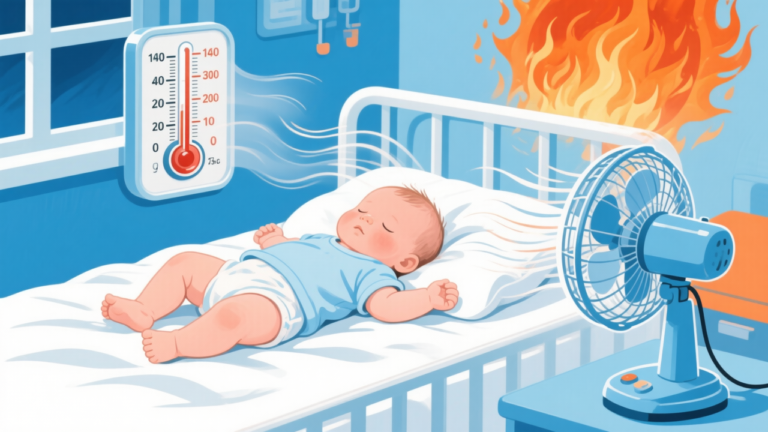
- Keep the room at a comfortable temperature (68–72°F / 20–22°C). Overheating increases SIDS risk.
- Offer a pacifier at sleep time once breastfeeding is established. Pacifier use during sleep is associated with reduced SIDS risk.
Room-Sharing vs. Bed-Sharing: What the Evidence Actually Says
The AAP recommends that babies room-share (sleep in the same room as parents, but on a separate surface) for at least the first 6 months, and ideally the first year. Room-sharing is associated with a up to 50% reduction in SIDS risk.
Related reading: Baby Witching Hour: Why It Happens & How to Survive It.
Bed-sharing (co-sleeping in the same bed) is not recommended for infants under 4 months, and the AAP advises against it in all cases for babies under 1 year. The risks increase significantly when:
- The adult is excessively tired, has consumed alcohol or sedating medications, or is a smoker.
- The sleep surface is soft (couch, armchair, waterbed).
- There are other children or pets in the bed.
- The baby is premature or low birth weight.
If you choose to bed-share despite the guidance, reduce risk by:
- Using a firm mattress with no gaps between the mattress and headboard/wall.
- Removing all pillows and heavy blankets from near the baby.
- Placing baby on her back, away from the edge, and between the wall and a parent (not between two adults).
- Never bed-sharing on a couch or chair — this is one of the most dangerous sleep environments for an infant.
Swaddling Safety: When to Start, How to Do It, and When to Stop
Swaddling can calm newborns and reduce the startle reflex that wakes them. But it must be done safely.
How to swaddle safely:
- Use a thin, breathable blanket or a purpose-made swaddle product.
- Wrap snugly around the arms and torso, but leave enough room for the hips to move and bend.
- Always place a swaddled baby on her back.
- Stop swaddling as soon as your baby shows signs of rolling (usually around 8–12 weeks, but some babies try earlier).
Swaddling risks:
- Hip dysplasia if the legs are wrapped too tightly.
- Overheating if too many layers are used.
- Increased SIDS risk if a swaddled baby is placed on her stomach.
See also: How to Swaddle a Baby Safely: Step-by-Step Guide
Products to Avoid: Weighted Swaddles, Positioners, Crib Bumpers, and Inclined Sleepers
The following products are not safe for newborn sleep and should never be used:
| Product | Why It’s Unsafe |
| Weighted swaddles or weighted sleep sacks | Can restrict breathing and increase risk of suffocation. The FDA issued a warning in 2022. |
| Sleep positioners | Can shift and block baby’s airway. The FDA has warned against these since 2010. |
| Crib bumpers (padded) | Linked to suffocation and entrapment deaths. Banned from sale in the U.S. under the Safe Sleep for Babies Act (2022). |
| Inclined sleepers (e.g., Rock ‘n Play) | Associated with over 70 infant deaths. Recalled in 2019. Babies can roll and suffocate at the incline. |
| Loose bedding, pillows, and stuffed animals | Suffocation hazards for any infant under 12 months. |
Stick to a bare, flat, firm sleep surface. That is the gold standard.
When Newborn Sleep Problems Signal Something More Serious
Most newborn sleep problems are normal and resolve with time. But some sleep issues point to an underlying medical condition that needs attention. Here is what to watch for.
Sleep Issues That May Indicate Reflux (GERD) — Red Flags to Watch For
All babies spit up. But gastroesophageal reflux disease (GERD) is more than just spit-up. It causes pain, poor weight gain, and significant sleep disruption.
Signs that reflux may be affecting your baby’s sleep:
- Arching the back or crying during or after feeds
- Frequent spit-ups (more than a tablespoon at a time, repeatedly)
- Refusing to feed or pulling off the breast/bottle frequently
- Coughing or wheezing during sleep
- Poor weight gain or weight loss
- Waking in apparent pain, not just hunger
What to do: Talk to your pediatrician. Mild reflux can often be managed with feeding adjustments (smaller, more frequent feeds; keeping baby upright for 20–30 minutes after eating). Severe cases may need medication. Never thicken feeds or change formula without your doctor’s guidance.
See also: Signs of Acid Reflux in Babies: A Parent’s Checklist
When Frequent Waking Could Be a Feeding Problem (Low Supply, CMPA, Tongue Tie)
If your newborn wakes constantly to feed and never seems satisfied, consider these possible causes:
- Low milk supply. Stress, infrequent nursing, certain medications, and medical conditions can reduce supply. A lactation consultant can help you assess and build supply.
- Cow’s milk protein allergy (CMPA). Some babies are sensitive to proteins in cow’s milk that pass through breast milk or formula. Symptoms include bloody or mucousy stools, eczema, excessive fussiness, and poor sleep.
- Tongue tie (ankyloglossia). A tight frenulum under the tongue can prevent effective milk transfer. Your baby may nurse frequently but never get a full feed. A simple evaluation by a pediatrician or ENT specialist can diagnose this.
What to do: If you suspect any of these, bring it up at your baby’s 2-week or 4-week checkup. Early intervention makes a big difference.
Breathing Problems During Sleep: When Noisy Breathing Is Concerning
Newborns are noisy breathers. Periodic breathing (short pauses followed by rapid breaths) is common and usually harmless. Congestion, as discussed above, also causes noisy breathing.
However, contact your pediatrician immediately if you notice:
- Pauses in breathing lasting longer than 20 seconds (apnea)
- Blue or gray color around the lips, face, or chest (cyanosis)
- Flaring nostrils with each breath
- Retractions — the skin pulling in between the ribs or under the ribcage
- A grunting sound with every breath (not just occasional grunting during sleep)
- Breathing rate consistently above 60 breaths per minute while resting
These signs can indicate respiratory distress and need urgent medical evaluation.
The 6-Week Peak: Why Everything Gets Worse Before It Gets Better
Many parents notice that crying, fussiness, and sleep disruption peak around 6 weeks. This is well documented in pediatric research. Crying typically increases from birth, peaks at about 6 weeks, and then gradually declines by 12–16 weeks.
Why it happens:
- The nervous system is undergoing rapid development.
- Babies become more aware of their environment and more easily overstimulated.
- Growth spurts hit around 3 weeks, 6 weeks, and 3 months, driving cluster feeding and more frequent waking.
- Digestive system maturity causes more gas and discomfort.
What helps:
- Know that this is a developmental phase, not a permanent state.
- Use the 5 S’s approach (swaddle, side/stomach position while holding only, shush, swing, suck) to soothe your baby.
- Take breaks when you need them. Put baby safely in her crib and step away for a few minutes if you feel overwhelmed.
- Seek support from your partner, family, or a trusted friend.
Building Your Newborn Sleep Toolkit (Products, Routines, and Support)
You do not need a lot of gear to help your newborn sleep. But a few well-chosen items — and a few simple routines — can make a real difference.
Essential Gear That Actually Helps (Swaddles, White Noise, Bassinets)
Swaddles and sleep sacks:
- Velcro or zip swaddles (like Halo SleepSack or Love to Dream) are easier to use than blanket swaddles and reduce the risk of loose fabric in the crib.
- Look for lightweight, breathable fabric (cotton or muslin).
- Once baby shows signs of rolling, transition to a sleep sack with arms free.
White noise machines:
- White noise mimics the constant sound environment of the womb. Studies suggest it can help babies fall asleep faster and sleep longer.
- Keep the volume at or below 50 decibels (about the level of a quiet shower). Place the machine at least 7 feet from the crib.
- Continuous white noise is better than sound machines that play music or nature sounds on a timer.
See also: White Noise for Babies: Is It Safe and Does It Work?
See also: Newborn Startles Awake Constantly and Will Not Sleep.
Bassinets:
- A bassinet that meets current CPSC safety standards is a safe sleep space for the first 4–6 months.
- Look for a firm, flat mattress and a snug fit (no gaps between mattress and sides).
- Popular options include the Halo BassiNest, Guava Family Lotus, and Mika Micky (bedside sleeper).
- Avoid “smart” bassinets that rock or vibrate automatically — the AAP has not found these to be safe for unsupervised sleep.
See also: Best Bassinets for Newborns: Pediatrician-Approved Picks
The Newborn Bedtime Routine: What’s Realistic at Each Age
You cannot “sleep train” a newborn. But you can start building healthy sleep associations from day one.
0–2 weeks: There is no real routine. Feed, change, sleep — repeat. Focus on safe sleep and getting rest yourself.
2–4 weeks: Start a simple 3–4 step wind-down before the longest stretch of sleep:
- Dim the lights.
- Change the diaper.
- Swaddle.
- Feed in a quiet, dark room.
4–8 weeks: Add one or two calming steps:
- Warm bath (optional, 2–3 times per week).
- Gentle massage or lotion.
- Swaddle.
- Feed.
- White noise on.
- Into the bassinet drowsy but awake (when possible).
8–12 weeks: You may notice a more predictable bedtime emerging between 7:30 and 9:30 p.m. Keep the routine consistent. Babies thrive on predictability.
See also: Baby Sleep Schedule by Age: What to Expect Each Month
When and How to Ask for Help: Partner Shifts, Lactation Consultants, and Pediatrician Visits
You do not have to figure this out alone. Here is who to call and when:
- Your partner or support person. Set up shift work early. For example, one person handles 9 p.m.–2 a.m., the other takes 2–7 a.m. This protects both parents’ mental health.
- A lactation consultant (IBCLC). If breastfeeding is painful, baby is not gaining well, or you suspect low supply or tongue tie, see an IBCLC. Most insurance plans cover lactation support.
- Your pediatrician. Bring specific questions to well-child visits: “How many wet diapers should she have?” “Is this amount of spit-up normal?” “Should I be concerned about her sleep?” Write your questions down before the appointment.
- A therapist or postpartum support group. Sleep deprivation is a real risk factor for postpartum mood disorders. If you are feeling hopeless, irritable, or unable to cope, reach out. Postpartum Support International (1-800-944-4773) offers free resources.
Key Takeaways
- Newborn sleep problems are normal. Short sleep cycles, frequent waking, and day/night confusion are expected in the first 12 weeks.
- Safe sleep saves lives. Always place baby on her back, on a firm flat surface, with nothing else in the sleep area.
- Most problems improve with time. The 6-week peak is real — things often get harder before they get easier.
- Trust your instincts. If something feels wrong — poor feeding, breathing concerns, extreme fussiness — call your pediatrician.
- You are not alone. Ask for help from your partner, a lactation consultant, or your pediatrician. Taking care of yourself is part of taking care of your baby.
Frequently Asked Questions About Newborn Sleep
Can I sleep train a newborn?
No. Sleep training is not appropriate for babies under 4 months. Newborns lack the neurological ability to self-soothe. They need to eat frequently and rely on caregivers to help them regulate. Focus on safe sleep practices and building gentle routines instead. Formal sleep training methods (like cry-it-out or Ferber) are generally not recommended until at least 4–6 months of age, and you should discuss timing with your pediatrician.
When will my baby sleep through the night?
“Sleeping through the night” means different things to different people. Most pediatricians define it as a 6–8 hour stretch. Most babies do not consistently achieve this until 4–6 months of age, and some not until later. In the first 12 weeks, a 3–4 hour stretch is a good sign. Every baby develops at her own pace.
Is it normal for my newborn to make so many noises?
Yes. Newborns grunt, squeak, whimper, snort, and even cry out during sleep. These sounds are caused by active sleep (the infant version of REM), small nasal passages, and an immature nervous system. As long as your baby is otherwise feeding well, gaining weight, and seems comfortable when awake, these noises are normal.
Should I wake my newborn to feed?
In the first 2 weeks, yes. Wake your baby every 2–3 hours during the day and every 3–4 hours at night until she has regained her birth weight. After that, if she is gaining well, you can let her sleep longer stretches at night and wake for feeds during the day. Always confirm this with your pediatrician at the first checkup.
Is it safe to use a pacifier at night?
Yes. The AAP recommends offering a pacifier at nap time and bedtime once breastfeeding is well established (usually around 3–4 weeks). Pacifier use during sleep is associated with a reduced risk of SIDS. If the pacifier falls out after baby falls asleep, you do not need to put it back in.
Why does my newborn fight sleep so much?
Newborns fight sleep for several reasons: they are overtired (cortisol makes it harder to fall asleep), overstimulated (too much light, noise, or handling), uncomfortable (gas, reflux, congestion), or going through a growth spurt. Try reducing stimulation, watching for early sleep cues, and keeping wake windows short.
How do I know if my baby is getting enough sleep?
Focus on the overall pattern rather than any single nap. Signs your baby is sleeping enough include: regular weight gain, 6+ wet diapers per day (after day 5), alertness during wake periods, and meeting developmental milestones. If you are concerned, track sleep and feeds for 24 hours and share the log with your pediatrician.
Can I let my newborn cry it out?
No. “Cry it out” is not appropriate for newborns. Babies under 3–4 months cannot self-soothe and need responsive caregiving. If your baby is crying, respond to her needs. If you feel overwhelmed, place baby safely in her crib and take a few minutes to calm yourself. Never shake a baby.
When to Call the Pediatrician
Most newborn sleep problems are normal. But contact your pediatrician — or seek emergency care — if you notice any of the following:
- Breathing difficulties: Pauses in breathing longer than 20 seconds, blue/gray coloring, flaring nostrils, or chest retractions. Call 911 or go to the ER immediately.
- Poor feeding: Baby refuses to eat, takes less than half her usual amount, or has fewer than 6 wet diapers per day after the first week.
- Poor weight gain: Baby has not regained birth weight by 2 weeks or is not gaining at least 1 ounce per day in the first 3 months.
- Signs of dehydration: Sunken soft spot (fontanelle), no tears when crying, dry mouth, or fewer than 4 wet diapers in 24 hours.
- Extreme irritability: Baby cannot be consoled, cries for more than 3 hours at a time, or seems to be in pain.
- Fever: A rectal temperature of 100.4°F (38°C) or higher in a baby under 8 weeks requires immediate medical attention.
- Bloody or mucousy stools: Could indicate cow’s milk protein allergy or another gastrointestinal issue.
- Vomiting that is forceful or green/yellow: This is not normal spit-up and needs urgent evaluation.
See also: When to Call the Pediatrician: Newborn Warning Signs
Bottom Line
Newborn sleep problems are among the most challenging parts of early parenthood — but they are also among the most normal. Your baby’s short sleep cycles, frequent waking, day/night confusion, and noisy sleep are all signs of a developing nervous system, not a problem you caused or need to fix.
The most important things you can do in the first 12 weeks are:
- Follow safe sleep guidelines every single time.
- Feed your baby responsively and on demand.
- Start building a simple, calming bedtime routine.
- Ask for help when you need it — from your partner, your pediatrician, or a lactation consultant.
- Take care of yourself. A rested parent is a better parent.
This phase will pass. The 6-week peak is real, and things do get better. You are doing a hard job, and you are doing it well.
- Moon, R. Y., et al. “Sleep-Related Infant Deaths: From 20 Years of Recommendations to a New Policy.” Pediatrics, 2022; 150(1): e2022057990. HealthyChildren.org — AAP Safe Sleep Guidelines
- World Health Organization. “Infant and Young Child Feeding: Guidelines.” WHO, 2023. WHO — Infant Feeding Guidance
- National Institute of Child Health and Human Development (NICHD). “Safe Sleep for Babies.” NIH, 2023. NICHD Safe Sleep
- Centers for Disease Control and Prevention. “Sudden Unexpected Infant Death and SIDS.” CDC, 2023. CDC — SIDS Prevention
- NHS (UK). “Helping Your Baby to Sleep.” National Health Service, 2023. NHS — Baby Sleep Tips
- Hiscock, H., et al. “Infant Sleep and Settling: Evidence-Based Strategies for Primary Care.” Journal of Paediatrics and Child Health, 2020; 56(6): 845–851.
- National Health and Medical Research Council (NHMRC, Australia). “Clinical Practice Guideline: Crying in the Infant.” NHMRC, 2023.
- American Academy of Sleep Medicine. “Sleep Recommendations.” AASM, 2023. AASM Sleep Guidelines
Medical Disclaimer
This article is for general educational purposes only. It does not constitute medical advice, diagnosis, or treatment. The information provided here should not replace a consultation with your child’s pediatrician or a qualified healthcare professional. Every baby is unique, and individual medical decisions should be made in partnership with your child’s doctor. If you believe your baby has a medical emergency, call 911 or go to the nearest emergency room immediately.
Recommended Bassinets for Safe Sleep
The following bassinets meet current AAP safe sleep guidelines and are highly rated by parents:
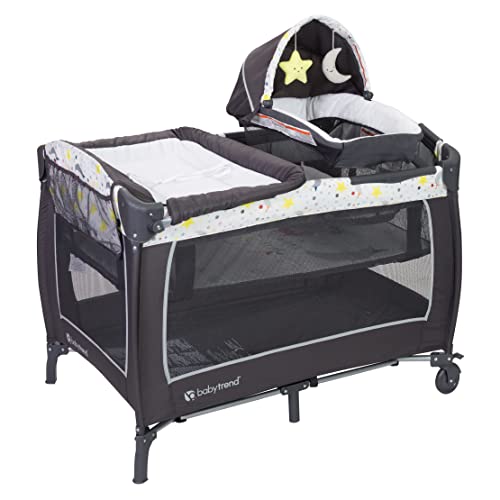
Baby Trend Lil’ Snooze Deluxe II Nursery Center, Twinkle Twinkle …
- 100% Polyester
- Imported
- Cozy napper with canopy and 2 plush toys

Graco Pack ‘n Play® On The Go™ Playard, Kaden
- Bassinet designed to fold with your playard for easy setup and take-down
- Features folding feet and wheels for 20% more compact fold than other Graco playards
- Full-size infant bassinet provides an easy-to-reach and easy-to-view spot for your baby to sleep

Cowiewie Bassinet Bedside Sleeper, Baby Bassinet with 7 Adjustabl…
- 【Ultra-Stable Pyramid Structure + Universal Silent Wheels】Safety First! Our pyramid base bedside bassinet ensures rock-s…
- 【99% Gap-Free Bassinet Bedside Sleeper】Strictly compliant with U.S. safety standards, our bedside bassinet creates a 99%…
- 【7-Level Height Adjustment】Unlike standard 3-level or 4-level baby bassinet, Cowiewie offers 7 adjustable heights (16.7″…

Dream On Me Karley Bassinet in Black, Lightweight Portable Baby B…
- LIGHT and VERSATILE:The Karley Bassinet is designed with a lightweight aluminum frame that allows you to move it easily …
- ROOMY INTERIORS: With dimensions of 34.5Lx19.5Wx37H inches, the Karley is as spacious as they come . The roomy, airy bas…
- STYLISH LOOK: The Karley is made out of a soft, safe and comfortable polyester foam fabric, which is easy to clean. It i…
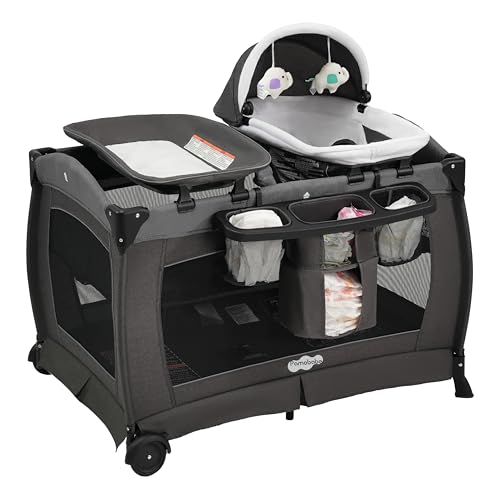
Pamo Babe Pack and Play 4-in-1 Baby Playard with Bassinet & Chang…
- Please make sure the newborn bassinet is horizontal when using, Cannot be used if tilted
- [4-in-1 Versatile Design] This pack and play combines a baby playard, newborn bassinet, insert bassinet, and changing ta…
- [Quick Setup & Travel-Ready] Folds and unfolds in seconds with a compact fold design . Perfect for grandparents’ house, …
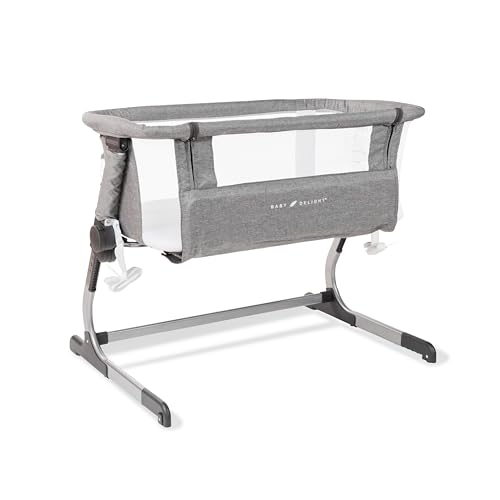
Baby Delight Beside Me Dreamer Bassinet | Bedside Sleeper | 7-Pos…
- 100% Polyester
- MAXIMUM SAFETY: Sleep soundly knowing your baby is safely nestled in the bedside sleeper. Anchors at the bottom firmly s…
- STYLYISH AND COZY: Your little one will rest on a comfy, yet firm mattress surrounded by breathable, mesh walls that kee…
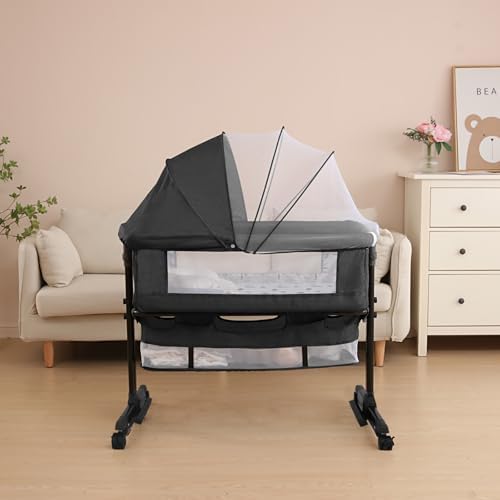
YADAQE Baby Cradle, Freestanding Bedside Bassinet, 3-in-1 Convert…
- Newborn’s Independent Comfort Space: Features a supportive mattress and breathable mosquito net with a waterproof layer …
- Multi-functional design: The crib-side bassinet doubles as a bedside sleeping basket, and can also be used independently…
- Mesh design ensures visibility: Breathable side mesh promotes airflow, reducing suffocation risk, while the transparent …

BCOL 3 in 1 Baby Bassinet Bedside Sleeper, Bedside Crib for Baby,…
- VERSATILE CONVERTIBLE MODE: This Baby Bassinet is armed with CPC, ASTM, and CPSIA Certified. All Baby Bassinet of produc…
- HEIGHT ADJUSTABLE & FLEXIBLE: This bedside cradle features 3 adjustable height positions that can be easily adjusted usi…
- SAFETY AND STABILITY: The bedside sleeper features a stable and sturdy structure, and utilizes a double-sided mesh desig…
Common mistakes parents make with newborn sleep problems
- Assuming a higher price means a safer or better-performing option — certification and correct fit matter far more.
- Skipping the instruction manual, weight limits and product registration, which is how recall notices reach you.
- Changing several things at once, so you cannot tell what actually helped your baby.
- Relying on advice from social media instead of your pediatrician when something feels off.
- Newborn Sleep Routine
- Newborn Sleep Regression Signs
- Toddler Sleep Problems
- Newborn Sleep Schedule
- baby sleep & nursery hub
- NICHD Safe to Sleep basics
- AAP 2022 safe sleep policy
- CPSC nursery recalls
Medical disclaimer: this article is for general education and does not replace individual medical advice. Always follow your own pediatrician’s guidance for your child.
Related ChildBloom Guides
- Newborn Only Sleeps When Held
- Newborn grunting: Why Is My Newborn Grunting at Night? (When to Worry)
- Newborn Sleeps Too Much and Will Not Feed
- Baby Rolling Eyes Back When Sleeping
- Newborn Waking Every Hour? Causes, Fixes & When to Worry
- Why Does My Baby Cry Every Evening? Understanding PURPLE Crying & Coli
- How Long Should Newborn Sleep? Daily Hours & 0–3 Month Guide
- Browse all Sleep & Nursery guides
References & Medical Sources
- NICHD Safe to Sleep: safe sleep environment
- AAP parent guide to safe sleep
- NICHD infant sleep research overview
- NHS advice on helping your baby sleep
Reviewed by the ChildBloom pediatric panel. Learn about our physicians on the About page. This article is educational and does not replace your child’s clinician.




8 Comments