Safe sleep products: 13 safest types for 2026 (CPSC rules)
Safe sleep products: 13 safest types for 2026 (CPSC rules)
Ranked list of 13 safe sleep products (types) plus a quick CPSC/AAP compliance checklist: 16 CFR parts, tracking labels, CPCs, and recalls.
You’re trying to build a registry (or replace a hand-me-down) and you just want a sleep setup you can trust. But store pages and social posts treat “safe” like a feature—mesh sides, cozy inserts, travel-ready extras—so it’s easy to buy something that’s confusing at best and dangerous at worst.
This guide gives you a quick way to verify sleep claims, then ranks 13 sleep products by safety. It also flags the designs that go wrong in real life—inclines, restraint-style travel sleepers, aftermarket mattresses, and “sleep add-ons”—and ends with a clear, practical bedsharing reality check.
Safe sleep basics
Safe sleep in 2026 still comes down to four non-negotiables: a flat, firm, bare, separate sleep surface. “Separate” means your baby sleeps in their own space, not in an adult bed or on a couch; the American Academy of Pediatrics (AAP) recommends room sharing (baby in their own sleep space, in the same room) for at least the first 6 months, and says room sharing can reduce SIDS risk by as much as 50%. On soft seating like couches and armchairs, the AAP cites risk rising up to 67 times—that’s the line you don’t cross.
If your baby dozes off in sitting or inclined gear, treat it as a cue to move them right away to their approved sleep space. A “sleepy moment” doesn’t turn a non-sleep product into a safe place to sleep.
SUID vs SIDS
SUID—an umbrella term for sudden unexpected infant deaths (including SIDS, unknown cause, and accidental suffocation/strangulation in bed)—isn’t rare enough to shrug off. The CDC reports 3,400 SUID deaths in the U.S. (2024, about).
SIDS—a subset of SUID where the death remains unexplained after investigation—accounted for 1,351 deaths (2024). The point isn’t panic; it’s that small-looking risks become real at a population level, so the basics matter every single sleep.
Flat means ≤10°
“Flat” has a number behind it. CPSC guidance for bassinets/cradles defines a safe sleep surface (in its rest, non-rocking position) as ≤10 degrees head-to-toe from horizontal.
The Safe Sleep for Babies Act draws the hard line on the other side: an inclined sleeper for infants is defined as having a sleep surface greater than 10 degrees, and that category is banned. If a product’s pitch is “inclined,” “positioning,” or “reflux angle,” you’re looking at a safety regression dressed up as a feature.
Ban lines in 2026
SSBA—a U.S. federal law banning crib bumpers and inclined sleepers for infants (incline >10°) starting November 12, 2022—made two popular “sleep accessories” outright illegal to sell, offer for sale, manufacture for sale, distribute, or import in the U.S., regardless of when they were made.
Under that law’s guidance, “crib bumper” includes padded bumpers, vinyl bumper guards, and vertical slat covers. A non-padded mesh crib liner is explicitly not included—so “not banned” and “safe or necessary” are two different claims.
Verify compliance fast
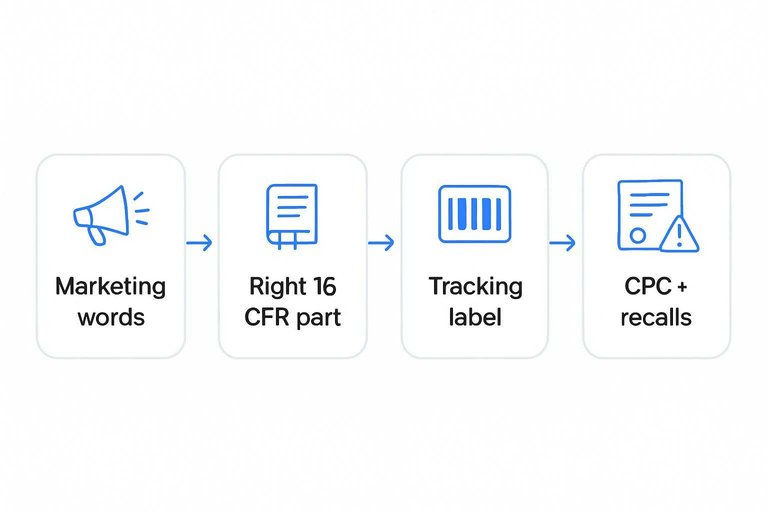
U.S. infant sleep safety isn’t a “brand reputation” thing—it’s a verifiable compliance thing: the right 16 CFR part, a tracking label on the product itself, and a CPC you can actually obtain.
Start with the marketing words. If a product is marketed or intended for infant sleep, it can be an infant sleep product (16 CFR part 1236)—meaning a sleeping accommodation for babies up to 5 months that isn’t already covered by another CPSC sleep standard—and products manufactured on or after June 23, 2022 fall under that federal rule.
Match the product to the right rule number. A CPSC mandatory standard / 16 CFR part is the specific federal regulation a product must meet (like cribs, bassinets, play yards, bedside sleepers). If it’s a bedside sleeper, it isn’t “either/or”: it must meet 16 CFR part 1218 (bassinets/cradles) and 16 CFR part 1222 (bedside sleepers).
Treat “baby box” and “in-bed sleeper” listings as compliance problems until proven otherwise. The CPSC flags products like baby boxes, baby nests, and travel tents as examples that get pulled into the infant-sleep-product category based on marketing—and notes that baby boxes marketed for sleep likely would not comply because they typically can’t meet bassinet/cradle requirements.
Find the tracking label on the product, not just the box. A tracking label / durable product marking is a permanent ID marking (including month/year of manufacture) required on durable infant/toddler products under 16 CFR § 1130.4; if you can’t find it on the item itself, don’t buy it.
Ask for the CPC, then check recalls. A CPC (Children’s Product Certificate) is the manufacturer/importer’s certification that the product complies with applicable CPSC rules; if a seller can’t produce it, move on. Then search the model on SaferProducts.gov and the CPSC site—CPSC’s 2025 warning on Tuyedoqe travel bassinets cited violations tied to real hazards (restraints, low sides, no stand), not vibes.
13 safest product types (ranked by safety confidence)
This ranking is about safety confidence, not “best features.” The highest-confidence picks are primary sleep spaces covered by mandatory U.S. rules; next are fit-critical items, because a great crib can be undermined by a bad mattress match. (In the CPSC’s crib mattress rulemaking materials, staff analyzed 139 fatalities—fit and sleep-surface failures show up often enough to treat mattress choice as core, not accessory.)
For a “womb-like” feel, the safe move is to mimic containment and calming cues without changing the sleep surface: use sleep clothing (swaddle/sleep sack) and sucking (pacifier) rather than padding, nests, or anything that changes angle.
| Rank | Product type | Why it ranks here | What to verify fast |
|---|---|---|---|
| 1 | Full-size crib | Mature mandatory standard | 16 CFR part 1219; tracking label |
| 2 | Non-full-size/mini crib | Mandatory standard | 16 CFR part 1220 |
| 3 | Play yard (sleep use) | Mandatory standard | 16 CFR part 1221 |
| 4 | Bassinet/cradle | Dedicated sleep standard | ASTM F2194 reference in materials |
| 5 | Bedside sleeper | Dedicated sleep standard | ASTM F2906 reference in materials |
| 6 | Crib mattress (full-size) | Standardized; high consequence | 16 CFR part 1241 |
| 7 | Mini-crib mattress | Fit-critical | 16 CFR part 1241; exact sizing |
| 8 | Play yard mattress (replacement) | Fit-critical | 16 CFR part 1241; brand match |
| 9 | Fitted sheet (correct size) | Fit-critical | Tight fit; no added padding |
| 10 | Wearable blanket / sleep sack | Keeps sleep space bare | No loose blankets needed |
| 11 | Swaddle wrap | Containment without extra bedding | No extra inserts/positioners |
| 12 | Pacifier (sleep) | Soothing without soft goods | No plush/blanket attachments |
| 13 | Breathing/heart/motion monitor | Not primary SIDS protection | NIH: not recommended for SIDS |
One shopping tell: cribs and crib rules keep evolving—the CPSC has an update to the full-size crib rule (16 CFR part 1219) with an August 1, 2026 effective date, so “meets current standard” should be something a seller can document, not just imply.
Failure modes to avoid
“Unsafe” in real listings usually isn’t subtle. It’s a product that adds restraint, gaps, soft sides, or extra layers—all of which create the same three bad outcomes: entrapment (baby stuck), strangulation (something tightens), or a fall (baby rolls or climbs out).
Travel bassinet traps
Before you buy a “travel bassinet,” scan the photos for these design cues:
- Any restraint system (belts, crotch straps, shoulder straps). A sleep space shouldn’t need to hold a baby down.
- Low, collapsible, or sagging sides—especially when the sidewall is fabric that can bow inward.
- No rigid stand / floor frame, or a setup that’s meant to sit on a bed, couch, or other soft surface.
- “Tent” or “pod” designs where the structure can shift and create corners, folds, or slack fabric near the face.
If the product looks like it’s solving “rolling” by containing the baby, you’re not looking at a sleep space—you’re looking at a restraint-and-fabric problem.
Add-ons and marketing
These are the repeat offenders that turn a compliant sleep space into a hazard:
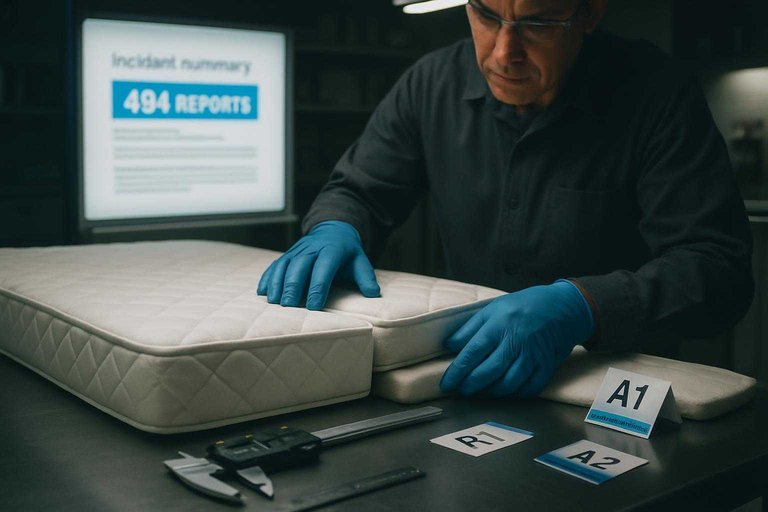
- Aftermarket mattresses (third‑party replacements): mismatches create edge gaps and wedging risk; CPSC staff documented 494 reports associated with a crib mattress in materials supporting the federal crib mattress rule.
- Wedges/positioners/nests/baby “boxes”: anything that props, tilts, or corrals changes the sleep surface.
- Mesh crib liners: not banned like padded bumpers, but HealthyChildren.org warns they can work loose and suffocate or trap a child—and toddlers can use them to climb out (fall risk).
- “SIDS prevention” monitor claims: NIH’s Safe to Sleep says home heart/breathing/motion monitors are not recommended as a primary way to detect or prevent SIDS.
When a listing sells “peace of mind” by adding parts to the sleep space, treat that as the red flag—not the benefit.
Bedsharing reality check
“Safe Sleep 7” is a popular checklist meant to make bedsharing “safe.” The American Academy of Pediatrics’ public guidance is more direct: it recommends room sharing in the same room, and does not recommend bed sharing under any circumstances.
If you’re asking, “Is Safe Sleep 7 actually safe?” the practical answer is: it may be discussed as risk reduction, but it isn’t a stamp of safety. That’s where clinicians diverge: the Academy of Breastfeeding Medicine’s Clinical Protocol #6 (2019) argues bedsharing is likely to happen and calls for open, nonjudgmental counseling—including providing information on safer bedsharing even when bedsharing is discouraged.
NICHD’s Safe to Sleep® guidance is clear that bed sharing increases the risk of SIDS, suffocation, and other sleep-related infant deaths—and it calls out situations that push risk higher: soft sleep surfaces, adult fatigue or substances, babies younger than 4 months, and babies born preterm or with low birth weight.
Translate that into product choices. If what you want is closeness for feeding and settling, choose a compliant bedside sleeper that keeps your baby on a separate flat, firm surface right next to you. Avoid in-bed “nests,” positioners, or anything that adds soft sides, padding, or edges inside an adult bed—those are the exact conditions that turn “I’ll be careful” into a preventable trap.
Buy the standard, not the story
If you want a sleep setup you can trust, treat “safe” as something you can verify—not something a listing promises with mesh, inserts, or travel extras. Start by picking a primary sleep space that’s built for sleep under the right 16 CFR part, then confirm the tracking label is on the product and the seller can provide a CPC before you bring it home. Keep the setup flat (≤10°), firm, bare, and separate, and skip anything that solves sleep with restraints, extra layers, or aftermarket mattress swaps. When you want closeness, choose room sharing with a compliant bedside sleeper—not an in-bed nest or a “safe co-sleeping” add-on.
Frequently Asked Questions
- What’s the fastest way to tell if a “safe sleep product” is actually compliant with U.S. CPSC rules?
- Match the product type to its mandatory 16 CFR standard (for example: full-size cribs 16 CFR part 1219, non-full-size cribs 16 CFR part 1220, play yards 16 CFR part 1221, crib mattresses 16 CFR part 1241). If a listing can’t clearly tell you which rule it meets, treat that as a shopping stop sign.
- Where should I find the tracking label on safe sleep products, and what should it include?
- Look for a permanent tracking label on the product itself (not just the box), because durable infant/toddler products require a durable identification marking under 16 CFR § 1130.4. If you can’t locate that marking on the item, don’t buy it.
- Are inclined sleepers or crib bumpers still legal to buy in 2026 if they’re sold as “loungers” or “sleep aids”?
- No—under the Safe Sleep for Babies Act of 2021, inclined sleepers (greater than 10 degrees) and crib bumpers are banned as consumer products, even if marketing tries to reframe them. If a product’s function relies on incline or bumper-like padding, skip it.
- How to mimic the womb safely without buying a baby nest, positioner, or “breathable” pod?
- Use calming cues that don’t change the sleep surface: a swaddle wrap or sleep sack for containment and a pacifier for soothing. Avoid products that add padding, sidewalls, or an incline because they change the sleep environment rather than the baby’s clothing/comfort.
- What can I use for safe co-sleeping if I want baby right next to me?
- Use a bedside sleeper designed for infant sleep that meets the bedside sleeper standard (ASTM F2906) rather than an in-bed nest or positioner. NICHD Safe to Sleep® states bed sharing increases the risk of SIDS, suffocation, and other sleep-related infant deaths.
Vet Listings Before You Buy
Once you’re shopping, the hard part is translating a product page into clear, checkable compliance—and spotting red flags before they end up in your home.
Use childbloom to double-check safe-sleep gear against the relevant standards and warning signs, so your shortlist stays focused on truly compliant options.
Sources
- Bassinets and Cradles Business Guidance | CPSC.gov — referenced in Flat means ≤10°
Written with Skribra