Baby Heat Stroke: Signs, Immediate Steps, and When to Get Help
Baby Heat Stroke: Signs, Immediate Steps, and When to Get Help
You’re holding a flushed, fussy baby while the thermostat climbs, and a thought you can’t shake shows up: is this baby heat stroke? It’s a scary moment, and the fact that you’re reading this already means you’re doing the right thing — pausing to get clear instead of guessing. This article gives you the signs to watch for, how to tell baby heat stroke apart from milder overheating, immediate cooling steps you can start right now, and the concrete thresholds that mean it’s time to call 911 or head to the ER. You’ll also get practical prevention tips for sleep, outings, and hot rooms, plus guidance for higher-risk babies. What you won’t find here: invented doses, ice-bath “remedies,” or reassurance that replaces a clinician’s judgment. When in doubt, call your pediatrician or emergency services — fast action matters more than perfect wording.
Medical disclaimer: This information is for general education and does not replace professional medical advice. If you suspect baby heat stroke or your infant has a fever with lethargy, unresponsiveness, seizures, or hot dry skin, call 911 or go to the ER immediately.
Looking for expert guidance on baby heat stroke? This comprehensive guide covers everything you need to know, from understanding the basics to making informed decisions for your family.
What does baby overheating look like — subtle and severe signs?
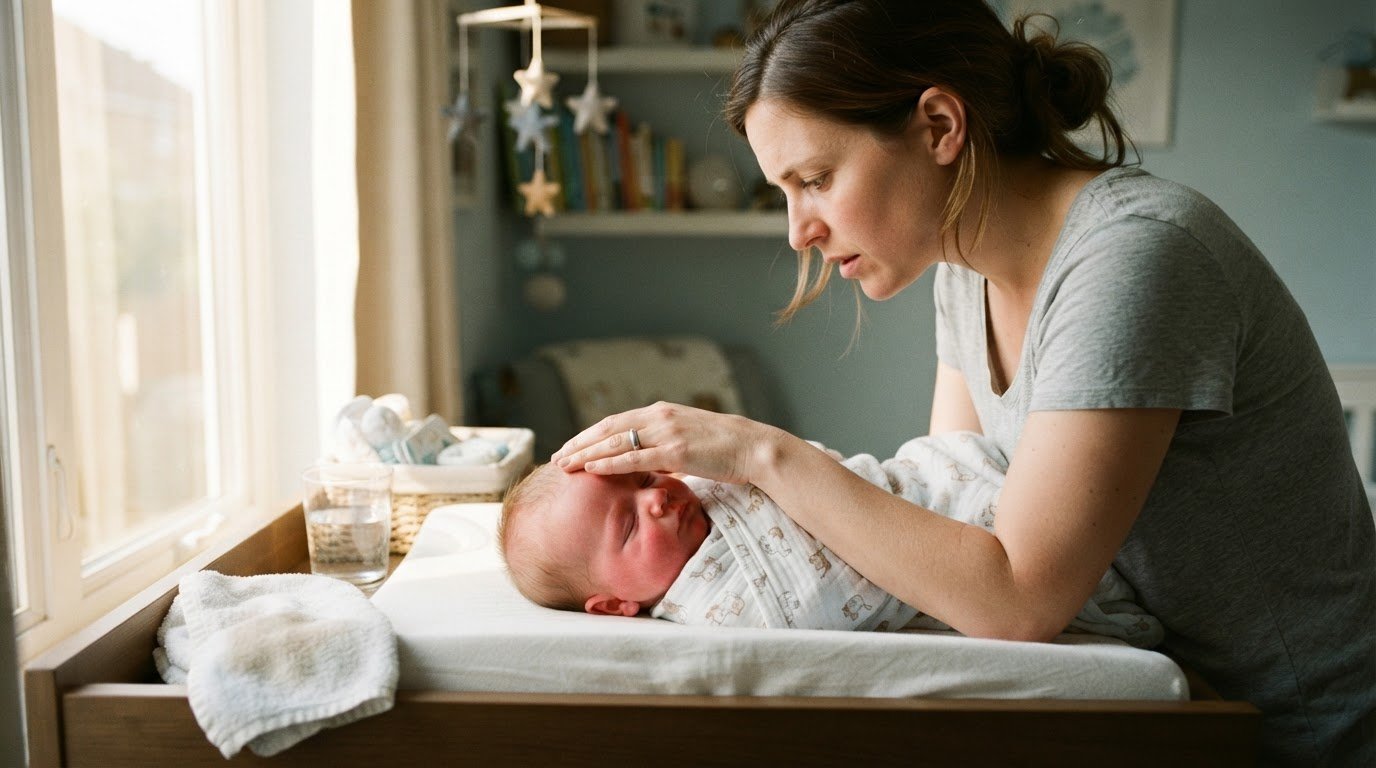
You’ll first notice baby overheating signs in behavior, not just skin color. A baby who’s unusually fussy, floppy, or suddenly quiet while in a warm room or carrier may be overheating before any obvious redness appears. Early clues parents often miss include damp hair, a hot neck or chest, rapid breathing, fussiness that doesn’t settle, fewer wet diapers than usual, and skin that feels hotter than the back of your own neck. Severe signs that demand action are hot/red/dry skin, lethargy, unresponsiveness, seizures, rapid or labored breathing, a high temperature, and vomiting. If you see any severe sign, start cooling and call 911 or go to the ER now — these are general thresholds, not an individualized diagnosis.
Early clues parents often miss
- Flushed cheeks, damp hair or neck
- Fast breathing, restlessness, or unusual quietness
- Fewer wet diapers
- Skin hot to touch on chest/neck
When signs become dangerous
- Hot, red, dry skin with high temperature
- Lethargy, unresponsiveness, seizures
- Rapid/labored breathing, vomiting
If your baby is under 3 months with a fever, or you see any dangerous sign, call your pediatrician or emergency services immediately — age thresholds and exact temps should be confirmed with a clinician. Do not give water before 6 months without pediatric guidance, and never use ice baths or alcohol rubs.
Medical disclaimer: This information is for general education and does not replace professional medical advice. If you suspect baby heat stroke or your infant has a fever with lethargy, unresponsiveness, seizures, or hot dry skin, call 911 or go to the ER immediately.
Baby heat stroke vs heat exhaustion — what’s the difference?
Baby heat exhaustion is overheating that’s caught early; baby heat stroke is a medical emergency where the body can no longer regulate temperature. Both start the same way — the difference is how severe the symptoms are and how fast they escalate.
Heat exhaustion: what to watch for
- Heavy sweating (or damp hair/neck — the clues parents often miss)
- Fast breathing, restlessness, or unusual quietness
- Flushed cheeks, skin hot to touch on chest/neck
- Fewer wet diapers than usual
- May vomit or seem clingy
Baby heat exhaustion means the body is struggling but still trying to cool itself. Move to shade or AC, offer fluids (breastmilk/formula only if under 6 months — check with your pediatrician), and sponge with lukewarm water. If symptoms don’t improve in minutes, escalate.
Heat stroke: red-flag symptoms
- Hot, red, dry skin with high temperature (sweating may actually stop)
- Lethargy, unresponsiveness, or seizures
- Rapid or labored breathing, vomiting
- Confusion or floppiness
Heat stroke in infants can progress fast — a child’s body temperature can rise 3-5 times faster than an adult’s. This is 911 territory.
The short version: heat exhaustion = uncomfortable, act now; heat stroke = dangerous, call emergency services while cooling.
Medical disclaimer: This information is for general education and does not replace professional medical advice. Age thresholds and exact temperatures should be confirmed with your pediatrician.
How to cool a baby safely — step-by-step while you decide on 911
Start cooling now while you decide whether to call 911 — the goal is to bring baby’s core temperature down steadily, not shock it. Move to shade or air-conditioning, remove layers, and begin the steps below. If baby is lethargic, unresponsive, seizing, or has hot dry skin with a high temp, call 911 first and cool while you wait.
Move to shade or AC, remove layers
- Get baby into shade or an air-conditioned room right away.
- Remove excess clothing; leave diaper on if you need privacy before help arrives.
- Place baby on a cool surface, not directly on hot pavement or a blanket.
Cool cloths, fluids, and what NOT to do
- Sponge or cloth with lukewarm or room-temperature water — not ice-cold.
- Fan gently while skin is damp to help evaporation.
- Offer breastmilk or formula only if under 6 months — check with your pediatrician first; water before 6 months needs guidance.
- Never use ice baths, alcohol rubs, or cold water immersion.
Watch and decide
- If symptoms improve in minutes, keep monitoring and call your pediatrician.
- If no improvement, or baby is sleepy, vomiting, breathing fast, or floppy — escalate to emergency care.
- A child’s body temperature can heat up 3-5 times faster than an adult’s — that speed is why acting fast matters.
Medical disclaimer: This information is for general education and does not replace professional medical advice. Age thresholds and exact temperatures should be confirmed with your pediatrician.
When to call 911 or go to the ER — concrete thresholds
If your baby shows signs of heat stroke, trust your gut and call 911 or go to the ER now — don’t wait for every symptom to line up.
Call 911 now if you see these
- Unconscious, floppy, or unresponsive
- Seizure or stiff jerking
- Hot, dry skin with no sweat and a very high temp
- Fast, labored breathing or blue lips
- Confusion or bizarre behavior in an older baby
These are general emergency thresholds, not a diagnosis — your pediatrician can confirm age-specific cutoffs for your child.
Call your pediatrician same-day for these
- Heavy sweating, fussiness, or pale skin
- Vomiting or diarrhea with reduced wet diapers
- Temp above 100.4°F in a baby under 3 months
- Symptoms that improve with cooling but return
What to do while you decide
Move to shade or AC, remove layers, and sponge with lukewarm water while fanning gently. If baby is under 6 months, offer breastmilk or formula only — water needs pediatric guidance first. Never use ice baths or alcohol rubs.
A child’s body heats 3-5 times faster than an adult’s, so acting fast matters more than being perfect. If in doubt, call 911 — emergency care would rather hear a false alarm than miss a window.
Medical disclaimer: This information is for general education and does not replace professional medical advice. Age thresholds and exact temperatures should be confirmed with your pediatrician.
Can babies get heat stroke indoors or in the car?
Yes — babies can get heat stroke indoors and in parked cars, and both scenarios are more common than parents realize.
Indoor overheating risks
A room that feels comfortable to you can still be too warm for a baby. Direct sun through windows, wrapped babies near heat sources, and heavy sleep sacks in warm bedrooms all raise the risk. Watch for flushed skin, rapid breathing, and fewer wet diapers — classic baby overheating signs that creep up quietly.
Car heat dangers
A parked car heats fast, even with windows cracked. A baby’s body temperature can rise 3-5 times faster than an adult’s, so “just a minute” is not safe. Never leave a baby unattended in a car, not even in shade or with the engine running.
Quick checks
- Feel the back of the neck — clammy or hot skin means too warm.
- Remove layers and move to air conditioning if you notice baby overheating signs.
- If baby is listless, vomiting, or has a high temp, treat it as an emergency — call 911.
Medical disclaimer: This information is for general education and does not replace professional medical advice. Age thresholds and exact temperatures should be confirmed with your pediatrician.
Prevention: safe room temp, clothing, and hydration for babies
Safe prevention starts with a room that feels comfortable to you, light clothing, and breastmilk or formula on demand — but exact temperature ranges and hydration rules depend on your baby’s age and health, so confirm them with your pediatrician.
Room temperature and clothing guidance
Keep the room comfortably cool rather than relying on a single magic number. Lightweight, breathable fabrics and one more layer than you’d wear are a reasonable starting point; heavy sacks and sealed windows push baby overheating signs higher. If the back of the neck feels clammy or hot, remove a layer and move baby to airflow.
Hydration for babies under 6 months
Breastmilk or formula meets hydration needs for most babies under 6 months; do not offer water without your pediatrician’s guidance. During heat waves or illness, ask about feeding frequency and urine output rather than guessing ounces.
Quick checks
- Dress in light, loose layers and adjust for indoor overheating prevention at naptime and bedtime.
- Watch flushed skin, rapid breathing, and fewer wet diapers — classic baby overheating signs that creep up quietly.
- If baby is listless, vomiting, or has a high temp, treat it as an emergency — call 911.
For sleep strategies that balance warmth and safety, see Parents Postpartum Sleep Strategies.
Medical disclaimer: This information is for general education and does not replace professional medical advice. Age thresholds, exact temperatures, and hydration plans should be confirmed with your pediatrician.
Higher-risk babies: premature, fever, dehydration — what extra caution looks like
Premature infants, babies with fever, and those showing dehydration signs need tighter monitoring and earlier pediatrician contact — their ability to regulate temperature is lower, and baby heat stroke can escalate faster.
Watch these baby overheating signs more closely:
- Fewer wet diapers than usual, dry mouth, no tears when crying
- Rectal temperature above 100.4°F in an infant under 3 months, or any fever with lethargy
- Skin that’s hot, flushed, or unusually cool and clammy
Extra caution:
- Preemies: check temperature more often during the first months, even indoors
- Fever + heat: treat the fever per your pediatrician’s plan and watch for worsening
- Dehydration: offer breastmilk or formula more frequently; do not give water without pediatric guidance
If you see listlessness, vomiting, or a high temp, treat it as an emergency — call 911.
Medical disclaimer: This information is for general education and does not replace professional medical advice. Age thresholds, exact temperatures, and hydration plans should be confirmed with your pediatrician.
The bottom line
You already have what you need: the ability to spot early overheating signs and act before they escalate. If your baby shows confusion, hot or dry skin, or lethargy, treat it as heat stroke and start cooling now — move to shade or AC, remove layers, apply cool cloths, and offer fluids only if age-appropriate. Call 911 for unconsciousness, seizure, no sweating, or a rectal temp above 104°F; call your pediatrician same-day for moderate signs. Indoors and in cars can overheat a baby fast — never leave them unattended in a vehicle.
Medical disclaimer: This information is for general education and does not replace professional medical advice. Age thresholds, exact temperatures, and hydration plans should be confirmed with your pediatrician.
Related Reading on ChildBloom
- Severe dehydration baby: signs and emergency thresholds
- Baby seizure emergency: when to call 911
- Postpartum sleep strategies for parents
References and Resources
Frequently asked questions
What room temperature is too hot for a baby to sleep in?
The article recommends keeping the nursery between 68–72°F and dressing baby in one lightweight layer more than an adult would wear — but it doesn’t give a single “danger” number. You’ll notice baby is too hot if their chest or neck feels sweaty or hot to the touch. If the room feels uncomfortable to you, it’s likely uncomfortable for baby too.
Can a baby get heat stroke from a fever?
Yes — a fever raises core temperature, and adding external heat (hot car, direct sun, heavy clothing) can push a baby into heat stroke faster. The article flags fever plus overheating as a higher-risk combo, especially in infants under 3 months. Watch for lethargy, hot dry skin, or unusual fussiness and treat the fever while cooling baby down.
How do I know if my baby is dehydrated in hot weather?
Fewer wet diapers than usual, dry mouth, no tears when crying, and sunken soft spot are the signs the article highlights. In hot weather, offer breast milk or formula more frequently — don’t wait for thirst cues, since babies can’t tell you they’re dry. If you see any of these signs plus decreased activity, call your pediatrician.
Should I wake a hot baby to offer fluids?
For newborns and young infants, the article suggests waking every 2–3 hours to feed if it’s very hot — small, frequent feeds help more than forcing large amounts. Older babies can be offered water alongside milk, but don’t force fluids if baby is vomiting or lethargic. If baby refuses or seems confused, seek medical help instead of pushing fluids.
What if my baby’s chest feels hot but they seem fine?
A hot chest alone isn’t proof of heat stroke — check for lethargy, flushed skin, rapid breathing, or unusual fussiness before panicking. The article says to move baby to shade or AC, loosen clothing, and offer fluids while watching for 10–15 minutes. Call your pediatrician if the heat persists, baby seems off, or you’re in any doubt.
Is it safe to use a fan or AC directly on my baby?
The article says gentle airflow is fine — don’t point a fan directly at baby’s face or blast AC on high. Cool the room first, then let baby rest in the cooler air; sudden cold drafts can cause shivering, which actually generates heat. AC set to a comfortable 68–72°F is safer than direct streams on skin.
This FAQ is for general information and does not replace medical advice. If you suspect baby heat stroke — hot skin, lethargy, no tears, rapid breathing — call 911 or go to the ER immediately.