Baby Rash That Does Not Blanch: When to Get Urgent Help
Introduction: The Rash That Doesn’t Fade
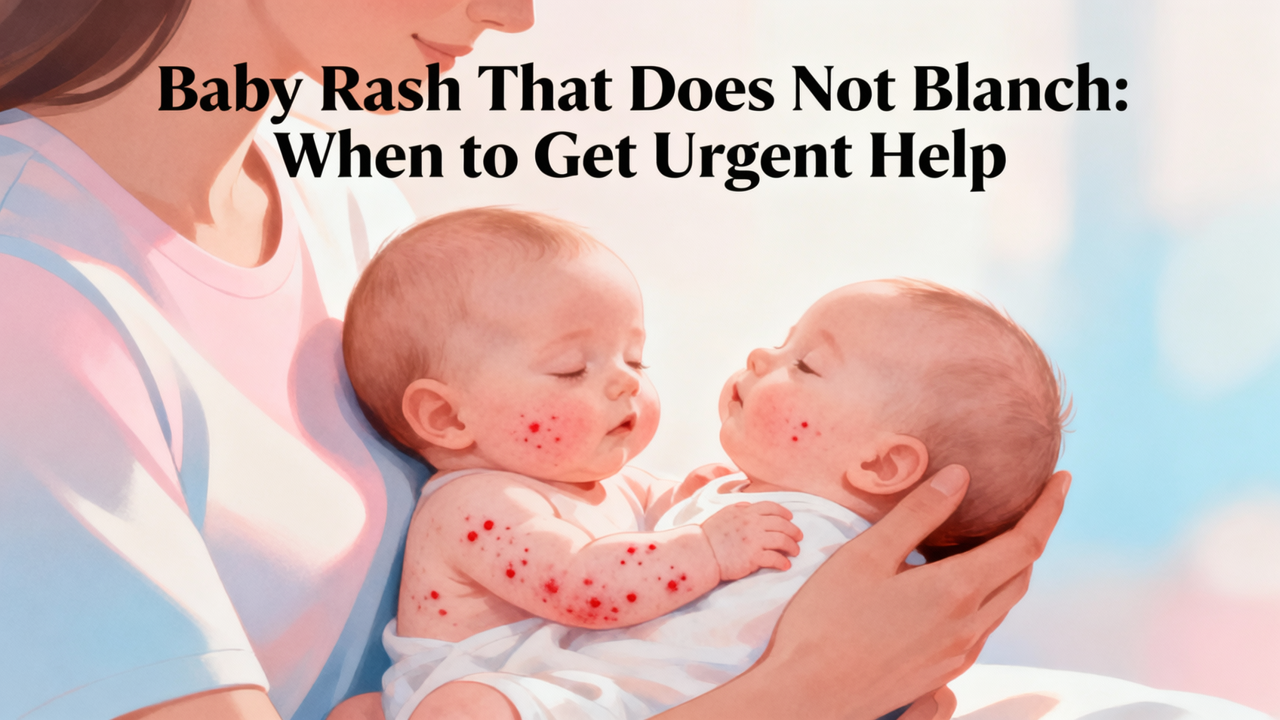
You’re changing your baby’s diaper when you notice them: tiny red or purple spots scattered across their skin. At first, you think it’s a heat rash or a reaction to the new detergent. But when you press your finger against one of the spots, something unsettling happens—nothing. The spot stays exactly the same color. It doesn’t fade. It doesn’t turn white. It just… stays.
This is a non-blanching rash, and it’s one of the most important distinctions in pediatric medicine. While most childhood rashes are harmless and self-limiting, a rash that doesn’t blanch (fade under pressure) is a sign that blood has leaked from tiny blood vessels beneath the skin. Sometimes, that leakage is benign—the result of a hard cough, a tight diaper, or a minor bump. Other times, it’s the first visible warning of a life-threatening infection like meningococcal sepsis, which can kill a child within hours.
The challenge for parents is this: the vast majority of non-blanching rashes in children are NOT serious. Studies show that 90% of children presenting to hospitals with non-blanching rashes do not have meningococcal disease, and up to 27.6% of healthy infants develop at least one petechia during their first year with no clinical significance.
But the 10% that *are* serious require immediate, decisive action. This article gives you the knowledge to distinguish between the two—to know when to calmly monitor at home, when to call your pediatrician for a same-day appointment, and when to drop everything and go to the emergency room.
Drawing on guidelines from the NHS (UK), NIH/StatPearls, Cleveland Clinic, Royal Children’s Hospital Melbourne, and pediatric emergency medicine protocols, this is your comprehensive guide to the non-blanching rash.
What Is a Non-Blanching Rash?
A non-blanching rash is a rash composed of spots or patches that do NOT fade or turn white when pressure is applied to the skin. This happens because the discoloration comes from blood that has already leaked out of capillaries and into the surrounding tissue—pressure can’t push that blood back into the vessels.
The Three Types of Non-Blanching Rash
| Type | Size | Appearance | Common Causes |
|---|---|---|---|
| **Petechiae** | Less than 2-3 mm (pinpoint) | Tiny red, purple, or brown dots; flat | Viral illness, coughing/vomiting, minor trauma, ITP |
| **Purpura** | 2 mm to 1 cm | Larger purple or reddish patches; may be raised | HSP, meningococcal sepsis, ITP, vasculitis |
| **Ecchymoses** | Greater than 1 cm | Large bruise-like areas | Trauma, bleeding disorders, abuse |
Sources: NIH/StatPearls, Banner Health, Geeky Medics
Blanching vs. Non-Blanching: The Critical Difference
| Feature | Blanching Rash | Non-Blanching Rash |
|---|---|---|
| **What happens when pressed** | Fades or turns white | Stays red, purple, or brown |
| **Cause of color** | Dilated blood vessels (blood still inside) | Blood leaked into tissue (outside vessels) |
| **Common examples** | Heat rash, viral exanthems, hives (urticaria) | Petechiae, purpura, bruises |
| **Typical concern level** | Usually low | Requires evaluation |
| **Urgency** | Often watch and wait | Assess promptly; may be emergency |
Sources: Royal Children’s Hospital Melbourne, NHS Kingston & Richmond
The Glass Test: How to Check at Home
The glass test is a simple, quick method parents can use to determine if a rash is blanching or non-blanching. It’s not a diagnostic tool, but it’s an excellent first step in triage.
How to Perform the Glass Test
Important caveats:
Common Causes of Non-Blanching Rash in Babies
Benign Causes (Most Common)
1. Mechanical Petechiae (Pressure-Related)
The most common cause of petechiae in otherwise healthy babies is simple mechanical pressure. The skin of infants is thin, and their capillaries are fragile. A sudden increase in pressure can rupture these tiny vessels.
Common mechanical triggers:
Key distinguishing feature: The baby is otherwise completely well—feeding normally, alert, no fever, active and happy.
2. Viral Illnesses
Many common viruses can cause petechiae as part of the illness. Studies show that respiratory viruses are identified in 67% of petechial rash cases in children.
Viruses associated with petechiae:
Key distinguishing feature: Baby has typical cold/flu symptoms (fever, cough, runny nose) and is otherwise well-appearing. Petechiae are usually limited in number and don’t spread rapidly.
Serious Causes (Require Immediate Attention)
1. Meningococcal Disease (Meningococcal Sepsis/Meningitis)
This is the most feared cause of non-blanching rash in children—and for good reason. Meningococcal disease, caused by the bacteria *Neisseria meningitidis*, can progress from first symptoms to death in as little as 4-6 hours.
Key features:
Critical point: The rash may not appear until the disease is already advanced. Do NOT wait for a rash to appear if your child has other serious symptoms.
2. Immune Thrombocytopenic Purpura (ITP)
ITP is an autoimmune condition where the immune system destroys platelets (the blood cells that help clotting). It often follows a viral infection.
Key features:
3. Henoch-Schönlein Purpura (HSP / IgA Vasculitis)
HSP is an inflammatory condition affecting small blood vessels, typically in children aged 2-5 years.
Key features:
4. Hemolytic Uremic Syndrome (HUS)
HUS is a serious condition often triggered by E. coli infection, causing destruction of red blood cells and kidney failure.
Key features:
5. Leukemia and Other Blood Cancers
In rare cases, non-blanching rashes can be an early sign of leukemia or other hematologic malignancies.
Key features:
6. Sepsis (Non-Meningococcal)
Other bacterial infections can also cause petechiae as part of a systemic inflammatory response.
Key features:
Complete Cause Summary Table
| Cause | Type of Rash | Associated Symptoms | Urgency |
|---|---|---|---|
| Mechanical pressure | Petechiae (localized) | None; baby well | Low; monitor |
| Viral illness | Petechiae (scattered) | Fever, cold symptoms | Moderate; see doctor |
| Meningococcal disease | Purpura, rapidly spreading | Fever, lethargy, cold extremities | **Emergency** |
| ITP | Petechiae, purpura, bruising | Nosebleeds, bleeding gums | Moderate; see doctor |
| HSP | Purpura (legs/buttocks) | Joint pain, abdominal pain | Moderate; see doctor |
| HUS | Petechiae, purpura | Bloody diarrhea, decreased urine | **Emergency** |
| Leukemia | Petechiae, purpura, bruising | Pallor, fatigue, infections | High; see doctor promptly |
| Sepsis | Petechiae, purpura | Fever/low temp, lethargy, poor feeding | **Emergency** |
| Non-accidental injury | Bruising, petechiae (unusual pattern) | Incongruent history | **Emergency** |
The Decision Tree: When to Worry, When to Act
Use this step-by-step guide to determine the appropriate response when you discover a non-blanching rash on your baby.
Step 1: Do the Glass Test
Step 2: Assess Your Baby’s Overall Condition
Is your baby well-appearing?
OR is your baby unwell?
Step 3: Determine the Response
| Scenario | Action |
|---|---|
| **Baby is well, rash is localized, and there’s a clear mechanical cause** (coughing, vomiting, tight diaper, minor bump) | Monitor at home. Take photos. If rash doesn’t fade within 24-48 hours or spreads, see pediatrician. |
| **Baby is well, rash appeared without clear cause, no fever** | Schedule same-day pediatrician appointment. |
| **Baby has fever + non-blanching rash, but appears otherwise well** | **Same-day pediatric evaluation required.** May need blood tests and observation. |
| **Baby is unwell (any red flag symptoms) + non-blanching rash** | **Go to ER immediately or call 911.** |
| **Rash is rapidly spreading** | **Go to ER immediately.** |
| **Rash is accompanied by severe headache, stiff neck, or photophobia** | **Go to ER immediately.** |
| **Rash is in unusual locations or patterns suggesting abuse** | **Go to ER immediately; may need safeguarding evaluation.** |
Sources: NHS Kingston & Richmond, Royal Children’s Hospital Melbourne, NHS Greater Glasgow & Clyde
Red Flags: Go to the ER Now
Do not wait, do not call for advice first—go to the emergency department or call 911 if your baby has a non-blanching rash AND any of the following:
Immediate ER Criteria
| Sign/Symptom | Why It’s Urgent |
|---|---|
| **Fever + non-blanching rash** | Possible meningococcal disease or sepsis |
| **Rapidly spreading rash** | Indicates active bleeding under skin; possible DIC or severe infection |
| **Lethargy or hard to wake** | Sign of serious infection or shock |
| **Inconsolable crying or irritability** | May indicate meningitis or severe pain |
| **Cold hands and feet** | Sign of poor circulation/shock |
| **Rapid breathing or grunting** | Respiratory distress or metabolic acidosis |
| **Pale, blue, or mottled skin** | Shock or severe sepsis |
| **Stiff neck** | Classic sign of meningitis (may be subtle in infants) |
| **Swelling of legs or joints** | Possible HUS or HSP with complications |
| **Bloody diarrhea** | Possible HUS |
| **Seizure** | Neurological emergency |
| **Unusual bruising pattern** | Possible non-accidental injury |
Sources: Banner Health, NHS Scotland, Meningitis Now
What Happens at the Hospital or Doctor’s Office
If your baby is evaluated for a non-blanching rash, here’s what to expect:
The Examination
The healthcare provider will:
Possible Tests
| Test | What It Checks For |
|---|---|
| **Complete Blood Count (CBC)** | Platelet levels, white blood cells, red blood cells, signs of infection |
| **Blood Culture** | Bacterial infection in bloodstream |
| **Coagulation Profile (PT/PTT)** | Blood clotting function |
| **C-Reactive Protein (CRP)** | Inflammation marker |
| **Blood Chemistry (CMP)** | Kidney function, electrolytes |
| **Urinalysis** | Kidney involvement (HUS), infection |
| **Viral PCR/Tests** | Specific viral causes |
| **Lumbar Puncture** | Meningitis (if suspected) |
Sources: Banner Health, NHS Kingston & Richmond
Treatment Depends on Cause
Special Considerations for Babies
Newborns (0-4 Weeks)
Infants (1-12 Months)
On Darker Skin Tones
Prevention and Peace of Mind
Vaccination
The most effective way to prevent meningococcal disease is vaccination. Ensure your baby receives:
Know the Signs of Meningococcal Disease
Remember the classic symptoms—but also know that they may not all appear, and the rash may come late:
The most important rule: Trust your instincts. If your child is seriously unwell and getting worse, seek help immediately—don’t wait for a rash.
Take Photos
If you discover a non-blanching rash:
Frequently Asked Questions (FAQs)
My baby has a few tiny red spots that don’t blanch, but seems perfectly fine. Should I worry?
A small number of petechiae in an otherwise well baby is often benign—caused by coughing, vomiting, crying, or minor pressure. Studies show that 27.6% of healthy infants develop at least one petechia with no clinical significance. However, because you can’t be certain of the cause at home, a same-day pediatrician appointment is the safest approach. If your baby is under 3 months, be more cautious and seek prompt evaluation.
Can teething cause petechiae?
Teething itself doesn’t directly cause petechiae. However, the excessive drooling and occasional coughing or gagging associated with teething could theoretically contribute to mechanical petechiae. If petechiae appear during teething and your baby is otherwise well, they’re likely benign—but still worth mentioning to your pediatrician.
What if the glass test is hard to do on my baby’s skin?
On darker skin tones, petechiae may be harder to see. Try the glass test on lighter areas like the palms, soles, inside the eyelids, or roof of the mouth. You can also use the “fingertip test”—press firmly with your fingertip and observe if the spot fades. When in doubt, have a healthcare provider examine the rash.
My baby had a non-blanching rash after a coughing fit. Is this normal?
Yes. Forceful coughing, vomiting, crying, or straining can cause mechanical petechiae, especially around the face, neck, and upper chest. These are caused by increased pressure in the chest rupturing tiny capillaries. If your baby is otherwise well, the rash is localized, and there’s a clear trigger, it’s usually benign. The spots should fade within a few days.
How quickly can meningococcal disease progress?
Alarmingly fast. Meningococcal disease can progress from first symptoms to death in as little as 4-6 hours. This is why speed matters. If your child has a non-blanching rash AND fever or appears unwell, do not wait—seek emergency care immediately.
Can a non-blanching rash appear without fever and still be serious?
Yes. While fever + non-blanching rash is the classic presentation of meningococcal disease, some serious conditions can present without fever:
Any new, unexplained non-blanching rash should be evaluated by a healthcare provider, even without fever.
What’s the difference between petechiae and a regular rash?
A regular rash (like heat rash or viral exanthem) is caused by inflammation or dilated blood vessels and typically BLANCHES (fades) when pressed. Petechiae are caused by blood leaking OUT of vessels and do NOT blanch. The glass test is the key distinction.
Should all non-blanching rashes be seen in the ER?
Not necessarily. If your baby is well-appearing, has no fever, and there’s a clear mechanical cause (like recent coughing or a tight diaper), a same-day pediatrician appointment is often appropriate. However, if there’s ANY doubt about your baby’s condition, or if any red flag symptoms are present, the ER is the safest choice.
Can vaccinations cause a non-blanching rash?
Vaccinations can occasionally cause mild rashes as part of the immune response, but these are typically blanching. A non-blanching rash after vaccination should be evaluated by a healthcare provider to rule out other causes.
My baby’s rash blanched at first but now doesn’t. What does that mean?
Some rashes—particularly in the early stages of meningococcal disease—may blanch initially and then become non-blanching as the condition progresses. If your child is unwell and the rash is changing, seek emergency care. Don’t rely on a single glass test—recheck if the situation changes.
What tests will the doctor do for a non-blanching rash?
The most common tests include:
These tests help distinguish between benign causes (viral illness, mechanical) and serious causes (meningococcal disease, ITP, HUS, leukemia).
Conclusion: Knowledge Is Your Best Defense
A non-blanching rash is one of the most anxiety-provoking findings a parent can discover. The good news is that the vast majority—90% or more—are caused by benign conditions like viral illnesses or mechanical pressure. The bad news is that the small percentage that are serious can become life-threatening with terrifying speed.
The key is not to panic, but to act decisively:
The glass test takes 10 seconds. The peace of mind it provides—or the emergency it reveals—is priceless.
Key Takeaways:
This article is for general informational purposes only and is not a substitute for professional medical advice, diagnosis, or treatment. Always consult your pediatrician about your child’s individual health needs. If you believe your child has a medical emergency, call your local emergency number immediately.
Written by Dr. Martinez, MD (Pediatrics) | Medically approved by Dr. Ahmed Raza, MD (Pediatrics) | Updated for 2026