11 Baby Gear Review Mistakes That Lead to Unsafe Picks
11 Baby Gear Review Mistakes That Lead to Unsafe Picks
Audit baby gear reviews for safety: 11 red flags plus checks for sleep claims/10° angle, recalls, CPCs, manuals, IDs, and car seats.
You’re building a registry (or fixing one) and trying to choose gear by reading reviews, comparisons, and star ratings. The problem is that a review can sound confident, show happy photos, and still skip the few checks that matter most when a product could affect breathing, sleep position, or crash protection.
If you get this wrong, you don’t just waste money—you may bring home something that shouldn’t be used the way it’s being praised, can’t be traced for recalls, or is safe only under strict rules the review never mentions. This troubleshooter gives you a quick, repeatable safety-first audit to run on any baby-gear review before you buy.
Safety-first review audit
Most baby gear reviews are written like shopping advice: “best,” “most comfortable,” “my baby loved it.” For safety-critical gear, that framing fails. Your job isn’t to find the perfect pick—it’s to avoid the ways a “good” review can still steer you into a product (or a use) that creates a predictable safety problem.
Two quick reader-questions, answered plainly:
- What brand is baby gear? “Baby gear” isn’t a brand. It’s a catch-all category for products made by many companies.
- Which companies make the best baby gear? There isn’t one “best” company across categories. The only reliable shortcut is a method: treat safety as evidence-based (standards, labels, recalls, manuals), then treat comfort and convenience as preferences.
11 mistake map
Use this table as a quick “failure-mode” map. If a review commits any of these, pause and run the audit before you buy.
| Mistake in baby gear reviews | Why it risks safety | Evidence that fixes it |
|---|---|---|
| 1) Treating star ratings as safety proof | Ratings measure satisfaction, not compliance | Standards/required certifications; recall checks |
| 2) Calling “baby slept great” a positive | Sleep anecdotes can normalize unsafe sleep setups | Bans + sleep-product standards (not stories) |
| 3) Missing banned categories | Some product types are illegal to sell/distribute under specific conditions | Banned hazardous product status (e.g., Safe Sleep for Babies Act bans certain items) |
| 4) Ignoring sleep-surface angle claims | A small incline can be the line between compliant and not | ISP rule (Infant Sleep Products rule, 16 CFR Part 1236) caps in-scope sleep surfaces at 10° |
| 5) Treating “certification seal” as a green light | Seals can be voluntary and not market-wide coverage | Verify what standard was tested, by whom, for that exact model |
| 6) Skipping recall history | Recalls are real-world signals that a product/version has documented hazards | Official recall databases + exact product identifiers |
| 7) Not asking for a CPC when it’s required | Some children’s products require third-party testing + written certification | Children’s Product Certificate (CPC): manufacturer/importer’s written certification based on a CPSC-accepted lab’s testing |
| 8) Not verifying the exact model/version | “Same name” isn’t the same product; versions drift | Model number, date codes, tracking label, manual match |
| 9) Ignoring durable-product markings | If you can’t identify it, you can’t trace recalls or requirements | Durable infant/toddler product markings: manufacturer/importer info, model, date of manufacture, etc. |
| 10) Reviewing features before the manual | The manual defines allowed use, limits, and unsafe configurations | Manual warnings + installation/use requirements |
| 11) Trusting the review source without integrity checks | Incentives and fake-review tactics change what gets omitted | Review-source integrity signals; FTC’s Consumer Reviews and Testimonials Rule targets deceptive review practices |
Safety vs preference
A safety-first read of baby gear reviews starts with one split: safety evidence versus preference evidence.
Safety evidence is documentation that survives your feelings. It includes things like a product being outside a banned hazardous category, meeting a relevant safety standard (for infant sleep products, that includes the federal ISP rule’s 10° cap for in-scope products), and having required identifiers and certifications—like a CPC for products that must be third-party tested and certified, or permanent markings on durable infant/toddler products so the exact model and manufacture date are traceable.
Preference evidence is everything that can be true and still unsafe. “Five stars,” “easy to fold,” “my baby slept so well,” “soft fabric,” “fits my trunk,” “looks sturdy”—those are real inputs for convenience and comfort after a product clears safety gates. But they don’t tell you whether the product is compliant, correctly identified, recalled, or being used in a way the manual allows.
Two-minute workflow
Run this fast audit on any review (even a marketplace listing) before you compare features:
- Classify the category + intended use. If the item is being used for infant sleep, treat it as safety-critical immediately.
- Run hard-stops. Screen for banned hazardous categories and for sleep-related constraints like the ISP rule’s 10° angle cap for in-scope sleep products.
- Verify identity and documents. Match model/version, labels, and (when required) the CPC; for durable products, confirm the permanent markings needed to trace the exact unit.
- Only then weigh preferences. Comfort, price, aesthetics, and “works for my baby” become meaningful after the safety evidence is in place.
That’s the core reframe: don’t “pick the best.” Eliminate the ways a review can be persuasive while still being wrong about safety.
Sleep claims hard-stop
In baby gear reviews, the fastest way to get an unsafe pick is to let “sleep” sneak in as a casual benefit. The moment a review implies your baby will sleep in a product, treat it as sleep-safety-critical.
HealthyChildren.org (the American Academy of Pediatrics’ consumer guidance site) notes that 4.7 million Rock ‘n Play infant sleepers were recalled—a reminder that “sleep as a bonus feature” is exactly where reviews can normalize high-stakes risk.
That changes your job. You’re no longer comparing fabrics, footprints, or “soothing.” You’re running a pre-buy gate: is this being presented (or used) as a sleep product, and is it even legal and safe to sell/distribute in that role?
Spot sleep language
Reviews rarely announce “this is an infant sleep product.” They imply it. These cues should flip your brain into sleep mode:
- “For naps” / “napper” / “napping pod.” If the value prop is sleep, screen it like sleep.
- “Newborn lounger” / “cozy nest” / “snuggle lounger.” “Lounger” language often smuggles in sleep use.
- “Overnight” / “all-night” / “sleep through the night.” If the review normalizes unsupervised or routine sleep, pause.
- “Reflux sleep” / “helps with spit-up at night.” Medical-sounding framing is still a sleep claim.
- “Safe for sleep” / “sleep-approved” (without naming a standard). Marketing certainty is not evidence.
- “Baby sleeps in it while we…” If the review describes sleep happening in a stroller, swing, infant carrier, or sling, treat that as a safety alarm: HealthyChildren.org notes that if a baby falls asleep in those, they should be moved to a firm, non-inclined sleep surface as soon as possible.
Ban means stop
A banned hazardous product is a product category that federal law treats as illegal to sell/distribute under specified conditions. In other words: there is no “but this brand seems nicer” exception.
Under the Safe Sleep for Babies Act of 2021, the U.S. Consumer Product Safety Commission’s business guidance is clear: as of November 12, 2022, all “inclined sleepers for infants” and “crib bumpers” (as defined in the Act) are considered banned hazardous products—regardless of date of manufacture.
So when a review praises an “inclined sleeper” style product, or treats crib bumpers as a comfort upgrade, your move isn’t “compare it to the other options.” Your move is: stop shopping that category. Run the hard-stop screen first, and only compare features after a product clears it.
Verify the incline
The line you’re checking is the 10° sleep-surface limit. If a product is being presented or used as a place for routine infant sleep, an unverified incline is a hard-stop.
Two terms you’ll see:
- Inclined sleeper (for infants): an infant product with a sleep surface inclined above the legal threshold (commonly described as greater than 10 degrees) that is intended/marketed/designed to provide sleeping accommodations.
- ISP rule (Infant Sleep Products rule): the federal safety standard (16 CFR Part 1236) that, among other requirements, caps infant sleep product sleep-surface angle.
Steps
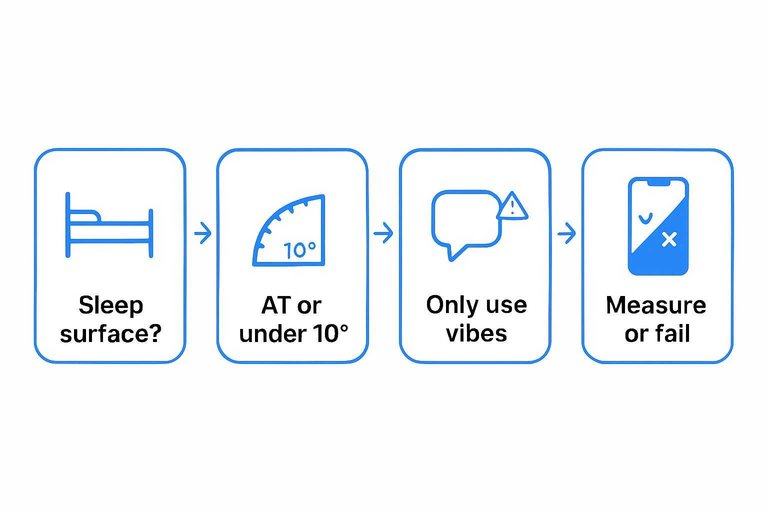
Decide whether you’re looking at a “sleep surface,” not just a “baby container.” If the review shows or encourages naps/overnight sleep in the product, treat it as sleep-safety-critical and keep going.
Look for an explicit angle claim and a test method. A trustworthy baby gear review will say the sleep surface is at or under 10° and explain how they verified it.
Flag reviews that only use vibes. “Baby slept great,” “anti-reflux angle,” or “slight incline” without a number is not safety evidence. Neither is “sleep-approved” without a standard or measurement.
If you can access the product (or its manual), do a quick screen measurement. The U.S. Consumer Product Safety Commission (CPSC) points to measuring an infant product’s maximum seat back/sleep surface angle along the occupant’s head-to-toe axis relative to horizontal, using the same method referenced in the ISP rule. A phone level/inclinometer can help you spot an obvious over-10° incline. (See CPSC’s Inclined Sleeper FAQs.)
If you can’t verify the angle, treat it as a fail for sleep use. Don’t “compare features anyway.” Your next move is to find a review (or documentation) that actually states the angle and method—otherwise you’re guessing where the safety line is.
When 10° isn’t final
A lot of baby gear reviews treat the U.S. angle cutoff like a magic stamp: “It’s under 10°, so it’s safe for sleep.” That’s a mistake, because the cutoff isn’t a universal agreement on what’s safe—it’s a regulatory line.
In the CPSC’s rulemaking record for the Infant Sleep Products final rule, a commenter pointed out that Canada allows only up to a 7° seat-back angle for sleep products and urged the CPSC to adopt that tighter limit. The CPSC kept 10° in the final rule anyway. The takeaway isn’t “pick a side.” It’s: don’t build your decision on being barely under a contested threshold.
How to use that as a parent when you’re reading baby gear reviews:
- If the review is treating the product as a sleep spot (naps count), your hard-stop is “flat enough that angle isn’t the feature.”
- If the selling point is elevation—“slight incline,” “reflux angle,” “keeps baby propped”—treat it as not a sleep product, even if the reviewer sounds confident.
- If the angle claim is close to the line or not clearly verified, don’t compare fabrics and portability. Rule it out for sleep use and move on.
Traceable product identity
A lot of baby gear reviews talk about “the” stroller or “the” high chair as if the name is the identity. It isn’t.
To do safety-first baby gear reviews, you need enough identifiers to prove you’re evaluating the exact version you’ll receive—and to check the exact version for recalls and manual rules.
A key category here is a durable infant or toddler product—a defined set of baby/toddler product categories under CPSC rules that must be permanently marked so the specific unit can be identified (including the date it was made). Those markings are how you keep “same product name” from becoming “different product, different risk.”
Find permanent markings
For durable products covered by CPSC’s tracking-label requirements (16 CFR Part 1130), look for permanent markings on the product itself (not just the box):
- Manufacturer or importer name. This is the “who,” which matters when brands license names or change factories.
- Contact information. A phone number, website, address, or other way to reach the responsible company.
- Model name and/or model number. This is the anchor for manual-matching and recall searches.
- Date of manufacture. The same model can change over time, and recalls often apply to specific date ranges.
When a review page doesn’t show these, don’t guess—go hunting:
- Zoom into product photos for the tracking label.
- Check the underside/back, battery compartment, frame crossbar, or label plate.
- Save screenshots of the listing and any label photos. Listings get edited, and you’ll want a record of what was represented when you decided.
Recall and manual check
Use the model number + manufacturer/importer name to find the manual for that exact product. Avoid “close enough” manuals that only match the product name.
Confirm the intended use and constraints in the manual. The manual is where you’ll find the allowed configurations, weight/height limits, and explicit “do not use” warnings that reviews routinely skip.
Run a recall search using the exact identifiers. Search by manufacturer/importer plus model name/number, then narrow by date-of-manufacture when the recall lists it.
Watch for version drift signals. If the review’s photos show one tracking label format or model number and the listing you’re buying shows another, treat it as a different product until you can reconcile the difference.
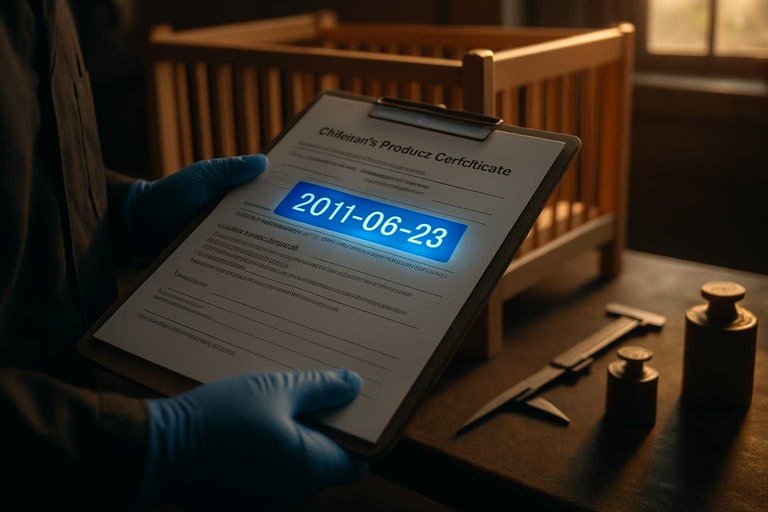
One concrete reason date matters: cribs placed in U.S. commerce have had to meet newer federal crib standards since June 28, 2011. Without a manufacture date and model identity, you can’t even place the product on the right side of that line.
If you can’t identify it, you can’t justify it—because you can’t trace it.
CPCs, cribs, seals
A lot of baby gear reviews treat “meets standards” as a vibe. For regulated children’s products, you want paperwork that ties a specific model to a specific set of safety rules—so you can do recall checks and avoid buying the “same name, different version” problem.
What a CPC is
A Children’s Product Certificate (CPC)—a written certification manufacturers/importers must issue for children’s products subject to safety rules, based on testing by a CPSC-accepted third-party laboratory—is the cleanest “safe enough to consider” signal that many reviews never mention.
When a review claims a product is “certified,” it should be able to point you to documentation, not a badge. At minimum, look for (or request from the manufacturer/importer) CPC details that let you match the certificate to the exact product you’re considering:
- Exact product identity: manufacturer/importer name plus the model name/number shown on the product or listing.
- Which rules it’s certifying to: the specific safety standard(s), not just “complies with regulations.”
- Who tested it: the third-party lab named on the certificate.
- When/where it was made or tested: enough to spot version drift (a “new” run isn’t always the same as the one in the review photos).
Where reviews go wrong is treating a certification seal as interchangeable with a CPC. For example, the JPMA (Juvenile Products Manufacturers Association) certification program described in federal documentation is voluntary—products are submitted voluntarily and tested to the applicable standard—so a seal can’t replace model-specific verification, recall checks, or category-specific legal bans.
Crib proof rules
Cribs are the easiest place to be strict, because there’s a hard compliance line.
CPSC guidance says that as of June 28, 2011, cribs offered for sale/resale or otherwise placed in U.S. commerce must comply with the newer federal crib standards. If a crib was manufactured before that date, CPSC says the preferred way to demonstrate compliance is a CPC or a third-party lab test report showing it meets the federal crib standards for full-size cribs (16 CFR Part 1219) or non-full-size cribs (16 CFR Part 1220).
So when you read baby gear reviews for cribs (especially “great deal” used crib recommendations), don’t accept “it looks sturdy” or “it’s solid wood.” Your minimum bar is: a manufacture date that puts it on the right side of 2011-06-28, or documentation (CPC/test report) that proves compliance anyway.
Audit the reviewer
A “good” baby gear review can still be a safety risk if the publisher is paid to keep the mood positive. Your goal isn’t to punish affiliate links—it’s to spot when the business model makes omissions more likely (missing recalls, skipping “don’t use it this way,” burying bad fit notes).
A quick reality check on a common SERP question: Is BabyGearLab a reliable source? Treat any site—BabyGearLab included—as only as reliable as what it makes checkable: how it got the product, how it makes money, whether it publishes corrections, and whether it shows safety work like recall checks, manual constraints, and the exact standard/rule it’s leaning on. Disclosures matter here, too: the FTC’s Endorsement Guides cover how endorsements are supposed to be presented, including when compensation or free products are in the picture.
Disclosures that matter
When money or freebies are involved, disclosure language is either a real signal—or decorative.
- Meaningful: “We earn a commission if you buy through our links.” (Tells you there’s an incentive to recommend.)
- Meaningful: “The brand provided this product for free” or “paid partnership/sponsored.” (Tells you the reviewer didn’t pay retail.)
- Meaningful: “We do not accept paid placements” plus a clear revenue model (affiliate, subscriptions, ads) and an edits/corrections policy.
- Performative: “Unbiased,” “independent,” “best overall” with no explanation of compensation.
- Performative: “We only recommend what we love” (a feeling, not a conflict statement).
One reason to take this seriously: the FTC Consumer Reviews and Testimonials Rule (16 CFR Part 465)—a U.S. trade regulation (effective October 21, 2024) targeting deceptive review/testimonial practices—authorizes courts to impose civil penalties for knowing violations. If a publisher is willing to play games with endorsements, they may also be willing to sand off safety-critical downsides.
Pollution and channels
Fake reviews and sketchy listings aren’t just annoying; they can break the link between the “reviewed product” and the one that shows up at your door.
- Identify the seller of record before you trust the rating. Prefer listings sold by the brand or a known retailer, not an unverified third-party storefront.
- Avoid channels where the listing can swap versions midstream. If the review’s photos/model info don’t match the current listing (model/version, tracking label, or manual), treat it as a different item.
- Insist on traceable identity in the listing. You want a model/version you can cross-check—otherwise you can’t confidently tie reviews, recalls, and manuals to what you’re buying.
On “What is the best website to buy baby stuff?” The best one is the channel that keeps the product identity intact from review to checkout—seller of record plus traceable model/version identifiers—so the safety evidence you verified still applies to what arrives.
Car seat review traps
Car seats are where “high-quality reviews” still mislead, because the same seat can be safe or unsafe depending on what happened to it (a crash), what you add to it (accessories), and how it’s installed and used.
Minor crash debate
A lot of baby gear reviews treat post-crash guidance like a single rule. It isn’t.
The National Highway Traffic Safety Administration (NHTSA) says car seats should be replaced after a moderate or severe crash. NHTSA also defines a minor crash (car seats)—a crash that meets all of NHTSA’s listed criteria (for example: the vehicle can be driven away, the door nearest the seat isn’t damaged, no injuries, airbags didn’t deploy, and there’s no visible damage to the car seat). NHTSA’s point is that a seat doesn’t automatically need replacement after a minor crash. (See NHTSA’s guidance on car seat use after a crash.)
But a review that stops there can still push you into a wrong decision, because the manufacturer’s manual can be stricter than NHTSA’s minor-crash criteria. For example, the Chicco Fit4 manual states: “You MUST replace this Child Restraint if it has been involved in a crash, even if you cannot see visible damage.”
If a review recommends a used seat or a “barely used” listing without asking “has it ever been in any crash?” and then applying the specific manual’s replacement rule, it’s doing shopping advice—not safety.
Accessory hard no
Car seat reviews love “comfort upgrades”: extra padding, strap covers, head supports, seat protectors, and any number of clever add-ons. That’s exactly where a review can turn hazardous while sounding helpful.
NHTSA’s glossary defines aftermarket products (car seats) as add-on parts/accessories not made or explicitly allowed by the car seat’s manufacturer. NHTSA notes these are not recommended unless they’re made or allowed by the original car seat manufacturer for use with that product.
So when a review praises an add-on—especially one that changes how the baby sits, how the harness lies, or how the seat fits the vehicle—treat the praise as a red flag until you can confirm the seat’s manufacturer explicitly allows it for that model.
The trap is subtle: the review may be accurate about comfort, but it can still normalize a configuration the manufacturer never tested or approved.
Misuse is common
“Easy install” is one of the most persuasive phrases in baby gear reviews—and one of the least trustworthy without proof.
NHTSA has estimated an overall misuse rate of 46 percent for car seats and booster seats. That number changes how you should read reviews: a reviewer’s confidence isn’t evidence that the setup is correct.
What a trustworthy car-seat review should document (not just claim):
- Which installation method they used, and what vehicle it was installed in.
- How they routed and tightened the belt/anchors—clear photos or video where the belt path and locking/tensioning are visible.
- How the recline was verified, using the seat’s built-in indicator or method described in the manual.
- Harness fit on an actual child-size occupant (or a clearly described fit check), including where the straps sit and how slack is removed.
- What went wrong on the first attempt, and what the manual said to do instead.
A review that can’t show its work is entertainment, not a safety reference.
Car-seat mini checklist (use this before you trust any “top pick”):
- Crash history: confirm whether the seat has ever been in a crash, then follow the exact manual’s replacement rule (not a generic rule).
- Minor-crash confusion: if someone cites NHTSA’s “minor crash” guidance, make sure they also check the manufacturer’s instructions.
- Accessories: ignore any add-on praise unless it’s made or explicitly allowed by the seat’s manufacturer for that model.
- Installation: require photos/video that show the install method, belt path, recline check, and tightness—not just “it felt solid.”
- Fit: require evidence of harness fit checks, not “baby looked comfy.”
- Manual match: ensure the review is using the manual for the exact model/version being sold, so the rules they’re following are the rules you’ll be bound by.
Run the audit before buying
Don’t use reviews to “find the best”—use them to catch the predictable ways a confident recommendation can still be unsafe. The next time a product page or roundup persuades you, pause and run the two-minute workflow: hard-stop anything being sold or used as sleep, then verify identity (model/version, markings) and the documents that make recall and manual checks possible. If the review can’t show bans/standards, angle limits where relevant, and traceable identifiers, treat it as shopping content—not safety evidence—and move on. Preferences only matter after a product clears those gates.
Frequently Asked Questions
- Are inclined infant sleepers and crib bumpers still legal to buy if a baby gear review recommends them?
- No—U.S. law treats “inclined sleepers for infants” and “crib bumpers” (as defined in the Safe Sleep for Babies Act) as banned hazardous products as of November 12, 2022, regardless of when they were made. If a baby gear review treats either as a “comfort upgrade,” stop shopping that category instead of comparing brands.
- What info should a baby gear review include so I can check the exact model for recalls and manual rules?
- It should show the durable-product tracking information on the product itself—manufacturer/importer identity, model name/number, and date of manufacture—so you can match the manual and run a recall search on the exact version. If the review or listing doesn’t show that identity, treat it as not traceable and keep looking.
- Is a certification seal in baby gear reviews the same thing as a Children’s Product Certificate (CPC)?
- No—a seal like JPMA indicates participation in a voluntary certification program, while a CPC is model-specific compliance documentation for products subject to CPSC rules. Use seals as a clue to investigate, not as a replacement for checking bans, recalls, and the exact product documentation.
- How can I tell if a baby gear review is biased or breaking disclosure rules?
- Look for plain-language disclosure that the publisher earns commissions, received free product, or was paid, then verify they publish corrections and show safety evidence (recalls, manuals, standards) rather than just star ratings. The FTC’s Consumer Reviews and Testimonials Rule took effect October 21, 2024, and targets deceptive review and testimonial practices.
- Is the 10-degree rule a guaranteed safe-sleep green light in baby gear reviews?
- No—10° is a U.S. regulatory limit used in infant sleep product rules, but the rulemaking record reflects disagreement (including a noted Canadian limit of 7° for sleep products). For baby gear reviews, treat “incline as a feature” as a sleep red flag and require a clearly verified angle and test method before considering sleep use.
Turn Reviews Into Safety Evidence
Once you’ve learned what to screen for, the next challenge is finding reviews that consistently show the documents, identifiers, and standards behind the claims.
At childbloom, pediatrician-signed guides vet baby gear against safety standards, recall history, and real-family use—so your shortlist starts with evidence, not hype.
Sources
- Children’s Product Certificate | CPSC.gov — referenced in 11 mistake map
- Safe Sleep for Babies Act Business Guidance | CPSC.gov — referenced in Sleep claims hard-stop
- Inclined Sleeper FAQs | CPSC.gov — referenced in Verify the incline
- Car Seat Use After a Crash: Replacing Car Seats | NHTSA — referenced in Car seat review traps
Written with Skribra