Alternate Vaccination Schedule: What It Is, Risks, and Benefits
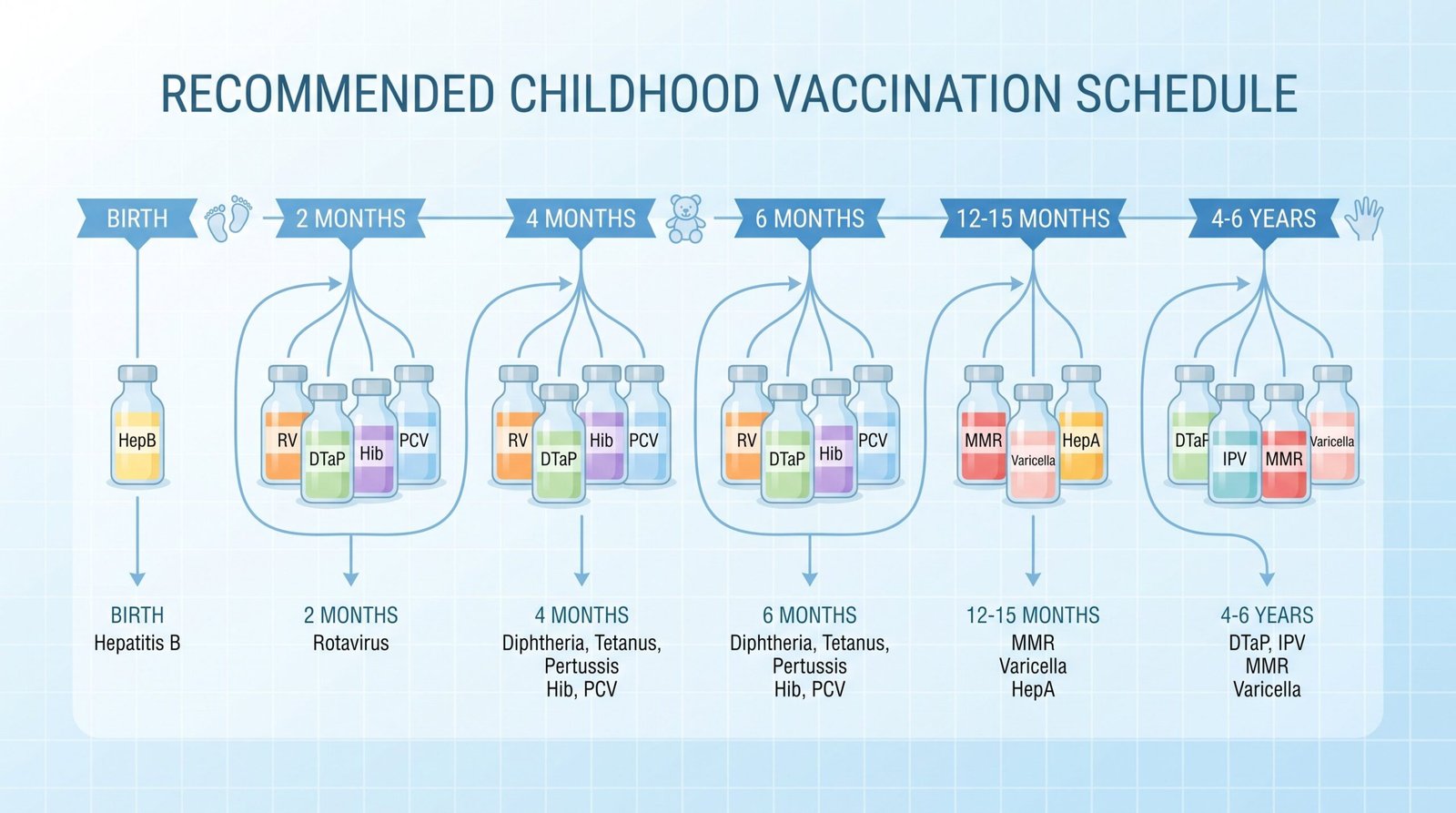
You’ve probably heard another parent mention spacing out shots, or maybe your pediatrician brought up the standard CDC schedule and you found yourself hesitating. An alternate vaccination schedule simply means spreading out or reordering the recommended childhood immunizations instead of following the CDC’s timeline as published. Some parents call it a delayed vaccine schedule, others reference Dr. Sears’ plan by name, but the underlying idea is the same: fewer shots per visit, spread over more visits.
If you’re trying to figure out whether this approach is safe, how it actually differs from the standard timeline, or what pediatricians think about postponing a vaccination schedule, you’re in the right place. We’ll walk through what these alternative schedules look like in practice and where the real evidence stands.
This guide breaks down the most common alternative vaccination schedules, compares them directly to CDC recommendations, and lays out the documented risks and any claimed benefits. As a site built around named pediatrician review rather than opinion, we’re focused on giving you the clinical picture, not talking you into or out of a decision that belongs between you and your child’s doctor.
Why parents consider an alternate vaccination schedule
Most parents who ask about spreading out shots aren’t rejecting vaccines outright. They’re worried about the number of injections crammed into a single well-visit, especially around the two, four, and six-month checkups when a baby can receive four or five shots at once. That visual, a screaming infant getting jabbed repeatedly, drives a lot of the interest in a delayed vaccine schedule. Others come to the conversation after reading something online that claimed a link between vaccine timing and autism, allergies, or immune overload, even though the CDC and the American Academy of Pediatrics have repeatedly found no credible evidence supporting those claims (see the CDC’s vaccine safety page).
The reasons parents most often cite
Here’s what actually comes up in pediatric offices when families ask about a vaccine schedule alternative:
- Needle anxiety, both the parent’s and the child’s, especially after a rough previous visit
- Perceived immune overload, the belief that a young immune system can’t handle multiple antigens at once (research doesn’t support this concern)
- Family history of autoimmune conditions or severe allergic reactions, which sometimes prompts a more cautious, spaced-out approach in consultation with a specialist
- Distrust of pharmaceutical companies or government health guidance, often amplified by social media
- A premature or medically fragile birth, where a neonatologist may genuinely recommend adjusting timing
- Wanting to "watch and wait" for a reaction before adding another vaccine to the mix
Fear travels faster than data
Social media plays an outsized role here. A single viral post about a vaccine delayed schedule "protecting" a child can spread further and faster than a peer-reviewed study debunking the same claim. Parenting forums and parent groups on Facebook often reinforce this cycle, where anecdote gets treated as evidence. Anecdotes feel more persuasive than statistics, especially to a sleep-deprived new parent scrolling at 2 a.m., which is exactly why so many families ask their pediatrician about postponing a vaccination schedule even when they can’t point to a specific study behind the request.
Most requests to delay vaccines come from fear of the process, not from evidence against the vaccines themselves.
When the concern is medically legitimate
Occasionally the reasoning is sound. A child with a documented severe allergic reaction to a vaccine component, a bleeding disorder, or an ongoing course of immunosuppressive treatment may genuinely need a modified timeline, but that decision should come from a specialist familiar with the child’s chart, not a parenting forum. Specialists weigh the actual risk of the underlying condition against the risk of delayed protection, something a general internet search can’t do. Pediatricians we’ve spoken with are clear that these cases are the exception, not the rule, and that the vast majority of families requesting a postpone vaccination schedule approach are healthy kids whose parents are reacting to fear rather than a documented medical need.
Regardless of the motivation, the conversation is worth having openly with your child’s doctor rather than making the decision alone. Doctors would rather walk through your specific worries, whether it’s needle count, ingredients, or family history, than have you quietly skip or delay shots without their knowledge. That transparency is where the next section picks up: how to actually have this conversation and adjust a schedule safely if you decide to.
How to safely adjust your child’s vaccine schedule
Once you’ve decided to raise the topic, the goal shifts from "should I delay" to "how do I do this without leaving my child exposed." A safe delay vaccine schedule conversation starts with your pediatrician, not a printout from a website or a friend’s recommendation. Bring your specific concerns, whether it’s needle count, ingredient worries, or a family medical history, and ask your doctor to walk through the actual risk of waiting on each individual vaccine rather than treating the schedule as one block.
Talk to your pediatrician before you change anything
Your child’s doctor knows local disease activity, your child’s health history, and daycare or travel exposure risks that a generic online schedule can’t account for. Some practices will document an alternative vaccine schedule in the chart so every provider your child sees, including urgent care or a different pediatrician on call, knows what’s been given and what’s pending. Skipping this step is how kids end up with gaps nobody tracks.
A modified schedule only works if it’s written down and followed by every provider your child sees.
What actually stays non-negotiable
Not every vaccine carries the same urgency. Some protect against diseases with a narrow, dangerous window in early infancy, and pediatricians are far less flexible about delaying those.
| Vaccine | Why timing matters |
|---|---|
| Pertussis (part of DTaP) | Whooping cough is most deadly under 6 months |
| Hib | Meningitis risk peaks in infancy |
| Pneumococcal (PCV) | Highest severe-illness risk in the first year |
| Rotavirus | Must start and finish within a strict age window |
Steps for adjusting responsibly
- Get specific, ask which shots concern you and why, rather than requesting a blanket delay.
- Request a written, dated schedule you can bring to every visit.
- Track reactions after each shot instead of assuming a future one will cause the same issue.
- Confirm catch-up timing against the CDC’s published catch-up schedule so gaps don’t stretch longer than intended.
- Revisit the plan at each well-visit as your child’s risk factors (daycare, travel, exposure) change.
Following this process keeps a vaccine schedule delayed by choice from turning into one delayed by neglect.
Comparing popular schedules: Dr. Sears vs. CDC catch-up
When parents search for an alternative vaccine schedule, two names dominate the results: the CDC’s official catch-up schedule and Dr. Robert Sears’ alternative plan, first published in "The Vaccine Book." They solve different problems. The CDC catch-up schedule exists for kids who missed doses, not for families intentionally spacing out a healthy infant’s shots. Dr. Sears’ plan, by contrast, was built specifically for parents who want fewer injections per visit, even though it stretches full protection out over a longer window.
The CDC catch-up schedule
This schedule assumes a child fell behind, whether from illness, insurance gaps, or a missed appointment, and it’s designed to close that gap as fast as safely possible. It uses minimum intervals between doses rather than the ideal spacing, so a child can catch up without doubling up on live vaccines too close together. Pediatricians reach for this schedule constantly; it’s not controversial, and the CDC publishes it openly alongside the standard timeline.
Dr. Sears’ alternative schedule
Sears’ plan intentionally separates vaccines that are normally given together, spreading a two-month visit’s worth of shots across several extra appointments. He also delays some vaccines, like Hepatitis B at birth, until later in infancy. The tradeoff is real: more office visits, more copays for some families, and a longer stretch where a child is unprotected against diseases like pertussis or Hib during the exact months they’re most dangerous.
Spacing out shots doesn’t reduce risk, it just relocates the window of vulnerability further into infancy.
Side-by-side comparison
| Feature | CDC Standard/Catch-up | Dr. Sears’ Alternative |
|---|---|---|
| Purpose | Full protection ASAP or after a missed dose | Fewer shots per visit, spread out |
| Office visits by age 2 | Fewer, more shots each | More visits, fewer shots each |
| Evidence base | Decades of clinical trials and surveillance | Author’s clinical opinion, no trial data |
| AAP/CDC endorsement | Yes | No |
| Protection timing | Fastest against early-infancy diseases | Delayed on several key vaccines |
Neither schedule is inherently wrong to ask about, but only one has been studied at scale. If you’re weighing a vaccine schedule alternative like Sears’ plan, know that you’re trading a documented safety record for a personal comfort preference, which is worth naming honestly before you commit to it.
Weighing the risks and benefits of delaying vaccines
Every family considering a delayed vaccine schedule deserves a clear-eyed look at what’s actually being traded, not just reassurance in either direction. The biggest documented risk is time: every week a vaccine is postponed is a week your child stays unprotected against a disease that hasn’t gone away just because it’s rare in your neighborhood right now. Outbreaks of measles and pertussis in under-vaccinated communities show what happens when enough families push timing back at once, according to CDC outbreak surveillance data.
The documented risks
Spacing shots out also means more office visits, more copays for many families, and more total needle sticks over time since combination vaccines get split apart. It can complicate daycare enrollment, since many centers require proof of an on-time schedule. It also makes tracking harder, a partial schedule is easy to lose track of across providers, pediatric offices, and school enrollment paperwork.
Delaying a vaccine doesn’t remove the risk of the disease, it just extends how long your child is exposed to it.
The claimed benefits
Parents who choose a vaccine schedule alternative usually cite fewer tears per visit and a feeling of more control over their child’s care. Those benefits are real for the parent’s peace of mind, but they’re not medical benefits in the clinical sense. No published research shows better immune outcomes, fewer allergies, or reduced autism risk from spacing out shots, a point the American Academy of Pediatrics has stated plainly.
Side-by-side summary
| Standard CDC schedule | Delayed/alternative schedule | |
|---|---|---|
| Protection timing | Fastest possible | Extended window of vulnerability |
| Office visits | Fewer | More |
| Total needle sticks | Fewer, combined | More, spread out |
| Evidence of added safety | N/A | None documented |
| Parental comfort | Sometimes lower | Often higher |
Weighing these tradeoffs honestly, rather than assuming delay is automatically the gentler choice, is what separates an informed decision from one driven purely by fear.
Making an informed choice for your child
Deciding whether to follow an alternate vaccination schedule isn’t about picking a side in an online argument. It’s about weighing a documented, decades-long safety record against a personal comfort preference, then having that conversation openly with your child’s pediatrician instead of guessing alone. The evidence is consistent: delaying doesn’t make vaccines safer, it just stretches out the window when your child is unprotected against diseases that are still circulating. If needle count or family history genuinely worries you, say so at the next well-visit and ask your doctor to walk through each vaccine individually rather than requesting a blanket delay.
Good decisions come from good information, not fear scrolled at midnight. For more physician-reviewed guidance on infant health, gear, and safety questions like this one, browse the clinical desk articles at ChildBloom before your next appointment.
Authoritative Resources
Frequently Asked Questions
What is an alternate vaccination schedule?
An alternate vaccination schedule spreads out or reorders the recommended childhood immunizations instead of following the CDC’s timeline. Some parents delay certain vaccines or give them one at a time rather than in combination.
What are the risks of delaying vaccines?
Delaying vaccines leaves children vulnerable to serious diseases during the period of greatest risk. Diseases like measles, pertussis, and Hib can be life-threatening in young children. The CDC schedule is designed to protect children when they’re most vulnerable.
Is the CDC vaccine schedule safe?
Yes, the CDC vaccine schedule is extensively studied and continuously monitored for safety. It’s developed by experts from the CDC, AAP, and AAFP based on decades of research. The schedule protects children from 16 serious diseases.
Can I space out vaccines to reduce side effects?
Spacing out vaccines has not been proven to reduce side effects and actually increases the time children are vulnerable to diseases. Most side effects are mild and temporary. The CDC schedule minimizes the number of visits while maximizing protection.
Disclaimer: This article is for general informational purposes only and is not a substitute for professional medical advice. Always consult your pediatrician.