Helping Toddlers Express Feelings: A Parent Guide (1–3 Years)
Helping Toddlers Express Feelings: A Parent Guide (1–3 Years)
Medically reviewed by Dr. Ahmed Raza, MD, FAAP — ChildBloom Medical Review Panel. Last updated: September 24, 2026.
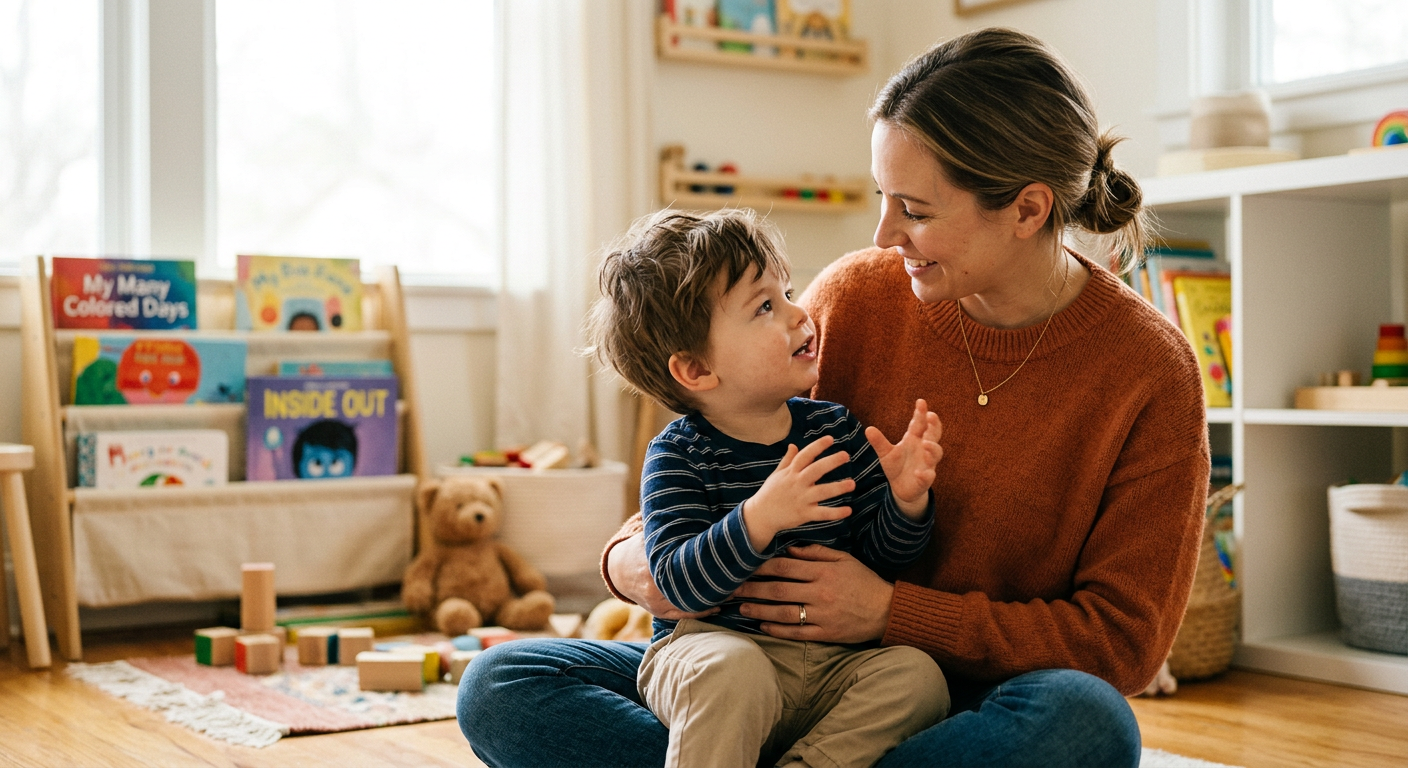
Toddlers have big feelings and very few words. Long before they can say “I am frustrated,” it shows up as tears, hitting, clinging, or going limp on the floor. This guide covers what to say in the moment, the words your child can learn at each age, and when a pediatrician should take a look.
Why feelings are so hard to say out loud
Between the first and third birthdays, tantrums are common because language is still catching up. Toddlers understand more than they can express, and words for feelings develop later than words for objects (KidsHealth).
Emotions also swing fast at this age. A two-year-old can go from beaming to weepy in minutes, and those swings are part of learning to control actions, impulses, and feelings (HealthyChildren).
The second year brings a push for independence. Your child may swing between “I do it myself” and clinging to you, sometimes within the same hour, and both are normal (HealthyChildren).
Expect the same rule to be kept on Monday and broken on Tuesday. Two-year-olds have little control over strong feelings yet, so lapses are part of the age rather than a sign of a bad day (HealthyChildren).
Name the feeling in one short sentence
Pediatricians at the American Academy of Pediatrics describe emotion coaching as three moves: notice the feeling, name it, then meet the need underneath (HealthyChildren).
A sentence like “You are mad. We have to leave the playground, and you were having fun” does more work than a question. One label, one reason, said in a calm voice, is usually enough.
Feeling understood makes a feeling easier to carry, and it hands your child the exact word to reach for next time. You are building a small vocabulary that your child can use before the next meltdown.
Your voice matters as much as your words. Keep it low and even, because toddlers read tone before they understand sentences.
It also helps to name your own feelings out loud in plain words: “I am frustrated, so I am taking a breath.” Children copy what they see far more than what they are told (KidsHealth).
Answer the serve, and you build the return
Babies and toddlers send out “serves” all day long: a coo, a point, a cry, a look at your face. When you answer with eye contact, words, or a hug, that back-and-forth exchange is called serve and return, and it is how young brains grow (Harvard Center on the Developing Child).
Naming what your child sees, does, or feels helps build language connections even before your child can talk. That is why narrating the day works: “You found your red shoe. Shoe goes on your foot.”
You do not need long talks. Short replies, repeated many times a day, are what a young child’s brain expects and uses.
Narrating the day is the simplest way to practice. Name people, places, and things during baths, walks, and nappy changes, and add one feeling word when one fits (KidsHealth).
Sportscasting: describe what you see
Sportscasting means narrating your child’s behavior out loud in a warm tone. Saying “You stacked the blue block on top” tells a toddler they have been noticed, even when they were not asking for attention (HealthyChildren).
It works best during calm play, which makes it easier to reach for during hard moments. Describing instead of judging keeps the room quiet and keeps you connected.
Feelings words your toddler can actually use
Most 18-month-olds say about ten words, including “mama” and “dada.” Start with single feeling words such as mad, scared, and sad, and pair each one with a face or a gesture (KidsHealth).
By 24 months, many toddlers put two words together and read your face for cues. Typical social milestones at this age include noticing when someone is hurt or upset and looking at your face to see how to react (KidsHealth).
Practice these words at easy moments: while dressing, during bath time, or in a picture book. If words are slow to arrive, our toddler speech milestones guide shows what to expect and when to ask about it.
Use play to teach feelings
Play lets a child try out feelings at low stakes. One AAP resource suggests sorting feelings into color zones, drawing a face for each zone, and then asking how to get back to the green one (HealthyChildren).
Stories work the same way. Talk about what a character feels at bedtime, then about what you felt today, and let your child answer with words, drawings, or toys.
Children who do not want to talk it out still need an outlet. The same resource recommends a small “let it out” spot with paper, clay, or dress-up props, offered as a choice rather than a punishment.
Movement helps many toddlers settle faster than talking does. Jumping, a tight hug, deep breaths, or a walk around the room can all work, so let your child show you what calms them (HealthyChildren).
Keep a routine you can count on, since big changes in the day often land as big feelings at night. Predictable meals, naps, and bedtimes remove some of the friction before it starts (HealthyChildren).
Give 15 minutes of full attention
Set aside 10 to 15 minutes, two or three times a week, with the phone away and your child choosing the game. The AAP calls this sunshine time, and its purpose is to help a child feel seen (HealthyChildren).
Sportscasting fits naturally here, because you are simply describing what your child is doing. A timer keeps the session short enough to repeat on busy days.
Regular attention also matters during the day. KidsHealth advises catching your child being good and praising it specifically, so attention arrives before it has to be demanded (KidsHealth).
What to do when the feeling becomes a tantrum
Tantrums are a normal part of development, most common between ages 1 and 3, and they happen equally in boys and girls. They range from whining and crying to screaming and kicking, and they are how young children show that they are upset (KidsHealth).
During an outburst, keep your own voice low and steady. Comfort a child who is tired or hungry, and move a child who is hitting to a quiet, safe place to settle (HealthyChildren).
Offer small choices before trouble starts, such as which cup to use or whether teeth come before the bath. Reducing power struggles in advance leaves fewer feelings to explode (KidsHealth).
Prevention is mostly ordinary stuff. Keep off-limits things out of sight, distract your child toward a new activity, and plan outings around snacks and naps rather than the other way around (KidsHealth).
When your child wants something you have said no to, stay calm and keep your answer short. A long explanation in the middle of a tantrum tends to feed it instead of ending it (KidsHealth).
Once your child is calm, offer a hug and name what they did well: “You settled yourself down.” Then, and only then, talk about what to say next time instead. For a fuller walkthrough, see our guide to toddler tantrums.
Some families set up a calm corner with a cushion, a few books, and soft music. Offer it as a place to choose when feelings run high, never as a punishment for having them (KidsHealth).
Hard goodbyes and separation feelings
Separation anxiety usually appears around the first birthday and is a normal part of childhood development. Crying and clinging at drop-off do not mean something is wrong (KidsHealth).
Build one short goodbye ritual: a kiss, a calm “I will come back after lunch,” and then leave. Use time your toddler can picture, such as after lunch or after nap, and come back when you promised (KidsHealth).
Do not sneak out. A child who never knows when you will disappear tends to hold on tighter, while a child who sees you leave and return learns that you always come back (HealthyChildren).
Plan ahead when you can. Let a new babysitter visit while you are still home, and try not to leave right when your child is hungry, tired, or just waking up (KidsHealth).
Common mistakes parents make
- Interrogating mid-meltdown. Asking “Why are you crying?” adds pressure when your child cannot answer yet. Save the questions for when everyone is calm (KidsHealth).
- Giving a long lecture while feelings are still high. KidsHealth suggests staying brief when your child has been refused something, then moving on to the next activity (KidsHealth).
- Sneaking away instead of saying goodbye. A quick exit often makes clinging worse. A short ritual and a kept promise build trust instead (HealthyChildren).
- Using time words a toddler cannot picture. “In an hour” means nothing at two years old. Try “after lunch” or “after your nap” (KidsHealth).
- Letting hitting or biting slide. The AAP calls for zero tolerance on hitting, kicking, and biting. Stop the behavior and help your child reset (HealthyChildren).
- Giving in at the peak. A reward at the end teaches that the tantrum worked. Stay kind, stay firm, and reconnect once the storm passes (KidsHealth).
Tiredness and hunger make all of this harder, so a predictable day helps. Our toddler sleep schedule guide covers the rest and naps that keep evenings calmer (KidsHealth).
Red flags — when to call your pediatrician
Call your pediatrician if tantrums are happening more often, lasting longer, or getting more intense than before. Also call if you often feel angry or out of control while responding to them (KidsHealth).
Ask for a visit if your child seems very passive or withdrawn, sad most of the time, or hard to satisfy nearly all day. Those patterns are worth a conversation rather than a wait-and-see approach (HealthyChildren).
Tell your pediatrician if your child has lost skills they once had, or is not meeting milestones you expected. You know your child best, and small worries are worth raising (KidsHealth).
Separation fear that continues into the school years and blocks daily activities also deserves a check-in. Panic symptoms before a goodbye are another reason to ask (KidsHealth).
Worries about words and language belong in the same conversation. Bring them to your next well-child visit, and read our positive parenting guide for the day-to-day side of it.
Frequently asked questions
When will my toddler say feelings words? Feelings words usually arrive after simple nouns, because they are harder to say and easier to show. Most 18-month-olds have about ten words in total, and understanding runs ahead of speech at this age (KidsHealth).
Should I ask my child why they are upset? Not in the middle of it. Name what you see instead, then ask gentle questions later, once your child is calm and can think clearly.
Are tantrums a sign of a problem? Usually not. Tantrums are a normal part of development between ages 1 and 3, and most children grow out of them as language and self-control improve (HealthyChildren).
Does naming a feeling make the behavior worse? Naming is not the same as giving in. Emotion coaching helps a child feel understood, and limits can still hold at the same time (HealthyChildren).
What if my child will not talk about feelings at all? That is common, and talking is not the only way in. Drawing, dress-up, music, or a favorite toy can carry the same message when words are too hard that day (HealthyChildren).
References
- AAP HealthyChildren: Helping Little People Manage Big Feelings
- AAP HealthyChildren: Emotional Development, 2 Year Olds
- AAP HealthyChildren: Emotional Development, 1 Year Olds
- AAP HealthyChildren: Top Tips for Surviving Tantrums
- AAP HealthyChildren: Play Activities to Help Children Manage Emotions
- Nemours KidsHealth: Temper Tantrums
- Nemours KidsHealth: Disciplining Your Toddler
- Nemours KidsHealth: Separation Anxiety
- Nemours KidsHealth: Developmental Milestones at 18 Months
- Nemours KidsHealth: Your Child’s Development at 2 Years
- Harvard Center on the Developing Child: Serve and Return
Medical disclaimer: This article is general information, not individual medical advice. Talk with your own pediatrician about your child’s speech, behavior, growth, or development, and seek urgent care for breathing trouble, a fever in an infant under 3 months, or any sudden change in your child’s condition.





2 Comments