Winter Baby Care: Dry Skin, RSV, and Indoor Air Safety
Medically reviewed by Dr. Ahmad Raza, MD (Pediatrics) — ChildBloom Medical Review Panel. Last updated: August 4, 2026.
Editorial & affiliate disclosure: our guidance is written and reviewed by clinicians. ChildBloom may earn a commission from qualifying purchases made through links on this page, which never changes what our pediatric reviewers recommend.
Looking for clear answers about winter baby care? This pediatrician-reviewed guide covers what matters, what to skip, the safety checks that count, and exactly when to involve your doctor — based on current AAP, CDC and CPSC guidance on winter baby care.
Quick pediatrician summary: winter baby care
Short answer: A pediatrician explains winter baby care: what is normal, the real risks, red flags to watch for and exactly when to call your doctor.
Written by the ChildBloom Pediatric Panel, FAAP | Medically reviewed July 14, 2026 | Last updated July 14, 2026
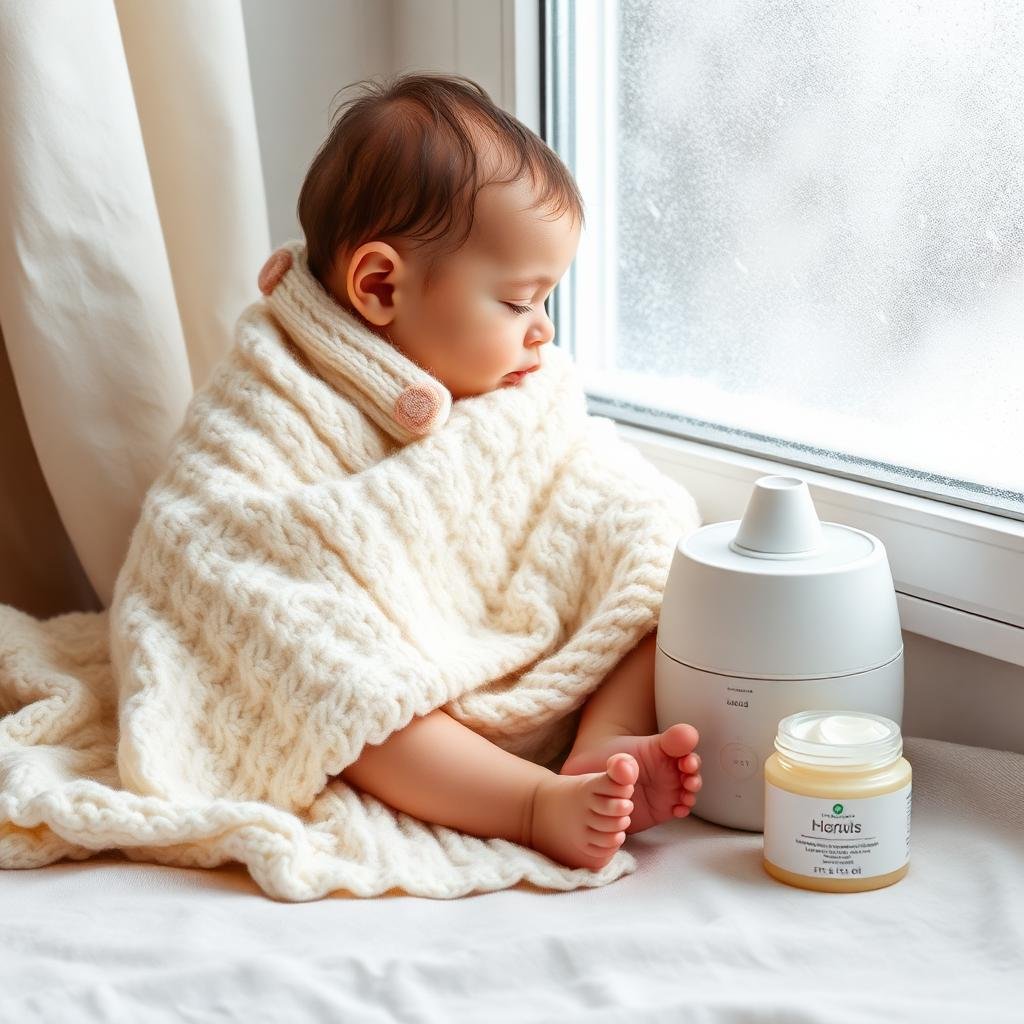
Winter is the season that tests both your baby’s skin and their immune system. The same heated indoor air that keeps your family comfortable also strips moisture from infant skin at an alarming rate. The same sealed windows that trap warmth also trap respiratory viruses. And the cold, dry outdoor air that you venture into for errands creates a temperature swing that stresses a baby’s still-maturing systems.
As a pediatrician, I see three conditions spike predictably every winter: eczema flares, RSV bronchiolitis, and viral upper respiratory infections. All three are interconnected — dry skin compromises the barrier that keeps pathogens out, dry nasal mucosa impairs the nose’s ability to filter viruses, and crowded indoor spaces increase exposure.
This article will walk you through the winter-specific risks for babies and give you a clinical framework for managing each one.
PART 1: WINTER DRY SKIN — WHY HEATED AIR IS THE ENEMY —
1.1 The Humidity Problem
Comfortable indoor heating maintains air temperature at 68-72F — but it does not add moisture. Cold outdoor air holds very little moisture (absolute humidity at 30F is approximately 3-4 grams per cubic meter, compared to 15-20 grams at 80F). When you bring that dry air indoors and heat it, the relative humidity drops to 10-20%. For reference: – Ideal indoor humidity for skin health: 40-60% – Typical heated home in winter: 10-25% – Desert climate: 20-30%
Your heated home in winter is essentially a low-humidity chamber. For an adult, this means slightly dry skin and static electricity. For a baby with thin, immature skin, it means accelerated transepidermal water loss (TEWL), compromised skin barrier function, and eczema flares.
1.2 The Winter Itch (Asteatotic Eczema)
This is a specific form of dry skin eczema that peaks in winter. It presents as: – Fine, cracking, “crazy-paving” pattern on the skin (look closely — the surface looks like a dried riverbed) – Most common on the lower legs, arms, and trunk – Intensely itchy – Worse after bathing (hot water strips oils) – More common in babies with a baseline tendency toward eczema
1.3 The Winter Skin Care Protocol
Step 1: Humidify the baby’s room. Use a cool-mist humidifier to maintain 40-60% relative humidity. Clean the humidifier weekly to prevent mold and bacterial growth. Use distilled water to minimize mineral dust.
Step 2: Shorten and cool down baths. Reduce bath time to 5 minutes or less. Use lukewarm water (not hot — hot water strips oils from the skin). Use a soap-free, fragrance-free cleanser only on the diaper area and skin folds. Do not use cleanser on the entire body every day.
Step 3: The “soak and seal” method. Within 3 minutes of removing the baby from the bath, while the skin is still damp, apply a thick layer of moisturizer (cream or ointment — not lotion). This traps the bathwater in the stratum corneum.
Step 4: Switch to an ointment at night. During the day, a ceramide-rich cream is sufficient. At night, use a petrolatum-based ointment (Aquaphor or Vaseline) on dry areas. The longer contact time provides deeper barrier repair.
Step 5: Moisturize proactively. Do not wait for the skin to look dry. Apply moisturizer after every bath and at least once more during the day. Prevention is far easier than repair.
PART 2: RSV SEASON — WHAT EVERY PARENT NEEDS TO KNOW —
2.1 What Is RSV?
Respiratory syncytial virus (RSV) is the most common cause of lower respiratory tract infection in infants. By age 2, nearly all children have been infected at least once. For most healthy older children and adults, RSV is a mild cold. For infants — particularly those under 6 months, those born premature, and those with underlying heart or lung conditions — it can cause severe bronchiolitis and pneumonia.
2.2 The Seasonality
RSV season in the United States typically runs from October through March, peaking in December-January. The virus spreads through: – Respiratory droplets (coughing, sneezing) – Direct contact with contaminated surfaces (RSV survives on hard surfaces for several hours) – Close personal contact (kissing, holding)
2.3 Symptoms in Infants
Early symptoms (mimic a common cold): – Runny or congested nose – Mild cough – Low-grade fever – Decreased appetite
Warning signs (progression to bronchiolitis): – Rapid breathing (>60 breaths/minute in an infant) – Nasal flaring (nostrils widening with each breath) – Retractions (skin pulling in between the ribs or below the ribcage with each breath) – Wheezing – Gray or blue color around the lips or fingernails (cyanosis — this is an emergency) – Lethargy or difficulty waking – Poor feeding (fewer wet diapers)
2.4 Prevention Strategies
- Handwashing: Everyone who handles the baby should wash hands first. This is the single most effective preventive measure.
- Limit exposure: During peak RSV season, avoid crowded indoor spaces with the baby when possible.
- No sick contacts: Anyone with cold symptoms should not hold or be near the baby.
- Breastfeeding: Breast milk provides antibodies (especially secretory IgA) that protect the respiratory mucosa.
- Keep surfaces clean: Wipe down high-touch surfaces (doorknobs, phones, counters) regularly.
- Avoid smoke exposure: Secondhand and thirdhand smoke impair the respiratory mucosa’s ability to fight infection.
- Palivizumab (Synagis): For high-risk infants (premature, congenital heart disease, chronic lung disease), monthly injections of this monoclonal antibody during RSV season significantly reduce the risk of severe RSV infection. Ask your pediatrician if your baby qualifies.
2.5 When to Go to the ER
Go to the emergency room immediately if your baby: – Is under 3 months old and has any difficulty breathing – Has blue or gray color around the lips or face – Has pauses in breathing (apnea) – Is severely lethargic or difficult to wake – Has signs of significant dehydration (no wet diapers for 8+ hours, sunken fontanelle) – Is breathing very rapidly (>60 breaths/minute) or with visible retractions
PART 3: INDOOR AIR QUALITY — THE HIDDEN WINTER HAZARD —
3.1 The Problem
When windows are sealed for months, indoor air accumulates pollutants: – Volatile organic compounds (VOCs) from cleaning products, paint, and new furniture – Particulate matter from cooking, candles, and fireplaces – Carbon monoxide from gas stoves and furnaces (in poorly ventilated homes) – Biological allergens (dust mites, mold, pet dander) that concentrate in sealed environments – Dry air that irritates the respiratory mucosa
3.2 What You Can Do
- Run a cool-mist humidifier (40-60% humidity). This protects both skin and respiratory mucosa.
- Use a HEPA air purifier in the baby’s room. True HEPA filters remove 99.97% of particles 0.3 microns and larger.
- Ventilate when possible: Open windows for 10-15 minutes daily, even in winter, to flush accumulated VOCs and CO2. Choose a time when outdoor air quality is acceptable.
- Avoid candles, incense, and air fresheners. These generate particulate matter and VOCs.
- If you have a gas stove, use the range hood every time you cook. Gas stoves emit nitrogen dioxide (NO2), which irritates the respiratory tract.
- Install carbon monoxide detectors on every level of the home and near sleeping areas. Test monthly.
- Avoid smoking indoors. Thirdhand smoke (residue on surfaces and clothing) is a significant irritant for infant airways.
PART 4: WINTER CLOTHING — THE OVER-BUNDLING TRAP —
Many parents, anxious about the cold, dress their babies in too many layers. Overheating in winter is a real risk — and it is not just uncomfortable. Overheating is a recognized risk factor for SIDS.
The rule: Dress the baby in one more layer than you would comfortably wear in the same environment.
Check for overheating: Feel the baby’s chest or the back of their neck. If warm and dry, the clothing is appropriate. If sweaty or hot, remove a layer. Do NOT use hand temperature as a guide — babies’ hands are normally cool.
Car seat safety and winter coats: Bulky coats and bunting bags create a gap between the baby’s body and the harness, making it dangerously loose in a crash. The correct approach: 1. Secure the baby in the car seat in their regular clothing (a thin fleece layer is fine). 2. Tighten the harness snugly (you should not be able to pinch excess webbing at the shoulder). 3. AFTER the harness is secured, place the coat or bunting bag OVER the harness like a blanket. 4. Remove the over-layer when the car warms up to prevent overheating.
PEDIATRICIAN’S TAKE —
Winter is the season where I see the most preventable problems: eczema flares from dry air, RSV hospitalizations from preventable exposures, and overheating from over-bundling. The solutions are not complicated. Run a humidifier. Moisturize aggressively after baths. Wash hands before touching the baby. And please — do not put a puffy coat under a car seat harness. I have seen harnesses loosen so much in crashes that the child was essentially unrestrained. A blanket over the secured harness is the safe alternative.
WHEN TO CALL THE DOCTOR —
- Baby has rapid breathing, nasal flaring, or retractions (possible RSV bronchiolitis)
- Baby is under 3 months and has a fever of 100.4F (38C) or higher
- Baby’s skin is cracking, bleeding, or shows signs of infection (honey-colored crusts)
- Baby is refusing feeds or has significantly fewer wet diapers
- You suspect carbon monoxide exposure (headache, nausea, dizziness in multiple family members — leave the house immediately and call 911)
- Eczema has not improved after 7-10 days of consistent moisturizing and humidification
RELATED ARTICLES —
- Summer Baby Care: Preventing Overheating, Dehydration & Heat Rash
- Holiday Season with a Baby: Germs, Travel & Overstimulation Survival Guide
- Seasonal Baby Care Guide: Summer, Winter, Fall & Spring Health & Safety Tips
RECOMMENDED PRODUCTS —
Best Winter Baby Gear & Humidifiers (Bunting bags, humidifiers, layering products reviewed) [See our top picks ->]
MEDICAL DISCLAIMER: This article is for informational purposes only and does not constitute medical advice. Always consult your pediatrician for diagnosis and treatment of your child’s specific condition.
Winter Skin Care: Protecting Your Baby’s Delicate Skin
Winter is particularly challenging for baby skin because the combination of cold outdoor air and dry indoor heat strips moisture from the skin. The most important winter skin care strategy is moisturizing frequently with a thick, fragrance-free cream or ointment. Apply moisturizer within 3 minutes of ending a bath, while the skin is still damp, to lock in moisture. Use a cream rather than a lotion, as creams contain more oil and provide better protection. For babies with very dry skin, an ointment like petroleum jelly or Aquaphor can be used on particularly dry patches. Keep baths short, 5 to 10 minutes, and use warm rather than hot water. Avoid bubble baths and harsh soaps that strip natural oils from the skin. Pat your baby dry rather than rubbing, and apply moisturizer immediately. In the nursery, keep the humidity between 40 and 50 percent with a cool-mist humidifier to combat the drying effects of indoor heating. Dress your baby in soft, breathable fabrics like cotton rather than wool or synthetic materials that can irritate dry skin. When going outside, protect your baby’s face with a thin layer of petroleum jelly or a baby-safe moisturizer, and always use a hat and scarf to protect the face from wind. With consistent care, winter does not have to mean dry, irritated skin for your baby.
Remember, your pediatrician is always your best resource for personalized winter baby care advice. Every baby is different, and what works for one may not work for another. Trust your instincts and do not hesitate to call your doctor with any winter health concerns.
Related: Best Moisturizer Newborn Dry Skin
📖 More from the Health & Safety Hub: your A-Z pediatrician guide to baby health, common illnesses, fevers, rashes, allergies, safety
Frequently asked questions about winter baby care
Is winter baby care normal in babies?
Mild, short-lived episodes are common and usually settle with simple home care. It is not normal if your baby is feeding poorly, unusually sleepy, breathing fast, has a fever under 3 months of age, or the problem is getting worse instead of better.
When should I call the doctor about winter baby care?
Call the same day for fever in a baby under 3 months, breathing difficulty, repeated vomiting, dehydration signs such as very few wet diapers, unusual floppiness or a rash that does not fade with pressure. Trust your instinct — if something feels wrong, get your baby seen.
What can I safely do at home for winter baby care?
Focus on comfort, hydration, feeding and rest, and use only medicines and doses your pediatrician has approved for your baby’s age and weight. Avoid honey under 12 months, avoid over-the-counter cough and cold products under 6 years, and never give aspirin.
Common mistakes parents make with winter baby care
- Assuming a higher price means a safer or better-performing option — certification and correct fit matter far more.
- Skipping the instruction manual, weight limits and product registration, which is how recall notices reach you.
- Changing several things at once, so you cannot tell what actually helped your baby.
- Relying on advice from social media instead of your pediatrician when something feels off.
Related pediatrician-reviewed reading
- Top 5 Winter Baby Essentials
- Seasonal Baby Care Guide
- Complete Guide to Baby Skin Care
- Baby Skin Mottled
- baby health & safety hub
References & further reading
Medical disclaimer: this article is for general education and does not replace individual medical advice. Always follow your own pediatrician’s guidance for your child.
Quick answer: focus on comfort and warning signs
Winter care should address temperature, clothing, skin moisture, indoor-air habits, feeding, and exposure to illness. Product claims about humidifiers or air cleaning should be qualified and supported by current guidance.
RSV warning signs
Seek medical attention for difficulty breathing, reduced feeding or fluid intake, pauses in breathing, decreased activity, or worsening symptoms. Very young infants may not have a fever with RSV.
Medical review
Reviewed by Dr. Ahmad Raza, MD, Pediatrics. This page was reviewed for pediatric accuracy and safety. It is educational information and does not replace individualized advice from a qualified clinician.




2 Comments
Comments are closed.